TL;DR
- The fear that machines will destroy all the jobs is as old as the machines themselves. It has been wrong every time, in aggregate, while being right about specific jobs and specific workers during specific transitions. The honest task is to separate the aggregate story from the distributional one, because they lead to very different policy conclusions.
- AI is genuinely different from previous automation waves in one important respect: it affects cognitive work for the first time at scale. The empirical evidence through 2025 shows significant task-level disruption, a troubling hollowing of entry-level pipelines in knowledge professions, and meaningful productivity gains for workers who use these tools well. What it does not yet show is the mass unemployment that the most alarmed voices have predicted.
- The libertarian perspective on AI disruption is not “let it rip and ignore the human costs.” It is something more demanding: allow the creative destruction to generate the prosperity it has always generated, resist the impulse to freeze the status quo through licensing and regulatory capture, reduce the barriers that prevent displaced workers from accessing new opportunities, and address genuine hardship through mechanisms that preserve individual dignity and economic incentives rather than ones that create dependency and stasis.
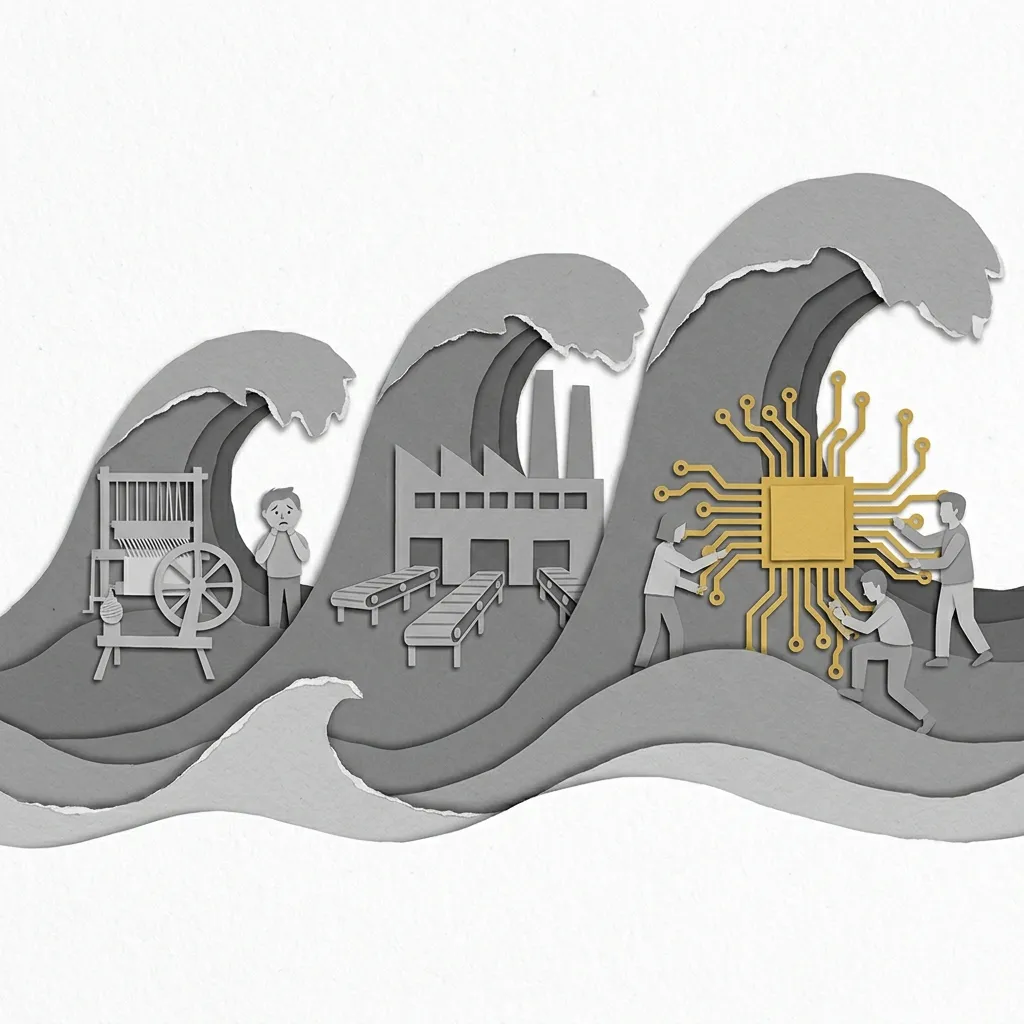
Every generation gets its own version of the same fear. In 1589, Queen Elizabeth I refused to grant a patent to William Lee’s stocking-frame knitting machine because she worried it would put hand-knitters out of work. In 1811, the Luddites smashed mechanized looms in Nottinghamshire for the same reason. In 1930, the economist John Maynard Keynes coined the phrase “technological unemployment” to describe what he believed was an emerging permanent condition. In 1964, a “Ad Hoc Committee on the Triple Revolution” warned President Johnson that automation was on the verge of eliminating the need for human labor entirely. In 2013, Oxford researchers Frey and Osborne estimated that 47 percent of US jobs were at high risk of computerization within 20 years. In 2023, Goldman Sachs estimated that generative AI could automate tasks representing 300 million jobs globally.
The fear has been consistent. The outcome has been, in aggregate, something different: more jobs, higher wages, and rising living standards, alongside genuine hardship for specific workers in specific sectors during specific transitions. Understanding why requires separating two questions that the debate almost always conflates: what happens to the total number of jobs, and what happens to particular workers. The answers are different, and getting them confused produces bad analysis and worse policy.
The Historical Pattern: What Automation Has Always Done
The stocking-frame episode makes for an instructive starting point. Queen Elizabeth was wrong. The knitting machine did not eliminate employment in the textile sector. It dramatically expanded it. As the cost of knitted goods fell, demand for them rose faster than productivity improved, drawing more workers into the trade rather than fewer. Textile employment in Britain grew throughout the 18th century even as mechanization accelerated. (This outcome has a name: the Jevons Paradox, applied to labor. Making something cheaper tends to increase its consumption, which can increase total labor demand even when output per worker rises.)
The Luddites were expressing something more nuanced than simple fear of machines. The most careful histories of the Luddite movement note that the skilled croppers and frame-knitters who smashed machinery were not technological illiterates. They understood what the machines did. What they objected to was the way mechanization was being deployed: to de-skill their craft, reduce their autonomy, and transfer the productivity gains to mill owners rather than workers. Their grievance was partly about power and distribution, not just about job counts. That grievance was legitimate even though their preferred solution (machine destruction) was not.
The longer arc of the Industrial Revolution confirms the aggregate optimism. British living standards stagnated or declined in the first decades of mechanization, then rose substantially through the 19th century as productivity gains diffused through lower prices, higher real wages, and new industries that had not previously existed. The transition was real and painful for those who lived through it. The destination was materially better than the origin.
The same pattern recurred with electricity in the late 19th century, the internal combustion engine and mass production in the early 20th, computers in the 1970s and 1980s, and the internet in the 1990s and 2000s. Each wave eliminated specific categories of work (elevator operators, switchboard operators, typographers, travel agents, bank tellers in great numbers) while creating new categories that had not existed before (electrical engineers, automotive mechanics, software developers, UX designers, social media managers, data scientists). The net result in each case was more employment and higher aggregate wages, though the distribution of gains was uneven and the transition costs for specific workers were substantial.
The question for AI is whether this historical pattern will hold, and what is different enough about this wave to warrant revising the forecast.
What Makes AI Different This Time
The honest case for taking AI disruption more seriously than previous automation waves rests on one genuinely new feature: for the first time, cognitive work is the primary target rather than physical or routine clerical work.
Prior automation waves attacked specific categories of human activity in a fairly predictable hierarchy. First came the displacement of physical strength (steam engines, hydraulic lifts). Then came the displacement of routine physical dexterity (assembly-line robots, CNC machines). Then came the displacement of routine cognitive work (spreadsheets replacing bookkeepers, word processors replacing typists, ATMs replacing some bank tellers). Each wave left the judgment-intensive, creative, and relational work to humans, because machines were not good at it.
Generative AI, large language models, and the related technologies emerging since 2020 are different in their target domain. They perform competently at tasks previously considered to require human cognition: drafting and editing text, writing code, summarizing documents, analyzing data, generating images, answering research questions, producing legal briefs, and engaging in complex dialogue. These are not routine clerical tasks in the old sense. They are knowledge-work tasks that have historically defined the professional middle class.
This matters for the distribution of disruption. Previous automation waves disproportionately displaced manufacturing and clerical workers, creating the conditions for what economists call job polarization: growth at the top (high-skill, high-wage creative and managerial roles that machines could not do) and at the bottom (low-skill, low-wage service roles that machines could not do economically), with a hollowing of the middle where routine work had been concentrated. AI’s distinctive feature is that it attacks the top of this distribution for the first time, not just the middle.
The implications are uncertain enough that serious economists disagree about them. What the evidence shows so far is discussed next.
What the Evidence Actually Shows: 2022 to 2025
The empirical record on AI and the labor market through 2025 is not a story of mass displacement. It is a more complex story with several distinct threads.
Productivity at the task level is real and substantial. Study after study of specific AI tools in specific professional contexts has found large productivity gains. GitHub Copilot users complete coding tasks 55 percent faster. Customer service agents using AI assistance resolve more tickets per hour. Lawyers using AI for document review and research produce work faster and with fewer errors. Consultants using AI produce higher-quality analysis in less time. (Law and Economics Center, “Artificial Intelligence in the Workplace,” 2024.) These gains are not trivial. They represent the kind of productivity jump that, historically, has eventually translated into wage growth and economic expansion.
Aggregate job displacement has not materialized. Despite the task-level productivity story, economy-wide employment statistics through early 2025 do not show the mass displacement that the alarm-call forecasts predicted. The Anthropic economic research team found limited evidence of large-scale AI-driven unemployment in aggregate employment data. AI-investing firms have, on average, grown faster and hired more workers, not fewer. The employment impact has been concentrated in hiring slowdowns and role redesign rather than mass layoffs. (Anthropic Economic Research, 2025.)
The entry-level pipeline problem is real and underappreciated. The most specific and well-documented harm from AI in the labor market is the collapse of entry-level hiring in knowledge professions. Law firms are hiring fewer junior associates because AI handles the document review and research that first-year lawyers traditionally did. Consulting firms are hiring fewer entry-level analysts because AI handles the data analysis and slide preparation. Investment banks are hiring fewer junior financial analysts. Software companies are hiring fewer junior developers. (Federal Reserve Bank of Dallas, “Artificial Intelligence and the Labor Market,” 2024.) This matters beyond the direct employment impact because these entry-level roles have historically functioned as training grounds: the way junior professionals learn to do senior work is by doing junior work and being supervised. If AI handles the junior work directly, the question of how the next generation of senior professionals develops their skills remains genuinely open.
Skill compression is a documented pattern. AI tools have a distinctive distributional effect within professions: they help lower-performing workers more than higher-performing ones. Junior or less experienced workers using AI achieve output quality closer to senior experts than they could unassisted. This is partly good news (it raises the floor) and partly economically challenging (it reduces the premium for experience and expertise in ways that could eventually compress wages at the top of the knowledge-work distribution). Daron Acemoglu of MIT has argued that this compression, combined with the direction of current AI development toward automation rather than augmentation, poses risks of reduced demand for skilled labor that prior automation did not create.
The Acemoglu-Autor debate is the most important honest intellectual disagreement in this field. Acemoglu has expressed sustained concern that AI development is currently oriented toward replacing rather than augmenting human labor, and that this orientation is a choice, not a necessity. The technology could be directed toward making human workers more productive at tasks they already do, rather than toward removing them from those tasks entirely. Autor, his frequent collaborator, is more optimistic: he argues that AI could rebuild middle-class jobs by making previously rare expertise widely available, enabling workers who currently lack the credentials for professional work to perform near-professional-quality services. Both are serious economists working with serious evidence. Their disagreement is about the direction of development, not the magnitude of the technology’s potential impact.
The Case for Concern: What Displacement Advocates Get Right
The case that AI poses a genuine threat to labor is not made by irresponsible alarmists alone. It includes serious economists and researchers who acknowledge the historical pattern while arguing that AI is different in magnitude or kind from prior automation waves.
The strongest version of the concern focuses not on whether jobs will be created in new sectors (they will) but on the pace and distribution of the transition. Even if AI eventually creates more jobs than it destroys, the transition period imposes real costs on real people who cannot easily retrain, relocate, or reinvent themselves. A 55-year-old paralegal whose document-review work has been taken over by AI is not well-positioned to transition to AI research or prompt engineering. A graphic designer whose output is being replaced by generative image tools cannot simply pivot to training the AI that replaced them. The aggregate outcome of more jobs does not much comfort the individual worker whose specific skills are no longer needed.
The concentration concern is also real. AI development is enormously capital-intensive. The training runs for large language models cost hundreds of millions of dollars. The compute infrastructure is controlled by a handful of hyperscale cloud providers. The leading AI labs are either owned by those hyperscalers (Google’s DeepMind, Microsoft’s investment in OpenAI) or dependent on them for compute. This concentration of the productive capacity of the most transformative technology in a generation in the hands of a small number of entities creates genuine concerns about market power, about who captures the productivity gains, and about the political economy of AI governance. If AI produces a step-change in economic productivity but the gains flow primarily to capital owners and away from labor, the result could be an increase in aggregate wealth alongside an increase in inequality and a reduction in labor’s share of income. Labor’s share of US GDP has been declining for four decades; a technology that dramatically raises capital productivity relative to labor productivity could accelerate that trend.
The Acemoglu concern about the direction of technological development deserves serious engagement. Technology is not exogenous. It does not simply arrive from outside the economic system and impose its effects. Firms and researchers make choices about what kinds of AI to build, what kinds of tasks to target, and what kinds of human-machine arrangements to design. Those choices are shaped by incentives, tax policy, labor costs, and patent structures. When it is cheaper to automate a task than to hire a human (partly because of payroll taxes, occupational licensing, healthcare costs tied to employment, and other regulatory costs layered onto labor), the incentive is to automate. When automation is heavily subsidized through capital expensing provisions while labor is taxed, the incentive is amplified. The direction of AI development is not a natural force; it is a product of policy choices, and different policy choices could produce a different direction.
The Case Against Alarm: What the Historical Pattern Suggests
The case against alarm rests on both the historical record and the economic theory that explains it.
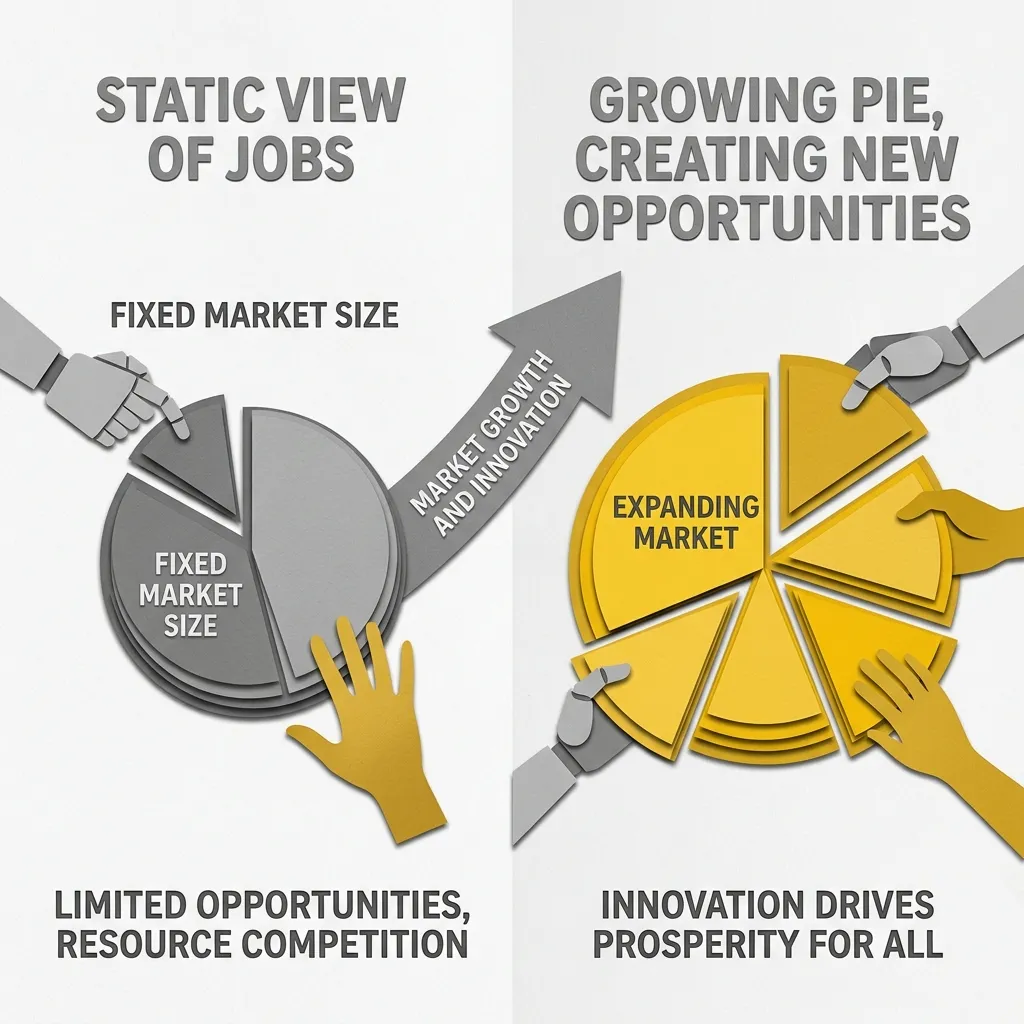
The lump of labor fallacy. The fundamental error in the alarm-case argument is the implicit assumption that the number of jobs in the economy is fixed: that if AI does more, humans must do less. This assumption, called the lump of labor fallacy by economists, has been demonstrably wrong in every prior technological transition. The number of jobs is not fixed. It is determined by the level of economic activity, which is itself a function of productivity, income, and the resulting demand for goods and services. When productivity rises, prices fall (or wages rise), which expands demand, which requires more labor to meet, which creates new employment. The cotton gin made cotton harvesting dramatically more productive. It did not reduce employment in cotton. It expanded the cotton economy.
The mechanism by which productivity gains translate into new employment is not magic. It requires time, capital reallocation, and the willingness of workers to acquire new skills. But the mechanism exists and has worked consistently for two centuries. There is no theoretical reason why AI would break it, and the empirical evidence through 2025 shows that it has not done so yet.
The unexpandable demand fallacy. A related error is the assumption that human wants are finite: that once machines can produce enough, people will simply stop wanting things. This has been falsified by two centuries of rising productivity. As the real cost of satisfying basic material needs has fallen, humans have consistently revealed new preferences: for health, longevity, education, experience, art, entertainment, status, novelty, and services that require human judgment and connection. The notion that AI will make human desires satiable enough to eliminate the demand for human labor underestimates the apparently bottomless human capacity to want things.
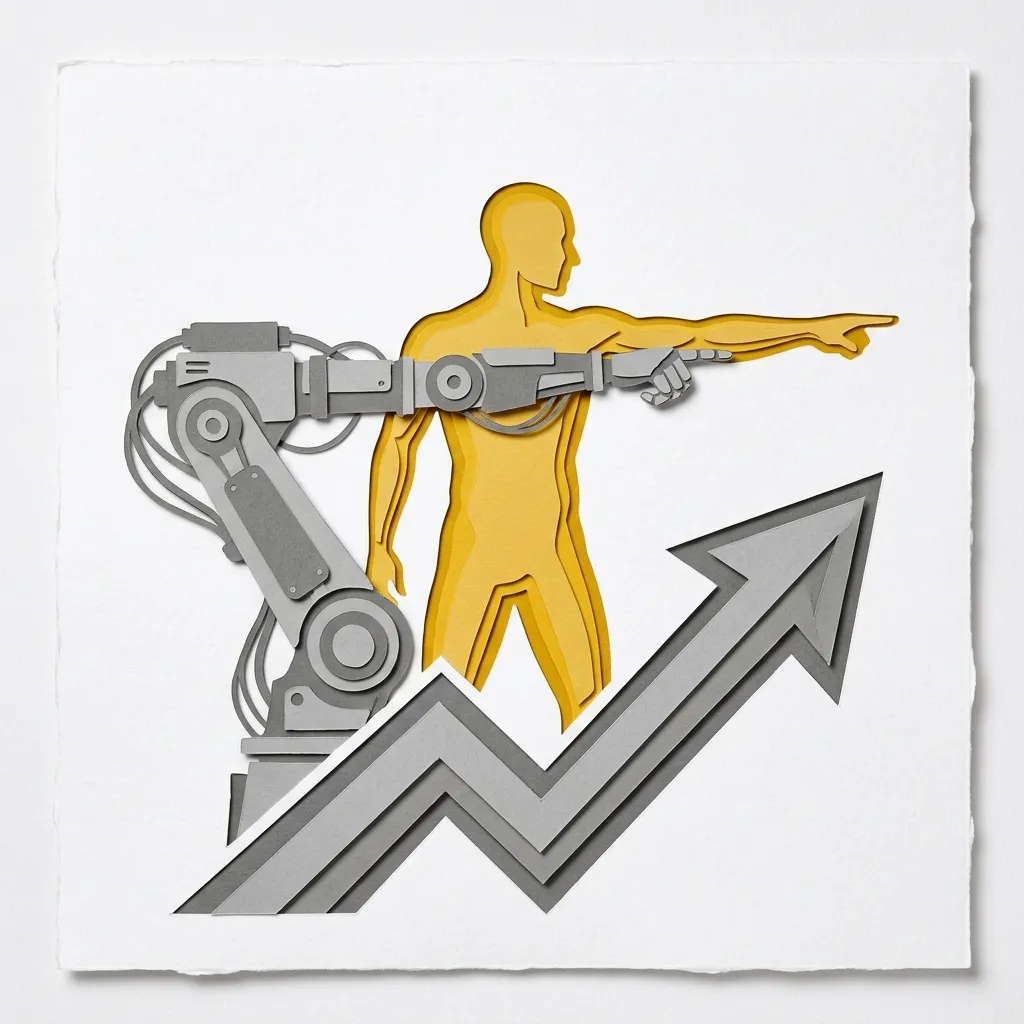
The complementarity effect. AI, like most prior automation, is not a perfect substitute for human labor across all tasks. It is better than humans at certain things (processing large datasets, generating first drafts, maintaining consistency across repetitive tasks) and worse at others (exercising contextual judgment, building trust, navigating ambiguous social situations, providing genuine human connection, taking responsibility for consequential decisions). These differences mean that AI and human labor are complements rather than pure substitutes in many workflows. As AI handles the tasks it does best, human workers can focus on the tasks it does less well, which are typically the higher-judgment, higher-value tasks. This complementarity is the mechanism by which AI raises the productivity of human workers rather than simply displacing them.
New job categories that did not previously exist. The historical pattern of new technologies creating new categories of work that did not previously exist is likely to continue. AI has already created demand for prompt engineers, AI trainers, AI safety researchers, AI ethics officers, AI product managers, and machine learning operations specialists. It has created demand for human auditors of AI outputs in high-stakes domains (medicine, law, finance) because regulators and clients require human accountability for AI-generated work. As AI pervades more industries, the demand for people who can interface between the AI and human layers of organizations will grow. The imagination of the pessimists, like all prior generations of technological pessimists, is constrained by the categories that already exist. The jobs that will be created by AI do not yet have names.
The Distributional Reality: Job Polarization and the Hollowed Middle
The aggregate optimism and the distributional concern are not incompatible. Both can be simultaneously true: more total work, but distributed differently; higher aggregate wages, but with a compressed middle and winners and losers who are not randomly distributed across the population.
The concept of job polarization, developed principally by MIT economists David Autor and Daron Acemoglu, describes the pattern observed across several decades of automation and globalization: employment growth concentrated at the high-skill, high-wage end and the low-skill, low-wage end, with a decline in the middle where routine cognitive and physical work had been concentrated. The accountant whose work was not yet automatable in 1980 was doing better than the assembly-line worker whose work was. The financial analyst in 2000 was doing better than the travel agent whose work had been computerized. The occupational structure was becoming a U-shape rather than a bell curve.
AI threatens to steepen and widen this polarization rather than reverse it. If AI can now perform the routine cognitive tasks that defined the high-skill end of the 1990s labor market (legal research, financial analysis, software development, medical imaging interpretation), the tasks that remain most distinctively human are the ones requiring either very high-level abstract judgment (the top of the distribution) or physical presence and human connection (care work, skilled trades, the bottom of the wage distribution but not necessarily the bottom in terms of job security). The middle, where much of the professional class has historically lived, faces more sustained pressure than in prior automation waves.
This distributional pattern is what creates the legitimate social and political concern around AI. Not that aggregate employment will decline (the evidence does not support that fear), but that the gains will accrue to a narrower band of workers and capital owners while the costs of transition fall disproportionately on workers in the specific sectors and skill categories that AI is most rapidly entering.

What the Bad Policy Responses Look Like
Before describing the libertarian path, it is worth being clear about what the bad responses are, because both major political tendencies in the United States are drawn toward them.
The progressive response: restrict AI to protect existing jobs. The instinct to protect workers from disruption through licensing requirements, mandatory human-in-the-loop regulations for AI outputs, and legal restrictions on AI deployment in specific sectors is understandable in its intent and problematic in its effects. Requiring that AI-assisted legal work be reviewed by a licensed attorney at full billing rates does not protect the paralegal; it merely adds cost that makes legal services less accessible. Prohibiting AI from generating medical imaging interpretations until they have been independently reviewed by a radiologist at full radiologist billing rates does not improve outcomes; it merely preserves the radiologist’s income while making diagnostic services more expensive. Occupational licensing that requires human professionals to be present for tasks that AI can perform reliably is regulatory capture by the licensed profession. It serves the incumbent at the expense of the consumer and does not stop the technology; it merely determines who captures the productivity gain.
More broadly, the attempt to slow AI adoption through precautionary regulation in order to “give workers time to adjust” misunderstands the mechanism. Workers do not adjust by being protected from the market signal that their skills are becoming less scarce. They adjust by responding to that signal, which requires that the signal be transmitted, not muffled. The appropriate response to disruption is not to slow the technology; it is to ensure that the people who are disrupted have access to the support and flexibility they need to respond.
The conservative response: deny the distributional problem exists. The opposite error is to invoke the historical record of aggregate job creation so confidently that the legitimate concerns about specific workers’ transitions get dismissed. “The market will sort it out” is not sufficient as a response to the entry-level pipeline problem, the hollowing of middle-skill professional roles, or the concentration of AI productivity gains in the capital that owns the compute. The market will, eventually, sort it out. The question is what happens to workers during the transition and whether the institutions that are supposed to support transition (education systems, retraining programs, portable benefits, competitive labor markets) are actually functioning.
The common error: regulatory capture for incumbents. Both progressive and conservative governance are susceptible to the capture pattern in which the entities that benefit most from protecting the status quo (existing incumbents, licensed professionals, established platforms) successfully lobby for regulations that prevent new entrants from competing with them using AI tools. This is not a market outcome. It is a government-manufactured outcome that protects the incumbent at the expense of the consumer and the potential entrant. The libertarian critique of regulatory capture applies as fully to AI as to any other domain.
The Creative Destruction Framework: Schumpeter’s Insight Applied
Joseph Schumpeter’s concept of creative destruction is the most useful intellectual frame for understanding what AI is doing to the labor market and what the appropriate response is.
Schumpeter observed that capitalism’s driving force is not the optimization of existing production but the constant disruption of existing production by new methods, new products, and new organizations. This disruption is “creative” because the new displaces the old by being better: cheaper, faster, more useful, more abundant. It is “destructive” because the old does not simply recede; it is actively displaced, and the workers and capital invested in the old must relocate.
The creative destruction cycle for AI follows the pattern. AI is destroying value in specific occupational niches: document review, routine code generation, basic customer service, first-draft content creation. As those functions are automated, the capital and labor that was performing them is being released for redeployment elsewhere. The redeployment takes time and involves friction. The released workers do not automatically appear at the new jobs. The freed capital does not automatically flow to the most socially beneficial use. But the potential for redeployment exists and is large: there is essentially unlimited demand for better healthcare, more personalized education, better infrastructure, more creative goods, and more human services of all kinds. The question is whether the institutions are in place to facilitate the redeployment.
Schumpeter was also clear that creative destruction is politically uncomfortable because the destroyers are diffuse (consumers who benefit from lower prices and better products) while the destroyed are concentrated and organized (workers in the displaced sector who can point to specific job losses). This political economy explains why incumbent industries are so effective at lobbying for protection even when protection is clearly welfare-reducing in aggregate. The AI disruption will follow this pattern: the industries and occupations most threatened by AI will be the most effective advocates for regulation that slows adoption, even though such regulation harms the many diffuse beneficiaries of lower costs and better services.

The Libertarian View: Neither Panic Nor Complacency
The libertarian perspective on AI and the labor market resists both the progressive impulse to slow the technology and the complacent dismissal of its distributional consequences. It starts from a different set of premises.
Technology is not the threat; government responses to technology often are. The primary risk in the AI transition is not the technology itself. It is the combination of (1) regulatory capture by incumbents using AI as a pretext for licensing restrictions that protect them from competition, (2) policy choices that tilt the playing field toward capital and away from labor through differential tax treatment, and (3) the concentration of AI capability in a small number of entities that receive government favoritism through contracts, subsidies, and intellectual property protections. Addressing these problems does not require slowing AI; it requires removing the government interventions that generate them.
On differential tax treatment: the US tax code currently treats capital expenditures (including AI compute and software) more favorably than labor (which bears payroll taxes, is subject to employment mandates, and triggers various regulatory costs). This asymmetry is a policy choice that tilts the labor-versus-automation calculation toward automation in ways that would not exist in a neutral tax environment. A libertarian who cares about genuine market outcomes, rather than government-subsidized ones, should want that asymmetry corrected.
On IP and concentration: the intellectual property regime that gives AI companies multi-year monopolies on specific model architectures, training methods, and datasets may be less essential to innovation incentives than its beneficiaries claim. Open-source AI development (Meta’s LLaMA, Mistral, and dozens of others) has demonstrated that competitive AI models can be developed and released without the IP monopoly structure. The concentration of AI in hyperscalers is partly a function of the regulatory and IP environment that raises barriers for smaller entrants. A more competitive AI market would distribute the productivity gains more broadly.
The problem of the transition is real, and the libertarian response must address it honestly. The historical argument that technology creates more jobs than it destroys does not help a 50-year-old paralegal whose skills have been rendered obsolete before she can retrain. The libertarian case for allowing creative destruction to proceed is stronger when the institutions that support transition are functional than when they are not.
The existing US safety net for displaced workers is poorly designed for the current challenge. Unemployment insurance requires wage employment to qualify (leaving out gig workers and the self-employed), lasts for only 26 weeks in most states, and provides no support for retraining. The existing federally funded job retraining programs (Trade Adjustment Assistance, Workforce Innovation and Opportunity Act programs) have a documented poor track record. The occupational licensing system, which requires years of credentialed training to enter many professions, creates enormous barriers for workers trying to transition between sectors.
Milton Friedman’s Negative Income Tax proposal is more consistent with libertarian principles than either the current welfare system or UBI. Under the NIT, people below a defined income threshold receive a payment that phases out as their income rises, maintaining the incentive to work while providing a genuine floor. Unlike UBI, it targets support to those who actually need it. Unlike the current welfare system, it does not trap recipients in dependency by imposing effective 100 percent marginal tax rates when benefits phase out at the job-income threshold. Unlike occupational licensing, it does not prevent displaced workers from accessing new labor markets. A negative income tax combined with the deregulation of occupational licensing and the removal of the payroll tax subsidy to automation would address the distributional consequences of AI disruption without requiring anyone to slow the technology.
The education system is the deepest failure. The most significant long-term challenge that AI poses for human workers is not displacement from specific jobs; it is the question of whether the skills that humans bring to the labor market will remain valuable. That question is answered primarily by what and how people are taught, and the US education system has been poorly adapted to labor market realities for decades. A system designed to produce compliant factory workers in the early 20th century, modified incrementally since, is not well-positioned to produce the judgment, creativity, ethical reasoning, relational skill, and adaptive learning capacity that will be most valuable in an AI-mediated economy.
The libertarian response to this failure is not to regulate AI education out of existence but to introduce competitive markets into education itself: school choice, deregulation of alternative credentials, recognition of competency rather than seat-time, and removal of the credential monopoly that links educational credentials to occupational licensing in ways that protect institutional incumbents rather than developing talent. The specific human skills that are most resistant to AI automation (contextual judgment, ethical reasoning, relationship management, creative synthesis across domains) are precisely the skills that a genuinely competitive and adaptive education market would have the strongest incentive to develop.
Freedom of movement matters here too. One underappreciated libertarian point about AI and labor markets is that geographic and occupational mobility are among the most important mechanisms by which workers respond to disruption. Workers who can move to where new opportunities are, change occupations when their old one is automated, and enter new sectors without massive credentialing barriers adapt to technological change much more successfully than those who cannot. The US has significant regulatory barriers to all three forms of mobility: occupational licensing (3,800 licensed occupations in some states), zoning restrictions that make housing in high-opportunity areas prohibitively expensive, and credential requirements that create high entry costs for new occupational sectors. Removing these barriers would do more for displaced workers than any AI-specific regulation.

The Specific Reforms Worth Fighting For
The libertarian approach to AI and labor does not produce a simple “hands off” conclusion. The current system is already deeply interventionist, and many of the interventions tilt the playing field in ways that amplify AI’s distributional harms while slowing the diffusion of its benefits. Here are the specific changes that would move the system in the right direction.
Eliminate the payroll tax asymmetry. Social Security and Medicare payroll taxes apply to wages and salaries but not to capital returns. This means that every dollar a company pays a human worker is taxed at 15.3 percent (split between employer and employee) while every dollar it deploys in AI compute is not. This is not a neutral market outcome. It is a government subsidy for automation relative to employment. Moving toward a consumption tax or a flat tax that applies symmetrically to labor and capital income would remove this distortion and let firms make labor-versus-automation decisions based on actual comparative productivity rather than government-imposed cost differentials.
Deregulate occupational licensing. About 25 percent of US workers are in licensed occupations, up from 5 percent in the 1950s. Many of these licenses serve primarily to protect incumbents from competition rather than to protect consumers from harm. A displaced factory worker who wants to become a massage therapist can face 500 hours of required schooling. A nurse practitioner who moves between states must often restart their licensing process from scratch. These barriers directly impede the labor market adaptability that makes technological transitions manageable. Federal minimum standards for occupational licensing reciprocity and a sunset review process for licensing requirements would reduce these barriers without eliminating consumer protection.
Reform unemployment insurance to cover the modern workforce. Gig workers, the self-employed, and workers in non-standard arrangements cannot currently access unemployment insurance in most states. As AI accelerates the shift toward project-based and freelance work, an unemployment insurance system tied to traditional wage employment leaves a growing share of the workforce without any transition support. Expanding eligibility and making benefits portable across states would address the worst gaps without creating the disincentive structures that plague the current welfare system.
Introduce genuine competition into higher education. The current credentialing system gives four-year colleges a near-monopoly on labor market entry for professional occupations, backed by the federal student loan system that funnels hundreds of billions of dollars annually to accredited institutions regardless of student outcomes. Recognizing industry certifications, apprenticeships, and competency-based credentials on equal footing with traditional degrees for federal employment and federal contracting would break this monopoly and create market incentives for cheaper, faster, and more relevant skill development.
Reform the intellectual property regime for AI training data. The current copyright regime is being contested in courts across the country, with AI companies arguing that training on copyrighted data is fair use and content creators arguing that it is theft. The outcome of this litigation will determine whether AI development proceeds in a competitive, distributed way or becomes concentrated in entities large enough to license vast datasets from major media companies. A narrower copyright term, a clearer fair use standard for computational training, and a public domain commons for training data would support a more competitive AI ecosystem that distributes the gains more broadly.
Consider a Negative Income Tax rather than UBI as the safety net for disrupted workers. If the political consensus toward some form of income support for displaced workers grows, Friedman’s NIT is superior to UBI from both a libertarian and a practical standpoint. It targets support to those who actually need it, maintains work incentives through a gradual phase-out rather than a cliff, and is less expensive to fund than a universal basic income. The NIT should be designed to replace, not supplement, the existing welfare bureaucracy, realizing efficiency gains rather than simply layering another program on top of the existing stack.
The Human Dimension the Data Does Not Capture
Any complete account of AI and the labor market has to acknowledge something that does not appear in the productivity statistics or the employment surveys: work is not only a source of income. It is also a source of identity, community, structure, meaning, and the experience of competence that psychologists identify as central to human wellbeing. The displacement of work by technology creates costs that economic output measures miss entirely.
This observation does not lead, as some argue, to the conclusion that AI should be slowed or that the state should mandate human employment for its own sake. That path leads toward the economic equivalent of paying people to dig holes and fill them back in, which does not generate either wealth or genuine dignity. It does lead toward the recognition that a society managing a major technological transition well needs to provide not only income support for displaced workers but also meaningful opportunities for contribution: in care work, in the trades, in creative endeavors, in civic life, in education, in the community institutions that are the substrate of human connection.
A libertarian understanding of this points toward civil society rather than the state as the primary locus for providing those opportunities: mutual aid associations, religious communities, craft guilds, voluntary cooperatives, and the rich ecosystem of non-state institutions that have historically provided the framework within which people build meaningful lives. The weakening of these institutions over the past century, partly through displacement by state welfare programs and partly through the atomizing effects of consumerism, is a real cultural loss that makes technological transitions harder. Rebuilding them is a project that no government program can accomplish and that no technological development precludes.
The AI transition, like every technological transition before it, will produce both winners and losers. The losers deserve honest acknowledgment and practical support. The winners deserve to be allowed to keep what they create and invest it in the next wave. The society that gets this balance right will prosper; the one that either denies the disruption or responds to it by freezing the status quo in amber will fall behind in ways that make everyone worse off, including the workers it was trying to protect.
Go Deeper: Books by Alex Merced
The intersection of technology, economics, and liberty is where some of the most important policy arguments of the coming decade will be fought. Alex Merced has written directly in all three registers.
Economic Ideas: From Beginning to Early 2026 develops the economic framework for understanding technological disruption and labor markets. The creative destruction concept, the lump of labor fallacy, the economics of skill-biased technological change, the Schumpeterian analysis of innovation and competitive dynamics, the history of automation fears from the Luddites forward, and the distributional economics of job polarization are all developed with the historical depth that makes the current AI debate legible rather than novel. Understanding what makes this wave different requires understanding what prior waves had in common.
The Field Guide to Libertarianism articulates the political philosophy behind the approach proposed in this article. The libertarian case for allowing creative destruction to proceed, the critique of occupational licensing as incumbent protection, the distinction between market-generated inequality (which reflects voluntary choices) and government-generated inequality (which reflects captured rules), the argument for Friedman’s NIT over state welfare programs, and the central role of civil society rather than the state in providing the human institutions of community and meaning are all developed as applied political arguments that bear directly on how a free society responds to AI.
Political Thought and Debates of the United States places the AI and labor debate in the longer arc of American political argument about the proper role of government in managing economic transitions. The New Deal’s response to the Great Depression (which itself was partly a response to the automation anxieties of the 1920s), the Great Society’s expansion of labor market regulation, the Reagan-era deregulation project, and the ongoing debate about the welfare state’s proper scope all inform how the AI transition is likely to be governed and mis-governed. The political history in this book helps distinguish between the enduring arguments and the contingent political configurations that determine which ones prevail.
All three are available on Amazon. The full catalog of Alex Merced’s work is at books.alexmerced.com.
Sources and Further Reading
-
Congressional Budget Office. “The Economic and Budget Outlook: 2024 to 2034.” cbo.gov, 2024.
-
Law and Economics Center. “Artificial Intelligence in the Workplace: Productivity, Displacement, and the Policy Response.” laweconcenter.org, 2024.
-
Federal Reserve Bank of Dallas. “Artificial Intelligence and the Labor Market.” dallasfed.org, 2024.
-
Acemoglu, Daron, David Autor, et al. “Artificial Intelligence and Jobs: Evidence from Online Vacancies.” National Bureau of Economic Research Working Paper, 2022.
-
Autor, David. “Work of the Past, Work of the Future.” American Economic Review Papers and Proceedings 109 (2019): 1-32.
-
Acemoglu, Daron. “The Simple Macroeconomics of AI.” NBER Working Paper 32487, 2024.
-
Anthropic. “Economic Research Report: AI and Employment.” anthropic.com, 2025.
-
Frey, Carl Benedikt, and Michael A. Osborne. “The Future of Employment: How Susceptible Are Jobs to Computerisation?” Technological Forecasting and Social Change 114 (2017): 254-280.
-
Keynes, John Maynard. “Economic Possibilities for Our Grandchildren.” In Essays in Persuasion. Harcourt Brace, 1932.
-
Schumpeter, Joseph A. Capitalism, Socialism and Democracy. Harper and Brothers, 1942. (Source of the creative destruction concept.)
-
Friedman, Milton. Capitalism and Freedom. University of Chicago Press, 1962. (Source of the Negative Income Tax proposal.)
-
Goldman Sachs Research. “The Potentially Large Effects of Artificial Intelligence on Economic Growth.” gs.com, 2023.
-
Brynjolfsson, Erik, and Andrew McAfee. The Second Machine Age: Work, Progress, and Prosperity in a Time of Brilliant Technologies. W.W. Norton, 2014.
-
World Economic Forum. “The Future of Jobs Report 2025.” weforum.org, 2025.
-
Occupational Licensing: A Framework for Policymakers. White House Report, 2015.
-
Putnam, Robert D. Bowling Alone: The Collapse and Revival of American Community. Simon and Schuster, 2000. (Background on civil society institutions.)
-
St. Louis Federal Reserve. “Generative AI and the Productivity Paradox.” stlouisfed.org, 2024.