TL;DR
- The United States spends approximately $181 billion per year in direct federal subsidies, grants, tax expenditures, and other financial support for private corporations, according to analyses by the Cato Institute and others. State and local governments add another $40 to $50 billion annually in economic development incentives, tax abatements, and targeted subsidies. These figures do not include the value of regulatory advantages, loan guarantees, and other indirect benefits that government confers on specific industries and companies.
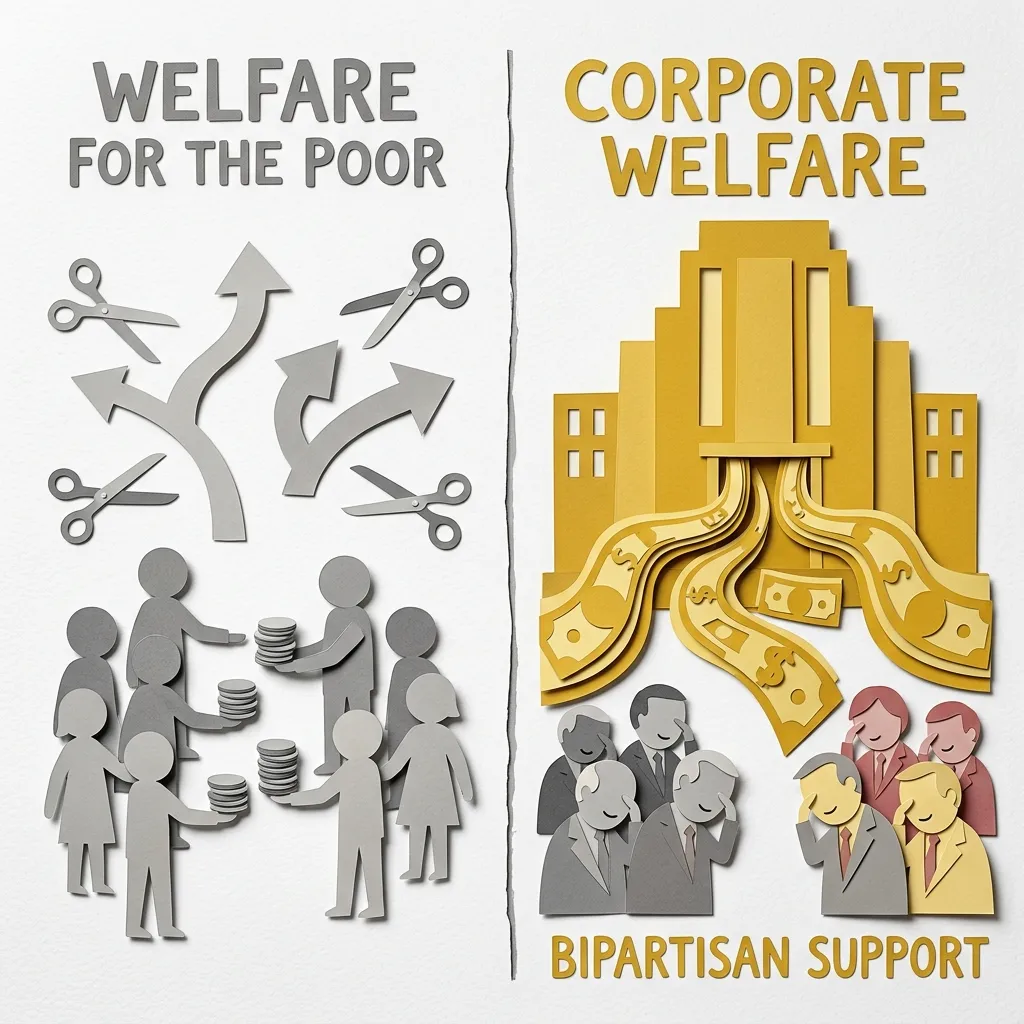
- The political economy of corporate welfare is structurally different from the political economy of individual welfare. Programs that provide benefits to poor individuals are debated vigorously, subjected to means tests, and targeted for budget cuts in every fiscal negotiation. Programs that provide benefits to corporations are embedded in tax code provisions, buried in appropriations bills, and shielded by the lobbying power of the companies that benefit from them. Corporate welfare persists regardless of which party holds power because the beneficiaries are always large enough to fund the political campaigns that sustain it.
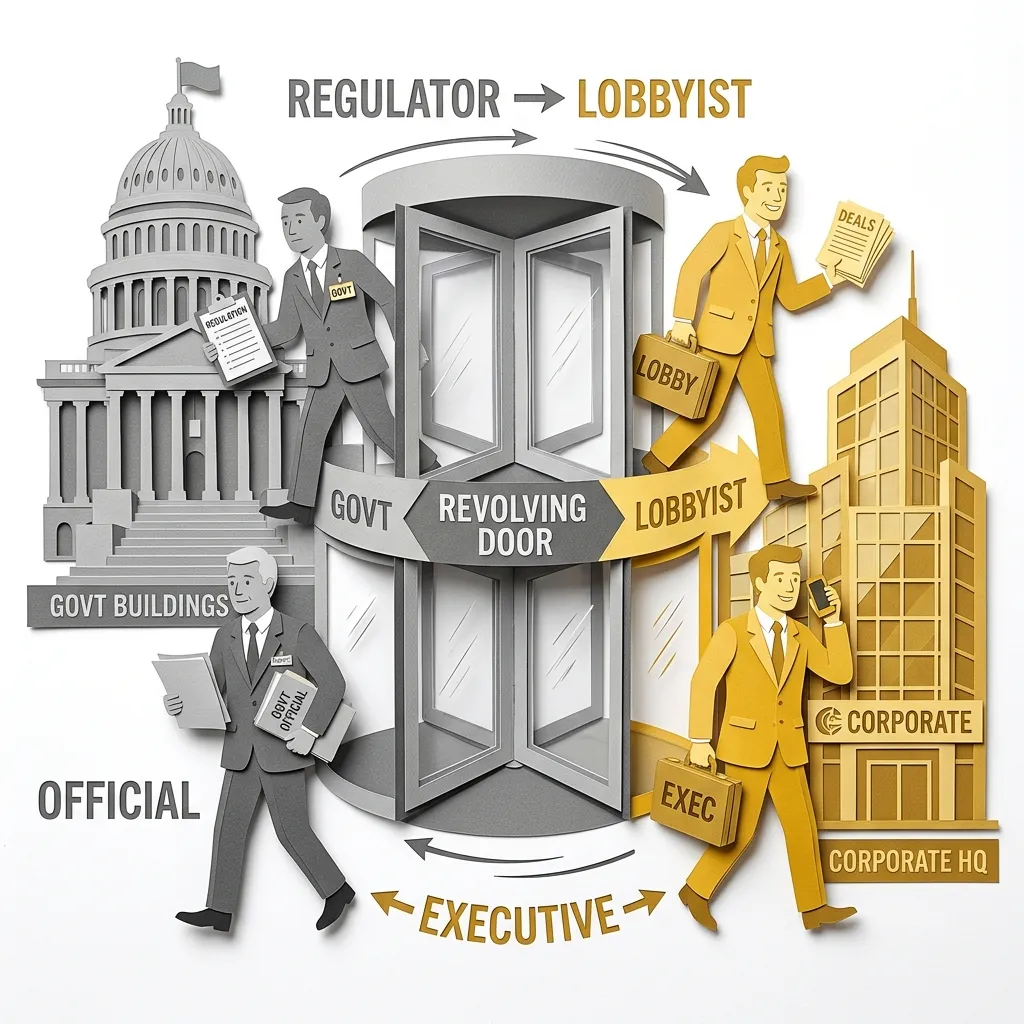
- The mechanism that sustains corporate welfare is the revolving door between industry and government: the same people who populate industry trade associations and corporate government relations departments populate the regulatory agencies and congressional staff that write the rules governing corporate benefits. This interchange of personnel creates a systematic bias in how government programs are designed and administered, favoring the industries whose alumni populate the relevant agencies and committees.
- The libertarian critique of corporate welfare unifies the left and right sides of the political spectrum around a common observation: that giving government the power to pick economic winners and losers produces a political economy in which the winners are those with the most political power rather than those who best serve consumers. Ending corporate welfare would require a genuine commitment to the principle that the government does not have the right to take money from taxpayers and give it to corporations, regardless of what economic development justification is offered.
Ask most Americans whether they support socialism, and a large majority will say no. Ask the same Americans whether they support giving money to Boeing, Archer Daniels Midland, Intel, ExxonMobil, or the major commercial banks, and many will say they have no particular opinion. The connection between these two questions is the point that most political discussion about corporate subsidies avoids: the United States already operates an extensive system of government support for private economic activity that would be recognizable as socialism in any country that did not call it “economic development,” “industrial policy,” “energy security,” or “too big to fail.”
Corporate welfare is not a fringe concern of political extremists. It is a mainstream feature of American economic policy that costs the federal government alone more than $181 billion annually, affects nearly every major industry in the economy, and persists across Democratic and Republican administrations with remarkable continuity. The specific beneficiaries change from administration to administration: Democrats favor clean energy companies, union-dominated industries, and politically connected green technology firms; Republicans favor fossil fuel companies, defense contractors, and politically connected manufacturing firms. Both parties favor the financial sector, which knows how to maintain its government insurance arrangements regardless of which party nominates the Treasury Secretary.
Mapping the Landscape of Corporate Subsidies
The full landscape of government support for private corporations is difficult to survey because it is deliberately obscured. Unlike welfare programs for individuals, which are generally transparent budget line items subject to public reporting requirements, corporate subsidies are distributed through multiple channels that are separately administered and that do not aggregate into a single visible total.
Direct subsidies are the most visible: outright grants, payments, and direct financial transfers to specific companies or industries. The Department of Agriculture provides direct payments to agribusiness. The Department of Energy provides grants to energy companies for research and development. The Export-Import Bank provides subsidized financing to companies exporting American-made products, primarily benefiting Boeing and other large aerospace manufacturers. The Department of Defense contracts include substantial research and development funding that supports private companies while primarily benefiting the companies that develop and retain the resulting intellectual property.
Tax expenditures are the largest and least visible category. Tax expenditures are provisions in the tax code that reduce the tax liability of specific industries or activities: accelerated depreciation for manufacturing equipment, percentage depletion allowances for oil and gas extraction, research and development tax credits, low-income housing tax credits that are allocated to real estate developers, carried interest treatment that allows hedge fund managers to pay capital gains rates on what are economically management fees. The total value of business-related tax expenditures in the federal budget runs to hundreds of billions of dollars annually. Unlike direct spending, tax expenditures are not subject to annual appropriations review and are rarely evaluated for their effectiveness in achieving stated policy goals.
Loan guarantees provide corporate support without appearing as spending in the federal budget: the government guarantees that it will repay a loan if the borrower defaults, enabling the borrower to obtain financing at lower cost than the market would otherwise provide. The Export-Import Bank’s loan guarantee program primarily benefits Boeing by enabling its foreign airline customers to obtain below-market financing for aircraft purchases. The Small Business Administration’s loan guarantee programs reach a wider range of businesses, including genuinely small ones, but the largest guaranteed loans flow to companies that are not small in any meaningful sense. The Federal Housing Administration’s mortgage guarantee program supports the housing industry broadly but particularly benefits the large financial institutions that originate and hold the guaranteed mortgages.
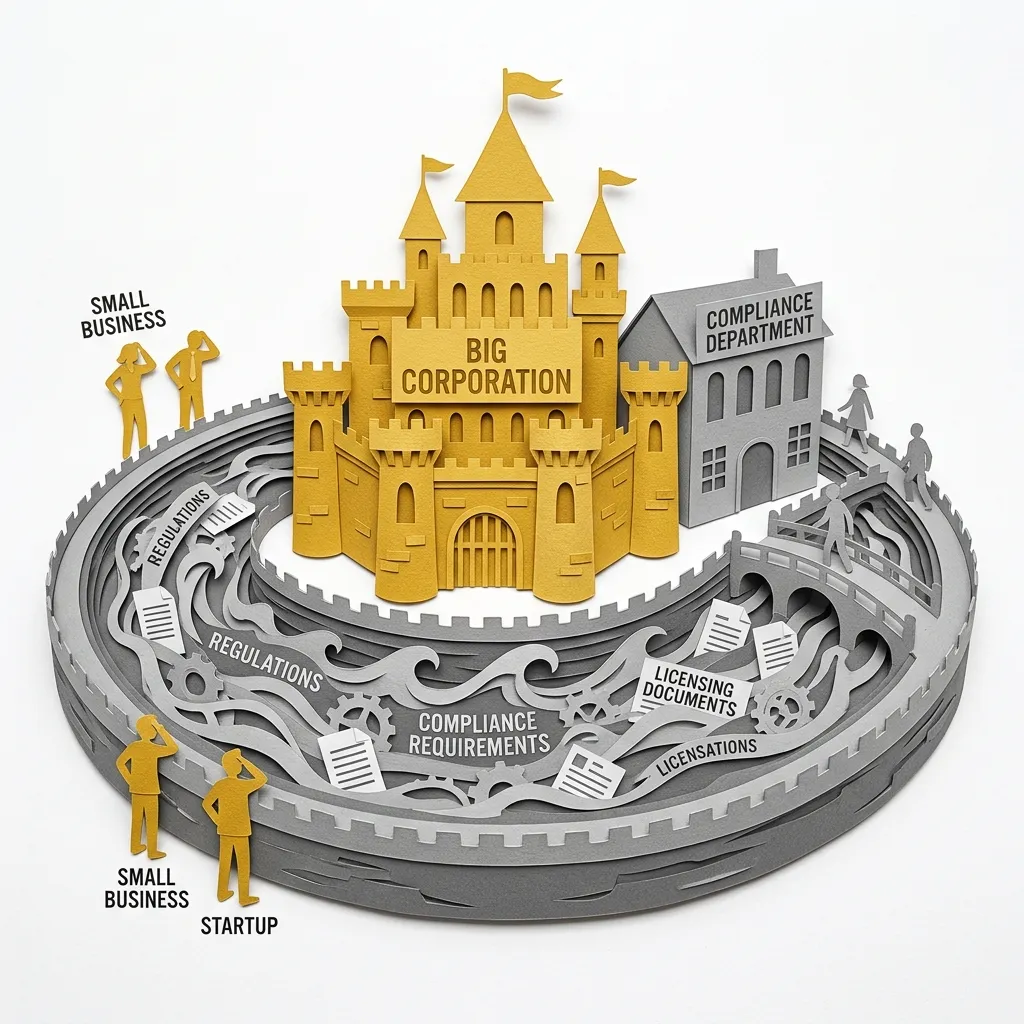
Regulatory advantages, often called “regulatory moats,” are less obvious than direct subsidies but potentially more valuable. When a regulatory requirement is complex, expensive to comply with, and burdens all producers equally in nominal terms but not in practical terms, the burden falls disproportionately on smaller competitors who lack the compliance infrastructure that large incumbents maintain. The Dodd-Frank financial reform legislation, nominally designed to prevent the kind of excessive risk-taking that produced the 2008 financial crisis, imposed compliance costs that large banks could absorb and that community banks and credit unions found crushing. The result was a substantial consolidation of the banking industry that benefited the largest banks at the expense of smaller competitors that provide more localized services and more competitive terms.
The Export-Import Bank, farm subsidies, the defense procurement system, the mortgage interest deduction, depreciation schedules for specific industries, tariff protection for domestic manufacturers, and below-market royalty rates for mineral extraction on federal lands all represent specific instances of a general pattern: government intervention in the economy that directs benefits to specific industries or companies based on political power rather than market performance.

The Export-Import Bank: A Case Study in Corporate Welfare
The Export-Import Bank of the United States, commonly called the Ex-Im Bank, is a federal government institution that provides financing, loan guarantees, and export credit insurance to facilitate the export of American goods and services. It was created in 1934 and has operated continuously since, making it one of the longest-lived corporate subsidy programs in the federal government.
The Ex-Im Bank’s defenders argue that it promotes American exports, supports American jobs in export industries, and counters the export subsidies provided by foreign governments to their own companies. All of these arguments have some merit. The problem is that the benefits of Ex-Im financing flow overwhelmingly to a small number of very large companies, primarily Boeing, which at various points has received approximately 40 percent of all Ex-Im financing. The bank’s nickname among critics, “Boeing’s Bank,” is an accurate description of where its benefits primarily go.
The argument that Ex-Im supports American jobs in export industries is true but incomplete. It supports jobs at Boeing and at other large manufacturers who benefit from Ex-Im financing. It does so by providing subsidized financing to Boeing’s foreign airline customers, enabling them to purchase Boeing aircraft at lower cost than would otherwise be available. The foreign airlines that benefit from this financing are, necessarily, competitors of American airlines. The Ex-Im Bank subsidizes Boeing at the cost of making the foreign competition facing American carriers more financially capable. The net employment effect across the entire economy, rather than just at Boeing, is ambiguous.
The Ex-Im Bank was temporarily not reauthorized from 2015 to 2019 due to congressional opposition led by conservatives who objected to it as corporate welfare and some progressives who objected to it as subsidizing labor outsourcing. During that period, Boeing managed to export aircraft without Ex-Im financing, demonstrating that the bank is not essential to Boeing’s ability to compete in the international market. It is instead a subsidy that makes Boeing’s product cheaper for foreign buyers, benefiting Boeing’s revenues and the foreign airlines that purchase its products at subsidized prices.
The Ex-Im Bank’s supporters successfully lobbied for its reauthorization by arguing that failing to counter foreign export credit agencies would disadvantage American manufacturers. This argument has a certain logic but also a well-recognized flaw: it is the classic race-to-the-bottom argument for subsidies, in which each country subsidizes its own exporters to counter the subsidies provided by others, and the net result is that all countries waste public resources on subsidies that roughly cancel each other out. The economically efficient solution is international agreement to limit export subsidies, not competitive escalation of domestic subsidy programs.
The Defense Industry: When Corporate Welfare Meets National Security
The defense industry presents the most politically durable case for corporate welfare because national security concerns genuinely do complicate the application of pure market principles to defense procurement. The United States cannot fully outsource its defense industrial base to the lowest-cost global producers and maintain the ability to produce weapons systems in wartime. There are legitimate arguments for maintaining domestic production capacity in strategically critical industries.
But the defense procurement system that has evolved over decades is not principally designed to maintain strategic industrial capacity at minimum cost. It is designed to distribute contracts, bases, and defense-related employment across congressional districts in ways that create political constituencies for defense spending regardless of its strategic necessity. The phenomenon known as “strategic pork,” in which weapons systems are manufactured in dozens of congressional districts specifically to make their cancellation politically difficult, has been documented extensively.
The F-35 fighter program, one of the largest defense programs in history, contracts with suppliers in over 1,300 companies located in 48 states. This distribution was not designed primarily for manufacturing efficiency. It was designed to ensure that virtually every congressional district has a financial stake in the program’s continuation, making it nearly impossible for any congress member to vote against funding without directly affecting employment in their district. The political durability of the F-35 program, despite its cost overruns, performance problems, and years-long schedule slippage, reflects the success of this strategy.
The “cost-plus” contracting structure used in much of defense procurement creates particularly perverse incentives. Under cost-plus contracts, the government reimburses the contractor’s allowable costs and adds a profit margin on top. This structure eliminates the contractor’s incentive to control costs, since higher costs mean higher absolute profits even at the same profit margin percentage. It creates an incentive to pad cost estimates in proposals and to allow costs to escalate during execution, since the government bears the cost and the contractor bears no risk.
The revolving door between the defense industry and the Department of Defense is among the most thoroughly documented examples of the broader corporate-government interchange. Senior military officers and civilian defense officials routinely move to positions at major defense contractors within months of leaving government service. The personnel interchange creates relationships, institutional knowledge, and informal understandings that benefit the companies whose former executives now populate the relevant regulatory and procurement agencies.
Farm Subsidies: Welfare Laundered as Rural Support
Farm subsidies represent the most politically durable form of corporate welfare in American domestic policy, sustained by an elaborate political mythology that conflates support for the large agribusiness operations that actually receive most subsidy payments with support for the small family farmer that most Americans associate with agriculture.
Federal farm subsidy programs originated during the Great Depression, when the collapse of agricultural commodity prices combined with drought to devastate genuine family farms whose operators were too numerous and too poor to effectively lobby for their own interests. The original programs, including price supports, production controls, and crop insurance subsidies, were designed to stabilize farm income during periods of commodity price collapse and to prevent the loss of agricultural productive capacity.
The programs that survived from the New Deal era to the present bear little resemblance to their original design. Price supports and production controls gave way to direct payment programs and commodity loan programs that send government checks to farmers and landowners based on historical production levels, regardless of current need, current production, or current prices. The largest payment recipients are not struggling family farmers. They are large agricultural operations, agribusiness corporations, and wealthy landowners who happen to have historical base acres in program crops.
The Environmental Working Group’s farm subsidy database, which tracks federal subsidy payments by recipient, consistently shows that the top 10 percent of recipients receive approximately 77 percent of all farm subsidy payments. The largest recipients include major agribusiness corporations, large institutional landowners, and wealthy individuals who maintain qualifying agricultural operations. The small-scale, diversified family farms that populate the political case for farm subsidies receive a small fraction of the total subsidy payments.
The political coalition that sustains farm subsidies is a classic example of concentrated benefits and diffuse costs. The largest farm subsidy recipients have direct financial stakes running into millions of dollars annually. The agricultural lobbying organizations that represent them are among the most powerful in Washington. Individual taxpayers pay approximately $25 billion per year in direct farm subsidies, which works out to roughly $190 per household, which is not negligible but is too diffuse and invisible to generate organized political opposition.
Crop insurance subsidies, which now dominate the farm subsidy landscape after the 2014 Farm Bill shifted much of direct payment support toward subsidized crop insurance, are particularly difficult to reform because they are administered through private insurance companies that have become a powerful additional constituency for the program. The federal government pays approximately 62 percent of the premium for federal crop insurance programs, with the remainder paid by the insured farmers. The private insurance companies that sell and administer the policies earn administrative fees and a portion of premium income from a program where the federal government bears most of the risk. These companies are now significant lobbying forces for the continuation and expansion of crop insurance subsidies, alongside the agribusiness operations that benefit from the coverage itself.
Why Corporate Welfare Persists Regardless of Party
The most politically important feature of corporate welfare is its bipartisanship. Every administration since the New Deal has expanded, redirected, and sustained corporate subsidy programs. The specific beneficiary industries change with the administration’s political coalition, but the overall volume of corporate support does not decline.
Democratic administrations favor labor-intensive industries in politically important states, clean energy companies that align with environmental policy priorities, and industries where workers are represented by major union donors. The Obama administration’s stimulus package directed substantial resources to clean energy companies, some of which, including Solyndra, became famous as examples of politically directed corporate investment that failed. The Biden administration’s Inflation Reduction Act directed hundreds of billions of dollars in clean energy subsidies to manufacturers of electric vehicles, batteries, wind turbines, and solar panels, primarily benefiting large corporations that could scale to meet the subsidy qualification requirements.
Republican administrations favor fossil fuel industries, defense contractors, and manufacturing firms that represent politically important constituencies. The Trump administration’s tariff program, while framed as protecting American workers from unfair foreign competition, primarily benefited the steel and aluminum industries at the cost of downstream manufacturers that use steel and aluminum as inputs, raising their costs and reducing their competitiveness. The semiconductor subsidies in the CHIPS Act, passed with bipartisan support and signed by President Biden, continued a pattern of both parties supporting industrial policy that directs government money toward specific technology sectors.
The structural reason that corporate welfare persists across administrations is that the political coalition supporting it is always larger than the coalition opposing it. Every corporate subsidy program has a defined set of beneficiaries with concentrated financial stakes who will actively organize, lobby, and contribute to political campaigns to defend it. The costs of the program are diffuse: spread across all taxpayers, embedded in the prices of goods produced by companies that benefit from competitive advantages conferred by their competitors’ subsidies, or hidden in regulatory complexity that favors incumbents over new entrants.
The political scientists Mancur Olson and James Q. Wilson documented this structural feature of democratic politics decades ago. The theory of concentrated benefits and diffuse costs predicts that democratic systems will systematically produce policies that benefit organized, concentrated interest groups at the expense of diffuse public interests, because the concentrated interests have both the motivation and the means to participate in politics more intensively than the diffuse interests.
Regulatory Moats: When Regulation Is the Subsidy
Beyond direct cash transfers, government regulation itself can function as a corporate subsidy by imposing compliance costs that large incumbents absorb but that small competitors and new entrants cannot afford.
Economists call this phenomenon “regulatory capture,” and it operates through the same revolving door mechanism that characterizes other forms of corporate-government interchange. When the architects of regulatory frameworks are industry alumni, when the officials administering them are industry alumni, and when the industries subject to them know that compliance with regulations is actually a barrier to entry for potential competitors, the regulation serves incumbent interests rather than public interests.
The telecommunications industry provides a clear example. Federal telecommunications regulation, administered by the Federal Communications Commission, has historically been shaped substantially by the major telecommunications companies that are subject to it. The result has been a regulatory framework that sustains the market position of incumbent cable and telephone companies while creating barriers to entry for potential competitors. The incumbent companies employ large compliance departments that handle regulatory filings, maintain relationships with FCC staff, and participate effectively in the regulatory process. A small company attempting to enter the broadband market faces the same compliance requirements without the organizational capacity to handle them efficiently.
The pharmaceutical industry is another example. The Food and Drug Administration’s drug approval process, which requires extensive and expensive clinical trials to demonstrate safety and efficacy, performs a genuine consumer protection function. It also creates a regulatory moat: the cost of bringing a new drug to market through the FDA approval process runs to hundreds of millions or even billions of dollars, a cost that is manageable for large pharmaceutical companies with extensive capital but that represents an enormous barrier for smaller competitors and for the development of treatments for rare diseases where the potential market is small.
The challenge with regulatory moats, compared with explicit corporate subsidies, is that they are harder to eliminate because they are embedded in regulatory frameworks that serve genuine public purposes alongside their incumbency-protecting effects. The FDA’s drug approval standards protect consumers from unsafe medications. Weakening those standards to lower barriers to entry would impose real costs. The appropriate reform is not to weaken regulatory standards but to find ways to achieve those standards at lower cost through improved regulatory process design, accelerated review timelines, and greater use of regulatory sandboxes and provisional approvals with post-market surveillance requirements.
The Free Market Critique: How to Stop Picking Winners
The case against corporate welfare from a free market perspective is not primarily a case about government spending levels. It is a case about the relationship between economic and political power.
In a market economy, resources flow to their most productive uses because the price system conveys information about what consumers value and what producers can supply at what cost. Companies that produce what consumers value at competitive prices thrive and grow. Companies that fail to serve consumer needs efficiently shrink and are replaced by more capable competitors. This competitive process, when it operates without distortion, tends to direct economic resources toward productive uses and away from unproductive ones.
Corporate welfare disrupts this process. When government subsidizes a specific industry, it directs resources toward that industry regardless of whether it would attract those resources on the basis of its productive performance. Companies that are kept in business by subsidies would fail without them, which means the resources going to them would be more productively employed elsewhere. When government provides regulatory advantages to incumbents, it protects them from the competition that would otherwise discipline their performance and incentivize improvement.
The political economy result of corporate welfare is that economic success becomes less dependent on serving consumers well and more dependent on cultivating government relationships. Companies invest in lobbying and regulatory capture rather than in innovation and customer service. The corporate hierarchy that emerges from a corporate-welfare economy reflects political connections rather than economic performance, and this is precisely the outcome that free market advocates say makes socialist economies less efficient than market economies.
The libertarian case against corporate welfare is therefore not simply a case for reduced government spending. It is a case that government should not have the power to pick economic winners and losers, because when government has that power, economic success is determined by political connections rather than by market performance, and the resulting economy serves the interests of politically connected large corporations rather than the interests of workers and consumers.
A Consistent Principle: End Corporate Welfare Regardless of Industry
The difficulty in building political coalitions against corporate welfare reflects its bipartisanship. Conservatives who oppose clean energy subsidies typically support defense subsidies and farm subsidies. Progressives who oppose fossil fuel subsidies typically support manufacturing subsidies and export promotion for industries employing union workers. Each side opposes the other side’s corporate welfare while defending its own, and the result is that the total volume of corporate welfare changes little regardless of election outcomes.
Breaking this pattern requires a consistent principle that applies regardless of which industry is being subsidized: government should not direct financial benefits to specific private companies or industries through subsidies, tax preferences, loan guarantees, or regulatory advantages.
Applying this principle would require ending or substantially reforming the Export-Import Bank’s large-borrower programs while maintaining its support for genuinely small exporters who cannot access commercial export financing. It would require reforming farm subsidies to limit payments by income and operation size, ensuring that support reaches actual small and mid-sized family farms rather than large agribusiness operations. It would require reforming the defense procurement system to move toward fixed-price contracts that give contractors genuine incentives to control costs. It would require ending the practice of using regulatory frameworks as incumbency protection devices by designing regulations that achieve their stated public purposes at minimum compliance cost for all regulated entities.
These reforms are individually technically feasible. They are politically difficult because each one faces determined opposition from the concentrated interests that benefit from the current system. Moving forward on any of them requires building political coalitions that cut across the usual partisan alignment, drawing on the portions of both left and right that share a genuine commitment to economic policy that serves all citizens rather than the most politically connected ones.
A word on where these proposals actually sit: the libertarian position on the Export-Import Bank is abolition, not reform. The libertarian position on farm subsidies is elimination, not a tighter means test. The principle at stake is that government should not direct resources toward specific private companies, period. That principle does not change because other countries subsidize their own champions. The U.S. should not subsidize Boeing even if France subsidizes Airbus, because the practice is wrong in principle, not merely wasteful in effect. The reforms described above are the politically achievable steps. They are not the libertarian endpoint. A reader should understand them as a path toward elimination of these programs, not as permanent improvements that preserve the programs in cleaner form.
How 10 Countries Handle Industrial Policy and Corporate Subsidies
The United States is not alone in directing government resources toward preferred industries and companies, but the structure and transparency of industrial policy varies considerably across countries, and some approaches produce better outcomes than others.
The European Union operates the most developed regulatory framework for controlling corporate subsidies among wealthy economies through its state aid rules. EU law generally prohibits member state governments from providing state aid that distorts competition and affects trade between member states, unless specific exemptions apply. Companies that receive impermissible state aid can be required to repay it to national governments. The EU’s state aid framework has required some member states to claw back billions in unauthorized subsidies, including Apple’s sweetheart tax deal in Ireland (though this ruling was subsequently overturned) and Amazon’s favorable tax treatment in Luxembourg. The framework is imperfect and enforcement is inconsistent, but the basic architecture of treating corporate subsidies as presumptively suspect rather than presumptively beneficial is fundamentally different from the U.S. approach.
Germany practices what its economists call “Ordoliberalism,” a philosophy of market-oriented economic governance that uses state power to ensure competitive markets function well rather than to direct resources toward specific industries. German industrial policy is less focused on picking specific winners than on maintaining the competitive environment in which industries can succeed: investing in vocational training, supporting research and development through the Fraunhofer Society and other public research institutions, and maintaining infrastructure. Germany does provide subsidies to coal-producing regions facing transition and has supported automobile manufacturers facing electrification challenges, but the overall emphasis is on maintaining competitive conditions rather than directing benefits to specific companies.
Japan has the most extensively documented industrial policy history of any developed economy. MITI (the Ministry of International Trade and Industry, now METI) actively directed credit and resources toward targeted industries in the postwar decades, guiding investment toward steel, automobiles, semiconductors, and electronics. Japan’s industrial policy worked in some cases, notably in building semiconductor capacity in the 1970s and automobile exports, and failed in others, notably in several MITI-directed collaborations in computers and software. Economists debate how much Japan’s industrial policy contributed to its growth versus how much it happened alongside it. Japan’s recent industrial policy efforts, including subsidies for domestic semiconductor production through TSMC’s Kumamoto facility, have drawn criticism for their cost relative to jobs created.
South Korea built its dominant industrial conglomerates (chaebols) through directed lending, subsidies, and trade protection administered by the Korean government from the 1960s through the 1990s. Hyundai, Samsung, LG, and Lotte all grew to global scale partly through government support. The chaebol model produced rapid industrial development but also created enormous corporate concentration, moral hazard in lending, and the structural vulnerabilities exposed in the 1997 Asian financial crisis. Post-crisis reform significantly reduced direct government direction of credit to chaebols, but their political influence over economic policy remains substantial. South Korea’s experience is frequently cited as a success story for industrial policy, but it is worth noting that South Korea has also endured some of the highest levels of corporate political influence and the most concentrated industrial ownership of any developed democracy.
Singapore uses the Economic Development Board (EDB) to actively court foreign direct investment through a combination of tax incentives, streamlined business regulations, subsidized infrastructure, and targeted sector development strategies. Singapore has successfully attracted major semiconductor fabrication plants, biomedical research facilities, and financial services firms through this strategy. The Singaporean model is often presented as an example of effective industrial policy, but it operates in an unusual context: a small city-state with the ability to make binding commitments, low corruption, and a political system that has maintained continuity of economic strategy across decades. Singapore’s industrial policy has produced genuine economic development, but the model is not directly replicable in democratic large-country contexts.
Taiwan provides the most dramatic recent example of industrial policy succeeding in a strategically important sector. TSMC (Taiwan Semiconductor Manufacturing Company) was founded in 1987 with partial government ownership and government-directed investment support. It has grown to become the world’s dominant manufacturer of advanced semiconductors, producing essentially all the most advanced chips that power modern computing, smartphones, and artificial intelligence applications. Taiwan’s semiconductor success is inseparable from government support in its early development, though TSMC has also been an exceptional company in its own right. Taiwan’s semiconductor ecosystem is now the object of competitive subsidy programs from the United States (CHIPS Act), Europe (European Chips Act), Japan, and South Korea, illustrating how one country’s industrial policy success triggers subsidy races in others.
France has a long tradition of “dirigisme,” government direction of economic activity toward national priorities. France has used state-owned enterprises, capital market direction, and targeted subsidies to support industries including aerospace (Airbus, co-founded with European partners), nuclear power, high-speed rail, and automotive manufacturing. France’s dirigiste tradition has produced mixed results: Airbus is a genuine competitive success relative to the Boeing duopoly, but French state-owned enterprises in other sectors have often been characterized by inefficiency and political employment decisions that prioritize workforce size over productivity. France’s heavy state direction of its economy has not prevented it from experiencing persistent unemployment and relatively slow productivity growth in recent decades.
Canada uses the Business Development Bank, various regional development agencies, and a complex system of research and development tax credits to support domestic business. Canada’s approach is less directed toward specific national champions than the Asian models and more focused on maintaining broad incentives for investment and innovation. Canada has nonetheless provided controversial targeted subsidies, including large subsidies for electric vehicle battery plants in Ontario and Quebec in competition with U.S. CHIPS and Inflation Reduction Act subsidies, illustrating how U.S. industrial policy triggers competitive responses in neighboring economies.
Ireland used its low corporate tax rate (12.5 percent), strategic EU membership, and favorable regulatory environment to attract the European headquarters and significant operations of major U.S. technology companies including Apple, Google, Microsoft, and Meta. Ireland’s strategy is a form of institutional competition rather than direct subsidy: lowering the cost of doing business relative to other jurisdictions rather than paying companies to locate there. This model is competitive but also highly vulnerable to international tax harmonization efforts, which have forced Ireland to agree to a minimum corporate tax rate under the OECD Global Minimum Tax framework.
Australia provides a research and development tax credit, various manufacturing subsidies, and investment in strategic industries, but has generally maintained a market-oriented approach to industrial policy. Australia abolished its automotive manufacturing subsidies when the major manufacturers (Toyota, General Motors) indicated they would exit the market regardless, allowing the industry to wind down rather than continuing to subsidize uncompetitive production. The Australian approach reflects a pragmatic recognition that subsidies for declining industries delay rather than prevent their decline.
The international comparison reveals that industrial policy’s success cases (Taiwan semiconductors, South Korea’s early chaebol development, Airbus) typically involve specific conditions: a clear strategic rationale, capable implementing bureaucracies with insulation from day-to-day politics, and time horizons measured in decades rather than election cycles. These conditions are rarely present in U.S. corporate welfare programs, which tend to be designed around political coalition maintenance rather than strategic industrial development and administered through agencies that are highly responsive to current political pressures.
Go Deeper: Books by Alex Merced
Corporate welfare is one of the clearest illustrations of why free market advocates and critics of economic inequality should often be on the same side. The political economy of corporate subsidy programs reflects the same mechanisms that produce other forms of government capture, and understanding those mechanisms is essential to any serious reform agenda.
Economic Ideas: From Beginning to Early 2026 provides the economic framework for understanding why corporate welfare reduces economic efficiency: rent-seeking theory explains why companies invest in lobbying rather than innovation when lobbying pays better, public choice theory explains why democratic systems systematically produce corporate welfare regardless of stated policy intentions, and comparative economic analysis explains why economies with more corporate subsidy programs tend to grow more slowly than those with less. The book’s treatment of regulatory economics explains how regulatory frameworks that nominally protect the public in practice often protect incumbents.
The Field Guide to Libertarianism develops the libertarian critique of corporate welfare as a betrayal of the free market principles that market advocates profess: a genuinely free market is one in which companies succeed by serving consumers rather than by cultivating government relationships, and corporate welfare is the mechanism by which the United States maintains nominal commitment to free markets while in practice directing the outcomes of markets through politically motivated government intervention. The field guide explains why opposition to corporate welfare should not be confused with opposition to business: genuine free market advocacy opposes government favoritism toward any specific business or industry.
Political Thought and Debates of the United States traces the history of corporate subsidy programs from the nineteenth-century tariff system through the New Deal agricultural programs through the postwar defense procurement complex through the contemporary industrial policy debates over semiconductors and clean energy, explaining how each successive phase of corporate welfare has been justified by the political ideology of its time and why the programs from each phase have survived to become the entrenched beneficiaries of subsequent administrations.
All three are available on Amazon. The full catalog of Alex Merced’s work is at books.alexmerced.com.
Sources and Further Reading
-
DeHaven, Tad. “Corporate Welfare in the Federal Budget.” Cato Institute Policy Analysis No. 703, July 25, 2012.
-
Olson, Mancur. The Logic of Collective Action: Public Goods and the Theory of Groups. Harvard University Press, 1965.
-
Wilson, James Q. The Politics of Regulation. Basic Books, 1980.
-
Stigler, George. “The Theory of Economic Regulation.” Bell Journal of Economics and Management Science 2 (1971): 3-21.
-
Environmental Working Group. “Farm Subsidy Database.” EWG, 2024. Available at ewg.org.
-
Stoller, Matt. Goliath: The 100-Year War Between Monopoly Power and Democracy. Simon & Schuster, 2019.
-
Niskanen, William A. Bureaucracy and Public Economics. Edward Elgar, 1994.
-
Weingast, Barry R., Kenneth A. Shepsle, and Christopher Johnsen. “The Political Economy of Benefits and Costs.” Journal of Political Economy 89 (1981): 642-664.
-
Stokes, Bruce. “Boeing and the Ex-Im Bank.” Cato Institute, 2015.
-
Good Jobs First. “Subsidy Tracker.” Available at goodjobsfirst.org.
-
Congressional Budget Office. “The Distribution of Major Tax Expenditures in the Individual Income Tax System.” CBO, 2013.
-
Lind, Michael. Land of Promise: An Economic History of the United States. Harper, 2012.
-
Gordon, John Steele. An Empire of Wealth: The Epic History of American Economic Power. HarperCollins, 2004.
-
Coase, Ronald. “The Problem of Social Cost.” Journal of Law and Economics 3 (1960): 1-44.
-
Rajan, Raghuram, and Luigi Zingales. Saving Capitalism from the Capitalists. Crown Business, 2003.