TL;DR
- The Fifth Amendment to the U.S. Constitution prohibits the government from taking private property except for “public use” and only with “just compensation.” These two requirements were meant to be real limitations on government power. Through a century of court decisions, particularly the Supreme Court’s 2005 ruling in Kelo v. City of New London, the “public use” requirement has been interpreted so broadly that it has become nearly meaningless. Governments can and do seize private property and transfer it directly to other private parties whenever they can argue that the transfer will produce economic development, tax revenue, or jobs.
- The history of eminent domain in the United States is also a history of which communities bear the cost of “public use.” Highway construction in the mid-twentieth century was routed through Black neighborhoods that lacked the political power to resist. Urban renewal programs demolished thriving communities that planners labeled as “blighted” using definitions that could be stretched to cover almost any neighborhood an authority wanted to clear. The people displaced by these programs received compensation that fell far short of their actual losses, and many never rebuilt.
- The “just compensation” requirement has its own systematic failure: it compensates property owners for the market value of what is taken but not for subjective value, community ties, business disruption, relocation costs, and the full range of harms that takings impose. Research consistently shows that displaced residents and businesses, particularly poor and minority ones, recover far less than their actual losses, and that the eminent domain process systematically undervalues what is taken from the least powerful property owners.
- Reform requires restoring the original meaning of “public use” to mean something genuinely public: a road, a school, a public utility, not a private developer’s project that will generate tax revenue. This is not a radical or impractical position. Forty-seven states passed some form of reform after Kelo. The question is whether those reforms have real teeth or whether they simply require more elaborate justifications for the same abuses.
On February 11, 2004, Wilhelmina Dery died in her home in New London, Connecticut. She was eighty-seven years old and had lived in that house since her birth in 1916. She died before she could be forced out. Her husband, Charles, who was also eighty-seven, had lived in the same house since the 1940s. They had raised their family there. Their son and daughter-in-law lived next door, in a house the son had owned for over thirty years.
The city of New London, Connecticut, had decided that their neighborhood should be cleared for a development project that would include a hotel, offices, and housing to support a nearby Pfizer pharmaceutical campus. The city invoked eminent domain to acquire the properties of families who declined to sell. The Derys, Susette Kelo, and six other homeowners sued, arguing that seizing their homes for the benefit of a private developer was not the “public use” that the Fifth Amendment permitted.
They lost, five to four, in the Supreme Court of the United States. The majority opinion, written by Justice John Paul Stevens, held that the City of New London’s plan for economic development constituted a legitimate “public purpose” within the meaning of the Constitution’s Takings Clause. The four dissenters, including Justices O’Connor, Scalia, Thomas, and Rehnquist, disagreed vigorously. Justice O’Connor’s dissent included what would become the most-cited summary of the decision’s implications: “Nothing is to prevent the State from replacing any Motel 6 with a Ritz-Carlton, any home with a shopping mall, or any farm with a factory.”
The Pfizer plant eventually left New London. The development project was never built. The land sat empty for years. Susette Kelo’s house was moved rather than demolished, preserved as a symbol of what had been done. The neighborhood was gone.
The Fifth Amendment’s Takings Clause: What It Actually Says
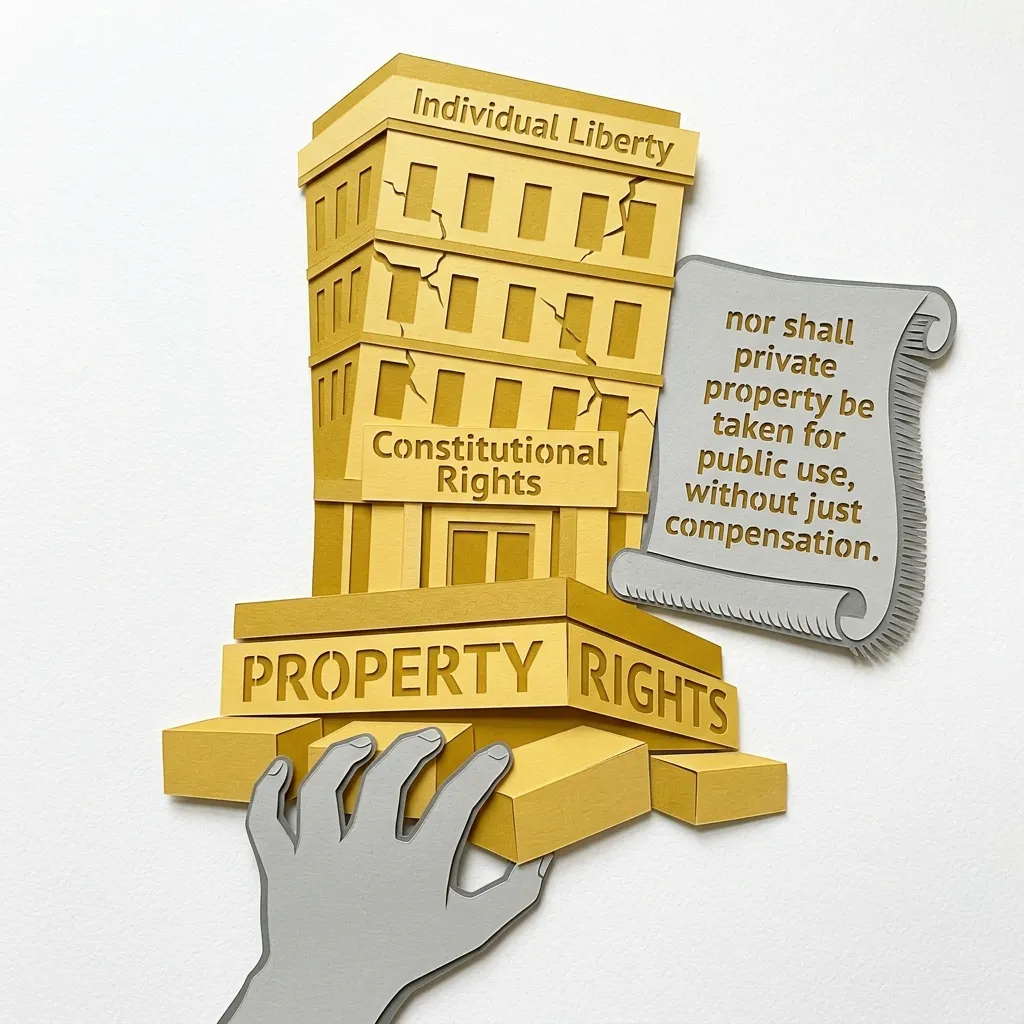
The relevant constitutional text is brief: “nor shall private property be taken for public use, without just compensation.” Two requirements: the taking must be for public use, and the owner must receive just compensation.
The Founders who wrote this language had specific concerns in mind. They had watched colonial governments and the British Crown seize property arbitrarily, without clear public purpose and without adequate compensation. They wrote the Takings Clause to impose real limits on this power. “Public use” was meant to constrain the government to genuine public purposes: roads, courthouses, fortifications, public buildings. “Just compensation” was meant to ensure that the burden of public projects fell on the public through the compensation payment, not on the unlucky individual whose property happened to stand where the government wanted to build.
For most of American history, federal courts applied these requirements with some rigor, though “public use” was interpreted to include public utilities and common carriers as well as government-owned facilities. The key limiting principle was that property had to be used by the public or made available to the public, not simply transferred to another private party for that party’s benefit.
The doctrinal erosion of “public use” proceeded through a series of Supreme Court decisions across the twentieth century. In Berman v. Parker (1954), the Court upheld an urban renewal project in Washington, D.C., that condemned an entire neighborhood labeled as “blighted,” even though many individual properties in the neighborhood were not themselves blighted. The Court deferred to Congress’s definition of the public purpose without independent scrutiny of whether the purpose was actually public. In Hawaii Housing Authority v. Midkiff (1984), the Court upheld Hawaii’s land reform act, which used eminent domain to transfer land from a small number of large landowners to existing tenants, reasoning that reducing oligopolistic land concentration was a legitimate public purpose. Together, these decisions established that the Court would defer broadly to legislative judgments about what constituted a public purpose, setting the stage for Kelo.
Kelo confirmed and extended these precedents. Once the Court accepted that economic development, tax revenue, and job creation could constitute public purposes justifying private-to-private takings, the practical constraint of “public use” on government power effectively disappeared. Any city with a redevelopment plan, any state with an economic development authority, could invoke eminent domain against private property whenever a planner concluded that a different private use would generate more revenue.

The Highway Era: When Public Use Meant Destroying Black Communities
The most devastating application of eminent domain in American history preceded Kelo by several decades and took place under the rubric of transportation and urban renewal rather than private economic development. The highway construction era of the 1950s through the 1970s, funded by the Federal-Aid Highway Act of 1956, displaced an estimated three to four million people across the United States, and those displacements fell with systematically disproportionate weight on Black and brown communities.
The pattern was consistent across dozens of American cities. Highway planners, operating under political pressure to route highways through existing urban neighborhoods rather than greenfield land that would require more expensive acquisition, chose paths through Black neighborhoods where land was relatively cheap because of historical discrimination in property values and where political resistance would be weakest. Black communities in mid-century American cities typically could not call on the political connections, legal resources, or media sympathies that allowed white communities to successfully redirect highway routes.
Robert Moses, the master builder who shaped the physical development of New York City through the mid-twentieth century, was notorious for routing expressways through Black and Puerto Rican neighborhoods and designing infrastructure that served white suburban commuters at the cost of the urban communities through which it passed. His Cross Bronx Expressway cut through the heart of the South Bronx in the 1950s and 1960s, displacing approximately 60,000 residents and destroying a densely settled Jewish and Black neighborhood that had been a thriving community. Moses reportedly acknowledged that he routed the expressway where he did partly because he could get the land most cheaply and move forward most quickly, without sustained political opposition.
Similar dynamics played out in cities across the country. In Nashville, the construction of Interstates 40 and 65 in the 1960s cut through the historically Black neighborhoods of North Nashville and Fisk-Meharry, areas that housed Tennessee’s Black middle class, Black colleges, and thriving Black businesses. Memphis displaced thousands of residents in Black neighborhoods for its freeway system. Atlanta’s construction of the downtown connector and the acquaintance of the Auburn Avenue corridor similarly devastated the commercial and residential heart of Black Atlanta. In Miami, the construction of I-95 destroyed the Overtown neighborhood, sometimes called “Harlem of the South,” destroying hundreds of businesses and displacing approximately 20,000 residents.
James Baldwin, speaking in 1963 at a meeting of the Equal Employment Opportunity Commission, coined what became the defining phrase for this process: “Urban renewal means Negro removal.” The observation captured what the data later confirmed: urban renewal programs nationwide used the language of slum clearance and public betterment while systematically targeting Black communities for displacement, directing the benefits of new development to white residents and suburban commuters.
The compensation provided to displaced residents was not just compensation in any meaningful sense. The takings laws of the era required payment of fair market value for the property taken, but fair market value in housing markets shaped by decades of redlining, racial covenants, and systematic devaluation of Black-owned property produced payments that did not reflect what the property would have been worth in a non-discriminatory market. And fair market value captured none of the value that displacement destroyed: the community networks, the relationships with neighbors and institutions, the cultural and social fabric that residents had built over decades and that could not be replicated by moving to a different neighborhood.
Research by urban historians including Arnold Hirsch, Thomas Sugrue, and Robert Self has documented in careful detail how these displacements were not accidents or unfortunate byproducts of neutral planning decisions. They reflected deliberate choices about whose homes and communities would bear the cost of building infrastructure whose benefits flowed primarily elsewhere.

Poletown: When Corporate Welfare Met Eminent Domain
The 1981 Michigan Supreme Court decision in Poletown Neighborhood Council v. City of Detroit illustrates how the “public use” doctrine was being stretched in the decades before Kelo to accommodate transfers of property to private corporations in the name of economic development.
In 1980, General Motors told the City of Detroit that it needed a large parcel of contiguous land on which to build a modern assembly plant, and that it would site the plant in Detroit only if the city could assemble the required acreage at a price that made the project economically viable. The city proposed to use eminent domain to condemn an entire neighborhood, Poletown (named for its historically Polish population), to provide GM with a 465-acre site. The project would require demolishing approximately 1,000 structures including homes, apartment buildings, churches, schools, hospitals, and businesses. Approximately 4,200 residents would be displaced.
The city argued that the plant would create thousands of jobs and generate significant tax revenue, and that these economic benefits constituted a sufficient public purpose to justify the taking. Critics, including the neighborhood residents and an unlikely alliance of left-wing activists and conservative Catholic priests from Poletown’s churches, argued that the project was straightforwardly a transfer of property from private residents to a private corporation and did not meet any reasonable definition of public use.
The Michigan Supreme Court, in a decision that drew harsh criticism from legal scholars across the political spectrum, upheld the condemnation. Justice James Ryan’s dissent became famous for its clarity: “The decision that the use of eminent domain for private corporations was a public use would have surprised even the most progressive public-use theorists of 1963, let alone 1963 B.C.” The court was endorsing a doctrine that any property transfer that a government thought would generate economic benefits could be called public use.
The Poletown precedent held in Michigan for over two decades, facilitating similar corporate welfare takings before the Michigan Supreme Court explicitly overruled it in 2004 in County of Wayne v. Hathcock, just one year before the U.S. Supreme Court reached the opposite conclusion in Kelo. The timing was ironic: a state court recognized the doctrinal error and corrected it at the same moment the federal Supreme Court locked it into constitutional law.
Just Compensation: The Other Broken Promise
The “just compensation” requirement has received less attention than “public use,” but its systematic failure to provide genuinely fair compensation represents an equally serious problem with how eminent domain operates in practice.
The constitutional requirement is that government pay “just compensation” for property taken through eminent domain. Courts have interpreted this to mean fair market value: the price a willing buyer would pay a willing seller in an arm’s-length transaction. This standard, while administrable, consistently fails to compensate property owners for the full magnitude of their losses.
Fair market value does not compensate for subjective value. A home in which a family has lived for forty years, where children were raised and grandchildren were brought to visit, has a value to its owners that exceeds what a stranger would pay for it. Economists call this subjective value or “premium over market value,” and research consistently shows that property owners in general, and in particular long-term homeowners and small business owners, would demand significantly more than market value to sell voluntarily. Eminent domain extracts property at market value and ignores the difference.
Fair market value does not compensate for business losses when a business is condemned. The building may be compensated at appraised value, but the business itself, its established customer relationships, its reputation built over years, its location-specific goodwill, is typically not compensated. A restaurant or hardware store that has operated for decades in a neighborhood being condemned receives compensation for the real estate and perhaps some moving expenses, not for the business that will be destroyed when forced to relocate.
Fair market value does not fully compensate for relocation costs. Property owners receive the appraised value of the property taken, but moving an entire household or business to a comparable location involves real expenses that are not always fully covered. In markets where housing prices have risen significantly since the condemned property was purchased, the fair market value payment may not be sufficient to purchase a comparable home in the same area. Residents of gentrifying urban neighborhoods who are displaced by eminent domain often cannot afford to return to the same neighborhood after the development is completed, even with the compensation payment in hand.
Research by economists studying eminent domain and urban displacement consistently finds that displaced residents are worse off financially than they would have been had the taking not occurred, even after accounting for compensation payments. A 2020 study by Yonah Freemark and colleagues examining urban renewal displacements found that displaced Black residents in particular experienced long-term income losses and residential instability that persisted for decades and were not compensated by the payments they received. The gap between “fair market value” and the full compensation that genuine justice would require falls hardest on the people who were already most economically vulnerable.

The Post-Kelo Reform Movement: Real Change or Just Paperwork?
The political backlash to Kelo was immediate, bipartisan, and intense. Polls conducted after the decision showed that approximately 80 percent of Americans disagreed with it regardless of political party. Within five years, 47 states had passed some form of legislation to restrict the use of eminent domain for private economic development, and 12 states amended their constitutions to explicitly prohibit Kelo-style takings.
The quality and effectiveness of these reforms varies enormously, however, and much of the initial enthusiasm for reform was eventually disappointed when implementation revealed how easily the protective language could be circumvented through definitions and exemptions.
The most common reform mechanism was to define or restrict “blight,” which is the alternative justification that cities often used when they wanted to condemn property for economic development but wanted to avoid the explicit “economic development” label that Kelo had made politically toxic. Many state reform laws banned eminent domain for “economic development” but retained it for “blight removal,” and then defined blight broadly enough that almost any urban neighborhood could be labeled blighted by a motivated condemnation authority.
In California, for example, the post-Kelo reform restricted the use of eminent domain for private economic development but retained broad blight condemnation authority. California’s Community Redevelopment Law, in effect until 2011 when Governor Jerry Brown dissolved redevelopment agencies as part of budget cuts, defined blight so broadly that it could be found to apply to most urban areas. A parking lot constituted blight if it lacked sufficient on-site parking; a residential neighborhood constituted blight if it had higher-than-average crime rates; virtually any older building could be called blighted on structural grounds. The effect was to allow economically motivated condemnations to continue under the blight justification while the state’s statute nominally restricted economic development takings.
The Institute for Justice, which litigated Kelo and has tracked post-Kelo reform legislation carefully, rates most state reform laws as providing inadequate protection. Their analysis of state reforms assigns letter grades to each state’s protections, finding that only about twenty states have enacted reforms that provide meaningful restrictions on eminent domain abuse, while the remainder have reforms that are cosmetic or easily circumvented.
The states that have enacted the strongest protections are instructive. Texas and Florida have constitutional amendments that substantially limit the use of eminent domain for private economic development. Arizona, New Mexico, and several other Western states have passed legislation requiring that takings serve a genuinely public use and that compensation reflect the full costs of displacement rather than just the market value of the property taken. These reforms show what real protection looks like and provide models for states that have enacted weaker protections.
The Racial Wealth Gap and Eminent Domain
The relationship between eminent domain abuse and the racial wealth gap in the United States is not incidental. It is structural. The specific communities that were most systematically targeted by urban renewal and highway construction takings in the twentieth century were communities that had built whatever wealth they possessed primarily through homeownership and small business, in neighborhoods that had been excluded from the mainstream of the American economy by discrimination.
Homeownership is the primary wealth-building mechanism for most American families, particularly non-wealthy families. The equity accumulated over decades of mortgage payments, the appreciation in home values, and the stability of permanent residence all contribute to household wealth in ways that renting cannot replicate. For Black American families in mid-century cities, the homes and neighborhoods that had been built despite systematic exclusion from suburban developments, from government-backed mortgages, from the full benefits of the postwar economic expansion represented their primary accumulated wealth.
Urban renewal programs that displaced Black neighborhoods in the 1950s through the 1970s did not simply move residents from one place to another. They destroyed accumulated community wealth that could not be replaced with the compensation payments received. The churches, the neighborhood institutions, the established businesses, the social networks built over generations, the security of knowing one’s neighbors, the proximity to jobs and transportation: all of these were destroyed by displacement and were not compensated.
The wealth gap between Black and white American families that persists today is substantially the result of specific policy choices, including eminent domain used to destroy Black wealth rather than to protect it. Understanding this history is necessary for understanding the stakes of how eminent domain is governed today. The question of who bears the burden of “public use” is not a technical legal question. It is a question about power, about which communities are treated as expendable when the government decides it wants their land.
The Libertarian Argument: Property Rights as Foundation, Not Incidental
The libertarian critique of eminent domain abuse rests on a proposition that goes beyond opposition to a specific doctrine: that property rights are not one value to be balanced against others in a political calculus, but the foundation on which other liberties depend.
John Locke argued that property rights precede government and that government is formed to protect them. The American founding generation largely accepted this view: the Declaration of Independence’s reference to “life, liberty, and the pursuit of happiness” was understood to echo Locke’s “life, liberty, and property,” with property as a proxy for the broader freedom to make decisions about one’s life and circumstances.
The connection between property rights and other liberties is not merely philosophical. It is practical. A person who cannot own property securely, who cannot be confident that the home they have lived in for decades or the business they have built will not be taken by a government that decides it can better deploy the land, has a fundamental vulnerability in their relationship to the state that compromises their independence. They hold their property as tenants of the political will rather than as owners with rights that the state is obligated to respect.
This is particularly consequential for people who lack political power. The wealthy and politically connected can protect their property through lawyers, political relationships, and media attention. They can make condemnation politically and legally expensive enough that governments choose to route highways or development projects elsewhere. The poor and politically marginalized cannot. The history of eminent domain in the United States is a history of power asymmetry: the people whose property was taken were overwhelmingly those who lacked the resources to resist.
The libertarian position holds that the Constitution’s requirement of “public use” was designed precisely to prevent this power asymmetry from operating through government action. By limiting takings to genuinely public purposes, the Founders intended to prevent the politically powerful from using the state’s eminent domain authority to take property from the politically powerless for private benefit. When “public use” is interpreted to mean “any purpose a legislature decides serves the public interest,” this protection disappears.
What Real Reform Requires
Meaningful eminent domain reform requires addressing both the “public use” and “just compensation” failures simultaneously.
On “public use”: the standard should be restored to something close to its original meaning. Property can be taken for government ownership and operation, for genuine common carriers that serve the public on a non-discriminatory basis, and for narrow categories where the physical nature of the activity requires integrated land use that cannot be accomplished through voluntary transaction. It should not be taken for economic development projects that will be owned and operated by private parties, even if those projects might generate tax revenue or jobs. The post-Kelo reform legislation of forty-seven states demonstrates that this limitation is politically achievable. The remaining work is ensuring that those reforms have real teeth rather than blight-definition loopholes that swallow the rule.
On “just compensation”: the standard should be amended to reflect the full cost of involuntary displacement rather than just the market value of the property taken. This should include the subjective premium that long-term owners would require for a voluntary sale, business goodwill and established customer relationships for commercial properties, actual relocation costs sufficient to acquire comparable replacement property in a comparable location, and documented indirect costs of displacement including income disruption. Several states have moved toward broader compensation standards. Federal Uniform Relocation Act provisions provide some protection but fall short of genuine compensation in many cases.
The most important structural reform is ensuring that the people most likely to be targeted by eminent domain have adequate legal resources to contest it. Low-income property owners facing condemnation typically cannot afford attorneys who specialize in eminent domain law. The gap between what a government condemnation authority can spend on its legal case and what an individual property owner can afford to spend on their defense is enormous. Expanded legal aid resources specifically for eminent domain challenges, fee-shifting provisions that make governments pay the legal costs of property owners who successfully contest overreaching takings, and organizations like the Institute for Justice that provide pro bono representation, all help to address this imbalance.
Finally, communities that were historically displaced by government action for urban renewal and highway construction deserve recognition of what was done and practical remedies where possible. Several cities have undertaken “reconnecting communities” projects that aim to repair the physical damage done by highway construction through Black neighborhoods, sometimes by relocating or covering highway infrastructure to restore community fabric. The federal Reconnecting Communities grant program created by the Infrastructure Investment and Jobs Act of 2021 provides funding for these efforts. These projects cannot undo the past, but they represent acknowledgment of a wrong that went uncomfortably unacknowledged for too long.
One important distinction here: restoring public use to its original constitutional meaning, requiring just compensation that covers genuine loss, and expanding legal resources for property owners fighting overreach are all genuinely libertarian reforms. They reduce government power and protect individual rights. The Reconnecting Communities grant program is different in kind: it is a government spending program responding to past government failure. The libertarian instinct is to stop the ongoing abuse rather than to fund repair through new federal programs. That distinction matters for readers who want to understand which reforms have principled libertarian grounding and which are pragmatic remedies operating within the same government framework that created the problem.
How 10 Countries Govern Eminent Domain: International Property Rights Frameworks
The United States is not alone in grappling with how to balance legitimate government power to assemble land for public use against individual property rights. How other countries structure this balance reveals significant variation, with several offering stronger protections than the post-Kelo U.S. system.
The United Kingdom governs compulsory purchase (the UK term for eminent domain) through a detailed statutory framework under the Compulsory Purchase Act 1965 and the Planning and Compulsion Purchase Act 2004. Unlike the U.S. system, British compulsory purchase requires explicit parliamentary or statutory authorization for each category of taking, rather than a broad constitutional authorization. Compensation is determined by an independent Lands Tribunal using detailed statutory formulas that include additional payments beyond market value, including home loss payments, disturbance payments, and severance payments for the impact on retained land. The UK system is procedurally demanding in ways that protect property owners: the acquiring authority must prove necessity, give extensive advance notice, and negotiate genuinely before proceeding to compulsory acquisition.
Germany applies strict proportionality principles to property acquisition under its Basic Law. Article 14 of the Grundgesetz (Basic Law) states that “property entails obligations” and permits expropriation only “in the public weal and for just compensation,” with compensation determined by law and subject to judicial review. German courts apply a genuine necessity test: the taking must be necessary to achieve the stated public purpose, and the government must demonstrate that no reasonable alternative existed that would achieve the same purpose with less impact on property rights. This proportionality requirement provides stronger protection than U.S. courts have typically applied, where the public purpose determination receives only rational basis review.
France uses a procedure called Declaration of Public Utility (Declaration d’Utilite Publique or DUP) that requires an administrative inquiry before expropriation can proceed. The inquiry includes public participation, review by an independent commissioner, and a formal administrative finding that the project serves a public purpose. Compensation is set by judicial tribunals applying detailed rules that include not just the market value of the property but all indirect losses causally connected to the taking. The French system’s public inquiry requirement provides transparency and citizen participation that the U.S. system often lacks.
Australia implements compulsory acquisition under Commonwealth and state legislation, with compensation schemes that are more generous than the U.S. just compensation standard. Australian compensation includes the market value of the land plus solatium payments (additional compensation for non-financial losses, including distress and inconvenience), site value, and special value to the owner. The solatium payment is explicitly designed to address the subjective value gap that U.S. fair market value compensation ignores. State legislation varies, with New South Wales providing particularly detailed compensation protections including just terms compensation requirements entrenched in the state constitution.
Canada carries out expropriation under federal and provincial legislation with varying degrees of protection. The Canadian Expropriation Act for federal takings and provincial equivalents generally require formal notice, negotiation prior to expropriation, and compensation that includes market value plus disturbance damages and injurious affection (the impact of the taking on retained property and neighboring land). Canada does not have a constitutional provision directly analogous to the U.S. Fifth Amendment’s public use clause, but courts apply administrative law principles that require proper purpose and procedural fairness.
Japan uses eminent domain sparingly by international standards, with courts applying strict requirements for necessity and full compensation. Japan’s Land Acquisition Act requires that the government demonstrate that the project cannot proceed without the specific land and that it has made genuine good-faith efforts to reach voluntary agreement before resorting to compulsory purchase. Japan has generally preferred voluntary negotiation over compulsory acquisition, partly because of cultural norms and partly because of the practical experience that contested takings generate significant political opposition that delays projects.
The Netherlands operates compulsory purchase under the Onteigeningswet, which requires royal decree authorization for specific takings and provides compensation that includes market value plus additional payments for loss of goodwill, temporary disruption, and relocation costs. The Netherlands has been grappling with a significant challenge related to compulsory purchase in the context of its nitrogen emissions reduction program, where the government has proposed purchasing farmland to comply with EU environmental requirements, generating substantial political controversy about the adequacy of compensation and the justification for forced purchases.
South Africa presents a uniquely contentious eminent domain debate, where the post-apartheid constitution includes a property clause that explicitly allows expropriation for land reform purposes in a context where historical dispossession created severe racial concentration of land ownership. The South African constitution’s Section 25 allows expropriation for “just and equitable” compensation that takes into account not just market value but also historical context, the current use of the property, and the purpose of the expropriation. South Africa’s efforts to amend its constitution to allow expropriation without compensation for land reform purposes generated significant international attention and domestic controversy, ultimately not proceeding as a constitutional amendment.
South Korea uses eminent domain extensively for infrastructure and development projects under the Act on Acquisition of and Compensation for Land. Korean compensation standards are detailed and include market value plus additional payments for relocation assistance and business losses. Korea has faced significant controversy over large-scale development projects including new city construction and transportation infrastructure, with cases of inadequate compensation and displacement of communities generating public protests that have influenced reforms to compensation standards.
Brazil applies desapropriação (expropriation) under constitutional and statutory frameworks that have evolved significantly. Brazilian compensation historically included a subjective value premium not present in the U.S. standard, reflecting a legal tradition that recognized the inadequacy of pure market value to compensate for involuntary loss. Brazil’s record on actually paying the constitutionally mandated compensation has been uneven, particularly in agricultural takings for land reform, where compensation was often in government bonds rather than cash, raising questions about whether the formal legal protections translated into practical protection.
The international comparison reveals that the U.S. post-Kelo framework provides weaker property rights protection than many comparable legal systems. The UK’s genuine necessity review, Germany’s proportionality doctrine, Australia’s solatium payments, and France’s mandatory public inquiry all provide protections that the U.S. system lacks. The consistent pattern is that countries with robust administrative law traditions apply more meaningful judicial review of eminent domain purposes than U.S. courts have applied since Berman.
Go Deeper: Books by Alex Merced
Eminent domain abuse is, at its core, a story about who holds power in a society and how that power is constrained. Property rights are simultaneously an economic institution and a political one, and the failure of “public use” doctrine reflects both the capture of regulatory institutions by politically connected interests and the deeper question of what individual rights mean in practice rather than in theory.
Economic Ideas: From Beginning to Early 2026 provides the economic framework for understanding property rights as a foundation of market economies and individual welfare, the economic costs of insecure property rights including reduced investment, distorted land use, and the destruction of community capital that cannot be measured in market transactions, and the economic analysis of eminent domain compensation standards and why “fair market value” systematically undercompensates displaced owners. The book’s treatment of externalities and public goods helps distinguish genuine public purposes from politically motivated private transfers.
The Field Guide to Libertarianism develops the libertarian philosophical case for strong property rights protections: why Locke’s insight that property precedes government rather than being granted by it remains essential to a free society, how the erosion of property rights through expansive eminent domain doctrine is connected to other expansions of government power over individual decisions, and why the asymmetry between politically connected and politically marginalized communities in their ability to resist eminent domain abuse represents exactly the kind of state power that libertarians most fear.
Political Thought and Debates of the United States traces the political history of the Takings Clause from the founding through Berman, Midkiff, and Kelo, explaining how each doctrinal step away from the original “public use” requirement reflected not just legal evolution but political choices about whose interests the doctrine would serve, and why the post-Kelo reform wave represents a genuine populist response to the perception, confirmed by the history of urban renewal, that eminent domain had become a tool of the powerful against the weak.
All three are available on Amazon. The full catalog of Alex Merced’s work is at books.alexmerced.com.
Sources and Further Reading
-
Kelo v. City of New London, 545 U.S. 469 (2005).
-
Berman v. Parker, 348 U.S. 26 (1954).
-
Hawaii Housing Authority v. Midkiff, 467 U.S. 229 (1984).
-
Poletown Neighborhood Council v. City of Detroit, 410 Mich. 616 (1981).
-
County of Wayne v. Hathcock, 471 Mich. 445 (2004).
-
Institute for Justice. “Kelo’s Long Shadow: Ten Years Later.” Institute for Justice, 2015.
-
Institute for Justice. “2022 Eminent Domain Report Card.” Institute for Justice, 2022.
-
Hirsch, Arnold R. Making the Second Ghetto: Race and Housing in Chicago, 1940-1960. Cambridge University Press, 1983.
-
Sugrue, Thomas J. The Origins of the Urban Crisis: Race and Inequality in Postwar Detroit. Princeton University Press, 1996.
-
Caro, Robert A. The Power Broker: Robert Moses and the Fall of New York. Knopf, 1974.
-
Freemark, Yonah, et al. “Urban Renewal and Its Long-Term Consequences for Displaced Residents.” Journal of Urban Economics 118 (2020).
-
Merrill, Thomas W. “The Economics of Public Use.” Cornell Law Review 72 (1986): 61-116.
-
Sandefur, Timothy. “The ‘Backlash’ So Far: Will Americans Get Meaningful Eminent Domain Reform?” Michigan State Law Review (2006): 709-77.
-
Epstein, Richard A. Takings: Private Property and the Power of Eminent Domain. Harvard University Press, 1985.
-
Sterk, Stewart E. “The Federalist Dimension of Regulatory Takings Jurisprudence.” Yale Law Journal 114 (2004): 203-76.