TL;DR
- Libertarians are not anti-environment. The standard accusation that a commitment to limited government means indifference to ecological destruction gets both the philosophy and the evidence backwards. The deeper libertarian critique is that the government is often the primary driver of environmental harm, through subsidies, land mismanagement, and the capture of regulatory agencies by the industries they are supposed to regulate.
- The libertarian case for environmental protection rests on property rights, common law, and the hard-won economics of externalities. Pollution is trespass. The atmosphere, waterways, and soil that serve as open sewers for industrial waste belong to someone, and that someone has standing to demand restitution. This framework is not a workaround; it is the oldest and most robust basis for environmental accountability in the Anglo-American legal tradition.
- The hardest problem is climate change. Its global scale, diffuse causation, and long time horizons strain the property-rights framework in ways that honest libertarians should acknowledge. The most defensible libertarian response is a revenue-neutral carbon price that removes all fossil fuel subsidies, corrects the externality, and lets markets determine the energy transition rather than picking winners through mandates.
The environmental debate in American politics has settled into a familiar and unproductive alignment. On one side, progressives and environmentalists argue that only aggressive federal regulation can protect the natural world from the predations of industry. On the other side, conservatives and many libertarians resist that regulation as government overreach, as a job-killer, or as the vehicle for a broader statist project dressed up in green language. Between these two camps, the environment itself rarely receives the serious analytical treatment it deserves.
The libertarian tradition has the intellectual resources to do better than this. It has a theory of property rights that explains precisely why pollution is wrong and who bears the cost of it. It has an economics of externalities that identifies where markets fail and why. It has a political economy that explains how regulatory agencies become captured by the industries they regulate, producing outcomes worse than no regulation at all. It has a Nobel Prize-winning account of how communities self-govern their commons without either the state or privatization. And it has a genuine moral commitment to the principle that no one has the right to use their freedom in ways that destroy someone else’s.
This article takes those resources seriously and applies them to the current environmental debates with the rigor they deserve. It does not claim that the libertarian framework resolves every environmental problem or that market mechanisms are sufficient for every ecological challenge. It claims that the libertarian framework is the most honest and analytically rigorous starting point for environmental thinking, and that a world more serious about property rights and less captured by political economy would be a cleaner one.
The Government Is Not the Environment’s Defender: It Is Often Its Enemy
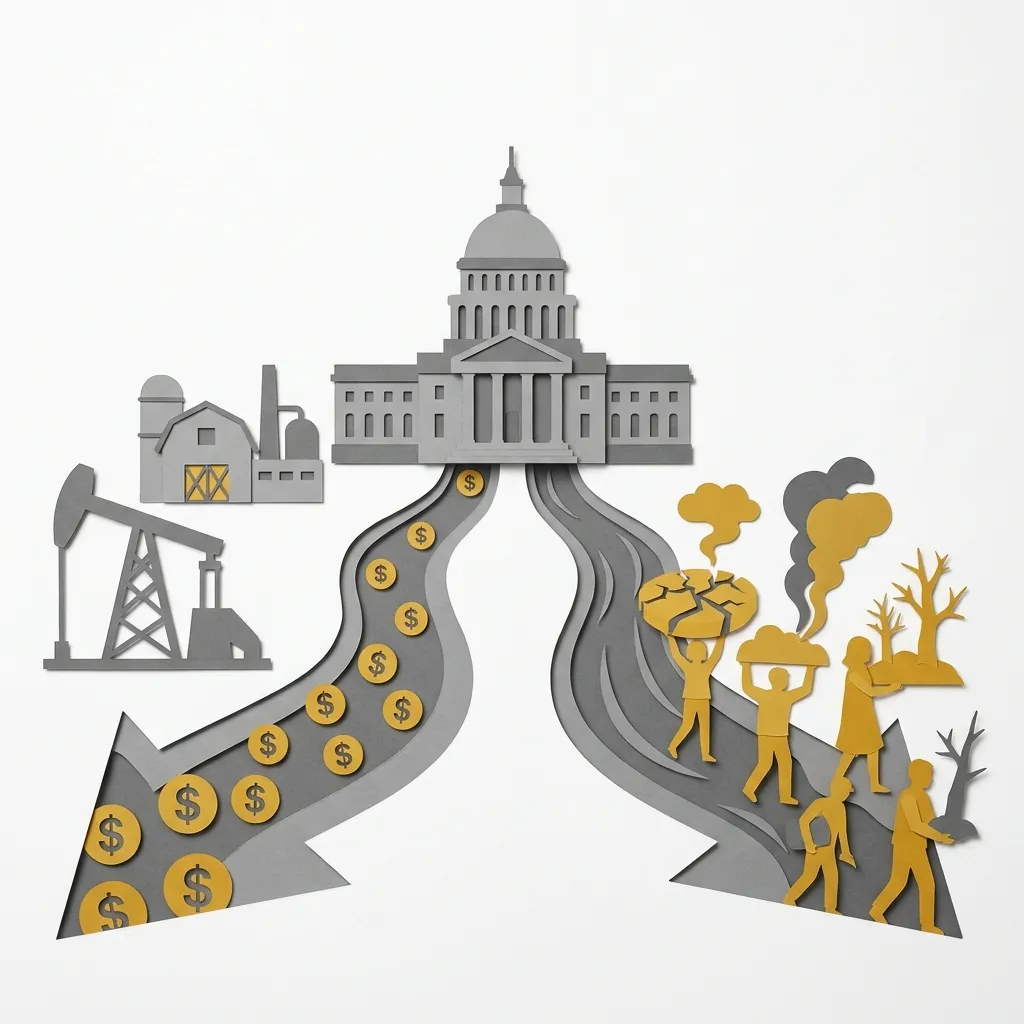
Before examining what libertarians can do for the environment, it is worth examining what the government has done to it. The standard narrative frames environmental protection as government standing between industry and nature, with only bureaucratic vigilance preventing industrial appetite from consuming everything. The record is more complicated, and less flattering to the state.
The United States government spends approximately $20 billion per year in direct subsidies to the fossil fuel industry through tax provisions, royalty relief, and direct payments. Globally, the International Monetary Fund estimated in 2023 that total energy subsidies, including both direct support and the implicit subsidy of allowing fossil fuels to be priced without accounting for their health and climate externalities, reached $7 trillion annually. (International Monetary Fund, “Fossil Fuel Subsidies,” 2023.) When a government actively makes carbon-intensive energy artificially cheap relative to its full social cost, it is not a neutral actor in the energy transition. It is an active participant in the delay of that transition, at public expense.
Agricultural subsidies tell a similar story. The US Farm Bill allocates roughly $20 billion per year in commodity subsidies, with the largest payments flowing to producers of commodity crops like corn and soybeans, which are produced using intensive monoculture methods that rely on synthetic nitrogen fertilizers, herbicides, and pesticides. The nitrogen runoff from these operations is the primary driver of the Gulf of Mexico dead zone, a region of oxygen-depleted water roughly the size of New Jersey that forms each summer at the mouth of the Mississippi River. (National Oceanic and Atmospheric Administration, “Gulf of Mexico Dead Zone,” updated annually.) Subsidizing the intensive agriculture that causes this damage is not a failure of markets. It is a specific government policy choice that distorts markets away from conservation-compatible farming methods.
Highway and suburban infrastructure policy represents a third case. The Interstate Highway System, built from the 1950s onward with federal funding, did not simply respond to demand for car travel; it created demand that would not otherwise have existed by making low-density suburban development economically feasible and by subsidizing the infrastructure costs of sprawl in ways that urban density could not access. Randal O’Toole and other researchers at the Cato Institute have documented how highway subsidies drove development patterns that increased vehicle miles traveled, reduced transit viability, converted farmland and natural areas to impervious surface, and increased stormwater runoff in ways that degrade watershed health. (O’Toole, “Gridlock: Why We’re Stuck in Traffic and What to Do About It,” Cato Institute, 2009.) The sprawl that environmentalists correctly identify as ecologically damaging is substantially a product of government transportation and land-use policy, not of unsubsidized market preferences.
The point is not that the government never does anything right on the environment. The Clean Air Act produced measurable and substantial air quality improvements in American cities. The Clean Water Act reversed decades of industrial water pollution with genuine success. The point is that the simple story in which the market destroys and the government protects is not accurate, and a libertarian analysis that takes the full record seriously has to account for the government’s dual role as both regulator and subsidizer of environmental harm.
The Libertarian Theory of Pollution: Property Rights as Environmental Protection
The foundational libertarian argument for environmental protection is not regulatory. It is legal. Pollution is trespass.
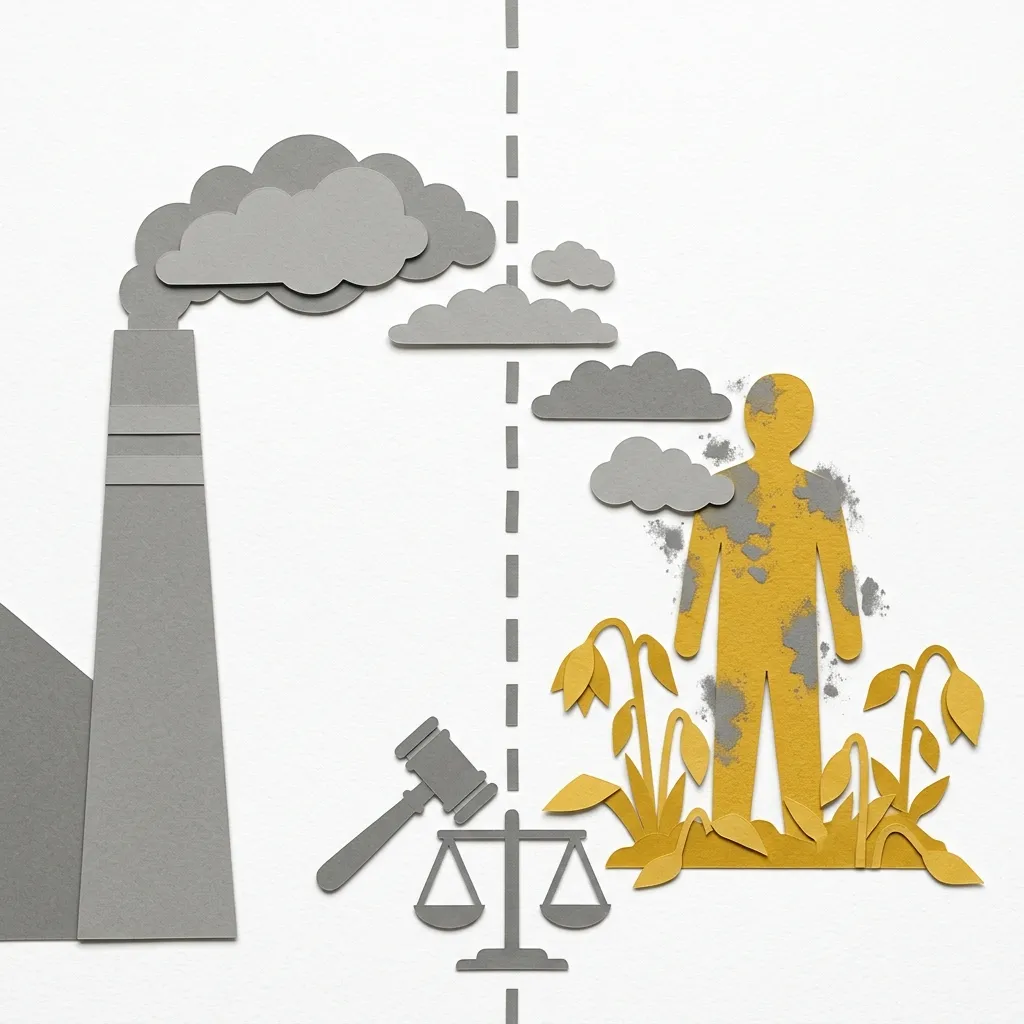
When a factory emits particulate matter that settles on a neighbor’s property, damages their crops, impairs their health, or makes their land unusable, it has violated that neighbor’s property rights. The neighbor did not consent to having their property used as a waste dump. The factory owner has no more right to use someone else’s air and land for waste disposal than to drive trucks across their fields without permission. This is not a metaphor or an analogy. It is the direct application of the most basic principle of private property: that ownership confers the right to exclude others from using your property without consent.
The English common law tradition recognized this for centuries before the EPA was founded. The doctrines of nuisance and trespass were applied to industrial pollution in the 19th century. Downstream property owners sued upstream factories for contaminating their water. Farmers sued industrial neighbors for damaging their crops with chemical discharges. Riparian rights, the legal framework governing water use along rivers and streams, developed as a system for allocating water use in ways that prevented upstream users from degrading the resource for downstream users. These were not government regulatory programs. They were property owners defending their rights in court.
What happened to this framework? Two things. First, the industrialization of the late 19th and early 20th centuries created pollution at scales that overwhelmed the case-by-case adjudication of common law courts. Second, and more consequentially, governments often actively limited the application of common law remedies to pollution. Courts in the 19th century were sometimes instructed to weigh the “public benefit” of industrial activity against the harm to individual property owners, and the “public benefit” of railroads, steel mills, and coal mines was consistently judged to outweigh the private harm to downstream farmers and landowners. This was not the market failing to protect the environment. It was the government actively limiting the legal tools that would have protected it, in service of industrial interests that could lobby for that protection.
Murray Rothbard, the libertarian economist and legal theorist, made this argument explicitly in his essay “Law, Property Rights, and Air Pollution” (1982). He argued that the common law framework, consistently applied, would have prevented most industrial pollution by treating it as trespass and requiring compensation. The weakening of that framework by legislative and judicial accommodation of industrial interests was a form of government subsidy to polluters: they were allowed to externalize costs onto their neighbors without paying for the right to do so. The regulatory state that followed was, in Rothbard’s analysis, an inadequate and often industry-captured substitute for the common law protection it had displaced.
Ronald Coase’s Nobel Prize-winning work “The Problem of Social Cost” (1960) developed the economic formalization of this insight. Coase showed that when property rights are well defined and transaction costs are low, parties will negotiate to reach efficient outcomes regardless of how rights are initially allocated. A factory that damages a neighboring farm can reach an efficient outcome if both parties can negotiate: either the farmer pays the factory to reduce emissions to the efficient level, or the factory pays the farmer compensation for the damage. The relevant policy question, in Coase’s framework, is who has the right to determine how the shared resource (clean air, clean water) is used, and whether the parties involved can negotiate around that assignment if it is inefficient.
The Coasean insight has been caricatured by critics as arguing that pollution is fine because parties will bargain their way to efficiency. That is not what Coase argued. What he argued is that defining property rights clearly and enforcing them consistently is the starting point for any environmental policy, because without that definition, there is nothing to negotiate and no basis for holding polluters accountable.
The Tragedy of the Commons and Its Misread Lesson
Garrett Hardin’s 1968 essay “The Tragedy of the Commons” in the journal Science is one of the most cited and most misunderstood pieces of writing in environmental policy. Hardin argued that any resource held in common and open to all users will be overexploited: each user has an incentive to take as much as possible before others do, while the costs of overuse are shared across all users. The rational strategy for any individual (take more) produces a collectively irrational outcome (resource depletion). He concluded that the only solutions were privatization or state coercion.
This conclusion was wrong, and Elinor Ostrom won the 2009 Nobel Prize in Economics for demonstrating exactly how and why it was wrong. Ostrom’s extensive fieldwork, documented in her 1990 book Governing the Commons, examined hundreds of cases of shared resource management around the world: Swiss alpine meadows managed by village communes for centuries, Japanese fishing villages governing their coastal waters through community rules, irrigation systems in the Philippines maintained by farmer cooperatives, lobster fisheries in Maine governed by informal territorial arrangements among fishers. In case after case, she found that communities had developed sophisticated self-governing institutions that managed shared resources sustainably without either state regulation or full privatization.
Ostrom identified eight design principles that characterized successful commons governance: clearly defined boundaries, rules adapted to local conditions, participatory decision-making among users, active monitoring, graduated sanctions for rule violations, accessible conflict resolution mechanisms, recognition of the community’s right to govern itself, and nested enterprises that coordinate across scales. These principles describe what successful voluntary community governance looks like. They do not describe what either a government regulatory agency or a private property regime typically looks like. They describe something in between and often more effective than either.
The libertarian lesson from Ostrom is not “therefore everything will be fine if we just leave it alone.” Ostrom documented many failed commons as well as successful ones. The conditions for successful self-governance are not automatic. They require community organization, clear expectations, and the capacity for enforcement. What Ostrom demonstrated is that the forced choice between privatization and state control is a false dichotomy: there is a third option, and it works in a remarkably wide range of conditions. The appropriate role for the state in this framework is to provide the legal framework within which community governance can operate (recognizing property rights, enforcing contracts, adjudicating disputes) without attempting to manage the resource directly.

Regulatory Capture: When Environmental Regulation Serves Industry
The progressive case for environmental regulation rests on the assumption that regulatory agencies will function as neutral technocratic bodies, applying scientific expertise to determine what levels of pollution are acceptable and enforcing those levels against industry. This assumption runs into a well-documented empirical problem: regulatory agencies are systematically captured by the industries they regulate.
Regulatory capture was first systematically analyzed by the economist George Stigler in his 1971 paper “The Theory of Economic Regulation,” for which he later received the Nobel Prize. Stigler observed that regulated industries have concentrated interests in the regulatory process (regulations directly affect their profitability) while the public has diffuse interests (each individual consumer or neighbor is affected only marginally by any single regulation). This asymmetry means that industry devotes far more resources to influencing regulatory agencies than the public does. Over time, the agencies come to serve industry interests more than public interests, restricting entry to new competitors, grandfathering existing pollution from incumbent firms, and setting standards at levels that incumbents can meet but new entrants cannot.
The history of EPA regulation provides many examples. The Clean Air Act’s “New Source Review” provisions, which imposed stricter standards on new sources of pollution than on existing ones, had the perverse effect of extending the operating lives of older, dirtier coal plants. Utilities could avoid New Source Review requirements by keeping their existing plants running rather than replacing them with newer, cleaner technology. This was not a market failure. It was a regulatory structure, successfully lobbied for by the coal industry, that protected the most polluting incumbent plants from competition from cleaner new technology.
The Endangered Species Act, which environmentalists treat as a landmark achievement, created perverse incentives for private landowners that libertarians identified early and that subsequent research has confirmed. Because property owners can lose the use of land where an endangered species is found, the rational response is to manage land to make it less attractive to endangered species before any are detected: what researchers dubbed “shoot, shovel, and shut up.” (Lueck and Michael, “Preemptive Habitat Destruction Under the Endangered Species Act,” Journal of Law and Economics, 2003.) A law intended to protect species created incentives to destroy habitat preemptively, precisely because it penalized property owners for the ecological value of their land rather than rewarding them for it.
The broader pattern is consistent: command-and-control environmental regulation tends to freeze existing technology in place (because standards are written around what incumbents already do), restrict competitive entry (because compliance costs favor large incumbents), create perverse incentives for landowners (because regulatory liability attaches to ecological quality), and capture agency decision-making for industry benefit (because industry has more resources to participate in the regulatory process than the public does). This is not an argument for no environmental protection. It is an argument for environmental protection designed differently.
What Works: Property Rights, Prices, and Voluntary Conservation
If the common law framework provides the conceptual foundation and Ostrom’s research provides the empirical grounding, what does a libertarian environmental policy actually look like in practice? Three institutional approaches have the strongest theoretical and empirical support.
Well-enforced property rights and common law liability. The most direct application of the property-rights framework is strengthening the legal tools that property owners have to seek compensation and injunctions against pollution. This means expanding standing to sue for pollution damages, eliminating the doctrines that weakened common law remedies in favor of industrial development in the 19th century, and creating liability rules that make polluters pay the full cost of the harm they cause. It means recognizing atmospheric rights and water rights as genuine property rights that can be defended in court. It means that communities located near industrial facilities have legal standing to seek damages when pollution harms their health and property, without waiting for a regulatory agency to act.
This is not a utopian proposal. Common law nuisance and trespass actions are already used in environmental litigation. The challenge is that the evidentiary requirements for proving specific causation are high in cases involving diffuse pollution from multiple sources, and that courts have sometimes been reluctant to grant injunctions against economically significant industrial operations. Strengthening these tools requires legal reform, not market magic.
Price signals that correct externalities. Where common law tools are insufficient because transaction costs are too high (too many parties, too diffuse causation, too difficult to trace specific harm to specific polluter), price mechanisms can internalize the social costs of environmental harm without requiring command-and-control regulation. The most analytically robust version is a revenue-neutral carbon tax: a fee on carbon emissions that reflects the social cost of those emissions, with all revenue returned to citizens through tax reductions or dividend payments.
The revenue-neutral carbon price has been advocated by economists across the ideological spectrum, from Pigou’s original externality framework to Milton Friedman-style monetarists to the Climate Leadership Council (which includes conservative Republican economists among its founders). It is consistent with libertarian principles in several respects: it corrects a real externality rather than prohibiting economic activity; it works through price signals rather than bureaucratic mandates; it lets markets determine how to achieve emissions reductions (rather than picking specific technologies through subsidies or mandates); and in its revenue-neutral form, it does not increase the size of government. The British Columbia carbon tax, implemented in 2008, demonstrated that a well-designed carbon price can reduce emissions without economic harm, while returning revenue to taxpayers through income tax reductions. (Murray and Rivers, “British Columbia’s Revenue-Neutral Carbon Tax,” Energy Policy, 2015.)
The libertarian case for a carbon price requires acknowledging that climate change is a real externality: that burning fossil fuels imposes costs on third parties who did not consent to bear them, including costs that will fall on future generations who cannot participate in the current political negotiation. Denying this to avoid the policy conclusion is not libertarian. It is willful ignorance of the property-rights framework that libertarians are supposed to apply consistently.

Voluntary conservation through land trusts, easements, and market-based mechanisms. The private conservation movement in the United States has demonstrated, through decades of practice, that voluntary mechanisms can protect significant amounts of ecologically valuable land without state ownership or regulatory mandates. Land trusts, which are nonprofit organizations that hold conservation easements or outright own land for conservation purposes, have permanently protected over 61 million acres in the United States as of 2020. (Land Trust Alliance, “National Land Trust Census,” 2020.) Conservation easements allow landowners to sell development rights while retaining ownership, providing income to the landowner while permanently restricting land use in ways that protect ecological values.
PERC, the Property and Environment Research Center based in Bozeman, Montana, has documented dozens of market-based conservation mechanisms that work through voluntary exchange rather than coercive regulation. Conservation banking, in which landowners create habitat for endangered species and sell credits to developers required to offset their impacts, creates a financial incentive for private habitat creation. Water markets, in which tradeable rights to water use can be purchased by conservationists (to leave water in rivers for fish rather than divert it for irrigation), have been used successfully in the American West. Payment for ecosystem services programs, in which downstream water users pay upstream landowners to adopt conservation practices that improve water quality, create direct financial incentives for private stewardship.
These mechanisms are not magic. They work best for specific, well-defined resources with clear property rights and low transaction costs. They work less well for diffuse pollutants, global commons, and resources for which property rights are difficult to define. But the consistent error in the environmental policy debate is to dismiss these mechanisms because they do not solve every problem, while ignoring the documented failures of regulatory approaches to solve the problems they were designed to address.

The Hard Problem: Climate Change and Its Honest Challenges
Climate change is the environmental issue that most strains the libertarian property-rights framework, and honest engagement with libertarian ideas requires acknowledging why.
The core problem is one of scale and diffusion. Carbon dioxide emitted anywhere in the world mixes uniformly in the atmosphere, affecting the global climate system. The harm falls on everyone, everywhere, and in the future, including people who are not yet born and cannot participate in the political process that will determine whether the harm is prevented. The causal chain from any specific emitter to any specific harm is probabilistic and diffuse: no one can sue the coal-fired power plant in Ohio for the flooding of their house in Bangladesh, because the causal contribution of that specific plant to that specific event is unmeasurable.
This is not a reason to deny climate change or its harms. It is a reason to acknowledge that the common law framework, which requires identifiable plaintiffs to prove identifiable harm caused by identifiable defendants, does not easily accommodate a problem of this structure. The high transaction costs of organizing the billions of parties affected by climate change, combined with the difficulty of proving specific causation, place climate change in the category where market mechanisms must be supplemented by some form of collective action.
The libertarian debate about climate policy is genuine and unresolved. Some libertarians, notably those associated with the Cato Institute’s climate program, accept the scientific consensus on anthropogenic climate change but argue that the costs of adaptation are lower than the costs of mitigation, and that technological innovation driven by normal market processes will ultimately solve the problem better than regulatory intervention. Others, including many in the free-market environmentalism tradition, accept that climate change is a genuine externality that justifies a corrective price, and that a revenue-neutral carbon tax is the policy most consistent with libertarian principles.
The strongest libertarian position on climate change is probably the following: accept the scientific consensus on the physical reality of anthropogenic warming; insist on the removal of all fossil fuel subsidies as an immediate, non-negotiable prerequisite to any further discussion; support a revenue-neutral carbon price as the least distortionary policy response to a genuine externality; resist command-and-control technology mandates, renewable energy subsidies, and centrally planned industrial policy in the energy sector; and support investment in adaptation for communities already experiencing climate impacts, particularly in developing countries where the harms are most severe and the populations most vulnerable.
This position is not “deny and delay.” It is a specific, coherent policy framework that takes the problem seriously while rejecting the particular regulatory instruments that progressives prefer, on grounds that those instruments are less efficient, more susceptible to capture, and more likely to produce perverse outcomes than a simple price signal.
The Loveatarian Case: Environment as a Property Rights Issue
What the libertarian environmental framework ultimately offers is a reframing of the environmental debate away from its current false choice between “industry destroys, government protects” and “environmental regulation is government overreach, therefore ignore the problem.” Both of those positions are intellectually inadequate, and both produce worse environmental outcomes than a property-rights framework consistently applied.
The property-rights framing says: the atmosphere, the rivers, the groundwater, and the soil belong to someone. When a company uses them as an open sewer, it is not exercising freedom. It is trespassing. The person whose air is fouled, whose water is contaminated, whose property is damaged by chemical drift has a right to seek redress, and that right is older and more fundamental than the EPA. The question is not whether environmental harms should be addressed, but how: through the legal accountability of trespass and nuisance, through price signals that force polluters to internalize costs, through voluntary community governance of shared resources, or through command-and-control regulatory programs that tend to be captured by the industries they regulate.
The Loveatarian adds to this framework the cultural argument that runs through every issue this blog addresses: the culture of mutual respect and voluntary coexistence that libertarians seek to cultivate is the same culture that produces good environmental stewardship. People who respect the property rights of their neighbors do not dump chemicals in their water supply. Communities that have strong voluntary institutions and genuine stake in local resources develop the norms and monitoring that Ostrom identified as essential to commons governance. The atomized, alienated individual who has no sense of community obligation is not better positioned to protect the environment than the over-regulated subject of a captured bureaucracy. Both fail.
A genuinely libertarian environmental vision is one in which property rights are clearly defined and robustly enforced, in which the costs of pollution fall on those who create it rather than on the neighbors and communities who bear it involuntarily, in which voluntary community institutions manage shared resources through the design principles Ostrom identified, and in which the specific market failures that require collective action, particularly the global commons problem of climate change, are addressed through price mechanisms rather than bureaucratic mandates. It is a vision that takes the environment seriously precisely because it takes property rights and individual liberty seriously. Those two commitments are not in tension. They are the same argument made from different directions.
The Specific Reforms That Follow from This Framework
A libertarian environmental agenda built on the principles above has specific policy content. These are the changes that would move the United States toward a cleaner environment while reducing rather than expanding the coercive apparatus of the state.
Remove all fossil fuel subsidies. This is the most immediate and unambiguous policy implication. There is no libertarian argument for government subsidy of any industry, and the libertarian argument against fossil fuel subsidies is identical to the argument against any other corporate welfare: it distorts markets, allocates capital away from its most productive uses, and imposes costs on taxpayers who did not choose to fund the subsidized activity. The $20 billion or more annually in direct fossil fuel subsidies, and the far larger implicit subsidy of allowing external costs to go unpriced, should be eliminated. This reform alone would do more for the energy transition than most regulatory interventions, by removing the market-distorting advantage that fossil fuels currently enjoy.
Reform agricultural subsidies to remove the premium for intensive monoculture. The commodity payment system under the Farm Bill effectively subsidizes the most environmentally damaging forms of agriculture while providing little support for conservation-compatible practices. Conservation Reserve Program payments (which pay farmers to take land out of production) are a more defensible use of agricultural support than commodity payments, and expanding them while eliminating commodity payments would reduce chemical runoff and provide habitat with the same or lower government expenditure.
Strengthen common law remedies for pollution. Congress could expand standing rules to allow downstream communities to bring nuisance and trespass claims against industrial polluters without having to demonstrate specific causation. A “public trust” doctrine more robustly applied through the courts, rather than through administrative agencies, would give courts the tools to require compensation for damages to shared air and water resources. This is not new regulation. It is the application of existing legal principles to resources that have historically been under-protected by those principles.
Implement a revenue-neutral carbon price with full repeal of energy subsidies and mandates. A carbon fee starting at $40 per ton of CO2 equivalent and rising predictably over time, with all revenue returned to citizens as a dividend and all existing energy subsidies, renewable mandates, fuel economy regulations, and other command-and-control climate measures repealed, would correct the climate externality while reducing the regulatory apparatus. British Columbia’s experience confirms that well-designed carbon prices can achieve both environmental and economic goals. The revenue-neutral design ensures that the policy does not increase the size of government.
Reform the Endangered Species Act to reward rather than penalize habitat stewardship. Replacing the current liability-based regime (which penalizes landowners for habitat on their property) with a payment-for-ecosystem-services regime (which compensates landowners for maintaining and enhancing habitat) would change the incentive from “shoot, shovel, and shut up” to active private conservation. Conservation banking, in which landowners can sell credits for habitat creation, provides a market mechanism for funding this transition.
Recognize and protect water rights, including rights for environmental flows. In the American West, water rights systems that allow tradeable water rights could be extended to allow environmental organizations to purchase water rights and dedicate them to instream flows for fish and ecosystem health. This has already occurred in some Western states, where conservation groups have purchased water rights to restore flows in depleted streams. Extending and clarifying the legal basis for these environmental water rights would allow voluntary markets to fund ecosystem restoration.
Go Deeper: Books by Alex Merced
The environmental debate is ultimately about three questions that political philosophy has been wrestling with for centuries: what do people owe each other, how should shared resources be governed, and what happens when individual freedom imposes costs on others who did not consent to bear them. Alex Merced has engaged all three in books that take libertarian ideas seriously enough to apply them rigorously.
Economic Ideas: From Beginning to Early 2026 develops the economic frameworks that underlie this article: externality theory and how it justifies corrective pricing for pollution, the public goods problem and when it requires collective action, the economics of regulatory capture and why agencies tend to serve concentrated interests rather than diffuse ones, and the history of property rights as a framework for resource governance. The Pigouvian tax analysis, the Coase theorem, and Ostrom’s commons research are all developed as economic arguments with direct policy implications for environmental protection.
The Field Guide to Libertarianism makes the political philosophy case that connects environmental protection to libertarian first principles. The argument that pollution is trespass, that the state’s failure to enforce property rights against industrial polluters is itself a form of government subsidy to industry, that voluntary community governance can protect shared resources without either privatization or state mandate, and that the revenue-neutral carbon price is the most liberty-consistent response to climate change are all developed as applications of the same property-rights and anti-coercion principles that define libertarianism across all policy domains.
Political Thought and Debates of the United States traces the political history of environmental regulation in the United States: from the Progressive Era conservation movement and its roots in both genuine ecological concern and elite control of natural resources, through the New Deal’s expansion of federal resource management, to the environmental regulatory expansion of the 1970s and the Reagan-era backlash, to the contemporary climate debate. Understanding how the environmental regulatory state developed, and whose interests it has served at each stage, provides essential context for evaluating both the progressive defense of that state and the libertarian critique of it.
All three are available on Amazon. The full catalog of Alex Merced’s work is at books.alexmerced.com.
Sources and Further Reading
-
International Monetary Fund. “Fossil Fuel Subsidies.” imf.org, 2023. (Estimates $7 trillion annually in direct and implicit subsidies globally.)
-
National Oceanic and Atmospheric Administration. “Gulf of Mexico Hypoxic Zone.” noaa.gov, updated annually.
-
Ostrom, Elinor. Governing the Commons: The Evolution of Institutions for Collective Action. Cambridge University Press, 1990.
-
Coase, Ronald H. “The Problem of Social Cost.” Journal of Law and Economics 3 (1960): 1-44.
-
Rothbard, Murray N. “Law, Property Rights, and Air Pollution.” Cato Journal 2, no. 1 (1982): 55-99.
-
Hardin, Garrett. “The Tragedy of the Commons.” Science 162, no. 3859 (1968): 1243-1248.
-
Stigler, George J. “The Theory of Economic Regulation.” Bell Journal of Economics and Management Science 2, no. 1 (1971): 3-21.
-
Lueck, Dean, and Jeffrey A. Michael. “Preemptive Habitat Destruction Under the Endangered Species Act.” Journal of Law and Economics 46, no. 1 (2003): 27-60.
-
Murray, Brian, and Nicholas Rivers. “British Columbia’s Revenue-Neutral Carbon Tax: A Review of Its Design, Performance, and Economic Effects.” Energy Policy 86 (2015): 674-689.
-
Land Trust Alliance. “2020 National Land Trust Census Report.” landtrustalliance.org, 2021.
-
Anderson, Terry L., and Donald R. Leal. Free Market Environmentalism for the Next Generation. Palgrave Macmillan, 2015.
-
O’Toole, Randal. Gridlock: Why We’re Stuck in Traffic and What to Do About It. Cato Institute, 2009.
-
PERC (Property and Environment Research Center). “Conservation Banking: Biodiversity Markets and Incentives for Conservation.” perc.org, 2015.
-
Pigou, Arthur C. The Economics of Welfare. Macmillan, 1920. (Original development of the externality concept and the case for corrective taxes.)
-
Yandle, Bruce. “Bootleggers and Baptists: The Education of a Regulatory Economist.” Regulation 7, no. 3 (1983): 12-16. (Classic analysis of how regulatory coalitions combine idealistic advocates and economic interests to produce regulation that serves the latter.)
-
Environmental Defense Fund. “Cap and Trade: A Proven Tool for Environmental Protection.” edf.org, updated 2024.
-
World Resources Institute. “Global Forest Watch.” globalforestwatch.org, updated annually.
-
Cato Institute, Center for the Study of Science. “Climate Change: What Is the Science?” cato.org, ongoing research series.