TL;DR
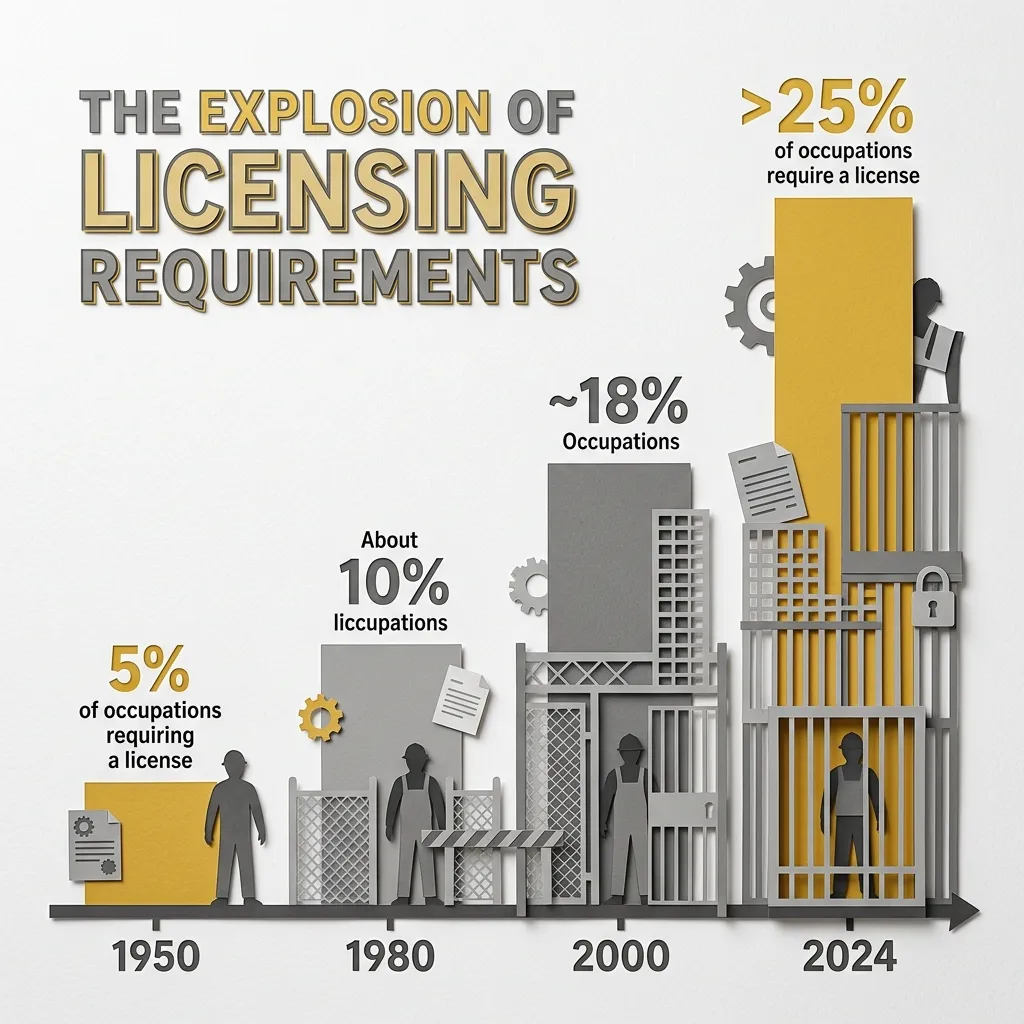
- In 1950, roughly 5 percent of American workers needed a government-issued license to do their jobs. Today that number exceeds 25 percent, representing more than 40 million workers across more than 1,000 occupations that require government permission to practice. The jobs affected are not limited to brain surgeons and airline pilots. They include hair braiders, interior designers, florists, tour guides, teeth whiteners, tree trimmers, horse massagers, and hundreds of other low-risk occupations whose connection to public health and safety is marginal at best.
- The evidence that occupational licensing improves consumer safety or service quality is weak. The evidence that it raises prices, reduces employment, limits upward mobility for low-income and minority workers, and shields incumbent practitioners from competition is substantially stronger. Every licensing requirement is both a barrier to entry for newcomers and a guarantee of reduced competition for those already licensed. One group almost always lobbies for new licensing requirements: the existing practitioners who will benefit from limiting new entrants.
- Licensing is not the only mechanism available for protecting consumers from incompetent service providers. Certification, bonding, insurance, market reputation, consumer ratings, and professional associations that self-enforce quality standards all perform similar protective functions without giving a government board the power to exclude competitors. The question is not whether consumers deserve protection from bad work. It is whether government-enforced exclusion of competitors is the right mechanism for providing that protection, given the evidence that licensing boards are consistently captured by the industries they regulate.
When Tennessee cracked down on an unlicensed interior decorator in 2010, the state was enforcing a law that required practitioners in that field to complete a four-year degree, pass a national exam, and work two years under a licensed designer before practicing independently. The interior decorator being cited, Megan Pruitt, did not arrange hospital floors or design buildings that required structural expertise. She helped clients pick paint colors, furniture, and window treatments. The state told her to stop or face criminal prosecution. She sued.
The case drew attention because it illustrated something broader about how occupational licensing works in practice. Interior design licensing in Florida, Louisiana, Nevada, and a handful of other states was pushed by an industry trade group, the American Society of Interior Designers, whose existing members had already met the requirements and stood to benefit directly from limiting the pool of potential competitors. The licensing board that enforced the requirements was composed largely of licensed interior designers. The requirements themselves had no demonstrated relationship to preventing consumer harm in the service being licensed.
This is the template for how most occupational licensing happens. It is not driven by consumer protection. It is driven by incumbent protection.
Five Decades of Permission Creep
The growth of occupational licensing from a narrow set of genuinely high-risk professions to a sprawling system touching one in four American workers is one of the most significant and least-examined regulatory developments in the postwar United States.
In 1950, the licensed occupations were primarily those whose practitioners could cause serious harm: physicians, dentists, lawyers, engineers, pharmacists. The rationale for licensing in these fields rested on genuine information asymmetries. Patients cannot easily evaluate whether a surgeon is competent before the surgery. The consequences of negligent medical practice can be severe and irreversible. A licensing system that requires demonstrated training and examines competence before allowing practice addresses a real problem.
By the 1970s, licensing had expanded to include a broader range of healthcare workers: nurses, physical therapists, X-ray technicians, clinical social workers. The public health rationale for these extensions was at least plausible, though already weaker than for physicians. By the 1990s, licensing was spreading to occupations with much more tenuous safety justifications: cosmetologists, real estate agents, barbers, security guards, massage therapists. By the 2000s and 2010s, the list had grown to include florists, interior designers, tour guides, landscape gardeners, auctioneers, taxidermists, and in some states, fortune tellers.
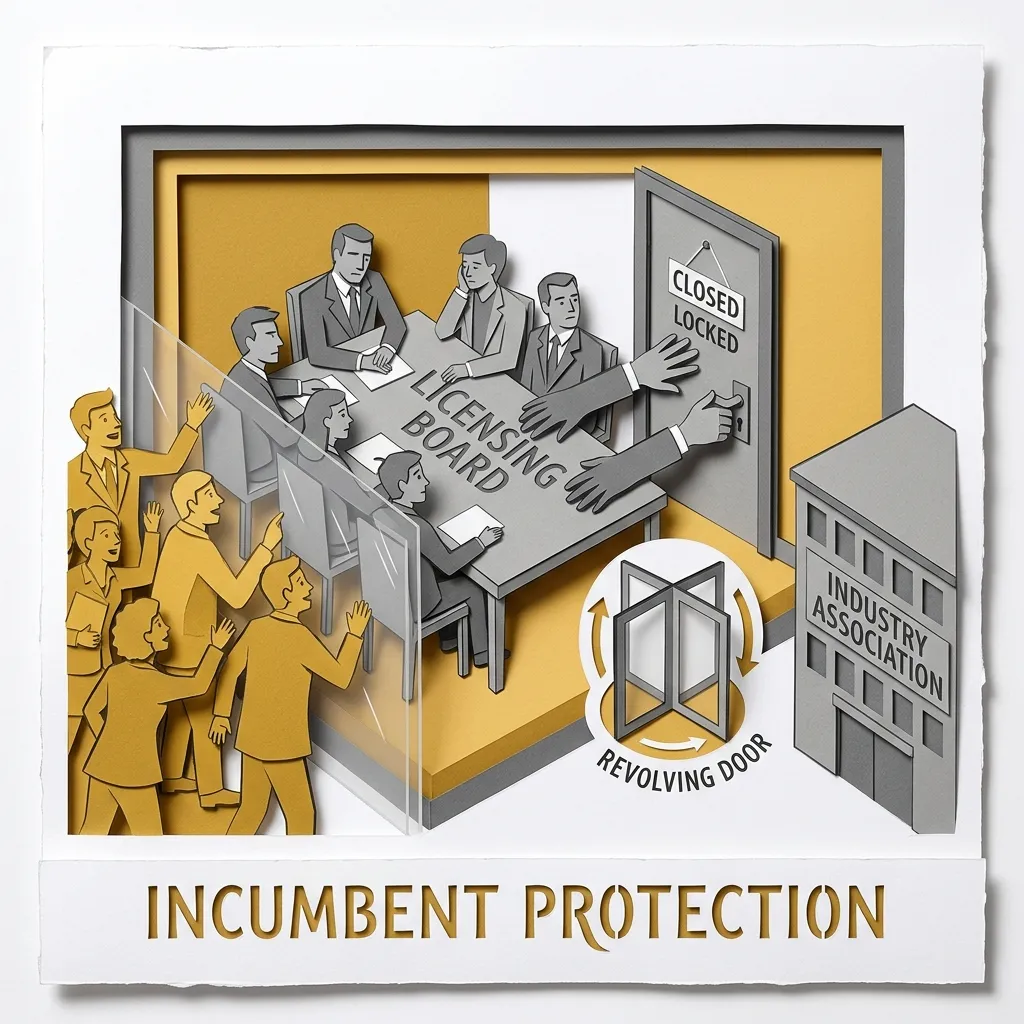
The growth was not driven by documented safety problems in the occupations being newly licensed. It was driven by professional associations successfully lobbying state legislatures to require their credentials for entry into the field, then having their members appointed to the licensing boards that would administer the requirements. This process, which economists call regulatory capture, converts a system nominally designed to protect the public into a system that protects established practitioners from competition.
Morris Kleiner, a University of Minnesota economist who has spent decades studying occupational licensing, documented in his 2006 book “Licensing Occupations: Ensuring Quality or Restricting Competition?” that the primary driver of licensing growth is political lobbying by occupational associations, not documented evidence of consumer harm from unlicensed practitioners. Kleiner’s research showed that the evidence of quality improvement from licensing was thin across a broad range of occupations, while the evidence of wage increases for licensed practitioners and price increases for consumers was consistently strong.
What Occupational Licensing Actually Does to Labor Markets
The economic effects of occupational licensing operate on both sides of the labor market: they reduce the supply of workers who can enter licensed occupations, and they raise prices for consumers who need services in those fields.
On the supply side, licensing creates a barrier to entry that is unrelated to actual competence in the work being performed. A person who wants to become a licensed cosmetologist in most states must complete between 1,000 and 2,000 hours of training at a cosmetology school, at a cost that typically runs between $5,000 and $20,000. This investment of time and money is required even for someone with extensive practical experience braiding hair or cutting hair for family and friends. The training content at cosmetology schools covers chemical processes like bleaching and perming, which require separate handling from braiding, but states typically do not offer separate credentials. If you want to braid hair professionally, most states historically required a full cosmetology license that includes hundreds of hours of training in chemical applications you will never use.
The hair braiding case became one of the most prominent examples of licensing overreach because it was so easy to illustrate. Hair braiding is a traditional practice in many African and African American communities, learned from family members and practiced for generations without formal instruction. Requiring traditional braiders to complete 1,500 hours of cosmetology school, at the cost of a year of their lives and thousands of dollars they may not have, before they can earn income from their skill is a barrier that falls hardest on the communities where braiding is most culturally embedded. The Institute for Justice litigated hair braiding licensing cases in more than a dozen states starting in the 1990s, winning in several and generating legislative reform in others. As of 2024, most states have either eliminated the cosmetology license requirement for braiders or created a separate, lower-burden braiding-specific registration, but several states still require the full cosmetology license for natural hair braiding.
The research on what licensing does to the workers who succeed in getting licensed is clear: it raises their wages, primarily because it reduces competition. A study by Kleiner and Krueger published in the Journal of Human Resources in 2013 found that licensed workers earn wages approximately 18 percent higher than comparable unlicensed workers, even after controlling for education, experience, and other factors. This wage premium sounds beneficial until you recognize what it represents: the wage premium is the rent that licensed workers extract from consumers because licensing has reduced competition, not a return to genuine quality differences.
For the workers who cannot afford or cannot complete the licensing requirements, the consequences are significant. They are excluded from legal practice of their trade, forced into lower-paying work in unrelated fields, or pushed into informal economy work that exposes them to legal risk. The licensing barrier is particularly severe for formerly incarcerated individuals, since many state licensing boards can deny or revoke licenses for past criminal convictions, sometimes with no connection between the conviction and the work being licensed. A person who was convicted of drug possession two decades ago may be ineligible for a cosmetology license in some states, not because they represent a safety risk to consumers, but because the licensing board has broad discretion to deny applications on character grounds.
Interstate mobility is another casualty of the fragmented state licensing system. Each state administers its own licensing requirements, and requirements vary substantially across states. A nurse practitioner licensed in Colorado may not be automatically licensed in Texas. A contractor licensed in Virginia may need to requalify in Maryland. A military spouse who moves when their partner is reassigned may lose the right to work in their licensed profession until they complete a new state’s requirements. The Council of State Governments estimated that occupational licensing restrictions reduce interstate migration by approximately 36 percent among licensed workers, locking people in place rather than allowing them to follow economic opportunity.
The Lobbying Machine Behind Licensing Growth
Understanding why occupational licensing has grown from 5 percent to 25 percent of the workforce requires understanding who benefits from each new licensing requirement and who lobbies for it.
The answer is almost always the existing practitioners in the field being newly licensed. The logic of incumbent interest in licensing is straightforward: existing practitioners have already met whatever requirements existed before licensing was introduced, or they receive grandfather provisions that exempt them from new requirements. New licensing requirements apply to new entrants, not to incumbents. The result is that licensing creates a protected class of existing practitioners while raising the cost of entry for everyone who comes after them.
The lobbying process is typically coordinated through trade associations and professional organizations. A state association of real estate brokers, for example, will hire lobbyists to convince a state legislature that the public interest requires a licensing requirement for home inspectors. The argument made to legislators emphasizes consumer protection: without licensing, unqualified inspectors could miss serious home defects and expose buyers to financial harm. The argument not made to legislators is that the real estate industry benefits from home inspectors who are beholden to a licensing board that real estate industry representatives will seek to populate.
The pattern of regulatory capture, in which regulated industries come to control the regulators, is particularly pronounced in licensing boards because the logic of board composition pushes in that direction. A licensing board for a profession needs members who understand the profession well enough to evaluate whether applicants meet competency standards. The most obvious source of such members is existing practitioners. Existing practitioners who serve on licensing boards make decisions that serve their interests as incumbents. The public interest, which consists primarily of ensuring that consumers have access to competent service at competitive prices, is structurally underrepresented on most licensing boards because it has no organized constituency.
Research by Dick Carpenter and colleagues at the Institute for Justice, published in “License to Work,” examined the specific lobbying mechanisms behind licensing requirements for 102 low- and medium-income occupations across all fifty states. They found extensive evidence of incumbent industries organizing and funding lobbying campaigns for licensing requirements, then seeking representation on licensing boards, then using those boards to create additional barriers to entry over time. The process is self-reinforcing: once an industry has a licensing board, the board creates its own institutional interest in the expansion of licensing requirements.
The Evidence on Quality: Does Licensing Actually Protect Consumers?
The stated justification for occupational licensing is consumer protection: preventing consumers from being harmed by incompetent or dishonest practitioners. If this justification were consistently supported by the evidence, the case for licensing would be stronger despite its economic costs. The evidence does not consistently support it.
A comprehensive review of research on licensing and quality conducted by the Obama White House’s Council of Economic Advisers in 2015 concluded that the evidence for licensing improving service quality was “scant” across most occupations reviewed. The report, titled “Occupational Licensing: A Framework for Policymakers,” examined dozens of studies and found that quality improvements from licensing were most clearly documented in healthcare professions with genuine information asymmetries and high potential for harm, and were substantially weaker or absent for lower-risk occupations.
Studies examining specific occupations illustrate why. Research on cosmetology licensing found no relationship between the length of required training hours and consumer satisfaction or safety outcomes. Research on real estate broker licensing found no evidence that licensed brokers deliver better outcomes for clients than unlicensed agents operating in states with lower barriers. Research on contractor licensing found mixed results that depended heavily on how quality was measured and what alternative mechanisms were available, such as insurance and bonding requirements. Research on dental hygiene licensing, which varies substantially across states, found no consistent evidence that the strictest licensing states had better dental health outcomes than states with more permissive rules.
The pattern across this research is consistent: licensing may improve outcomes in settings where the information asymmetry between provider and consumer is severe and the potential for harm is high. It does not consistently improve outcomes in settings where the information problem is less acute, either because the consumer can observe quality directly (a hair braid is immediately visible) or because alternative mechanisms like reviews, reputation, and insurance provide consumer protection without the anti-competitive effects of licensing.
The alternative hypothesis, that licensing works primarily as an entry barrier rather than a quality assurance mechanism, receives considerable support from studies that examine what happens when licensing requirements are loosened or eliminated. Studies of states that eliminated licensing for specific occupations generally find no deterioration in consumer outcomes and significant increases in employment and reductions in prices. Arizona, which has pursued a systematic program of licensing reform since 2019, has eliminated or reduced dozens of licensing requirements with no documented increase in consumer harm.
Who Pays: The Racial and Income Dimensions of Licensing Barriers
Occupational licensing’s costs do not fall equally across the income and racial distribution. The structure of licensing requirements systematically disadvantages the workers who are already most economically vulnerable.
The costs of licensing, in both money and time, are proportionally more burdensome for lower-income workers. A cosmetology license that costs $10,000 to obtain represents a very different burden for a worker from a middle-class family with savings and access to student loans than it does for a worker from a low-income family who needs to be earning immediately. The training hours required before licensing create a period of foregone income that higher-income workers can better afford to weather than lower-income ones. Licensing fees and renewal fees are flat amounts that represent larger percentages of lower incomes.
The racial dimensions of licensing barriers reflect both the economic barriers described above and the specific occupations that are licensed and how those requirements affect communities where those occupations are traditional. Hair braiding, as previously noted, disproportionately affects Black women for whom it is often both a community practice and an accessible route to self-employment. Licensing requirements that treat braiding as equivalent to chemical cosmetology and impose the same training burden are not neutral: they are barriers that fall hardest on a specific demographic group.
Research examining which workers are least likely to be licensed confirms that workers of color, workers without college degrees, and workers with lower incomes are all less likely to hold licenses even when working in licensed occupations. Part of this reflects the disproportionate cost of obtaining licenses. Part of it reflects that licensing boards’ character review processes, which can deny licenses based on criminal history, fall harder on communities with higher rates of involvement in the criminal justice system. The Institute for Justice’s research on criminal history bars to licensure found that more than a quarter of all licensed occupations have licensing rules that can deny applicants based on past convictions, often with no demonstrated nexus between the conviction and the safety concerns of the license.
The Veterans’ employment transition problem is particularly acute. Members of the military develop skills in medicine, logistics, engineering, construction, food service, transportation, and dozens of other fields during their service. When they leave the military, they often find that their military training and experience does not automatically translate into civilian licensing credentials. A combat medic who performed procedures far beyond what a civilian paramedic would handle cannot practice as an EMT without going through state-specific licensing processes that may not recognize their military training. The problem has attracted bipartisan attention, and dozens of states have passed legislation expediting licensing for veterans, but the underlying system remains fragmented and burdensome.

The Interstate Mobility Disaster
One of the most practically damaging consequences of state-by-state occupational licensing is its effect on geographic mobility, which is a crucial mechanism by which labor markets self-correct and workers pursue economic opportunity.
When jobs disappear in Detroit and new ones appear in Dallas, the ability of workers to move from one to the other matters enormously for both individuals and the broader economy. Licensing requirements that are valid in one state and not recognized in another impose a specific tax on interstate mobility that falls hardest on licensed workers: before relocating, they must determine whether their license will be recognized in the destination state, and if not, navigate a potentially lengthy and expensive relicensing process.
The federal military community illustrates the problem sharply. When a military member is reassigned to a new base, their family moves with them. If a spouse in that family is a licensed professional, including occupations as common as cosmetology, teaching, nursing, or real estate, they may find that their license does not transfer and that they must restart the licensing process in the new state. The frequency of military moves, which can occur every two to three years, means that some military spouses face repeated licensing barriers that effectively prevent them from maintaining careers in licensed professions. The Department of Defense has documented that the employment rate of military spouses is significantly below the rate for comparable civilian populations, and licensing barriers are identified as a significant contributing factor.
The scale of the interstate mobility problem has generated substantial bipartisan concern and some reform effort. Universal License Recognition laws, which require states to recognize out-of-state licenses for applicants who have been licensed in their home state for at least one year and have no disciplinary record, have been passed in more than fifteen states as of 2024, led by Arizona which was first in 2019. The federal government has also provided resources to states studying licensing reform, and the Department of Labor has funded research and reform recommendations since 2016 under both Republican and Democratic administrations.
These reforms are positive but partial. Interstate compacts, in which groups of states agree to recognize each other’s licenses in specific professions, have been implemented for nurses, physical therapists, and several other healthcare occupations, substantially reducing the mobility barriers for workers in those fields. Extending the compact model to additional professions and deepening the Universal License Recognition approach across more states represents the most promising near-term reform path.
What Actually Protects Consumers: The Alternatives
The argument for licensing reform is not that consumers do not deserve protection from incompetent or fraudulent service providers. The argument is that licensing is a poor mechanism for providing that protection, and that better mechanisms are available that do not impose the same anti-competitive and mobility costs.
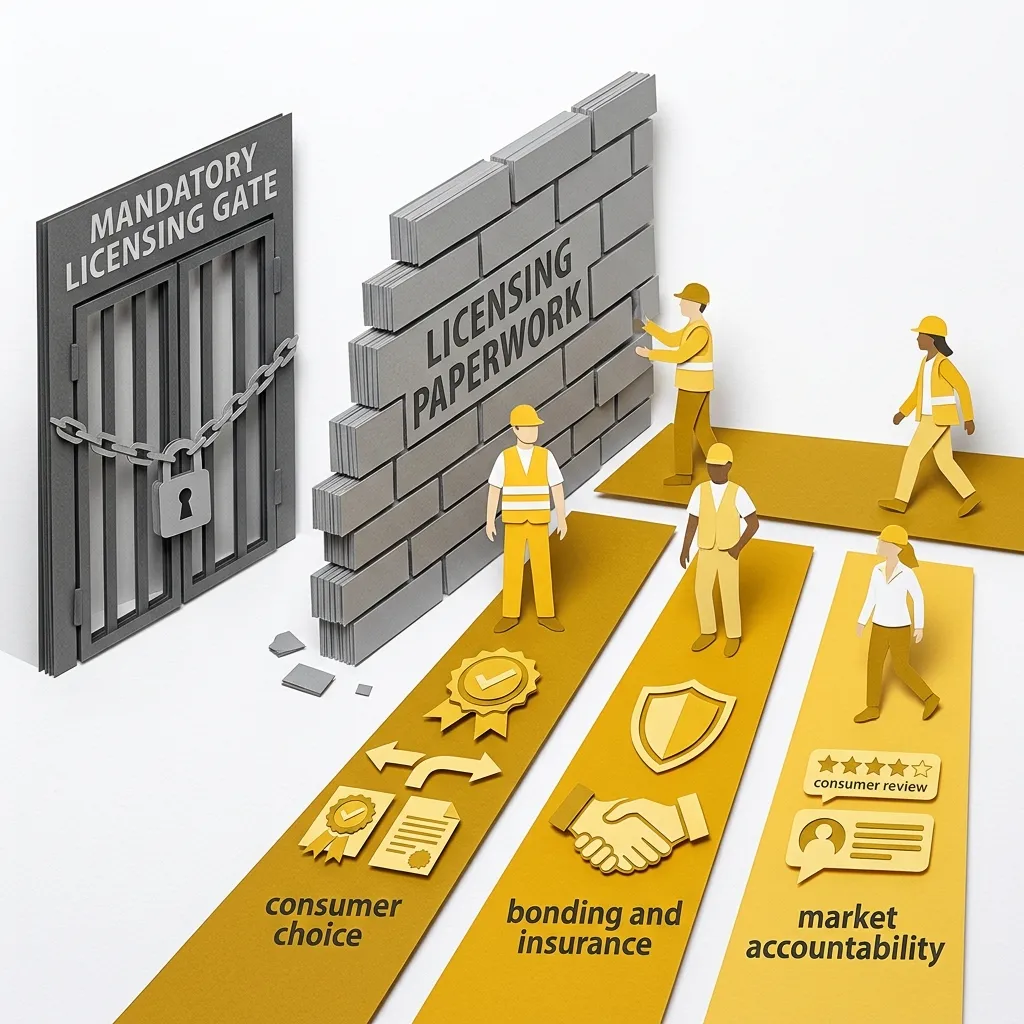
Certification, as distinct from licensing, is the most direct alternative. Under a certification system, a professional association or private credentialing body offers a certification that demonstrates competency, and practitioners can voluntarily obtain and advertise that certification. Consumers who want the assurance of a certified practitioner can seek them out; consumers who are price-sensitive or willing to rely on other signals of quality can choose from a broader pool. The crucial difference from licensing is that certification does not prohibit uncertified practitioners from offering their services. It provides information that allows consumers to choose, rather than prohibition that removes the choice entirely.
Many professional fields already use certification successfully as their primary quality signal. Certified financial planners hold voluntary credentials that are maintained by a private organization that enforces its standards and can revoke certification for misconduct. Computer programmers hold industry certifications from technology companies. Restaurant cooks hold food safety certifications in many jurisdictions. In none of these fields does the absence of a government-mandatory license appear to be causing the kind of systematic consumer harm that would justify one.
Bonding and insurance requirements provide a different kind of consumer protection: they ensure that practitioners who cause harm to consumers have financial means to compensate them. A bonded contractor who does defective work can be held accountable through the bond. A malpractice insurance requirement ensures that injured patients have a source of compensation beyond the individual practitioner’s assets. These mechanisms do not prevent incompetent practitioners from entering the market, but they do ensure that consumers who are harmed have a practical remedy, which is often more relevant to consumer protection than the theoretical prevention that licensing promises and rarely delivers.
Market reputation mechanisms, which have been substantially strengthened by online review platforms, provide consumers with information that was previously much harder to obtain. Yelp, Google, Angi, Thumbtack, and similar platforms aggregate consumer reviews that provide practical information about service quality from people who have direct experience. A plumber with 200 five-star reviews is providing more actionable consumer protection information than a plumbing license issued by a state board that cannot monitor ongoing quality of work. The rise of reputation platforms has substantially reduced the information asymmetry that licensing was originally designed to address.
Government has a role in protecting consumers from fraud and genuinely dangerous practitioners. That role is best discharged through fraud statutes, tort liability that allows injured parties to recover damages, health and safety codes that set standards without restricting entry, and targeted licensing that is reserved for occupations where the potential for irreversible harm is high and where the information asymmetry between provider and consumer genuinely cannot be resolved by market mechanisms.
The Political Paradox: Reform With Bipartisan Support That Never Happens
One of the most striking features of occupational licensing reform is that it enjoys bipartisan intellectual support without producing consistent legislative results.
The Obama White House’s 2015 report on licensing was a thorough critique of the licensing system from a Democratic administration. The Trump administration continued and expanded federal funding for licensing reform research at the Department of Labor. Multiple Republican and Democratic governors have signed Universal License Recognition laws or licensing deregulation bills. The Institute for Justice, a libertarian public interest law firm, has won licensing reform cases against Democratic and Republican state governments alike.
The political economy of the issue explains why bipartisan support for reform does not translate into consistent reform outcomes. The beneficiaries of licensing requirements are organized, concentrated, and politically active. The practitioners who hold licenses and the associations that represent them have direct financial stakes in maintaining licensing requirements and will devote significant political resources to defeating reform proposals that threaten their protected status. The people who would benefit from reform, the workers who would enter the field if barriers were lower and the consumers who would face lower prices and more competition, are dispersed, largely unaware of the connection between licensing and their situation, and do not organize to defend licensing reform proposals when associations lobby against them.
This is a standard public choice problem: concentrated benefits and diffuse costs produce organized support for the status quo and diffuse opposition to change, even when the status quo serves a narrow interest at the expense of the broader public. The fact that both major parties have at various times acknowledged the problem intellectually has not been sufficient to overcome the structural advantage that incumbent industries hold in state legislatures where most licensing decisions are made.
Reform happens primarily through three mechanisms: litigation by public interest law organizations that successfully challenges specific licensing requirements as unconstitutional restrictions on the right to earn a living; legislative reform driven by governors and legislators willing to make licensing reform a political priority and willing to absorb the political costs of fighting incumbent industries; and federal pressure through research funding, best practice guidelines, and conditions attached to federal workforce training funds. All three mechanisms have produced real, documented reform in some states. None has been sufficient to systematically reverse five decades of licensing growth.
A Practical Reform Framework
A systematic approach to licensing reform would apply a clear test to existing and proposed licensing requirements: does this requirement address a genuine, documented risk of serious harm to consumers that cannot be adequately addressed by certification, bonding, insurance, tort liability, or market reputation? If yes, licensing may be appropriate. If no, the requirement should be replaced with a less restrictive alternative or eliminated entirely.
Applying this test to the current universe of licensed occupations would produce a substantial reduction in the scope of licensing. Healthcare professions with high potential for serious harm would retain licensing. Low-risk service occupations whose quality consumers can observe and whose practitioners are accountable through reputation and market mechanisms would be converted to certification systems. Professions that require financial accountability for consumer harm would shift to bonding and insurance requirements.
Universal License Recognition should become the national standard: a practitioner licensed in good standing in any state should be presumptively eligible to practice in any other state without repeating the full licensing process. This change alone would substantially reduce the interstate mobility costs of licensing while maintaining the quality assurance functions of state licensing boards.
Criminal history bars to licensing should be narrowed to cases where there is a genuine demonstrated nexus between the conviction and the safety concerns of the licensed profession. A person convicted of financial fraud should not be licensed as a financial advisor; the nexus is clear. That same person should not be automatically barred from a cosmetology license; the nexus does not exist.
These reforms would not eliminate occupational licensing. They would rationalize it, reserving it for the cases where its benefits actually justify its costs and replacing it with less restrictive alternatives everywhere else. That is a modest proposal, given what the evidence shows. It is also politically difficult enough to explain why reform has proceeded slowly despite decades of intellectual consensus that the current system is badly calibrated.
To be clear about where these proposals sit relative to the libertarian ideal: the reform framework here still accepts mandatory licensing in healthcare and other “high risk” professions. That is a pragmatic call, not a libertarian one. The fully libertarian position is that voluntary certification, bonding, and market reputation replace government licensing across all occupations, because the evidence for licensing actually protecting consumers is weak even in high-stakes fields and the accountability of market mechanisms is stronger than most licensing advocates acknowledge. Additionally, on criminal history bars: narrowing them to cases with a demonstrated nexus is an improvement but not the endpoint. A person who has served their sentence has paid their debt. The libertarian position is elimination of criminal history bars from licensing, not case-by-case review of which convictions are close enough to the license category.
How 10 Countries Govern Occupational Licensing: International Approaches
The United States is unusual in the fragmented, state-by-state nature of its licensing system and in the degree to which it has extended licensing to low-risk occupations. How other countries regulate occupational entry reveals different approaches that often provide better outcomes for worker mobility and consumer welfare.
The European Union operates a mutual recognition framework for professional qualifications under Directive 2005/36/EC. EU citizens who hold a professional qualification in one member state are entitled to have that qualification recognized in other member states, subject to adaptation periods or aptitude tests where significant differences exist in training requirements. This system, covering more than 800 professions, prevents member states from using licensing as a barrier to the free movement of workers within the EU. The mutual recognition framework has been substantially strengthened since the UK’s departure from the EU, which exposed how dependent professional mobility was on EU law.
Germany maintains one of the world’s most distinctive occupational licensing approaches through the Meisterbrief (master craftsman certificate) system administered by the chambers of crafts (Handwerkskammern). The Meisterbrief is required to independently operate a business in approximately 41 skilled trades including electricians, plumbers, carpenters, and bakers, with training taking approximately four years beyond apprenticeship. Germany liberalized the system in 2004, removing the Meister requirement from approximately 53 trades, and studied the results. Liberalized trades showed substantially higher firm formation rates and employment growth without documented quality deterioration. In 2019, Germany partially reversed some liberalizations based on quality concerns in specific trades, providing a natural experiment in the effects of licensing changes in both directions.
The United Kingdom, after leaving the EU, lost the automatic mutual recognition system that had governed professional mobility between the UK and EU member states. The UK has been developing bilateral recognition agreements with individual EU member states and other countries, and has undertaken a review of its domestic licensing landscape. The UK’s post-Brexit experience illustrates how mutual recognition frameworks that were taken for granted became visible only when they were removed.
Australia has pursued national licensing reforms through the Council of Australian Governments (COAG), attempting to harmonize state-level licensing requirements to reduce the barriers to worker mobility between states. Australia’s National Licensing System for the building and construction industry established uniform national licensing standards across states. The process has been technically complex and politically contentious, but it represents a genuine effort to address the interstate mobility problem that characterizes U.S. licensing.
New Zealand has taken a more consistently deregulatory approach to occupational licensing than Australia, with periodic reviews of licensing requirements that apply a cost-benefit test to determine whether requirements are justified. New Zealand’s Regulatory Standards Act requires that licensing requirements be justified by evidence of market failure that licensing would address. The application of this standard has resulted in the elimination of licensing requirements for several occupations where evidence of consumer harm from unlicensed practitioners was absent.
Canada, like the United States, faces significant interprovincial licensing barriers that reduce worker mobility. Canadian provinces set their own licensing standards, and recognition between provinces has historically been limited. The Canadian Free Trade Agreement (2017) includes provisions on labor mobility that require parties to reduce licensing barriers, and significant progress has been made in healthcare professions and several trades. Canada’s experience with professional licensing reform in healthcare has been particularly relevant, as provinces have reduced scope-of-practice restrictions for nurse practitioners and pharmacists, allowing them to perform services previously reserved for physicians.
Japan maintains a complex licensing system covering a broad range of professions, with national licensing examinations for many occupations administered by government ministries. Japan’s licensing system is more uniform nationally than the U.S. state-based system, avoiding some of the interstate mobility problems, but has its own issues of restrictive practice definitions and slow evolution of scope-of-practice rules in response to workforce shortages in healthcare. Japan has been gradually liberalizing scope-of-practice rules in nursing and pharmacy in response to physician shortages.
Denmark relies more heavily on market mechanisms and professional certification than mandatory government licensing for many occupations. Danish labor markets, characterized by high trust, strong collective bargaining, and professional associations that maintain quality standards among members, produce quality assurance through mechanisms other than government-mandated licensing in many fields. The Danish model illustrates how a high-trust institutional environment can substitute for mandatory licensing requirements in lower-risk occupations.
France has a complex administrative licensing system for many professions, administered through professional orders (ordres professionnels) that are self-governing bodies with state-delegated authority. French professional orders for lawyers, doctors, architects, and other regulated professions exercise substantial control over entry, discipline, and practice standards. The system combines elements of mandatory licensing with professional self-regulation, with the orders operating under state supervision. France has been working to reduce restrictions in some professions in response to EU internal market requirements.
South Korea implemented significant professional licensing reforms in the 2010s, attempting to reduce barriers to entry in services sectors as part of a broader deregulation agenda. South Korea’s licensing reform program specifically targeted occupations where evidence suggested that licensing was protecting incumbents rather than consumers. The reforms faced substantial political opposition from incumbent professionals and had mixed success in practice, illustrating the same structural challenges to licensing reform that the U.S. faces.
The pattern across international comparison is that countries with more effective national licensing systems tend to have either strong mutual recognition frameworks (the EU), more nationally uniform standards (Japan), or more systematic cost-benefit review of licensing requirements (New Zealand). The U.S. fragmented state system, without effective national coordination or mandatory recognition, produces more severe mobility barriers than any comparable developed economy.
Go Deeper: Books by Alex Merced
Occupational licensing is a near-perfect case study in what happens when government regulation is captured by the industries it is supposed to regulate. The political economy of licensing, the evidence on its effects, and the alternatives available all fit directly into the frameworks Alex Merced develops in his books.
Economic Ideas: From Beginning to Early 2026 provides the economic framework for understanding regulatory capture: how well-organized incumbent industries convert nominally public-interest regulations into barriers that serve their private interests at public expense. The book’s treatment of rent-seeking behavior, where economic actors invest resources in obtaining government privileges rather than creating value, applies directly to why professional associations lobby for licensing requirements and why the resulting regulations consistently reflect incumbent interests rather than consumer welfare.
The Field Guide to Libertarianism develops the libertarian argument for the right to earn a living as a core liberty interest: the freedom to offer one’s labor and skills in exchange for compensation is not merely an economic preference but a form of basic autonomy that government should not restrict without strong justification. The field guide also addresses the genuine consumer protection concerns that motivate licensing advocates and explains why voluntary certification, bonding, and market reputation better serve those concerns than mandatory government exclusion of competitors.
Political Thought and Debates of the United States traces the political history of the Progressive Era regulatory impulse that gave rise to modern occupational licensing, explaining why the initial expansion of licensing to high-risk professions was reasonable and why the subsequent expansion to low-risk occupations reflects political dynamics rather than policy logic. The book’s treatment of the relationship between organized interests and regulatory agencies provides the political science context for understanding why licensing boards consistently serve incumbent industries rather than the public.
All three are available on Amazon. The full catalog of Alex Merced’s work is at books.alexmerced.com.
Sources and Further Reading
-
Kleiner, Morris M. Licensing Occupations: Ensuring Quality or Restricting Competition? W.E. Upjohn Institute for Employment Research, 2006.
-
Kleiner, Morris M., and Alan B. Krueger. “Analyzing the Extent and Influence of Occupational Licensing on the Labor Market.” Journal of Human Resources 48, no. 4 (2013): S121-S167.
-
Obama White House Council of Economic Advisers. “Occupational Licensing: A Framework for Policymakers.” Executive Office of the President, 2015.
-
Carpenter, Dick M., Lisa Knepper, Angela C. Erickson, and John K. Ross. “License to Work: A National Study of Burdens from Occupational Licensing.” 2nd ed. Institute for Justice, 2017.
-
Furman, Jason, and Sandra Black. “Obama’s Council of Economic Advisers Report on Occupational Licensing.” Brookings Institution, 2015.
-
Friedman, Milton. “Occupational Licensure.” Capitalism and Freedom. University of Chicago Press, 1962. (Original economic critique of licensing.)
-
Peterson, Bo E., Jonathan L. Rork, and Amanda S. Freeman. “Occupational Licensing and Interstate Migration.” Industrial Relations: A Journal of Economy and Society 54, no. 3 (2015): 477-505.
-
Phelan, Brian J. “Spatial and Cyclical Variation in Wage Returns to Occupational Licensing.” Labour Economics 49 (2017): 116-129.
-
Council of State Governments. “Occupational Licensing: Assessing State Policies and Practices.” CSG, 2018.
-
Redbird, Beth. “The New Closed Shop? The Economic and Structural Effects of Occupational Licensure.” American Sociological Review 82, no. 3 (2017): 600-624.
-
Blair, Peter Q., and Bobby W. Chung. “How Much of Barrier to Entry Is Occupational Licensing?” British Journal of Industrial Relations 57, no. 4 (2019): 919-943.
-
Johnson, Janna E., and Morris M. Kleiner. “Is Occupational Licensing a Barrier to Interstate Migration?” American Economic Journal: Economic Policy 12, no. 3 (2020): 347-373.
-
Institute for Justice. “Bottleneckers: Gaming the Government for Power and Private Profit.” 2020.
-
Department of Labor, Employment and Training Administration. “Occupational Licensing: Research and Policy.” 2024.
-
Arizona Governor’s Regulatory Review Council. “2023 Annual Report on Regulatory Reform.” State of Arizona, 2023.