TL;DR
- Social Security is facing a documented, actuarially certain fiscal shortfall. The Social Security Board of Trustees projects that the combined trust funds will be depleted by 2034, at which point incoming payroll tax revenue will cover only about 77 percent of scheduled benefits. This is not a rumor or a partisan talking point. It is the Social Security Administration’s own projection.
- The fiscal problem reflects a structural design flaw: Social Security is a pay-as-you-go system in which current workers fund current retirees, not a savings program in which workers accumulate their own retirement funds. When the ratio of workers to retirees was favorable, the system worked. When the Baby Boom generation retired and fertility rates fell, the ratio reversed, and the system’s structural vulnerability became visible.
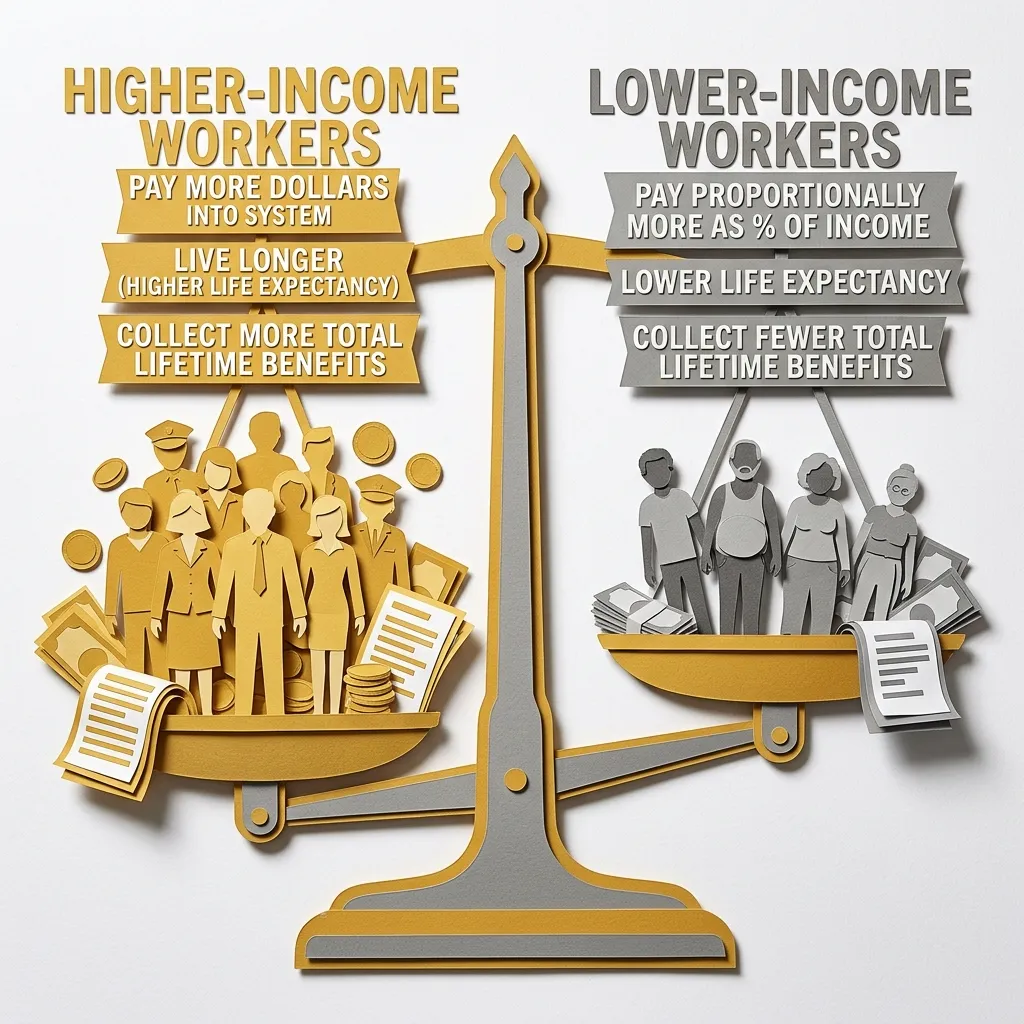
- The program also has distributional features that are less progressive than commonly assumed. The payroll tax is capped and regressive in its structure. Lower-income workers pay a higher percentage of their wages than higher earners, have lower life expectancy and therefore collect fewer total lifetime benefits, and the program’s benefit formula, while progressive in design, is substantially offset by these mortality disparities. Genuine retirement security for lower-income Americans requires reform that addresses these structural inequities rather than simply defending the status quo.
- Reform is possible without destroying the program or abandoning older Americans who depend on it. The options are well-understood and have been modeled extensively. The barrier is not analytical. It is political: both major parties have discovered that defending Social Security is easier than reforming it, which is why the known solution has not been enacted despite decades of warning.
When Franklin Roosevelt signed the Social Security Act in August 1935, he described it as a fundamental shift in how American society would treat its elderly citizens. The Depression had made the vulnerability of older Americans viscerally apparent: millions of retirees had lost their savings in the bank failures of the early 1930s, and there was no federal safety net to catch them. Social Security was designed as the foundation of a more secure retirement system, a guaranteed floor below which no elderly American would fall.
What Roosevelt signed was also, from the start, something different from what most Americans understood it to be. Social Security was not and is not a savings program. Your payroll taxes do not go into an account with your name on it. They go into a general fund that pays the benefits of current retirees. When you retire, your benefits will be paid by the payroll taxes of workers who are employed at that time. This pay-as-you-go structure, which FDR understood and chose deliberately for political reasons (a contributory program would be harder to cut than a welfare program), works when the worker-to-retiree ratio is favorable. It runs into trouble when it is not.
In 1940, when Social Security first paid retirement benefits, there were approximately 159 workers for every beneficiary. By 1950, the ratio had fallen to 16 workers per beneficiary. By 2024, it stands at approximately 2.7 workers per beneficiary. This demographic trajectory was foreseeable from the early years of the program. The Social Security trustees have been reporting on the program’s long-term financial challenges since the 1970s. The 1983 Greenspan Commission reforms, which raised the retirement age, increased payroll taxes, and subjected Social Security benefits to income tax for the first time, bought several decades of solvency but did not address the underlying structural problem. We are now approaching the end of the runway those reforms created.
The Fiscal Reality: What the Trustees Actually Say
The Social Security Board of Trustees publishes an annual report on the financial status of the trust funds. These reports are detailed, technically rigorous, and written by the program’s own administrators. They do not reflect partisan spin. The 2024 Trustees Report projects that the Old-Age and Survivors Insurance (OASI) trust fund will be depleted in 2033. The Congressional Budget Office, which independently models Social Security finances, projects depletion of the combined OASDI trust funds in 2034.
At the point of trust fund depletion, Social Security will not stop sending checks. Under current law, the program continues operating and paying benefits from current tax revenues. But current tax revenues are projected to cover only about 77 percent of scheduled benefits. This means a statutory benefit cut of approximately 23 percent would occur automatically unless Congress acts. For a retiree currently receiving $1,800 per month, that would mean a monthly reduction of approximately $414.
This is not a distant or theoretical problem. A worker who is 55 years old today will reach full retirement age around 2033. A 45-year-old today will reach full retirement age around 2043. These are not future generations in some abstract sense. They are people who are currently paying into Social Security and making retirement plans based on the benefits the program has scheduled.
The gap between the program’s projected revenues and projected expenses is substantial. Over a 75-year actuarial horizon, the Social Security Administration estimates the program is underfunded by an amount equivalent to approximately 3.2 percent of taxable payroll. To close this gap through payroll tax increases alone would require raising the combined employee-employer payroll tax rate from 12.4 percent to approximately 15.6 percent, a 26 percent increase. To close it through benefit cuts alone would require cuts of approximately 21 percent applied immediately or 26 percent if delayed until trust fund depletion. In practice, any realistic reform will involve some combination of both approaches applied gradually over time.

The Pay-As-You-Go Structure: Why It Creates Vulnerability
Understanding why Social Security faces these pressures requires understanding what it actually is, as opposed to what most Americans believe it to be.
Most Americans believe they are saving for their own retirement through Social Security. Survey research consistently finds that most workers think of Social Security as a program where their contributions accumulate in their own account and are returned to them with interest at retirement. The Social Security Administration’s own messaging reinforces this perception: the annual Social Security statement sent to workers projects their future benefit as if it were based on what they have personally contributed.
The truth is more complicated. Social Security taxes paid by today’s workers pay today’s retirees. The surplus from earlier decades, when the worker-to-retiree ratio was more favorable, was invested in special-issue Treasury bonds, creating what is called the Social Security trust fund. But the trust fund is an accounting mechanism within the federal government: it holds U.S. government bonds, which are obligations of the same government that owes the Social Security benefits. When the trust fund needs to be drawn down to pay benefits, the Treasury must either raise taxes, cut other spending, or borrow money to redeem those bonds. The trust fund is not a cache of saved resources sitting in a vault; it is an intragovernmental IOU.
This structure creates a fundamental vulnerability to demographic change. When birth rates were high and mortality was relatively early, many workers supported few retirees and the program generated large surpluses. When birth rates fell and longevity increased, fewer workers needed to support more retirees collecting benefits for longer periods. The math stopped working in the program’s favor.
FDR’s Treasury Secretary Henry Morgenthau raised exactly this concern in congressional testimony about the original Social Security Act. Morgenthau worried that the program as designed would require the government to accumulate enormous reserves that could not be invested productively, leading to the pay-as-you-go structure that was adopted. Morgenthau also noted the program’s long-term vulnerability to demographic change. The warning was understood and the political decision was made to proceed anyway, because the immediate political benefit of a contributory social insurance program was too valuable to sacrifice for actuarial prudence.

Who Actually Benefits: The Distributional Reality
The standard political defense of Social Security emphasizes its role as a progressive program that provides greater income replacement to lower-wage workers than to higher-wage ones. This is true in one dimension of the benefit formula and misleading in others.
The Social Security benefit formula is deliberately progressive: a lower-wage worker replaces a higher percentage of their pre-retirement earnings than a higher-wage worker. A worker who earned at the national average throughout their career receives benefits replacing approximately 43 percent of their pre-retirement earnings. A worker who earned the maximum taxable wage receives benefits replacing approximately 28 percent of their pre-retirement earnings.
But the benefit formula is only one dimension of how Social Security distributes resources. Two other dimensions work in the opposite direction.
The payroll tax itself is regressive. Social Security taxes apply only to earned income up to a cap, which is $168,600 in 2024. Income above this cap is not subject to Social Security tax. A worker earning $70,000 pays Social Security tax on 100 percent of their wages. A worker earning $500,000 pays Social Security tax on only 34 percent of their wages, with the remaining 66 percent of their income exempt. This means the effective Social Security tax rate falls as income rises above the cap, which is the definition of a regressive tax.
Life expectancy creates a second and more profound distributional problem. Benefits are paid for life, so the total lifetime benefits a person receives depend on how long they live. Higher-income workers live longer on average than lower-income workers, sometimes by a decade or more. Research published in the National Bureau of Economic Research and the Journal of Economic Perspectives has consistently documented a growing gap in life expectancy by income over recent decades. A male worker born in 1960 in the bottom income quintile has a life expectancy at age 50 that is approximately seven years shorter than a male worker in the top income quintile. Seven years of Social Security benefits at current average benefit levels represents approximately $150,000 in total payments.
When the benefit formula’s progressivity is combined with the regressive payroll tax and the life expectancy differential, the program’s net distributional impact on lower-income workers is substantially less progressive than the benefit formula alone suggests. Studies that account for all three factors, including prominent work by economist John Geanakoplos and colleagues at Yale, have found that Social Security provides lower returns to lower-income workers and workers who are members of racial groups with lower life expectancies, compared to what those workers would receive from market investments of the same payroll contributions.
This does not mean the program should be eliminated. For workers with no other retirement savings, Social Security may be the difference between poverty and subsistence. The point is that defending the current program on progressive distributional grounds requires ignoring significant evidence that the program is less progressive in practice than in design, and that reforming it to actually deliver on its redistributive promise would require changes that go beyond simply defending the status quo.
The 1983 Reforms: What They Did and Why They Were Not Enough
The last major Social Security reform occurred in 1983, under President Reagan and a Democratic Congress, based on the recommendations of a bipartisan commission chaired by economist Alan Greenspan. The context was an immediate crisis: the trust fund was projected to be depleted within months, and Social Security checks were genuinely at risk of not being paid.
The 1983 reforms combined tax increases with benefit cuts in a way that both parties could accept as necessary. The measures included: a phased increase in the normal retirement age from 65 to 67 (fully implemented by 2027); a 6-month delay in cost-of-living adjustments; subjecting Social Security benefits to income tax for the first time for higher-income beneficiaries; accelerating previously scheduled payroll tax increases; and extending Social Security coverage to federal employees and certain other groups who had been excluded.
These reforms generated substantial surpluses for two decades as the large Baby Boom cohort moved through peak earning years and contributed heavily to the system before beginning to retire. The trust fund grew from near-zero in 1983 to over $2.9 trillion at its peak in 2021.
The Baby Boom retirement, which began around 2011 and continues through approximately 2030, is drawing down those surpluses. Combined with lower fertility rates and rising longevity, the demographic trends the 1983 reforms bought time to address are now fully present. The trust fund surplus is shrinking and is projected to reach zero in 2033.
The reason the 1983 solution has not been replicated is partly political and partly structural. In 1983, both parties faced an immediate crisis that made inaction clearly impossible. Today, the deadline is a decade away, and both parties have strong electoral incentives to avoid association with benefit cuts or tax increases on wage earners. Democrats defend Social Security against any benefit reduction. Republicans defend it against any tax increase. Neither party has proposed a reform package that closes the actuarial gap, because doing so requires accepting some combination of the things both parties have declared off-limits.
What Reform Options Actually Look Like
The Committee for a Responsible Federal Budget, the Bipartisan Policy Center, and the Social Security Administration’s own Office of the Chief Actuary have modeled dozens of reform proposals in detail. The options are not mysterious. The math is well-understood. What is missing is political will.
On the revenue side: The most commonly discussed options include raising or eliminating the payroll tax cap (which would primarily affect high earners and would generate substantial additional revenue), increasing the payroll tax rate, subjecting additional forms of compensation such as employer-paid health insurance to payroll tax, and applying the payroll tax to investment income for higher earners. Raising or eliminating the payroll tax cap would also make the financing of Social Security more progressive, since the cap is the primary source of the program’s regressive financing structure.
On the benefit side: Options include further increases in the normal retirement age (calibrated to life expectancy rather than set at a fixed age), changing the benefit formula to reduce the rate of replacement for higher earners while protecting or modestly enhancing replacement for lower earners, changing the cost-of-living adjustment formula to use a more accurate measure of inflation for the elderly, and means-testing benefits for high-income retirees who have substantial other retirement income.
On the structural side: Options include allowing workers to direct a portion of their payroll taxes to individual retirement accounts, which was proposed by the Bush administration in 2005 and rejected by Congress. Individual accounts would allow younger workers to accumulate real savings rather than claims on future workers’ contributions, potentially producing better returns for lower-income workers who are currently disadvantaged by the life expectancy differential. The tradeoff is the transition cost: during a period when contributions are diverted to individual accounts, someone still has to pay the benefits of current retirees, which requires either additional borrowing or a reduction in benefits.
The libertarian case for individual accounts is not merely ideological. If lower-income workers have lower life expectancy and therefore collect fewer lifetime Social Security benefits than their contributions would justify, then a system that allows them to own and inherit their own retirement savings would genuinely serve them better than the current pay-as-you-go structure. The distributional critique of Social Security is, in this sense, a progressive argument for reform rather than a conservative argument against the program.
The most defensible reform approach combines modest adjustments from both sides: raising the payroll tax cap, adjusting the retirement age for longevity, protecting or modestly increasing the minimum benefit for the lowest-earning retirees, and making the cost-of-living adjustment more accurate. None of these changes is painless. All of them can be phased in gradually enough to protect current retirees and workers close to retirement. The longer Congress waits to act, the more severe the eventual adjustments will need to be.
Here is the honest accounting of what that agenda actually is: raising the payroll tax cap and adjusting the retirement age are not libertarian solutions. They are tax increases and benefit adjustments applied to a program that remains coercive, pay-as-you-go, and governed by political decisions rather than individual ownership. The libertarian position is that people should own their retirement savings, not hold claims on future workers’ taxes. The one element in this reform toolkit with genuine libertarian direction is individual accounts, allowing workers to own what they contribute rather than exchanging contributions for a government promise. This does not eliminate the coercion of mandatory contributions, but it moves toward ownership rather than intergenerational transfers. The transition cost from the current system to one with real accounts is the binding constraint on going further, since current retirees are owed benefits funded by current workers’ taxes. Readers should understand: the reforms here would make Social Security more solvent and somewhat more equitable. They would not make it libertarian. A fully libertarian retirement system looks more like Australia’s superannuation model with a minimal safety net, not like a restructured pay-as-you-go system.
How 11 Countries Structure Retirement: What Works and Why
The United States is not the only country grappling with an aging population and a pension system designed for a younger one. But the way other countries have structured retirement systems reveals genuine alternatives to the pay-as-you-go model that the U.S. relies on almost exclusively.
Chile executed the most radical reform in modern pension history in 1981, replacing its failing pay-as-you-go system with mandatory private individual accounts managed by private investment companies called AFPs (Administradoras de Fondos de Pensiones). Workers contribute 10 percent of their wages to their own accounts, accumulate real savings over their careers, and retire on the proceeds of those investments. The system produces genuinely owned retirement assets that workers can bequeath. The Chilean experience has produced better returns for higher-income workers with full careers but has exposed a weakness: workers with irregular employment histories or gaps due to caregiving accumulate insufficient savings, and women in particular have retired with accounts far smaller than men’s. Chile has responded with supplemental public support for the lowest earners, but the model demonstrates that individual accounts require safety nets for workers whose labor force participation is interrupted.
Australia built its superannuation system through a different path, adding mandatory employer contributions on top of the existing age pension rather than replacing it. Employers must contribute 11 percent of employee wages (rising to 12 percent by 2025) into portable individual accounts that workers own. The age pension provides a floor for those who accumulate insufficient superannuation. Australia’s system has produced one of the world’s highest household savings rates, accumulated over $3.5 trillion in superannuation assets, and created a pool of patient domestic capital that funds infrastructure and long-term investment. The design addresses Chile’s coverage gap because contributions flow even during part-time or casual work. The core libertarian appeal is that superannuation is owned savings, not a promise from future workers.
Sweden in 1998 replaced its pure pay-as-you-go pension with a “notional defined contribution” (NDC) system supplemented by a mandatory premium pension account. Under the NDC component, workers accumulate notional accounts that track their contributions at a return rate tied to wage growth, but the accounts hold claims on future tax revenues rather than actual invested assets. The premium pension component, amounting to 2.5 percent of wages, goes into real individual investment accounts. Sweden’s system automatically adjusts benefits to demographic reality through a “balancing mechanism” that reduces benefits if the system’s finances deteriorate, removing the political pressure that paralyzes U.S. reform. This automatic adjustment is the key feature that makes the Swedish system fiscally durable: it does not require a congressional crisis to trigger reform.
The Netherlands operates a three-pillar system widely considered the gold standard in pension design. The first pillar is a flat-rate state pension (AOW) funded by payroll taxes, providing equal basic income to all retirees regardless of earnings history. The second pillar is an occupational pension negotiated through collective bargaining and funded through employer-employee contributions to sector-wide pension funds with genuine assets. The third pillar is voluntary individual savings. The combination provides universal basic security while allowing individual variation above it. Dutch pension funds, managing approximately $1.5 trillion in assets, are among the world’s best-funded. The Netherlands faces its own challenges, including the difficulty of setting the “discount rate” that determines whether pension funds are adequately funded, but its basic architecture is far more resilient than a pure pay-as-you-go.
Singapore runs a compulsory savings system called the Central Provident Fund (CPF), in which workers and employers each contribute a percentage of wages into three individual accounts: ordinary (for housing, investment, and insurance), special (for retirement), and medisave (for healthcare). Unlike most pension systems, CPF balances are real assets owned by the worker. Singapore’s system achieves near-universal retirement coverage, eliminates the intergenerational transfer problem entirely, and functions as a forced savings system rather than a tax. Workers who reach the CPF minimum sum threshold at retirement can draw an income for life. Critics note that CPF contribution rates are high (up to 37 percent combined), limiting workers’ disposable income during their careers.
Germany runs a pay-as-you-go system similar to Social Security but with one significant difference: the contribution rate and benefit levels are automatically adjusted when the worker-to-retiree ratio changes, through a “sustainability factor” built into the pension formula since 2004. The sustainability factor reduces the annual adjustment to benefits when demographic deterioration worsens. Germany has also implemented a “Riester pension” voluntary supplemental account system, subsidized by the government, to encourage private saving alongside the state pension. The combination has limited Germany’s exposure to demographic risk more successfully than the U.S. approach of legislating fixes crisis by crisis.
The United Kingdom separates its state pension from earnings history through the new State Pension introduced in 2016, providing a flat-rate pension to anyone with 35 qualifying years of National Insurance contributions, regardless of prior earnings. The system’s flat-rate design is simpler and more transparent than the U.S. benefit formula. Workplace pensions are governed by auto-enrollment requirements introduced in 2012: employers must automatically enroll eligible employees in a workplace pension and make minimum contributions unless the employee actively opts out. Opt-out rates have been far lower than expected, demonstrating that inertia can be a powerful tool for building retirement savings. The UK also supplements low-income pensioners through Pension Credit, a means-tested top-up.
Japan faces the most severe version of the demographic challenge confronting all pay-as-you-go systems: a 29 percent share of its population over age 65 (the world’s highest), a total fertility rate of 1.2, and a pension system under significant fiscal pressure. Japan has responded through a combination of benefit cuts, contribution rate increases, and gradual retirement age increases, along with encouraging private saving through NISA tax-advantaged accounts. Japan has also worked to increase labor force participation by older workers and women to improve the ratio of contributors to beneficiaries. The Japanese experience illustrates that demographic pressure is manageable through adjustment but that the longer adjustment is delayed, the more severe it must be.
Canada overhauled its Canada Pension Plan (CPP) in 1997 and again expanded it beginning in 2019. The 1997 reform moved the CPP from pure pay-as-you-go to a “steady-state” model in which contribution rates were raised to pre-fund future obligations, and the resulting assets are invested through an independent CPP Investment Board that operates at arm’s length from government. CPP Investments now manages over $570 billion and has produced investment returns that substantially reduce the required contribution rate compared to pure pay-as-you-go. The 2019 enhancement expanded contributions and future benefits gradually over seven years. Canada’s model represents a successful hybrid that retains collective insurance while building genuine assets.
Denmark achieves exceptional retirement security through a combination of a small state pension, broadly negotiated labor market pensions, and ATP (the Danish supplemental pension fund). Labor market pensions in Denmark cover approximately 90 percent of the workforce through collective bargaining agreements, generating a high savings rate and pension assets approaching 200 percent of GDP. ATP provides a small universal supplemental pension funded by equal employer-employee contributions. The combination of a minimal state pension, mandatory occupational pensions, and ATP produces retirement income security while keeping the state’s promise modest enough to remain fiscally sustainable. Danish pension funds are among the world’s best-funded relative to obligations.
Norway solves the demographic problem differently: its National Pension Fund (the “oil fund”), funded by petroleum revenues, now holds approximately $1.6 trillion in global assets, making it the world’s largest sovereign wealth fund. Investment returns from the oil fund provide budgetary support that insulates the Norwegian pension system from the demographic pressures facing oil-poor countries. Norway’s approach is not replicable in the United States without a comparable resource endowment, but it illustrates the value of pre-funding pension promises with real assets rather than relying entirely on future workers.
The pattern across these systems is consistent: countries that have built genuine asset pools through mandatory individual accounts or funded occupational pensions are more resilient to demographic change than countries relying purely on pay-as-you-go financing. Countries that have built automatic adjustment mechanisms into their formulas handle demographic deterioration without political crisis. Countries that supplement their state systems with robust private saving produce higher overall retirement incomes. The United States does some of this through 401(k)s and IRAs, but access to these vehicles is skewed toward higher earners, and the Social Security system itself remains almost entirely unfunded.
Private Accounts in Practice: Not All Individual Accounts Are the Same
When proposals for private Social Security accounts appear in political debate, they are typically discussed as though “private account” is a single, defined thing. It is not. A private account can take several distinct forms, each with different risk profiles, return potential, cost structures, and guarantee features. The choice of vehicle matters enormously for how well it serves retirement security goals, and any serious reform proposal needs to specify what kind of vehicle it has in mind.
The brokerage-style individual investment account is the most direct analog to a standard IRA or 401(k). Workers contribute to an account they own, invest in a diversified portfolio of stocks, bonds, or index funds, and accumulate real assets over their working careers. At retirement, they draw down the account, or roll it into another vehicle. This model provides full upside participation in market returns, complete ownership and portability, and bequest value for heirs who inherit the remaining balance. The long-run real return on a diversified stock portfolio has historically been in the range of 5 to 7 percent annually after inflation, substantially higher than the 1 to 2 percent real return that Social Security’s pay-as-you-go structure provides to most current workers.
The trade-off is sequence-of-returns risk: a worker who retires in 2008 or 2020, just as markets crash, faces a very different outcome than a worker who retires in 2017 or 2024. The market does not care about your retirement date. A worker who has accumulated $400,000 and watches it drop to $250,000 in the year they planned to stop working faces a fundamentally different retirement than their account balance suggested. Mitigating this risk requires strategies like gradually shifting toward lower-volatility assets as retirement approaches, which reduces upside participation but also reduces crash exposure. Even with mitigation strategies, pure investment account ownership transfers market risk to the individual in a way that the current pay-as-you-go system does not, because Social Security benefits are guaranteed regardless of what the stock market does.
The fixed annuity offered by a private insurance company provides a different structure: the worker pays a lump sum to an insurance company at or before retirement, and the company contracts to pay a fixed monthly income for life. The monthly payment amount is determined at the time of purchase and does not change. The insurance company accepts the market risk and the longevity risk in exchange for the premium, and it can do so because it pools those risks across thousands of annuitants whose combined mortality experience is predictable even though any individual’s is not.
The fixed annuity’s appeal is its certainty: you cannot outlive the income, and the payment does not drop if markets decline. For a retiree with no other guaranteed income source, a fixed annuity that covers basic living expenses provides a security floor that investment accounts cannot reliably provide. The trade-offs are significant. Fixed annuities typically have no inflation adjustment, meaning that a payment that covers your expenses in 2025 may cover significantly less in 2045. At 3 percent annual inflation, the purchasing power of a fixed monthly payment falls by approximately 45 percent over 20 years. A $2,000 monthly payment in real 2025 dollars becomes the equivalent of about $1,100 in 2045 dollars. Fixed annuities also have no bequest value: when the annuitant dies, payments stop, and the remaining actuarial value stays with the insurance company. For workers who want to leave something to their children, a fixed annuity provides no inheritance vehicle.
Counter-party risk also matters: the income guarantee is only as good as the insurance company’s solvency. State insurance guarantee associations provide a backstop, typically covering up to $250,000 in annuity values per insurer, but coverage limits vary by state and are not equivalent to federal FDIC deposit insurance. A retiree who purchases a large fixed annuity from a single insurer that later becomes insolvent faces potential loss of income that state guarantee funds may only partially cover.
The fixed indexed annuity (FIA) attempts to address the inflation and market participation gap in traditional fixed annuities by tying the annual interest credit to the performance of a market index such as the S&P 500, subject to a floor (typically 0 percent, meaning the account cannot lose nominal value) and a cap (typically in the range of 5 to 10 percent, meaning returns above the cap are not credited). The structure provides downside protection, some upside participation, and more inflation mitigation than a pure fixed annuity.
The trade-offs are complexity and cost. FIAs use complex crediting formulas, participation rates, spread deductions, and cap rates that are difficult for most consumers to evaluate and compare across products. The insurance company profits from the spread between what the index returns and what the crediting formula passes through to the annuitant. FIAs typically have surrender charges, meaning that withdrawing money in the early years of the contract triggers significant penalties that can reach 10 to 15 percent. The products are heavily sold through commission-compensated agents, and commissions on FIA sales can be high enough to generate substantial conflicts of interest between what serves the agent’s income and what serves the client’s retirement.
The variable annuity provides investment account-like exposure within an annuity wrapper, allowing the annuitant to invest in sub-accounts that track mutual funds or index funds and to add optional guaranteed income riders for an additional fee. Variable annuities with guaranteed lifetime withdrawal benefit (GLWB) riders promise a minimum annual withdrawal amount regardless of account performance, providing a floor even if investment losses deplete the account value. This structure tries to combine investment growth potential with income guarantee protection.
The problem with variable annuities is cost. Base variable annuity mortality and expense charges typically run 1 to 1.5 percent annually. Adding a GLWB rider typically costs another 0.5 to 1 percent annually. Sub-account investment management fees add another 0.5 to 1 percent. Total annual costs of 2 to 3 percent on a variable annuity compound significantly over time: a 3 percent annual fee drag reduces a 7 percent gross return to 4 percent net, which over 30 years produces dramatically less wealth than a low-cost index fund in a standard brokerage account. The guaranteed income floor has real value, but it must be weighed against the substantial cost of providing it.
The deferred income annuity (DIA), sometimes called a longevity annuity, is a structurally different tool: rather than providing income immediately or allowing withdrawal before a designated date, the DIA is purchased years or decades before payments begin, with payments starting at a specified advanced age, typically 80 or 85. The logic is actuarial: by deferring payments to an age by which a significant fraction of buyers will have already died, the insurance company can offer much higher monthly payments per premium dollar to survivors. A worker who at age 60 purchases a longevity annuity that begins payments at 85 might receive four to five times the monthly income of a comparable immediate annuity, because the insurer’s actuarial cost is much lower when payments are deferred to advanced age.
The DIA serves a specific purpose in retirement planning: it hedges against the risk of living much longer than expected and depleting savings. A retiree who has a standard investment account to draw on from ages 65 to 85 and a DIA that kicks in at 85 can draw down the investment account more aggressively during the early retirement years, knowing that income is guaranteed for extreme longevity. The trade-off is that the worker forgoes the premium paid if they die before payments begin, and there is limited liquidity in the DIA structure before payments start.
The inflation-protected immediate annuity addresses the fixed annuity’s primary weakness by providing for annual income increases tied to the Consumer Price Index or to a fixed escalation rate. Inflation-adjusted annuities are significantly more expensive than equivalent fixed annuities: for the same premium, an inflation-adjusted annuity might provide 20 to 30 percent lower initial monthly income than a fixed annuity, because the insurance company is pricing in the cost of future payment increases. For a retiree in good health with a long life expectancy, the inflation-adjusted annuity provides better long-run purchasing power protection. For a retiree in poor health with a shorter likely lifespan, the higher initial income of the fixed annuity may actually deliver more total dollars over the retirement period.
What this means for Social Security reform: any proposal to introduce individual accounts into Social Security needs to address what happens to the account balance at retirement. A reform that allows workers to accumulate wealth in investment accounts but then requires them to annuitize all or part of that balance at retirement provides income security but limits bequest value and flexibility. A reform that allows workers to keep their balances as investment accounts maximizes flexibility and inheritance potential but exposes retirees to sequence-of-returns risk and longevity risk that some will not be able to manage. The most well-designed private account systems internationally, including Australia’s superannuation, allow workers to choose their own decumulation strategy among a set of approved options that includes both annuities and managed drawdown, rather than mandating a single approach.
The U.S. already has a de facto private account system for retirement savings: the 401(k) and IRA ecosystem. The gap is that these accounts are not universal. Workers without employer-sponsored plans or the disposable income to contribute voluntarily do not participate. A reform that extended Social Security toward individual accounts would need to address how those accounts are invested during accumulation, what default options workers who do not make active choices receive, how accounts are converted to income at retirement, and what protections exist for workers who experience market crashes near their retirement date. These are engineering questions, not just philosophical ones, and the answer to each of them has large distributional consequences for which workers benefit from the reform.
The Math of Delay: What Happens If Nothing Changes
The Social Security Trustees’ 2023 report projected depletion of the combined trust funds in 2033. At that point, if no legislative action has been taken, scheduled benefits would be cut automatically to approximately 77 percent of promised levels, affecting everyone receiving benefits at that time regardless of their income or need.
The ten years between now and that depletion point are not a comfortable buffer. Major Social Security legislation takes years to write, debate, pass, and phase in. The 1983 reforms that extended the system’s solvency by several decades required a bipartisan commission (the Greenspan Commission), a genuine crisis atmosphere in which checks were nearly missed, and a political moment in which the Reagan White House and congressional Democrats were both willing to share the political pain of benefit reductions and tax increases. None of those conditions currently exist.
The political coalition for reform has structural weaknesses. Older Americans vote at higher rates than younger ones and oppose benefit cuts more intensely than younger Americans support solvency. Raising the payroll tax cap is broadly popular in public polling but faces intense opposition from the business community and higher-income voters who disproportionately fund political campaigns. Individual accounts are supported in the abstract by younger workers but have been successfully opposed in legislative debate by arguments that they expose retirement security to market risk.
The specific harm of delay is compounding: every year that reform is postponed, the actuarial adjustment required gets larger. A small benefit adjustment made in 2024 would be equivalent to a large benefit adjustment made in 2032. Raising the payroll tax cap by 1 percent of wages in 2025 would close more of the financing gap than raising it by 2 percent in 2031. The mathematics of actuarial adjustment reward early action and punish delay, but the politics of Social Security consistently favor delay over the near-term pain of visible reform.
The workers who will be most harmed by the automatic cut that would follow trust fund depletion are those who have no supplemental retirement savings: lower-income workers whose lifetime earnings are below the threshold for maximum Social Security benefits and who never had access to or could not afford to contribute to 401(k) or IRA plans. These workers will receive 77 percent of a modest baseline benefit, at a time in their lives when the capacity to return to work is limited and alternative income sources are absent. The political system that has failed to act on Social Security reform will have produced its largest harm precisely for the people it most needs to protect.
The perverse structure of Social Security politics is that the people with the most political power in the system (current retirees, near-retirees, their organized lobbying associations) are the people who face no personal harm from continued delay. The people who face the largest long-term harm from inaction (younger workers who are paying into a system whose promises are at risk) are the people with the least political organization and the lowest voting rates. This distributional mismatch between political power and program risk is the most fundamental reason the system drifts toward crisis rather than reform. Changing that dynamic requires younger workers to connect their current payroll tax obligations to their future benefit uncertainty in a way that generates political engagement rather than resignation. That connection is not currently being made effectively by either political party, each of which prefers to campaign on benefit protection rather than honest solvency accounting.
Go Deeper: Books by Alex Merced
Social Security’s structural challenge is a compelling example of how programs designed with good intentions can create structural vulnerabilities that become visible only when demographic conditions change. The economic and political frameworks needed to assess it honestly and to think about reform are exactly what Alex Merced’s books develop.
Economic Ideas: From Beginning to Early 2026 covers the economics of pay-as-you-go pension systems, the relationship between demographic structure and fiscal sustainability, the theory of intergenerational transfers and what they require to be stable over time, and the economics of individual retirement accounts as an alternative to collective pay-as-you-go financing. Understanding Social Security’s structural challenge requires exactly this economic toolkit.
The Field Guide to Libertarianism makes the libertarian case for individual ownership of retirement savings as an alternative to social insurance, not from a perspective of indifference to older Americans’ well-being but from an analysis of why ownership-based systems serve lower-income workers better than pay-as-you-go systems when life expectancy differentials are taken into account. The field guide also engages the genuine security argument for social insurance and explains why libertarians who dismiss it are underestimating the political preconditions for a free society.
Political Thought and Debates of the United States traces the political history of Social Security from the New Deal through the Reagan-era reforms and the failed privatization debates of the Bush era, explaining why the political economy of Social Security reform is so different from other fiscal policy debates and why it has resisted the kind of bipartisan compromise that resolved the 1983 crisis, despite a new and equally predictable crisis now approaching.
All three are available on Amazon. The full catalog of Alex Merced’s work is at books.alexmerced.com.
Sources and Further Reading
-
Board of Trustees of the Federal Old-Age and Survivors Insurance and Federal Disability Insurance Trust Funds. The 2024 Annual Report of the Board of Trustees. U.S. Social Security Administration, 2024.
-
Congressional Budget Office. “The 2024 Long-Term Budget Outlook.” CBO, 2024.
-
Greenspan, Alan, et al. Report of the National Commission on Social Security Reform. January 1983. (The Greenspan Commission report.)
-
Geanakoplos, John, Olivia S. Mitchell, and Stephen P. Zeldes. “Would a Privatized Social Security System Really Pay a Higher Rate of Return?” NBER Working Paper 6713, 1998.
-
Chetty, Raj, et al. “The Association Between Income and Life Expectancy in the United States, 2001-2014.” JAMA 315, no. 16 (2016): 1750-1766.
-
Poterba, James. “Retirement Security in an Aging Population.” American Economic Review 104, no. 5 (2014): 1-30.
-
Diamond, Peter A., and Nicholas Barr. Social Security: The Economics of Public Pensions. Oxford University Press, 2006.
-
Ferrara, Peter. “Social Security: The Inherent Contradiction.” Cato Institute Policy Analysis No. 21, 1980.
-
Miron, Jeffrey, and Kevin Murphy. “The False Promise of Social Security.” Cato Institute, 2001.
-
Munnell, Alicia H. Social Security: The Last Liberal Program. MIT Press, 2008.
-
Committee for a Responsible Federal Budget. “The Reformer: Social Security Reform Options.” CRFB, 2024. reformthechart.org.
-
Social Security Administration. Office of the Chief Actuary. Social Security Reform Options. ssa.gov/OACT.
-
Bipartisan Policy Center. “Strengthening Social Security for Future Generations.” BPC, 2024.
-
Brown, Jeffrey R., Liebman, Jeffrey B., and Joshua Pollet. “Redistribution and Insurance: Mandatory Annuitization with Mortality Heterogeneity.” NBER Working Paper 9244, 2002.
-
Aaron, Henry J. “The Problem of Social Security.” National Tax Journal 73, no. 4 (2020): 1097-1119.