TL;DR
- American agricultural policy is one of the most consequential and least examined sets of government programs affecting the economy, the environment, and the food supply. The Farm Bill, renewed roughly every five years and covering nearly $1 trillion in spending per authorization, is routinely described as a lifeline for American farmers. The record suggests something different: it is primarily a transfer mechanism to the largest agribusiness operations, a market-distorting instrument that suppresses commodity prices and accelerates the disappearance of independent family farms, and an international dumping program that undercuts farmers in some of the world’s poorest countries.
- The premises underlying agricultural subsidies, that the market cannot provide sufficient food security, that farmers need protection from price volatility, and that the current policy structure protects the iconic American family farm, are either questionable on their own terms or demonstrably false given the actual distribution of benefits and outcomes.
- A policy framework that actually served farmers and consumers would look radically different: it would end commodity crop subsidies that flow overwhelmingly to the largest operators, reform crop insurance to remove the implicit encouragement of production in high-risk areas, enforce antitrust law against the concentrated buyers that depress farm-gate prices, and allow markets rather than program crop categories to determine what farmers grow.
Few political causes enjoy the rhetorical power of “helping American farmers.” The image of the independent family farmer, a person who works the land with their own hands, bears the risks of weather and markets, and produces the food the country depends on, carries enormous cultural weight in American politics. Both parties invoke this image when debating agricultural policy, and both use it to justify a system of government programs whose actual beneficiaries and effects bear little resemblance to the image being invoked.
The gap between the rhetoric of family farm support and the reality of American agricultural policy is one of the more instructive examples of how government programs work in practice. The Farm Bill, which encompasses commodity programs, crop insurance, nutrition assistance, conservation programs, and dozens of other provisions, spends around $1 trillion over each five-year authorization. Understanding where that money actually goes, what economic effects it actually produces, and whether the reasoning that justifies it actually holds up is the work of this article.
The argument here is not that farmers do not face genuine challenges. They do. The volatility of commodity prices, the rising cost of land, the market power of concentrated buyers in the meatpacking, seed, and grain trading industries, and the difficulty of entry for beginning farmers are all real and serious problems. The argument is that the existing policy structure does not address those problems effectively, and in several important respects actively makes them worse.
The Origins: A New Deal Program That Never Ended
The modern farm subsidy system traces its origins to the Great Depression and the Agricultural Adjustment Act of 1933. In 1932, agricultural commodity prices had collapsed catastrophically. Corn prices fell to eight cents a bushel. Cotton prices fell to levels that made production economically impossible for most farmers. Farm foreclosures were widespread, rural banks were failing, and the political pressure for intervention was overwhelming.
The original instruments were supply management and price support: the government would pay farmers to reduce their planted acreage, holding supply down to prop up prices, while setting price floors below which the government would purchase surplus production. The logic was straightforward and, in the context of a genuine market collapse, not unreasonable: markets have failed, prices are below the cost of production for virtually all producers, and short-term stabilization is warranted.
What followed was ninety years of mission creep, political consolidation, and the conversion of an emergency Depression-era stabilization program into a permanent system of income transfers to agricultural producers regardless of market conditions. The nominal structure has changed repeatedly. The 1996 Farm Bill (titled “Freedom to Farm”) was explicitly designed to phase out commodity payments and transition agriculture to market orientation. It lasted approximately three years before Congress began passing emergency spending packages to substitute for the eliminated programs, because commodity prices fell and farm state political pressure proved irresistible.
The current structure is built around two main commodity income programs: Price Loss Coverage (PLC), which triggers payments when commodity prices fall below reference prices set by Congress, and Agriculture Risk Coverage (ARC), which provides income support when revenues fall below a benchmark calculated from historical prices and yields. Both programs are available primarily to producers of a defined list of “program crops”: corn, soybeans, wheat, cotton, rice, peanuts, and a few others. Producers of vegetables, fruits, livestock, and dairy operate largely outside the commodity support system, with separate and generally less generous programs.
The crop insurance program, separately administered but linked to the overall commodity system, has grown from a minor backstop to the dominant form of farm income support in recent decades, with annual premium subsidies running around $10 billion per year and total indemnities paid in active years running far higher. The government pays approximately 62 percent of crop insurance premiums, with farmers paying the remainder, and private insurance companies administer the policies under a federal contract that guarantees them a profit margin.
Who Actually Gets the Money
The persistent political claim that farm subsidies support the family farm depends on a definition of “family farm” broad enough to include operations generating millions of dollars per year in gross revenues. The USDA does classify most farm operations as “family farms,” because the legal standard is ownership rather than scale. A farm owned and operated by a single family that grosses $5 million per year in commodity sales is classified as a family farm. The distinction between “family farm” and “corporate agriculture” in the USDA taxonomy is largely a legal distinction about ownership structure, not an economic distinction about scale or market power.
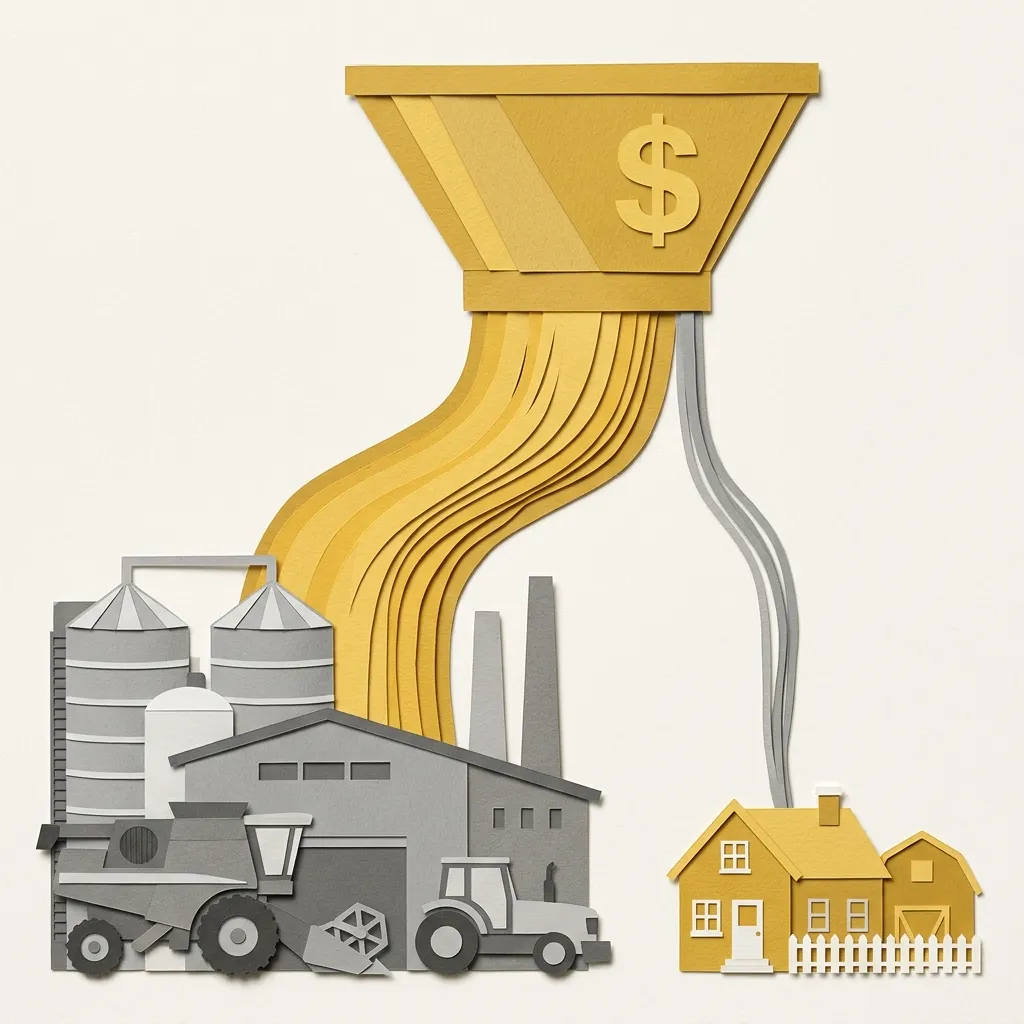
What the data actually show is a highly concentrated distribution of benefits. According to analysis by the Environmental Working Group, in recent years the top 10 percent of commodity subsidy recipients have collected roughly 65 percent of all payments. In 2024, 69 percent of farms in the United States received no federal commodity subsidy payment at all. (Environmental Working Group Farm Subsidy Database, 2024.) The 10,000 largest recipients collected more than the bottom 80 percent of all recipients combined.
The structural reason for this concentration is built into the program design. Commodity payments under both PLC and ARC are calculated based on base acres (historical planted acreage) and farm program payment yields (historical productivity). This means that the largest operators, who historically planted the most acres at the highest productivity, receive the largest absolute payments. A farm with 5,000 planted acres of corn receives payments roughly 50 times as large as a farm with 100 planted acres, because the payment formula tracks scale directly. There is no mechanism within the commodity program structure to weight payments toward smaller or beginning farmers.
The crop insurance subsidy structure is even more concentrated in practice, because the premium subsidy is proportional to the insured value of the crop, which is itself proportional to the scale of the operation. A large corn farmer with $3 million in insured value receives a premium subsidy of approximately $1.86 million from the federal government per policy year. A small farmer with $60,000 in insured value receives approximately $37,000. The program is formally available to both. The absolute benefit flows overwhelmingly to the large operator.
The payment limit rules nominally cap the amount any single individual can receive in commodity program payments at $125,000 per person per year. In practice, these limits are routinely circumvented through the structuring of farm operations across multiple legal entities: different family members, different partnership structures, and different legal ownership entities for different parcels of land can each be treated as separate payment recipients. Proposals to raise the payment limit to $155,000 and to expand definitions of qualifying pass-through entities would widen these loopholes further.
The Market Distortion Spiral
The economic case against commodity subsidies is not simply that they are poorly distributed. It is that they actively distort agricultural markets in ways that harm the overall efficiency of the sector and trap farmers in patterns of production that serve subsidy program logic more than consumer or market signals.
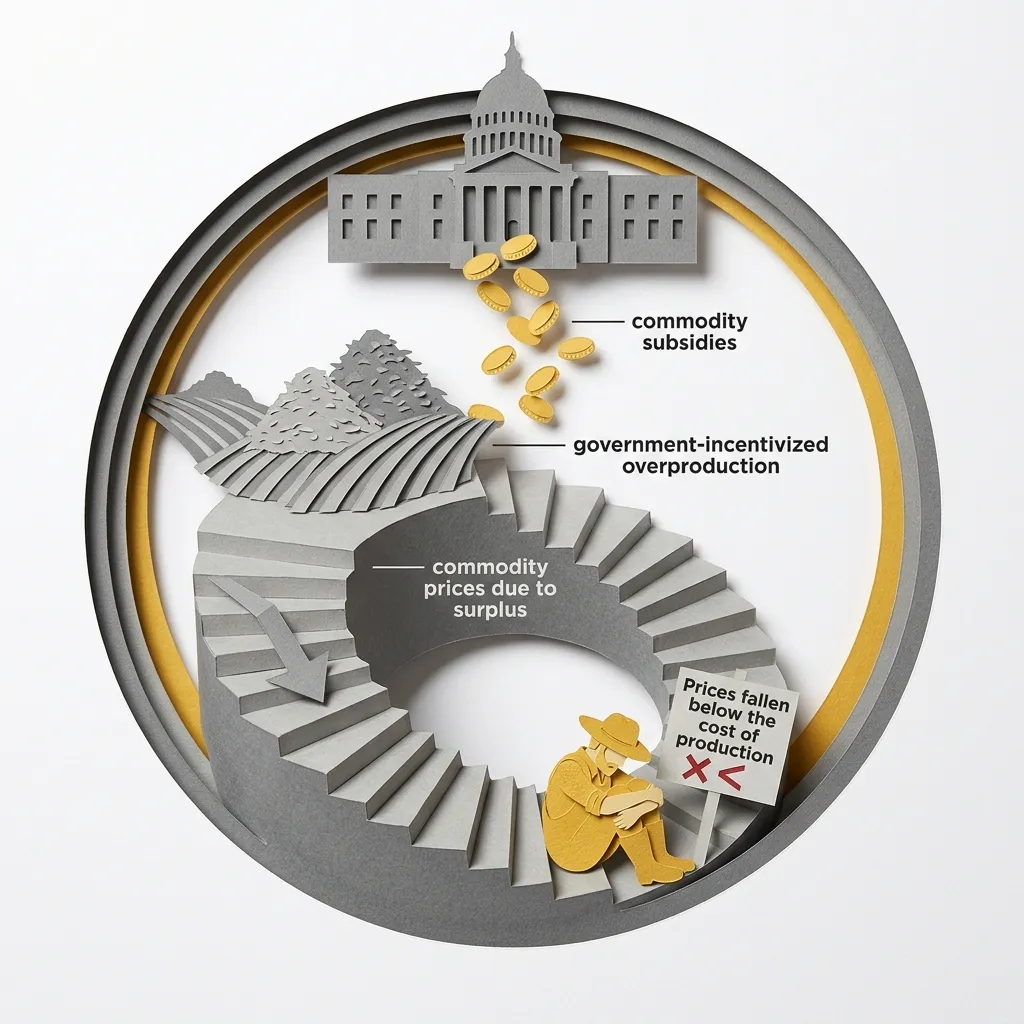
The most fundamental distortion is overproduction. Commodity support programs, by design, reduce the financial risk of producing program crops. When corn prices fall below the reference price, PLC payments compensate for some or all of the shortfall. When a crop fails or yields fall below historical averages, crop insurance indemnities replace some of the lost revenue. The effect is to partially decouple the financial outcome for the producer from the market signal. A farmer who would, in a purely market environment, shift acreage away from corn and toward another crop or use when corn prices are low is instead supported in maintaining corn production at near-historical levels, because the support payment reduces the cost of doing so.
The aggregate effect of this individual-level distortion is persistent overproduction of program crops relative to the level that market clearing would produce. Corn production in the United States has been consistently above levels that would prevail without subsidy support, contributing to chronically low corn prices that, in turn, require higher subsidy payments to sustain, which support continued production, which produces continued surplus. The University of Missouri’s FAPRI (Food and Agricultural Policy Research Institute) has modeled this dynamic repeatedly and consistently found that eliminating commodity programs would reduce planted acreage and raise market prices for most program crops, particularly corn and soybeans. (FAPRI, “U.S. Agricultural Baseline Projections,” various years.)
This creates a trap for farmers that is more insidious than simple overproduction. Farmers who are producing the program crop at scale are investing in equipment, infrastructure, land leases, and working capital that are calibrated to that scale of production. The capital investments are large, durable, and largely specific to the program crop. The implicit support from commodity programs is embedded in the land rental rates and land purchase prices that farmers pay, because landlords and sellers price that support into the expected future cash flows from the land. A farmer who rents land at a rate that reflects the expected subsidy income is not receiving a net benefit from the subsidy. The subsidy has been capitalized into the land rental cost, transferred to the landowner. Beginning farmers who must rent land at subsidy-inflated rates are paying, in higher rents, for a subsidy that technically flows to the operator but economically accrues to the landowner.
The crop insurance program introduces an additional distortion by effectively subsidizing production in areas that are economically or ecologically marginal. When the government pays 62 percent of crop insurance premiums, the private cost of insuring production in a drought-prone area is only 38 percent of the actuarially fair premium. This implicit subsidy encourages the expansion of crop production into areas where the private, unsubsidized risk of crop failure would make production economically unattractive. The result is cropland expansion into marginal lands that would otherwise be in pasture or native vegetation, with associated soil erosion, water quality impacts, and wildlife habitat losses. Studies of cropland expansion in the Upper Midwest have found that the largest driver of conversion of grassland and wetland to cropland is the combination of high crop prices and subsidized crop insurance reducing the perceived risk of expansion. (Wright and Wimberly, “Recent Land Use Change in the Western Corn Belt Threatens Grasslands and Wetlands,” PNAS, 2013.)
The Disappearing Family Farm: What the Numbers Actually Show
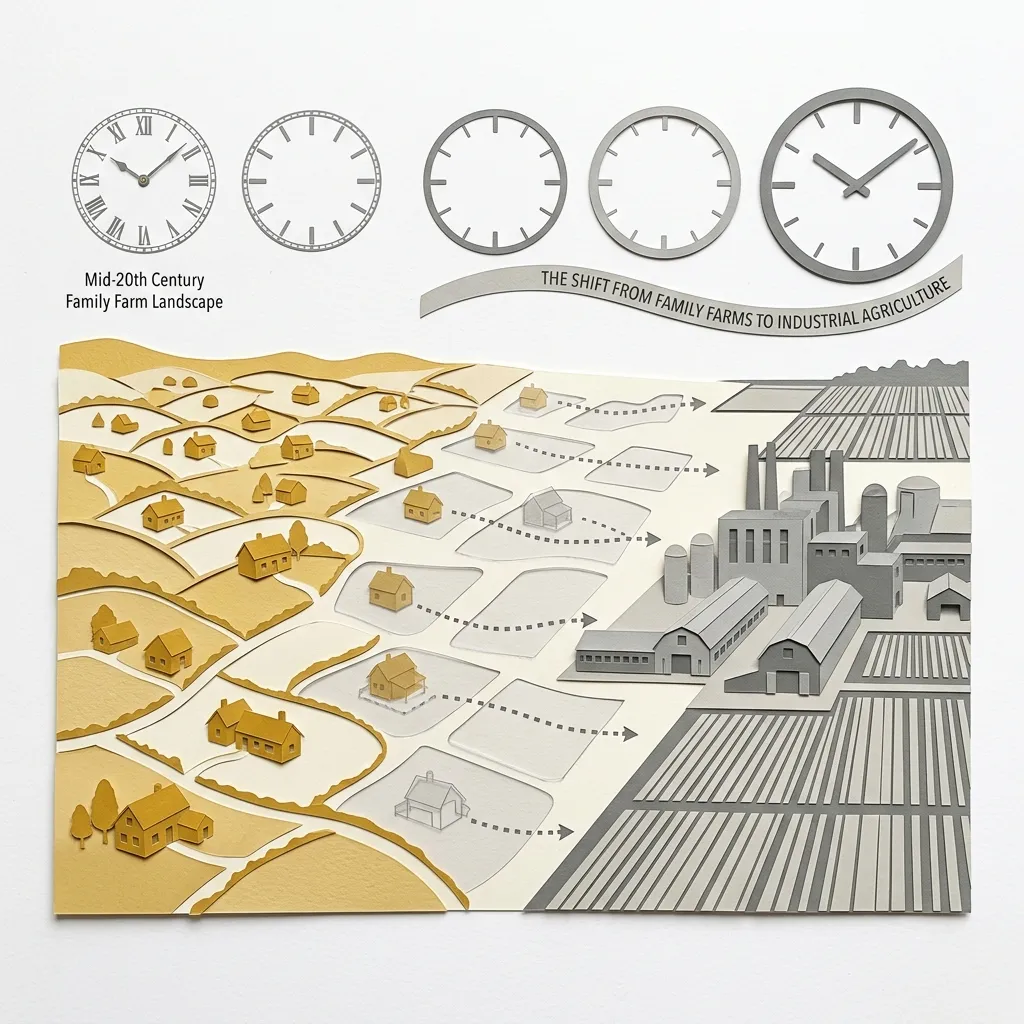
If the purpose of agricultural policy is to preserve the family farm as a viable economic institution, the policy has failed by any reasonable metric. The long-term trend in American agriculture is one of relentless consolidation: fewer farms, larger farms, and the concentration of production in a smaller number of ever-larger operations.
In 1950, there were approximately 5.6 million farms in the United States. By 2022, there were approximately 2 million. The number of farms peaked sometime in the early 20th century and has declined nearly every year since. The rate of decline has not slowed despite decades of farm subsidy programs. Between 2017 and 2022, the number of farms fell by more than 7 percent, with over 158,000 farms lost since the 2018 Farm Bill was enacted, even as the agricultural sector has received among the most generous government support in its history. Approximately 15,000 farms were lost in 2025 alone. (USDA National Agricultural Statistics Service, Census of Agriculture, 2022.)
The farm operations that are growing are large-scale commercial operations grossing over $1 million per year. These represent a small fraction of farms by count but now account for a majority of the value of agricultural production in the United States. The middle tier of commercial family farms, operations that are too large to be hobby farms but too small to capture full economies of scale in input purchasing, credit access, and equipment investment, is the category disappearing most rapidly. These midsize operations are caught between land rental costs inflated by subsidy capitalization, input costs inflated by seed and chemical industry consolidation, and output prices depressed by the overproduction that subsidy programs encourage.
The standard defense of this trend is that consolidation is simply the market process of efficiency improvement: larger operations produce at lower cost per unit, and the movement of resources toward more efficient producers is how markets are supposed to work. There is something to this argument, but it elides three important complications.
First, the consolidation is not occurring in a free market. It is occurring in a heavily subsidized market where the subsidy structure specifically advantages large operators through payment formulas that track scale directly and through crop insurance premium subsidies that reduce the effective risk premium for large operations. The efficient scale of agricultural operations, absent subsidies, would likely be smaller than what the current incentive structure produces.
Second, the concentration of market power on the buyer side of agricultural markets has suppressed farm-gate prices below competitive levels in ways that have nothing to do with efficiency. In beef cattle, four packing companies control approximately 85 percent of steer and heifer processing. In pork, four companies control approximately 67 percent of hog slaughter. In grain trading, four companies dominate the origination and export of the bulk of American corn and soybean production. This degree of concentration gives buyers significant monopsony power: the ability to pay farmers below-competitive prices because producers have few alternative buyers. The suppression of farm-gate prices by monopsonistic buyers is a distinct problem from market efficiency that affects all farmers regardless of scale, but it hits midsize and small operators hardest because they lack the negotiating leverage of the very largest producers.
Third, the loss of family farms is not just an economic event. It is the destruction of rural communities, ways of life, and the social institutions (rural schools, churches, local businesses, civic organizations) that depend on dispersed farm populations. These are real costs that do not appear in the efficiency calculations of agricultural economists.
The Commodity Crop Trap: What Farmers Cannot Grow
One of the most underappreciated distortions in American agricultural policy is the way it channels production toward a narrow set of commodity crops at the expense of the broader diversity of foods that consumers actually buy. The program crops (corn, soybeans, wheat, cotton, rice, and peanuts) receive the overwhelming majority of federal commodity support. The foods that most Americans eat most of: vegetables, fruits, tree nuts, dairy, beef, pork, and poultry, receive either far less support or no direct commodity program support at all.
This creates a structural incentive for farmers who have access to good cropland to plant program crops rather than produce the fruits and vegetables that would compete with the subsidized commodity prices in terms of consumer value added. The phenomenon is documented: states with good agricultural land that could support vegetable or fruit production have seen program crop acreage expand over recent decades, while vegetable and fruit production has become increasingly concentrated in regions (California, Florida) where land costs are high and water is scarce but where commodity program alternatives are less available.
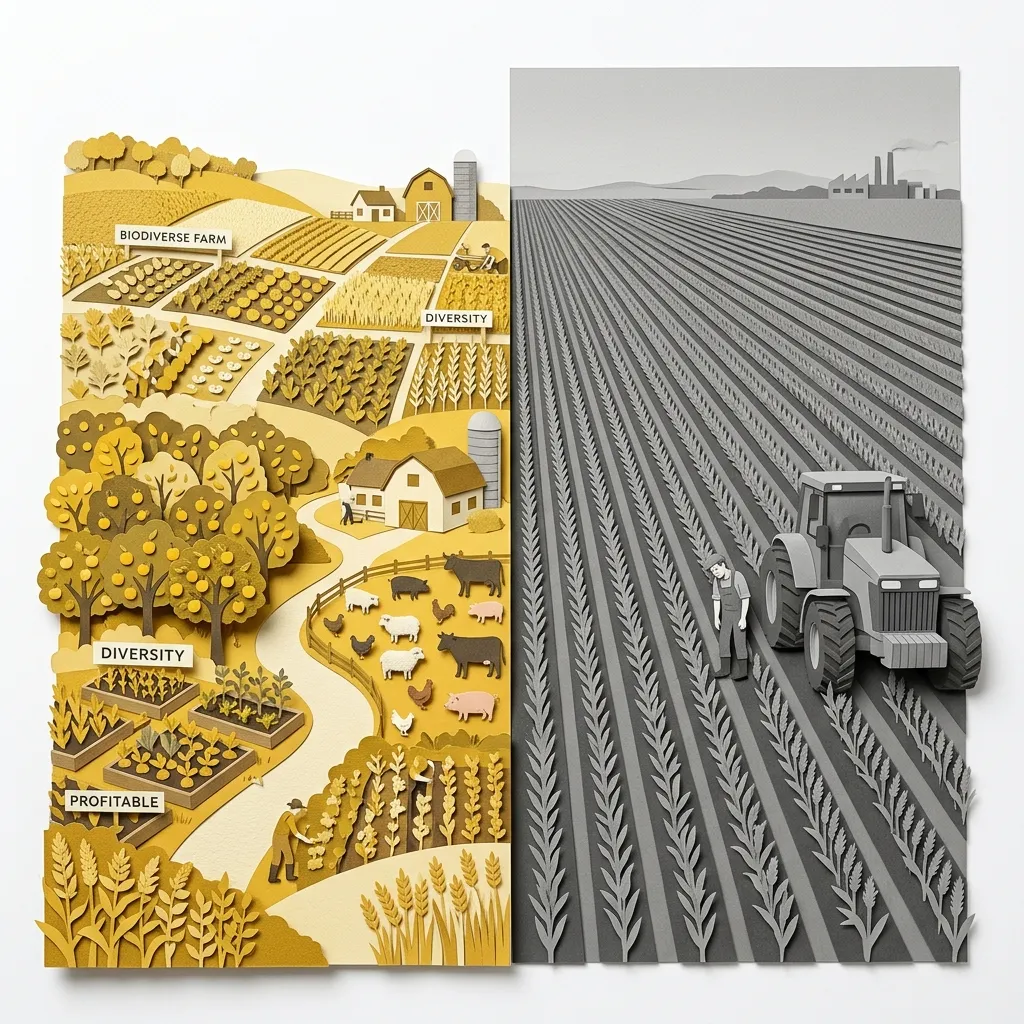
The environmental consequences of this artificial narrowing of crop diversity are substantial. Corn and soybean production on the scale encouraged by subsidies relies on intensive applications of synthetic nitrogen fertilizers and pesticides, which are associated with the Gulf of Mexico dead zone, declining pollinator populations, soil carbon loss, and groundwater contamination. A more diverse agricultural landscape, producing more crops per acre and relying on ecological relationships (cover crops, rotations, polyculture) rather than synthetic inputs, would produce lower external environmental costs. But the subsidy structure creates powerful financial incentives against that diversity.
Farmers who want to diversify their operations face a basic calculation: acres planted to program crops are eligible for commodity support payments and heavily subsidized crop insurance, while acres planted to vegetables and fruits are not. The effective price support for corn is not just the direct PLC payment at below-reference prices. It also includes the implicit support of subsidized crop insurance reducing the downside risk of corn production. A farmer choosing between corn and a specialty vegetable crop is comparing a supported, insured revenue stream against an uninsured market revenue stream. The bias toward the program crop is built into the risk calculus.
The 2014 Farm Bill included a provision (Section 11009, the “Specialty Crop Insurance Catastrophic Coverage” provision) that somewhat expanded crop insurance eligibility for specialty crops, and the conservation programs within the Farm Bill provide some support for diversification practices. But these are marginal corrections within a system whose fundamental architecture continues to favor commodity monoculture.
The Premises: Are They Even Valid?
The political justification for agricultural subsidies rests on several distinct claims. Each deserves scrutiny on its own merits.
The food security claim. The most common argument for agricultural support is that a nation must be able to feed itself and that the market, left to its own devices, cannot guarantee that capacity. This argument has several problems. First, it does not describe the American situation: the United States is one of the world’s largest agricultural exporters and has never in its modern history approached a food security crisis driven by insufficient domestic production capacity. The food security argument would have more logical force in countries with limited agricultural land and high import dependence. Second, food security requires food diversity: a nation that can produce 14 billion bushels of corn and 4 billion bushels of soybeans but cannot reliably produce the vegetables and proteins that constitute a nutritionally adequate diet has a different kind of food security problem. The commodity subsidy structure encourages exactly this kind of narrow, export-oriented production rather than the dietary diversity that genuine food security requires. Third, if food security is the goal, the policy should be calibrated to maintaining a minimum adequate production capacity across all essential food categories, not to supporting production of export commodities at subsidy-inflated levels.
The price volatility claim. The argument that farmers face uniquely severe price volatility that justifies income stabilization support has more empirical foundation. Agricultural production is subject to weather, disease, and global commodity market swings that are genuinely unpredictable and can devastate farm incomes in bad years. The question is whether the current subsidy structure is the right instrument for addressing this problem. Private crop insurance, without the 62 percent premium subsidy, would provide significant volatility protection to farmers at their own expense. Futures markets allow farmers to lock in prices in advance, providing protection against price falls. Revenue-based insurance products can cover both yield and price risk simultaneously. The argument for any government role in farm income stabilization would be much stronger if it were specifically targeted at genuinely catastrophic events that private markets cannot insure (large-scale regional drought, novel disease) rather than normal year-to-year price fluctuations that sophisticated farmers can and do manage through planning.
The family farm preservation claim. This is the claim most clearly contradicted by the evidence. If the purpose of farm subsidies is to preserve the family farm as a viable institution, nine decades of effort have failed dramatically and the failure has accelerated in recent decades. The number of farms has declined from 5.6 million to 2 million over the life of the subsidy programs. The percentage of production concentrated in the largest operations has grown continuously. The midsize commercial family farm has been disappearing faster than either very small farms or very large ones. The subsidy structure, which delivers the largest payments to the largest operators, has contributed to this consolidation by allowing large operators to outbid smaller ones for land and to absorb losses that would force smaller operators out of business.
The rural community preservation claim. A related but distinct argument is that farm subsidies preserve rural communities even if they do not preserve individual farms. This claim deserves some credit: agricultural regions do have some level of dependency on farm income that flows into local economies, and programs that support that income do sustain some rural economic activity. But the form of rural economic activity sustained by commodity subsidies, large-scale monoculture production with capital-intensive equipment, produces far less employment and local economic multiplier effect than the diversified, labor-intensive farming that the policy structure systematically disadvantages. A farmer running 5,000 acres of subsidized corn with GPS-guided equipment employs less local labor, buys fewer local inputs, and generates less local commercial activity than a cluster of smaller diversified farms producing vegetables, fruits, and direct-market livestock with comparable total acreage.
The International Dimension: Dumping on the World’s Poorest Farmers
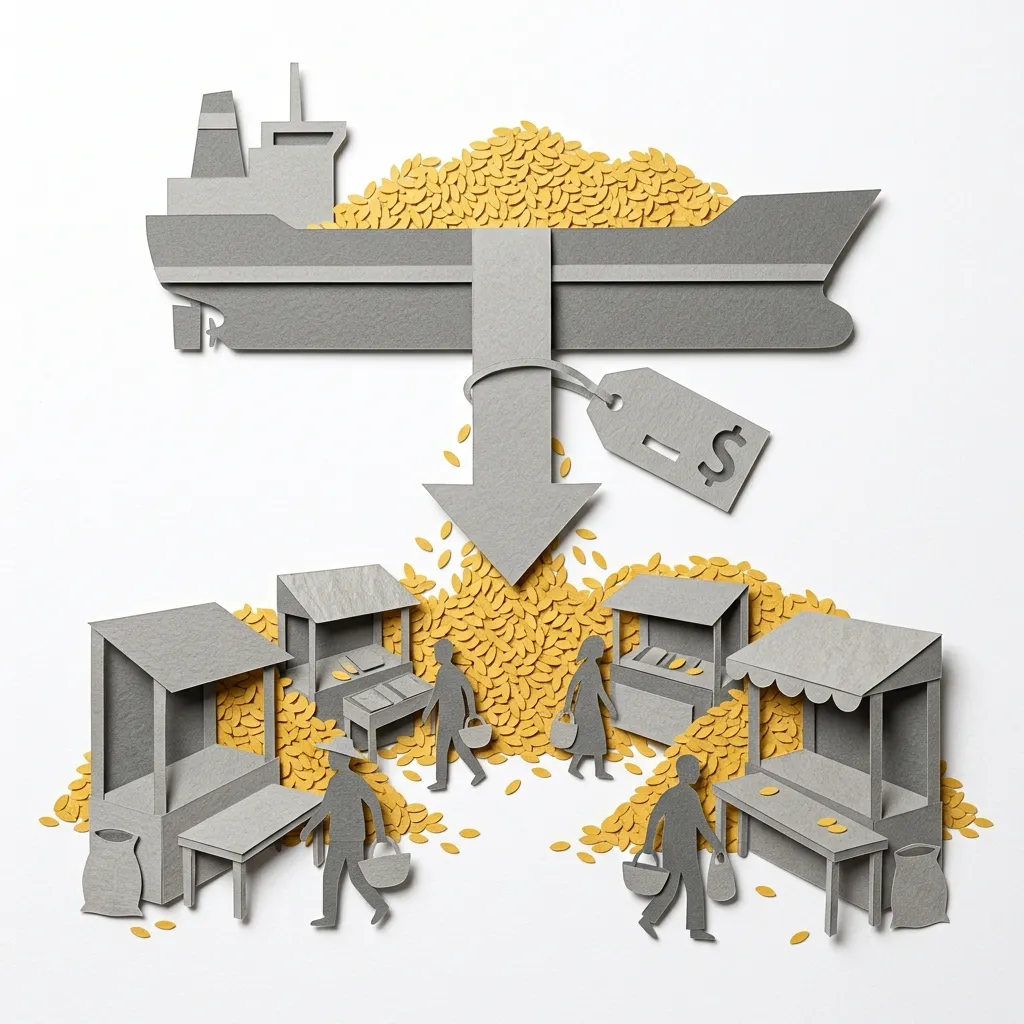
The effects of American agricultural subsidies do not stop at the US border. When the US government supports domestic commodity production at levels above what market prices would sustain, the resulting surplus production is exported at below-cost prices, flooding international markets and undercutting farmers in the countries that import American commodities.
The cotton case is the most thoroughly documented and litigated example. In 2004, the WTO Dispute Settlement Body ruled against the United States in the Brazil-US cotton dispute (DS267), finding that US cotton subsidies caused “serious prejudice” to Brazilian cotton producers by suppressing global cotton prices. The mechanism was straightforward: US subsidies enabled American cotton producers to sell on international markets at prices below their full cost of production, which depressed the world price of cotton and reduced the revenue of cotton producers in Brazil, West Africa, and other exporting regions. For West African countries including Mali, Burkina Faso, Benin, and Chad, where cotton is among the most important export crops and a primary source of income for hundreds of thousands of smallholder farmers, the suppression of global cotton prices by US subsidies represented a direct transfer of income from some of the world’s poorest farmers to American agribusiness and the US Treasury.
The cotton case is distinctive in having generated a formal WTO ruling, but the underlying mechanism applies to other subsidized commodities as well. American corn and soybean exports, produced with the implicit support of commodity programs and subsidized crop insurance, enter global markets at prices that reflect the partial socialization of American production risk. Countries that import American corn, soybeans, or wheat are buying commodities whose prices do not reflect the full cost of production because that cost has been partially paid by American taxpayers. This benefits consumers in importing countries who pay lower food prices, but it disadvantages domestic farmers in those countries who cannot compete with the artificially low import prices. In countries where smallholder agriculture is the primary employment for large portions of the population, this competition can be economically devastating.
What Agricultural Policy That Actually Served Farmers Would Look Like
A policy framework designed to actually serve the interests of farmers, consumers, and rural communities, rather than the interests of large agribusiness operators and commodity traders, would look substantially different from what the Farm Bill currently provides.
End production-linked commodity payments and allow markets to set prices. The commodity program structure, which links payments to historical planted acreage and production yields in specific program crops, should be phased out. If genuine income stabilization support for agricultural producers is warranted, it should take the form of revenue-based safety net programs that provide a floor below which farm household income cannot fall, regardless of which crops or livestock are produced. This would eliminate the structural bias toward program crops and allow farmers to respond to genuine market signals about what consumers want rather than to subsidy program eligibility criteria.
Reform crop insurance to remove the marginal land expansion incentive. The 62 percent premium subsidy encourages production in high-risk areas that the private insurance market would not support at actuarially fair prices. Reducing the premium subsidy and targeting remaining support toward small and beginning farmers (who have the least capital to self-insure against volatility) would reduce the marginal land expansion problem while preserving genuine volatility protection for producers who need it most.
Enforce antitrust law vigorously in agricultural markets. The monopsony power of concentrated meatpackers, grain traders, and seed companies depresses farm-gate prices and captures a disproportionate share of the value added between farm and consumer. This is not a subsidy problem; it is a competition law problem. The Packers and Stockyards Act of 1921 provides legal tools for addressing unfair trade practices in livestock markets that have been inconsistently enforced. Stronger antitrust enforcement against horizontal concentration in agricultural input and output markets would do more to improve farm incomes than any currently existing commodity program.
Invest conservation program dollars in actual conservation practices rather than commodity production. The Conservation Reserve Program, which pays farmers to take environmentally sensitive acres out of crop production, has a stronger record of achieving environmental goals than the commodity programs whose production incentives run directly counter to conservation objectives. Shifting spending from commodity programs toward conservation programs that reward land management practices (cover cropping, reduced tillage, buffer strips, wetland restoration) would reduce environmental externalities while providing income support to farmers who adopt those practices.
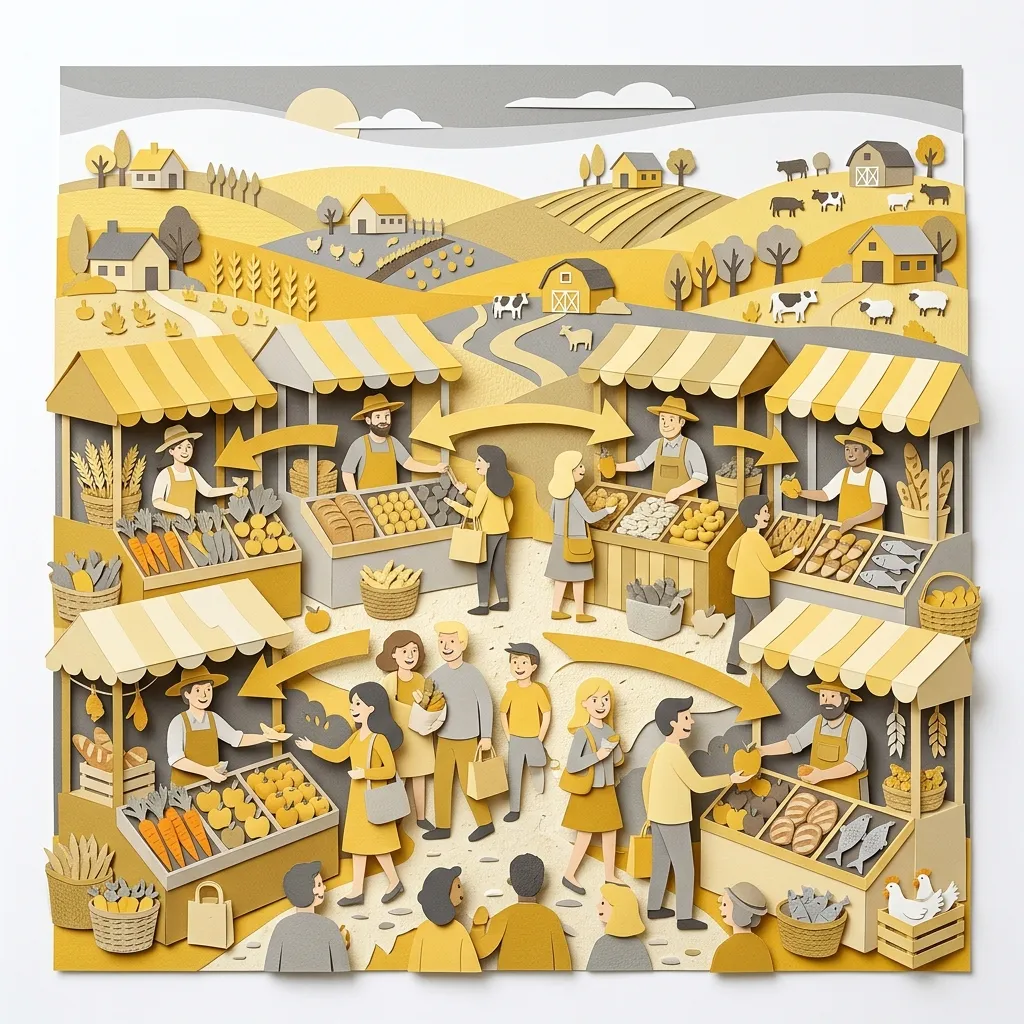
Support beginning farmers and direct-market agriculture. Programs that reduce barriers to entry for new farmers, provide access to land for beginning operators who cannot compete with established large-scale bidders for rented acreage, and support the development of direct-market infrastructure (farmers markets, food hubs, community-supported agriculture networks) would direct support toward exactly the kind of diversified, community-embedded farming operations that the current system disadvantages most severely.
Eliminate the implicit international subsidy of below-cost commodity exports. Ending commodity programs that enable below-cost production and export would remove the market distortion that harms developing-country farmers. This would likely raise global commodity prices somewhat, benefiting agricultural producers in developing countries and somewhat disadvantaging net food importing countries. The overall welfare effects would require careful analysis, but the fairness argument against using American taxpayer money to harm the poorest farmers in the world is strong regardless of the aggregate welfare calculation.
The Concentrated Interest Problem: Why This Does Not Change
Given the clarity with which the evidence points toward reform, a reasonable question is why agricultural policy has proven so resistant to change over nine decades. The answer is the concentrated interest problem that George Stigler analyzed in the context of regulatory capture more generally: the people who benefit most from the existing policy (large commodity crop producers, agribusiness input companies, crop insurance companies, and the commodity trading firms that benefit from US export competitiveness) have concentrated financial interests in maintaining it, while the costs are spread across all taxpayers, all consumers of food and agricultural products, and all the farmers in developing countries who cannot afford Washington lobbyists.
The Farm Bureau, the American Farm Bureau Federation, and the commodity-specific organizations (the Corn Growers, the Soybean Association, the Cotton Growers) spend tens of millions of dollars per year maintaining the political architecture that preserves their members’ subsidy benefits. Crop insurance companies spent extensively lobbying to expand and protect the premium subsidy structure in both the 2014 and 2018 Farm Bill negotiations. The four major meatpacking companies have consistently lobbied against antitrust enforcement that would limit their buyer power.
On the other side, the diffuse interests of consumers (who pay slightly higher taxes and face a somewhat distorted food supply), small and beginning farmers (who are disadvantaged by the existing structure), and international agricultural producers (who have no vote in American elections) have no comparable organizational representation in the congressional committees that write the Farm Bill. The result is predictable: each Farm Bill iteration makes marginal adjustments while preserving the fundamental structure that advantages the most politically organized and economically concentrated beneficiaries.
Understanding this dynamic does not require believing that every member of Congress who votes for the Farm Bill is corrupt or indifferent to farmers’ actual welfare. Many of them are genuinely convinced by the “family farm” framing that the programs serve the constituency they claim to serve, because the political actors who communicate most effectively with those members are the ones with the resources and organizational capacity to do so repeatedly. The remedy is not primarily electoral; it is epistemic. Reform requires that the public and their representatives understand what the programs actually do, for whom, and at what cost.
Go Deeper: Books by Alex Merced
Agricultural policy is a case study in how the gap between stated government intentions and actual policy outcomes opens up, widens over time, and becomes self-perpetuating through political economy dynamics that every student of liberty needs to understand.
Economic Ideas: From Beginning to Early 2026 develops the economic frameworks that make the Farm Bill’s problems legible: the theory of price supports and how they generate surplus, the economics of regulatory capture and how concentrated interests consistently outmaneuver diffuse ones in the legislative process, the Coase theorem applied to agricultural externalities, and the economic case for allowing price signals rather than political calculations to determine how land is used and what is grown. The commodity overproduction spiral documented in this article is a direct consequence of the subsidy economics covered in detail there.
The Field Guide to Libertarianism situates agricultural policy within the broader libertarian argument about why government programs designed to help particular groups so consistently end up serving different groups than intended. The public choice analysis of why legislatures keep renewing programs that fail their stated beneficiaries, the argument for market mechanisms over administrative allocation, and the case for voluntary community institutions over government management of economic risk are all developed there in terms directly applicable to the Farm Bill’s persistent dysfunction.
Political Thought and Debates of the United States traces the political history of agricultural policy from the New Deal through the current moment: how the Depression-era emergency became a permanent entitlement, how the “family farm” image has been deployed by both parties to protect programs whose primary beneficiaries are large agribusiness operators, and how the commodity system has survived multiple reform attempts through exactly the concentrated interest dynamics that this article describes.
All three are available on Amazon. The full catalog of Alex Merced’s work is at books.alexmerced.com.
Sources and Further Reading
-
Environmental Working Group Farm Subsidy Database. “Farm Subsidy Distribution, 2024.” ewg.org, 2024.
-
USDA National Agricultural Statistics Service. “2022 Census of Agriculture.” nass.usda.gov, 2024.
-
USDA Economic Research Service. “Farm Income and Wealth Statistics.” ers.usda.gov, updated annually.
-
Food and Agricultural Policy Research Institute (FAPRI). “U.S. Agricultural Baseline Projections.” fapri.missouri.edu, various years.
-
Wright, Christopher K., and Michael C. Wimberly. “Recent Land Use Change in the Western Corn Belt Threatens Grasslands and Wetlands.” Proceedings of the National Academy of Sciences 110, no. 10 (2013): 4134-4139.
-
WTO Dispute Settlement Body. “United States: Subsidies on Upland Cotton (DS267).” WTO, 2004 (panel) and 2005 (Appellate Body).
-
Stigler, George J. “The Theory of Economic Regulation.” Bell Journal of Economics and Management Science 2, no. 1 (1971): 3-21.
-
Orden, David, Robert Paarlberg, and Terry Roe. Policy Reform in American Agriculture: Analysis and Prognosis. University of Chicago Press, 1999.
-
Gardner, Bruce L. American Agriculture in the Twentieth Century: How It Flourished and What It Cost. Harvard University Press, 2002.
-
De Gorter, Harry, and Johan Swinnen. “Political Economy of Agricultural Policy.” In Handbook of Agricultural Economics, vol. 2B. Elsevier, 2002.
-
Goodwin, Barry K., and Vincent H. Smith. The Economics of Crop Insurance and Disaster Aid. AEI Press, 1995.
-
Patel, Raj. Stuffed and Starved: The Hidden Battle for the World Food System. Melville House, 2008. (Documents international dumping effects and commodity system incentives from a food system perspective.)
-
Pollan, Michael. The Omnivore’s Dilemma: A Natural History of Four Meals. Penguin, 2006. (Traces commodity corn from subsidy structure through food system consequences.)
-
Imhoff, Daniel, ed. The CAFO Reader: The Tragedy of Industrial Animal Factories. Watershed Media, 2010.
-
RAFI (Rural Advancement Foundation International). “Farm Crisis Reports: Disappearing Middle.” rafiusa.org, updated annually.
-
Farm Aid. “Who We Are: Family Farmers in Crisis.” farmaid.org, updated annually.
-
Lusk, Jayson L. The Food Police: A Well-Fed Manifesto About the Politics of Your Plate. Crown Forum, 2013. (Examines food policy paternalism including commodity program incentives.)
-
Imhoff, Daniel. Food Fight: The Citizen’s Guide to the Next Food and Farm Bill. Watershed Media, 2012.