TL;DR
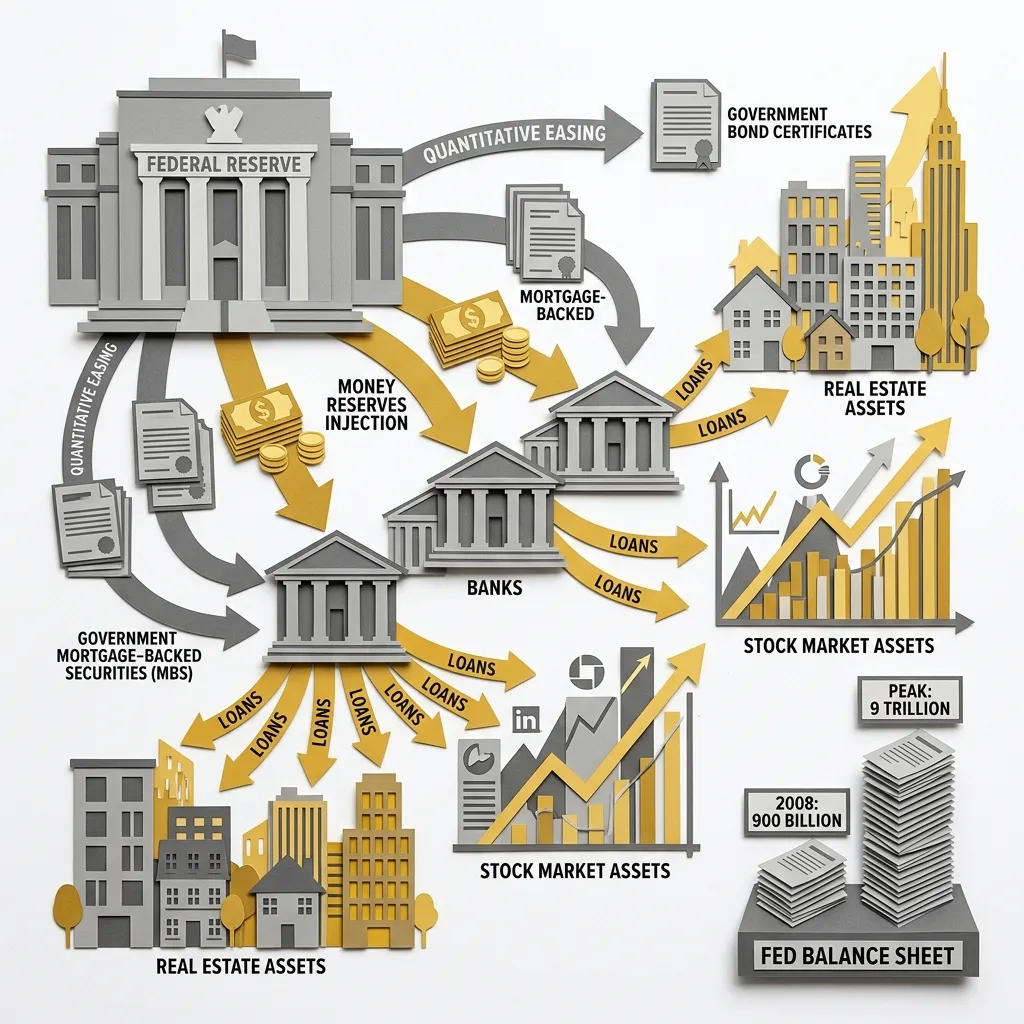
- The Federal Reserve does not print money in the literal sense. It creates bank reserves by purchasing financial assets from commercial banks, expanding the money supply through the banking system. When it does this faster than the economy’s productive capacity grows, more money chases the same amount of goods and services: that is inflation. The Fed has done this aggressively since 2008, expanding its balance sheet from approximately $900 billion before the financial crisis to a peak of over $9 trillion in 2022.
- The 2021-2023 inflation surge, which reached 9.1 percent at its peak, was the most significant inflation in four decades. It was not purely accidental. It was the predictable result of the Federal Reserve holding interest rates near zero and purchasing $120 billion per month in assets while the federal government simultaneously injected trillions of dollars in pandemic relief spending into an economy whose supply chains were disrupted. When that much money chases that few goods, prices rise.
- Inflation is a regressive tax. It reduces the purchasing power of money held as savings, which falls hardest on people who hold most of their wealth in cash and bank accounts rather than in stocks, real estate, and other assets that appreciate with or ahead of inflation. The wealthy own assets; the poor and working class own wages and savings. When inflation erodes money’s value, it transfers real purchasing power away from wage earners and toward asset owners. This is not a conspiratorial claim. It follows directly from the arithmetic of who holds what.
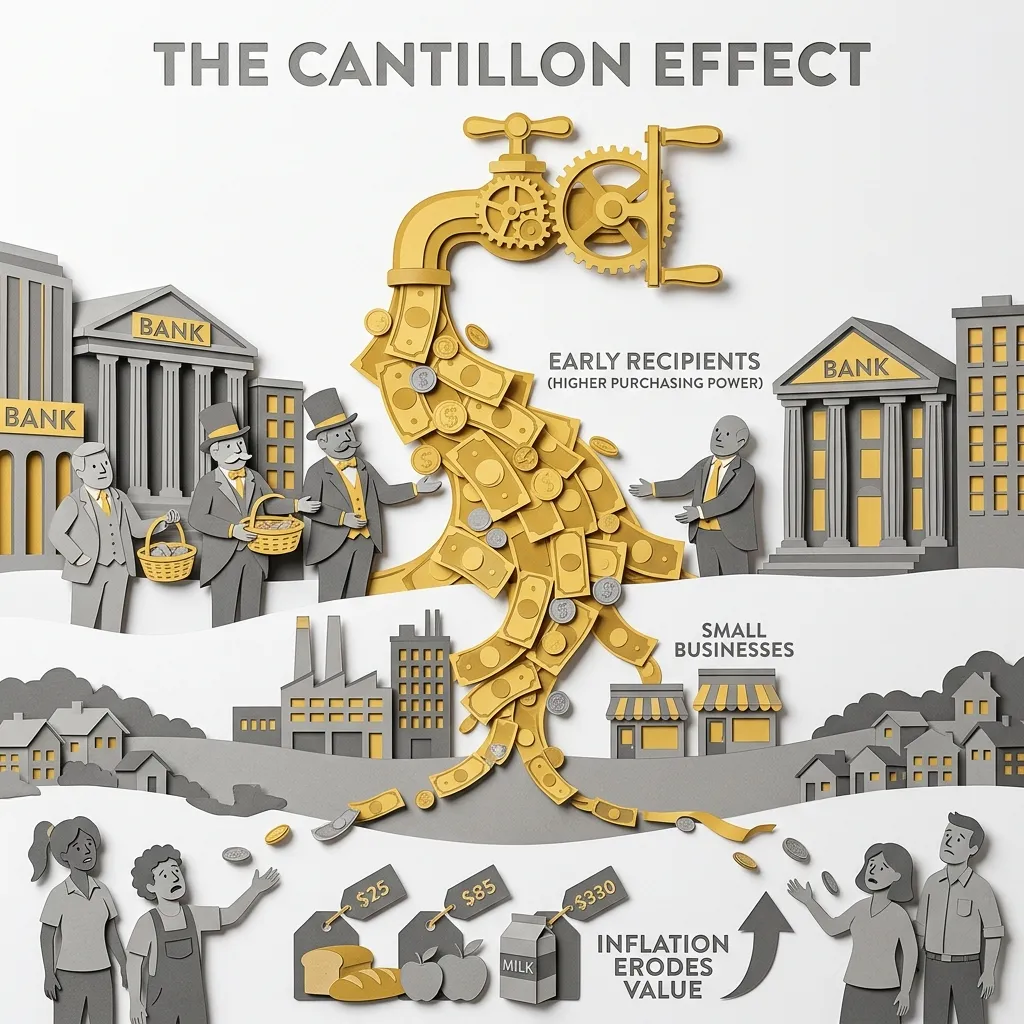
- The Cantillon Effect, named after eighteenth-century economist Richard Cantillon, describes the distributional consequence of money creation: newly created money benefits those who receive it first, before prices have risen, and imposes costs on those who receive it last, after prices have risen. In the modern economy, the first recipients of newly created money are financial institutions and asset-heavy investors. The last recipients are wage earners and fixed-income recipients. This distributional effect compounds wealth inequality through each monetary expansion cycle.
On October 3, 2008, the U.S. Congress passed the Emergency Economic Stabilization Act, authorizing the Treasury to purchase up to $700 billion in troubled financial assets. The Troubled Asset Relief Program that followed was itself consequential. But the more consequential monetary policy response to the 2008 financial crisis was conducted not by Congress but by the Federal Reserve, which expanded its balance sheet from approximately $900 billion before the crisis to $2.3 trillion by the end of 2009 through a program called quantitative easing, in which the Fed purchased U.S. Treasury bonds and mortgage-backed securities from commercial banks, crediting those banks’ reserve accounts with newly created money.
This process was described at the time as extraordinary and emergency. The Fed promised to reverse it once the crisis passed. The balance sheet remained elevated through the 2010s, never returning to its pre-crisis level, as the Fed implemented successive rounds of quantitative easing. When the COVID-19 pandemic hit in 2020, the Fed deployed quantitative easing again at an accelerated pace, purchasing $120 billion per month in assets at the program’s peak and expanding its balance sheet to $8.9 trillion by 2022.
The consequences for inflation were not immediate but were not long delayed. Consumer price inflation, which had run below the Fed’s 2 percent target for most of the decade following 2008, accelerated sharply starting in 2021 as pandemic-era supply chain disruptions coincided with historically large fiscal stimulus and continued monetary expansion. By June 2022, the Consumer Price Index showed 9.1 percent year-over-year inflation, the highest rate since 1981. The Federal Reserve responded by raising the federal funds rate rapidly, from near-zero to over 5 percent between March 2022 and July 2023, bringing inflation down but not without imposing significant costs on mortgage borrowers, small businesses, and anyone whose finances depended on affordable credit.
To understand what happened and why it matters for economic justice and political philosophy, you need to understand how the Federal Reserve actually works, what inflation actually does, and who benefits and who is harmed by the monetary policy choices that generated both the longest economic expansion in American history and the worst inflation episode in four decades.
How the Federal Reserve Actually Creates Money
The textbook description of the Federal Reserve as a “central bank that controls the money supply” is accurate but incomplete. The mechanism by which the Fed influences the money supply is more complex than popular understanding suggests, and understanding the mechanism matters for understanding the distributional consequences.
The Federal Reserve is a quasi-governmental institution created by the Federal Reserve Act of 1913. It is not a government agency in the standard sense: its twelve regional banks are privately owned by member commercial banks, but it operates under a congressional mandate and its chair is appointed by the president. This hybrid structure gives it substantial independence from direct political control, which is the feature its designers considered most important for preventing governments from inflating currencies for short-term political gain.
The Fed conducts monetary policy primarily through three mechanisms: setting the federal funds rate (the interest rate at which commercial banks lend reserves to each other overnight), conducting open market operations (buying and selling government securities), and setting reserve requirements (the fraction of deposits banks must hold rather than lend, though this requirement was effectively reduced to zero in 2020).
When the Fed wants to expand the money supply, it purchases financial assets, typically U.S. Treasury bonds, from commercial banks or other financial institutions. It pays for these purchases by crediting the reserve accounts that commercial banks hold at the Fed. These credits are created from nothing: the Fed does not take money from elsewhere to pay for its asset purchases; it creates new reserve balances. Commercial banks can then use these expanded reserves as the basis for new lending, since banking regulations allow them to lend a multiple of their reserve base. Through this fractional reserve mechanism, each dollar of new Fed reserves can support several dollars of new bank lending, multiplying the monetary expansion through the economy.
The process works in reverse when the Fed wants to reduce the money supply: it sells assets, removing reserves from the banking system and reducing the base for lending. The post-2022 period of quantitative tightening, in which the Fed allowed its balance sheet to shrink by not reinvesting the proceeds of maturing securities, worked through this mechanism.
The crucial feature of this process for understanding its distributional effects is the sequence in which newly created money moves through the economy. When the Fed creates reserves, those reserves go first to the commercial banks and financial institutions from which it purchases assets. Those institutions, flush with newly created liquidity, are the first to deploy the new money into the economy: they lend, they invest in financial assets, they purchase other securities. The prices of the assets they purchase begin to rise before the effects of the monetary expansion have propagated to the broader economy through wages and consumer goods prices.
The Cantillon Effect: Why Inflation Is Not Neutral
Richard Cantillon was an Irish-French economist whose 1730 essay “Essai sur la Nature du Commerce en Général” contains what is now recognized as the first clear statement of what economists call the non-neutrality of money in the short run. Cantillon observed that the introduction of new money into an economy does not simply raise all prices proportionally and simultaneously. Instead, the new money enters at specific points and creates distributional effects that depend on where it enters and how it flows through the economy.
In Cantillon’s formulation, when a gold mine produces new gold, the mine owners and their employees are the first to receive the new money. They spend it on goods and services, which raises prices in the sectors where they spend. Workers and suppliers in those sectors then have more money and spend it elsewhere, gradually propagating the price increases through the economy. By the time the new money has fully circulated through all prices, the early recipients of the new gold have enjoyed the ability to buy goods at the pre-inflation price, while later recipients have faced rising prices before their incomes have risen.
The modern application of Cantillon’s insight to central bank monetary policy is straightforward. When the Federal Reserve creates new reserves and uses them to purchase assets from financial institutions, those financial institutions are the Cantillon first recipients. They receive newly created money while prices are still at their previous level. They deploy this money into financial assets, real estate, and other investments, driving up asset prices. As the monetary expansion gradually flows through to wages, consumer spending, and ultimately consumer prices, the wage earners and fixed-income recipients who are at the end of the monetary transmission chain face higher prices for goods and services while their incomes have not yet risen correspondingly.
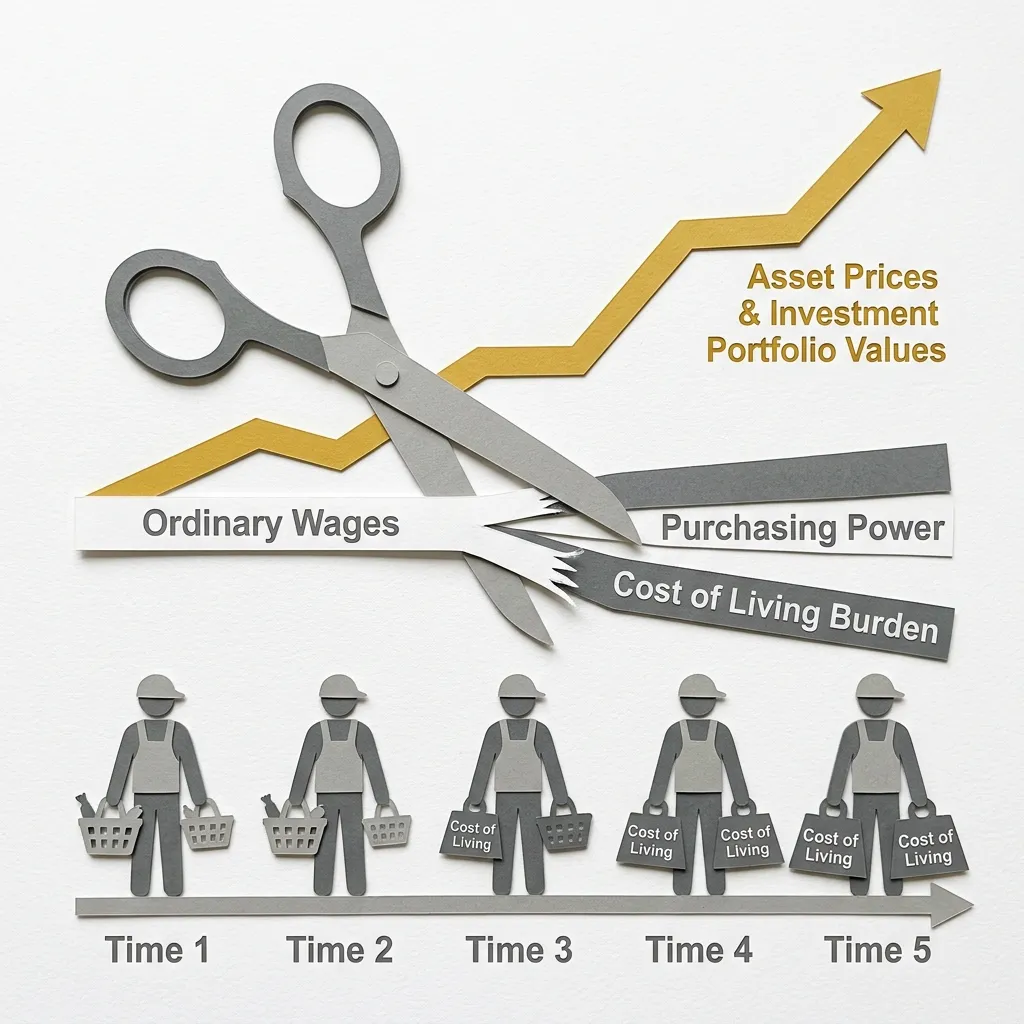
This sequence has a systematic distributional consequence. Wealthy households hold a disproportionate share of their wealth in financial assets and real estate. When the early stages of monetary expansion drive up asset prices, wealthy households experience gains in their financial positions. Working-class and lower-middle-class households hold a much larger fraction of their wealth in savings accounts, checking accounts, and wages. When the later stages of monetary expansion manifest as consumer price inflation, the purchasing power of wages and savings is eroded. The net effect of a monetary expansion cycle is a redistribution of real purchasing power from wage earners toward asset owners.
This is not a marginal or theoretical effect. Research by economists including Matteo Iacoviello at the Federal Reserve Board, Atif Mian and Amir Sufi at Princeton, and Emmanuel Saez and Gabriel Zucman at UC Berkeley has documented the relationship between periods of monetary expansion and widening wealth inequality in the United States and other countries with active central bank policy. The wealth share held by the top 1 percent increased substantially during the period of near-zero interest rates and quantitative easing from 2008 through 2021, while the wealth held by the bottom 50 percent remained relatively stagnant.
The 2021-2023 Inflation: A Preventable Disaster
The inflation surge that peaked at 9.1 percent in June 2022 was not primarily an accident of supply chain disruption or pandemic exogeneity, though both of those factors contributed. It was substantially the predictable consequence of an extraordinary expansion of both fiscal and monetary policy at a time when the supply side of the economy was constrained.
Starting in March 2020, the federal government deployed approximately $5 trillion in pandemic relief spending over two years through the CARES Act, the Consolidated Appropriations Act, the American Rescue Plan, and related legislation. Simultaneously, the Federal Reserve cut the federal funds rate to near zero and expanded its asset purchase program to $120 billion per month. This combined fiscal and monetary stimulus was among the largest in American history relative to the size of the economy.
The stimulus was justified by the severe economic contraction of early 2020, when pandemic lockdowns reduced economic activity sharply and unemployment surged to nearly 15 percent. The initial response was appropriate in scale to the shock. The problem developed as the stimulus continued long after the economic recovery was clearly underway. By mid-2021, the unemployment rate had fallen to 5.9 percent and was declining rapidly. GDP had returned to its pre-pandemic trend. Consumer demand was strong, in part because pandemic relief had increased household balance sheets. But supply chains remained disrupted, housing construction was constrained, and labor supply had not fully recovered.
Into this supply-constrained economy, the federal government and the Federal Reserve continued to inject demand stimulus. The American Rescue Plan of March 2021, at $1.9 trillion, was passed despite the clear evidence that the economy was recovering strongly. The Federal Reserve did not begin raising interest rates until March 2022 and did not stop its asset purchases until that same month. Economists including Larry Summers, Olivier Blanchard, and Jason Furman, all mainstream economists with impeccable progressive credentials, warned publicly and clearly in early 2021 that the combined fiscal and monetary stimulus was excessive relative to the economy’s capacity and would generate significant inflation. Their warnings were dismissed or minimized.
The Federal Reserve’s own explanation for its delay in responding to rising inflation was that it initially viewed the inflation as “transitory,” a product of pandemic-specific supply chain disruptions that would resolve themselves without requiring a policy response. This judgment turned out to be wrong, and persistently so. By late 2021, inflation had broadened beyond supply-chain-affected sectors like used cars and semiconductors to encompass shelter, services, and food: the components of the price level that are most directly affected by excess demand in the whole economy.
The people who paid for this policy error were not primarily the asset holders who had benefited from quantitative easing. They were the wage earners who saw their real wages fall as price increases outpaced pay increases. Real median wages fell by approximately 4 percent between early 2021 and mid-2022, meaning that the average worker had less purchasing power despite nominal pay increases. Workers at the bottom of the wage distribution, who spend a higher fraction of their income on food, energy, and housing, which inflated faster than the headline rate in 2022, were hit disproportionately hard.
The Federal Reserve’s subsequent rapid rate increases, while necessary to restore price stability, imposed additional costs: sharply higher mortgage rates that priced many prospective homeowners out of the market, reduced business investment as the cost of capital rose, and elevated debt service costs for households that had borrowed at variable rates. The rate increase also reduced the market value of the bonds the Fed had purchased during quantitative easing, generating mark-to-market losses on the Fed’s own balance sheet that, while they do not directly affect the Fed’s operations, illustrate the financial consequences of reversing an extended period of monetary expansion.
Asset Price Inflation: The Silent Wealth Transfer
The inflation that followed the 2021-2022 monetary and fiscal expansion was highly visible because it showed up in the Consumer Price Index: grocery prices, gasoline, rents. What is less visible, but no less economically significant, is the asset price inflation that preceded it and that was directly driven by the same monetary expansion policies over the prior decade.
From 2008 through 2021, the Federal Reserve held interest rates at or near zero and conducted successive rounds of quantitative easing. During this period, consumer price inflation remained relatively subdued, generally running below the Fed’s 2 percent target, which led many observers to conclude that the expansionary policy was not generating inflationary pressure. What they were missing was that the inflation was there, but it was manifesting in asset prices rather than consumer prices.
The S&P 500 index returned approximately 400 percent between the post-crisis low in March 2009 and January 2022, a gain that substantially outpaced economic growth, earnings growth, and the growth in the underlying productive capacity of the economy. Home prices nationally rose approximately 130 percent over the same period. Private equity valuations, art, collectibles, and other alternative assets similarly appreciated dramatically.
These price increases transferred enormous wealth to existing asset owners. A household that owned $500,000 in S&P 500 index funds in 2009 saw that investment grow to approximately $2.5 million by 2022. A household that owned no financial assets in 2009, which describes the majority of American households, received none of this wealth transfer. The Federal Reserve’s policies, conducted in the name of supporting the economy, functioned in practice as a mechanism for dramatically increasing the financial wealth of those who already held financial assets.
The Federal Reserve’s dual mandate, established by the Humphrey-Hawkins Act of 1978, requires it to pursue maximum employment and stable prices. It does not include an explicit mandate to prevent asset price inflation or to consider the distributional effects of its policies. Former Fed Chair Ben Bernanke and other Fed officials have at times acknowledged the wealth effects of low interest rates and quantitative easing, but have defended them on the grounds that they support employment growth that benefits all workers. The distributional critique of these policies does not require rejecting this defense entirely: low interest rates in the immediate aftermath of 2008 were probably necessary and appropriate. It does require acknowledging that extended periods of zero interest rates and quantitative easing have distributional consequences that work systematically against wage earners and in favor of asset owners.
The Fed’s Independence: Necessary Shield or Unaccountable Power?
The Federal Reserve operates with a degree of independence from elected government that is unusual among government institutions. The Federal Reserve Board of Governors is appointed by the president and confirmed by the Senate, but its members serve fourteen-year terms and cannot be removed by the president for policy disagreements. The twelve regional Federal Reserve Bank presidents are not political appointees at all: they are selected by the boards of the regional banks, which are composed substantially of representatives of the banking industry.
The case for central bank independence is well-grounded in historical evidence. Governments with direct control over their central banks have routinely used that control to expand the money supply for short-term political purposes, generating inflation that ultimately required severe recessions to suppress. The hyperinflations of the Weimar Republic, Zimbabwe, Venezuela, and numerous other countries all resulted from politically directed monetary expansion. Independent central banks, insulated from the pressure to finance government deficits or boost economies before elections, produce more stable monetary policy on average.
The case against the current degree of Fed independence is also serious. A body that makes decisions with enormous distributional consequences, including decisions that transfer trillions of dollars of real wealth from wage earners to asset owners through the Cantillon Effect, operates with minimal democratic accountability. The Federal Reserve’s quantitative easing programs were not authorized by Congress; they were conducted under the Fed’s own interpretation of its mandate and its legal authority to purchase financial assets. Congress was not asked to approve the expansion of the Fed’s balance sheet from $900 billion to $9 trillion. The policy choice to hold interest rates at zero for years, dramatically inflating asset values, was made by an unelected body of economists and bankers without public deliberation about its distributional consequences.
The libertarian position on central banking is divided. Some libertarians favor abolishing the Federal Reserve and returning to a gold standard or commodity money, on the grounds that government monopoly over money creation is inherently subject to political abuse and that market-determined commodity money provides a more stable and neutral monetary foundation. Others favor maintaining an independent central bank but constraining its discretion through rules, such as requiring it to follow a Taylor Rule or Nominal GDP targeting rule that leaves less room for discretionary expansion. Others favor simply improving the Fed’s transparency and expanding congressional oversight of its policy decisions.
What all of these positions share is the recognition that monetary policy is not a technical matter that can be safely delegated to experts operating without accountability. Money is the medium through which everyone in the economy participates. The rules that govern its creation and value have profound distributional consequences. Democratic societies deserve to understand those consequences and to hold accountable the institutions that make those decisions.
Sound Money: What the Alternatives Actually Look Like
The critique of Federal Reserve policy as distributionally regressive and prone to politically driven error raises a legitimate question: what are the realistic alternatives?
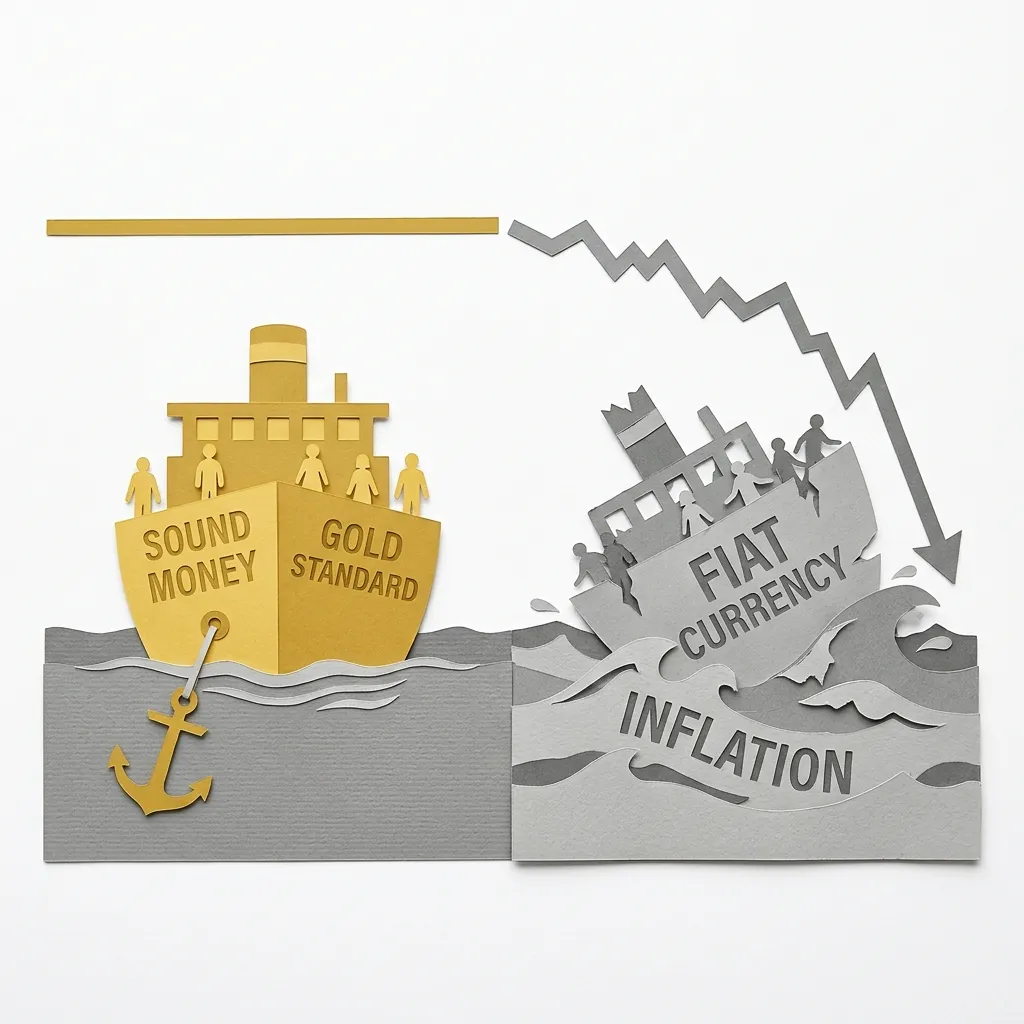
The gold standard, which tied the dollar to a fixed quantity of gold and prevented the government from creating money beyond its gold holdings, provided substantial monetary stability for most of the period between the Civil War and World War I. Under the gold standard, a dollar in 1879 bought approximately the same amount as a dollar in 1914. The dollar today is worth approximately 3 cents relative to its 1913 value, having lost 97 percent of its purchasing power since the Federal Reserve was created.
The gold standard’s critics have a serious point: the constraint on money creation also constrains the economy’s ability to respond to financial crises. The Great Depression’s severity was substantially worsened by the gold standard’s requirement that the money supply contract when gold outflows occurred, preventing the kind of emergency monetary expansion that eventually stabilized the banking system in the 1930s after Franklin Roosevelt suspended gold convertibility. An economy tethered to a commodity whose supply is determined by geology rather than by the economy’s needs cannot easily expand money supply to prevent deflationary spirals from becoming catastrophic.
The practical alternatives to the gold standard that maintain the discipline against monetary excess without the inflexibility include rules-based monetary policy frameworks. A Taylor Rule, named after Stanford economist John Taylor, specifies how the Fed should set interest rates based on the gap between actual and target inflation and the gap between actual and potential output. Following such a rule mechanically would have required the Fed to raise rates much earlier in 2021 than it did, potentially preventing a significant portion of the subsequent inflation. Nominal GDP targeting would require the Fed to maintain a stable growth path for the total money value of economic activity, providing a different kind of discipline without the rigidity of a commodity standard.
Cryptocurrency, particularly Bitcoin, has attracted interest as an alternative monetary system that is governed by algorithm rather than by institutions. Bitcoin’s fixed supply schedule, programmed into its protocol, prevents the kind of discretionary expansion that critics attribute to central banks. The case for cryptocurrency as a monetary standard founders on its extreme price volatility, which makes it impractical as a unit of account for ordinary transactions, and on its current use primarily as a speculative asset rather than as a medium of exchange.
The most realistic path toward more disciplined monetary policy in the near term is not a return to the gold standard or replacement of the dollar with Bitcoin. It is enhanced congressional oversight of Federal Reserve decision-making, explicit requirements for the Fed to follow rules-based frameworks and to explain deviations from those frameworks in public testimony, and greater transparency about the distributional consequences of specific policy choices. None of these changes requires dismantling the Federal Reserve. They require treating monetary policy as a public policy question with public consequences rather than as a technical exercise delegated entirely to experts.
The 2% Inflation Target: Who Decided and Why?
The Federal Reserve’s 2 percent annual inflation target, which it formally adopted in 2012, is so widely accepted in current monetary policy discussion that it is rarely examined critically. Where did this number come from, and who does it serve?
The 2 percent target was not derived from first principles of monetary economics. It emerged from pragmatic central bank experience, most notably from the Reserve Bank of New Zealand, which set a 0-2 percent inflation target range in 1990, and from subsequent adoption by other central banks. The theoretical justification offered for a positive inflation target rather than zero inflation includes the argument that a small positive inflation rate provides monetary policy room to respond to downturns by lowering real interest rates, that it prevents the economy from entering deflationary spirals, and that measured inflation overstates true inflation because of quality improvements in goods not captured in price indexes.
What is rarely discussed is what a 2 percent inflation target means over time. At 2 percent annual inflation, a dollar today is worth approximately 82 cents in twenty years and approximately 67 cents in forty years. This built-in erosion of money’s value is deliberately maintained as a policy objective. Its primary victims are people who hold savings in cash and bank accounts, which describes most of the bottom 80 percent of the wealth distribution. Its primary beneficiaries are people who hold nominal debt, since inflation erodes the real value of fixed-rate borrowing, and asset owners, since assets generally appreciate with or ahead of general price levels.
The 2 percent target also means that the Federal Reserve is systematically targeting a redistribution of real wealth from savers to debtors and from wage earners to asset owners, as a permanent policy objective rather than as an accidental byproduct of economic management. This is not the way it is typically described in Federal Reserve communications, but it is a reasonable description of its practical consequences.
A Practical Monetary Reform Agenda
Recognizing the distributional failures of Federal Reserve policy does not require endorsing fringe monetary theories. It requires acknowledging that the current institutional setup has produced outcomes, most recently the 2021-2023 inflation, that harmed ordinary Americans, and asking what changes would make a repetition less likely.
First: the Federal Reserve should be required to follow a more rules-based approach to monetary policy. The Nominal GDP targeting framework, which has substantial academic support from economists across the political spectrum, provides a clear policy rule that would prevent both the excessive monetary stimulus of 2020-2021 and the excessive tightening that has sometimes characterized Fed policy. Congress should specify that the Fed adopt such a rule and explain publicly when and why it deviates from it.
Second: the distributional consequences of specific monetary policy decisions should be explicitly analyzed and reported to Congress. When the Fed makes major decisions about asset purchases or interest rate targets, its staff should model and report the expected effects on different income and wealth groups, just as it models the effects on overall employment and inflation. This information is relevant to democratic deliberation about monetary policy and is currently not systematically produced.
Third: the makeup of Federal Reserve governance should be reformed to reduce the overrepresentation of banking industry interests. Regional Federal Reserve Bank presidents play a significant role in monetary policy deliberation through the Federal Open Market Committee, and they are selected by processes that give substantial weight to banking industry preferences. Broadening the selection process to include more diverse representation of economic interests would not eliminate the technical competence of Fed governance but would reduce the institutional bias toward policies that serve financial sector interests.
Fourth: fiscal policy should be conducted with explicit awareness of its interaction with monetary policy. The 2021 inflation was as much a fiscal policy failure as a monetary policy failure. The combination of large fiscal stimulus and continued monetary expansion, deployed into an economy that was already recovering, produced an inflation that neither Congress nor the Fed had adequately prepared for. Better coordination and more explicit analysis of the inflationary implications of fiscal choices would reduce the risk of repeating the experience.
To be honest about where this reform agenda lands: these are improvements within the existing central banking framework, not a libertarian alternative to it. The libertarian tradition in monetary economics goes much further, toward competing currencies, commodity-backed money, or free banking without a central monopoly. Any institution with a monopoly on money creation faces the political pressures and capture dynamics documented throughout this article. Rules-based constraints on the Fed reduce the scope for discretionary abuse but do not solve the fundamental problem: an unelected institution with enormous distributional power operating without meaningful democratic accountability or market discipline. Rules can be changed; monopolies on money creation are harder to dislodge. The reforms proposed here are worth pursuing because they reduce harm in the near term. Readers who want to understand the full libertarian position on monetary policy should recognize that the endpoint is a smaller central bank role, not a better-governed one.
How 10 Countries Manage Central Banking and Inflation: International Monetary Frameworks
The Federal Reserve is one of many central banks worldwide, and the choices countries make about how to structure monetary governance reveal significant variation that is instructive for thinking about reform.
The European Central Bank (ECB) governs monetary policy for the 20 countries of the eurozone, with a narrower primary mandate than the Fed: price stability is the ECB’s primary objective, with support for economic growth as a secondary goal. The ECB’s inflation target is 2 percent, same as the Fed, but its institutional structure differs: the governing council is composed of representatives from all member countries’ central banks, and its independence is protected by the Treaty on the Functioning of the European Union in a manner that makes it harder for any single government to pressure it than the U.S. presidential appointment system allows. The ECB also conducted quantitative easing programs (though it calls them asset purchase programs) but faced significant legal challenges in Germany over whether bond purchases exceeded its mandate, illustrating how legal constraints on central bank authority operate differently in different constitutional systems.
The Bank of England adopted formal inflation targeting in 1992 after the UK’s exit from the European Exchange Rate Mechanism, becoming one of the first major central banks to explicitly announce an inflation target and make that the primary organizing principle of monetary policy. The Bank’s Monetary Policy Committee has a clear inflation target of 2 percent, and the governor is required to write an open letter to the Chancellor of the Exchequer explaining any deviation from that target beyond one percentage point. This transparency and accountability mechanism, while modest, is more explicit than the Fed’s public communications about deviations from its targets.
The Reserve Bank of New Zealand is historically significant as the origin of the formal inflation targeting framework now used by most central banks. New Zealand adopted a formal Policy Targets Agreement between the government and the Reserve Bank Governor in 1990, specifying the inflation target and making the governor individually accountable for meeting it. The New Zealand model demonstrated that explicit, transparent inflation targeting could anchor expectations and produce lower, more stable inflation without sacrificing economic growth, influencing the adoption of similar frameworks globally.
The Swiss National Bank has maintained one of the world’s most disciplined monetary policies, targeting price stability with an inflation range of zero to 2 percent. Switzerland has a culture of monetary conservatism rooted in its role as an international financial center and its historical experience of inflation. The SNB’s challenge in recent decades has been excessive currency appreciation rather than inflation, requiring it at times to intervene in currency markets to prevent the Swiss franc from becoming so expensive that it damages Swiss exports. Switzerland’s experience illustrates that the problem of excessive monetary discipline, rather than insufficient discipline, is a real issue in high-trust monetary systems.
Germany’s Bundesbank was the gold standard (metaphorically) of independent central banking discipline before Germany joined the eurozone. The Bundesbank’s institutional culture, shaped by the traumatic hyperinflation of the 1920s Weimar Republic, prioritized price stability above all other objectives and was notoriously resistant to political pressure to expand money supply. Germany’s low inflation throughout the postwar period compared favorably with most other European countries, and Bundesbank officials were consistently the strongest voices for ECB conservatism within the eurozone governance structure. Germany’s monetary history is the clearest example of how institutional culture, shaped by historical trauma, can sustain disciplined monetary policy.
Japan presents the opposite challenge: its central bank, the Bank of Japan, has struggled for decades with deflation rather than inflation, attempting to generate the low positive inflation rate that central banking theory considers optimal. Japan’s experience with quantitative easing predates the Fed’s post-2008 policies, as the Bank of Japan first deployed large-scale asset purchases in 2001 in an attempt to escape deflation. Japan’s extended experience has not definitively resolved the debate about whether quantitative easing can reliably generate inflation when the fundamental problem is insufficient demand, making Japan both an argument for and against aggressive monetary expansion.
Canada operates with an explicit inflation target of 2 percent within a 1 to 3 percent band, with a framework of joint accountability between the Bank of Canada and the federal government through a formal policy agreement that is renewed every five years. Canada’s inflation targeting framework has generally produced good results, with inflation remaining within the target band during most of the past three decades except during the post-pandemic period when Canada, like most countries, experienced elevated inflation.
Australia maintains a 2 to 3 percent inflation target through the Reserve Bank of Australia. Australia underwent a significant governance review following the post-pandemic inflation, with an independent review recommending changes to the RBA’s governance structure including the creation of a separate monetary policy board. Australia’s willingness to conduct a public review of its central bank’s performance and governance in the wake of an inflation miss is more transparent than the Fed’s approach to accountability after 2021-2023.
Singapore conducts monetary policy through exchange rate management rather than interest rate targeting. The Monetary Authority of Singapore (MAS) manages the Singapore dollar’s value against a trade-weighted basket of currencies, allowing the exchange rate to appreciate or depreciate within an undisclosed band as its primary monetary policy tool. This approach, which effectively imports monetary discipline from trading partners, has produced very low inflation for Singapore over decades. The exchange rate targeting approach is not readily replicable for large economies whose currencies serve as reserve currencies, but it illustrates that the interest rate and money supply framework is not the only available monetary policy architecture.
Brazil provides a cautionary example of central bank independence that has not always been maintained in practice. Brazil’s central bank, the Banco Central do Brasil, received formal legal independence in 2021, a relatively recent development. Before formal independence, political pressure on monetary policy contributed to a long history of high and unstable inflation. Brazil achieved significant monetary stabilization in the 1990s through the Real Plan, but subsequent political pressure on the central bank at various points has complicated monetary management. Brazil’s experience illustrates why formal institutional independence, backed by legal protections and genuine political commitment, matters for monetary outcomes.
The international comparison reveals consistent findings: countries with more independent central banks with clearer mandates and more explicit accountability for inflation targets have produced better inflation outcomes on average. The U.S. Fed’s dual mandate, which includes both price stability and maximum employment, has at times provided justification for policies that prioritized one goal in ways that compromised the other. Single-mandate central banks, like the ECB, face less internal tension but are less responsive to labor market conditions.
Go Deeper: Books by Alex Merced
Monetary policy is one of the most consequential and least understood areas of economic policy, combining technical complexity with enormous distributional stakes. The arguments in this article connect directly to the frameworks Alex Merced develops.
Economic Ideas: From Beginning to Early 2026 provides the economic foundation for understanding money: what it is, how central banks create it, the quantity theory of money that underpins inflation analysis, the Austrian business cycle theory that predicts how credit expansion leads to malinvestment and eventual correction, and the Cantillon Effect in its historical and contemporary forms. The book provides the analytical tools necessary for evaluating monetary policy debates rather than accepting central bank communications at face value.
The Field Guide to Libertarianism presents the libertarian case for sound money and monetary reform, not merely as an abstract preference for economic freedom but as a practical argument grounded in the historical record of central bank inflation, the documented distributional consequences of monetary expansion for wage earners versus asset holders, and the public choice analysis of why institutions without democratic accountability consistently drift toward policies that serve concentrated interests at diffuse public expense.
Political Thought and Debates of the United States traces the political history of the Federal Reserve from its creation in 1913 through the successive expansions of its mandate and authority, explaining how an institution originally designed to provide elastic currency and prevent bank panics evolved into a permanent engine of monetary expansion and why the political economy of central banking systematically favors policies that serve financial interests over the broader public.
All three are available on Amazon. The full catalog of Alex Merced’s work is at books.alexmerced.com.
Sources and Further Reading
-
Bernanke, Ben S. The Federal Reserve and the Financial Crisis. Princeton University Press, 2013.
-
Friedman, Milton, and Anna J. Schwartz. A Monetary History of the United States, 1867-1960. Princeton University Press, 1963.
-
Cantillon, Richard. Essai sur la Nature du Commerce en Général. 1730. (Translated by Henry Higgs, Macmillan, 1931.)
-
Hayek, F.A. Prices and Production. Routledge, 1931.
-
Mian, Atif, and Amir Sufi. House of Debt: How They (and You) Caused the Great Recession, and How We Can Prevent It from Happening Again. University of Chicago Press, 2014.
-
Saez, Emmanuel, and Gabriel Zucman. The Triumph of Injustice: How the Rich Dodge Taxes and How to Make Them Pay. W.W. Norton, 2019.
-
Iacoviello, Matteo. “Housing Wealth and Consumption.” International Finance Discussion Papers 1027. Federal Reserve Board, 2011.
-
Taylor, John B. “Discretion Versus Policy Rules in Practice.” Carnegie-Rochester Conference Series on Public Policy 39 (1993): 195-214.
-
Sumner, Scott. The Midas Paradox: Financial Markets, Government Policy Shocks, and the Great Depression. Independent Institute, 2015.
-
Summers, Lawrence H. “The Biden stimulus is admirably ambitious. But it is a risk.” Washington Post, February 4, 2021.
-
Blanchard, Olivier. “In defense of concerns over the $1.9 trillion relief plan.” Peterson Institute for International Economics, February 18, 2021.
-
Federal Reserve Board of Governors. “Statement on Longer-Run Goals and Monetary Policy Strategy.” January 2012 (updated August 2020).
-
Congressional Budget Office. “The Budget and Economic Outlook: 2022 to 2032.” CBO, May 2022.
-
Selgin, George. The Menace of Fiscal QE. Cato Institute, 2020.
-
Dowd, Kevin. New Private Monies: A Bit-Part Player? Institute of Economic Affairs, 2014.