TL;DR
- The gig economy is not a new development in American labor. Self-employment, contract work, and piece-rate compensation have characterized significant portions of the American workforce throughout its history. What is new is the scale, the coordination enabled by platform technology, and the legal controversy that has erupted when courts and legislatures have tried to apply employment law written for the industrial era of the 1930s to labor arrangements that operate on fundamentally different terms.
- California’s Assembly Bill 5, passed in 2019 and subsequently modified by the ballot initiative Proposition 22 and upheld by the California Supreme Court in 2024, represented the most significant legislative attempt to reclassify gig workers as employees. AB5 was well-intentioned and addressed real problems: platform companies that treat workers as independent contractors while exercising substantial control over their work and externalizing costs like benefits and insurance onto workers and the public. But AB5 also demonstrated the limits of solving a classification problem by forcing everyone into the employee category, since many workers chose gig arrangements precisely because of the flexibility they provide and resisted reclassification.
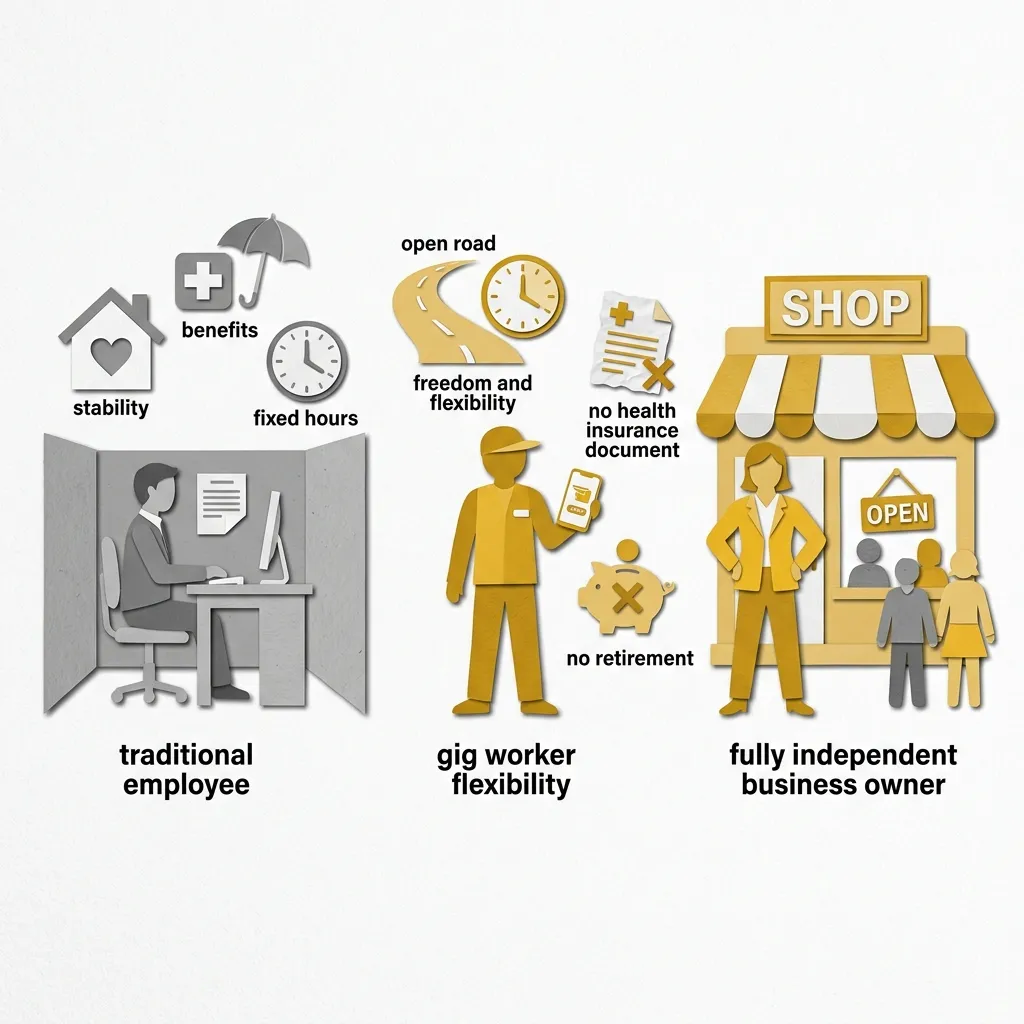
- The fundamental problem is that American labor law was built on a binary: you are either an employee with full benefits and protections, or you are an independent contractor with full autonomy and no benefits. Most gig workers occupy a middle position that this binary cannot accommodate: they have more flexibility than a traditional employee but less independence than a fully autonomous freelancer, and they bear costs in terms of lack of benefits that the independent contractor classification shifts onto them rather than onto the platform companies that benefit from their labor.
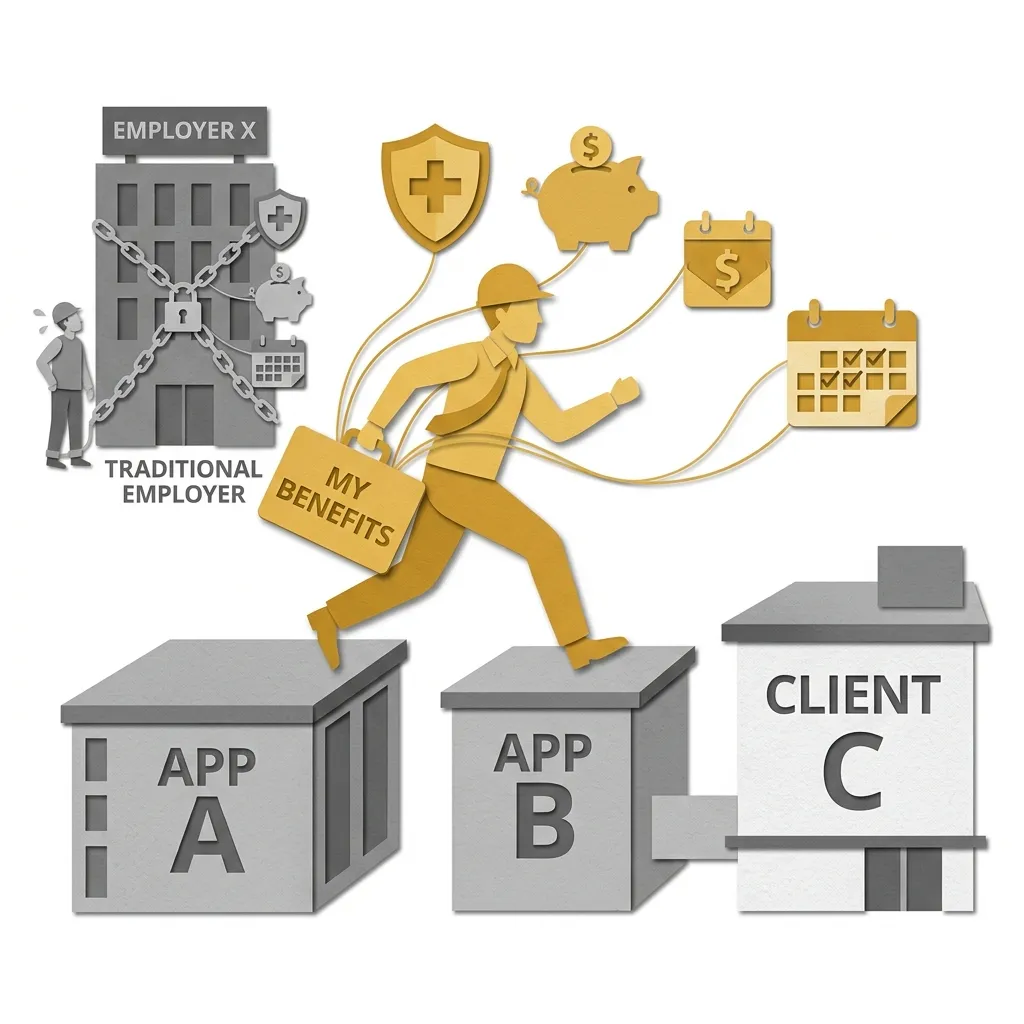
- The most constructive reform path recognizes that the goal is not to force all work into the employee category or to protect the current system that externalizes costs onto gig workers. The goal is portable benefits: a system in which health insurance, retirement savings contributions, paid leave, and workers’ compensation protections follow the worker across gig arrangements rather than being tied to a single employer relationship. This approach allows flexibility to coexist with protection rather than forcing a choice between them.
On a Tuesday afternoon in Los Angeles in November 2019, thousands of registered nurses, freelance journalists, translators, yoga instructors, court reporters, and truck drivers gathered for rallies and press conferences to protest a law that was supposed to protect workers. The law was California’s Assembly Bill 5. The crowd, many of them workers who identified as progressive, were angry at a progressive state legislature and a progressive governor who had signed the bill believing it would extend labor protections to gig economy workers.
What had gone wrong was a familiar story in labor policy: a law designed to solve one problem created others. AB5 codified the “ABC test” for worker classification, creating a presumption that anyone who performs work for a company is an employee unless the company can demonstrate three specific things: that the worker is free from the company’s control, that the work is outside the company’s usual course of business, and that the worker is customarily engaged in an independently established trade or occupation. The bill targeted Uber, Lyft, and DoorDash, whose app-based driver and delivery models had long operated in a legal gray area by classifying workers as independent contractors while exercising extensive algorithmic control over their routing, pricing, and ratings.
But the ABC test, applied strictly, swept in far more than app-based drivers. Freelance journalists who regularly wrote for one publication were reclassified as employees, causing publications that could not afford to employ them to stop using them. Court reporters who had operated as independent contractors for decades suddenly needed to be hired as employees or not at all. Musicians who performed through booking agencies faced new classification questions. Translators and yoga instructors found their contracts canceled. The law’s authors had intended to protect exploited gig workers; they had instead made it illegal for many people who had chosen flexible freelance arrangements to continue working under those arrangements.
The History of Work Classifications That Built This Mess
The binary classification of workers as either employees or independent contractors is embedded in labor law that was written in a specific historical context: the New Deal labor legislation of the 1930s, which emerged from a political economy dominated by large manufacturing employers and organized industrial unions, and which assumed that the primary labor relationship was between a large employer and a full-time, long-term worker.
The Fair Labor Standards Act of 1938 established minimum wages and overtime requirements for “employees” and exempted “independent contractors” from those protections. The National Labor Relations Act of 1935 gave employees the right to organize and bargain collectively, while independent contractors had no such right. The Social Security Act created payroll tax obligations for employers paying wages to employees. The tax code treats employee compensation and contractor payments differently, with employers withholding income taxes and paying payroll taxes on wages but not on contractor payments.
These distinctions made sense for the labor market of the 1930s, in which the paradigmatic labor relationship was a worker hired by a factory or office to work regular hours at a fixed rate in a supervised setting. The independent contractor classification was reserved for genuinely autonomous service providers: a plumber who ran their own business, a lawyer who operated a practice, a consultant who set their own terms and served multiple clients simultaneously.
The gig economy, powered by platform technology that enables platforms to coordinate the work of thousands of service providers in real time, represents a labor arrangement that genuinely does not fit neatly into either category as defined in New Deal-era law. Platform workers like Uber drivers and DoorDash couriers are not traditional employees in the sense that they set their own hours, choose which job offers to accept, use their own equipment, can work for competing platforms simultaneously, and do not receive directions about the specific manner of performing their work (beyond the routing guidance the app provides). But they are also not traditional independent contractors in the sense that they do not set their own prices, cannot negotiate individual terms with individual customers, are subject to algorithmic management that can deactivate their accounts, and are economically dependent on the platform in ways that traditional independent contractors are not.
The economic dependence of many platform workers on a single platform is the kernel of legitimate concern that underlies the worker classification debates. An Uber driver who drives full-time or near-full-time and derives most of their income from Uber faces a relationship with that platform that has many of the economic characteristics of employment: economic dependence, vulnerability to unilateral changes in platform terms, limited ability to exit the relationship without significant income loss. Calling this relationship “independent contracting” because the worker technically could work for Lyft or DoorDash instead does not address the actual economic reality of most full-time gig workers.
At the same time, the full-time gig worker is not the typical gig worker. Research consistently shows that the majority of gig workers use platform work as supplemental income alongside other employment or other life arrangements: students earning money between classes, parents fitting work around childcare schedules, retirees supplementing fixed income, primary-employment workers earning extra income for specific financial goals. For these workers, the flexibility of gig arrangements is genuinely valuable and the employee classification would not serve their interests.
Algorithmic Control: The Real Problem Platform Companies Created
The legitimate grievance that underlies AB5 and similar legislative efforts is not that all gig workers are being exploited. It is that platform companies have developed a specific business model that exercises substantial control over workers’ activities while using the independent contractor classification to avoid the costs that employment law would require them to bear.
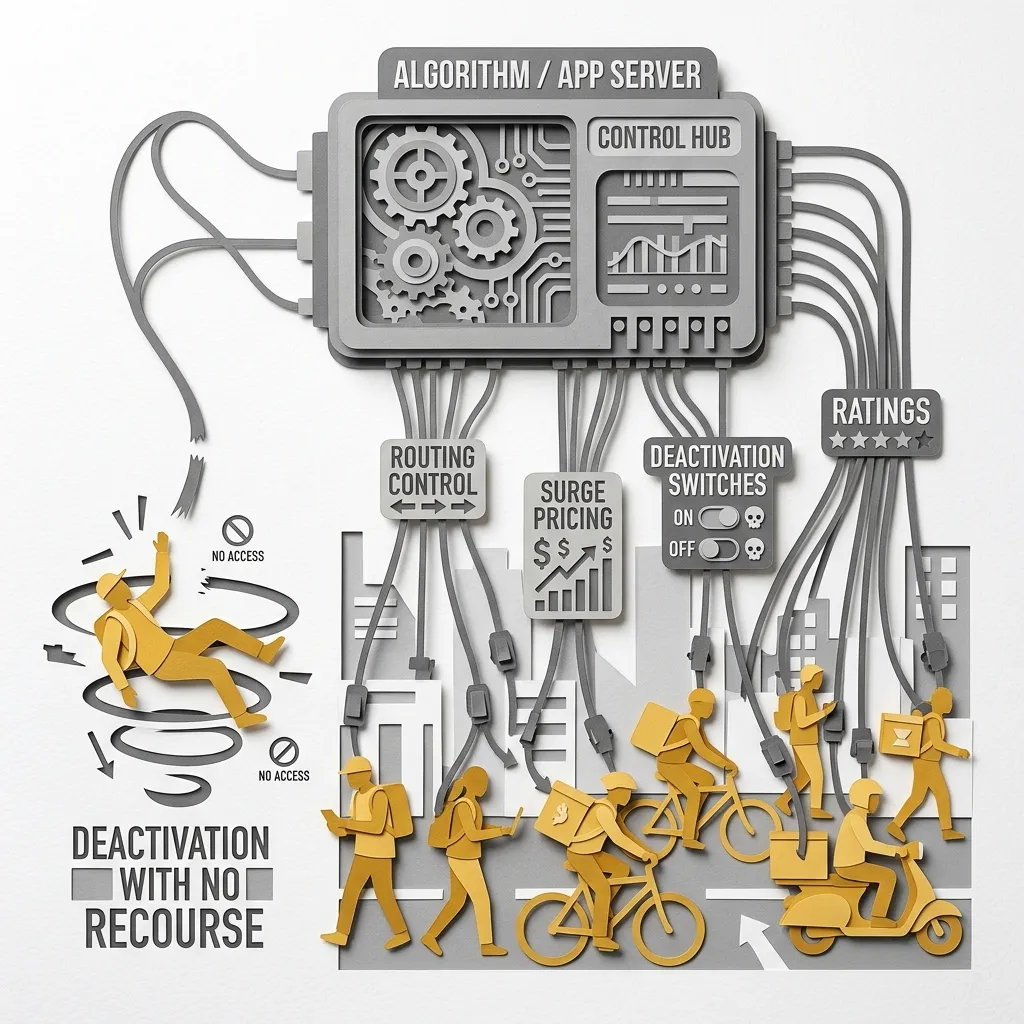
Algorithmic control is the term economists and labor researchers use to describe how platform companies direct workers’ behavior through the app interface without issuing explicit instructions of the kind that traditional employers give. An Uber driver is told by the app which rides to pick up, the optimal route to take, the price charged to the customer, the rating that determines their continued access to the platform, and the availability of surge pricing that affects their earnings. The driver nominally “decides” whether to accept each trip, but the algorithm is designed to make rejection costly through reduced future trip offers and eventual deactivation for low acceptance rates.
Research by Veena Dubal at the University of California and Alex Rosenblat at Data and Society has documented how platform companies use algorithmic management to exercise control that, if implemented by a human manager, would clearly constitute an employment relationship. The platforms set prices, control customer relationships, determine which workers are deactivated, and shape worker behavior through the incentive structure embedded in the algorithm. The nominal autonomy of accepting or rejecting individual jobs does not translate into genuine independence from platform control over the overall terms of the work.
The cost externalization problem compounds the control problem. When platform companies classify workers as independent contractors, they shift the cost of employment benefits onto the workers themselves and, when workers cannot afford those costs, onto the public systems that provide a safety net for the uninsured and underemployed. An Uber driver who is injured on the job may not be eligible for workers’ compensation coverage because they are classified as an independent contractor. A DoorDash courier who cannot afford health insurance relies on emergency room care, Medicaid, or goes without. A platform worker who loses their “contract” has no access to unemployment insurance because they were not employees.
These costs are real and they do not disappear just because the platform company avoids bearing them. They are simply transferred from the platform company’s balance sheet onto the worker’s budget or the public sector’s budget. Platform companies that externalize these costs are not operating in a free market; they are operating in a subsidized market where the subsidy comes from workers and taxpayers rather than from government directly.
This cost externalization distinguishes the legitimate critique of platform worker classification from a general objection to independent contractor status. A plumber who operates their own business, carries their own liability insurance, saves for their own retirement, and commands premium rates that reflect the costs of self-employment is genuinely an independent contractor bearing costs that are compensated by their earnings. A platform worker who earns rates comparable to or below minimum wage while bearing the same costs of uninsured self-employment is not bearing those costs voluntarily in exchange for premium compensation; they are bearing them because the platform company has structured the arrangement to avoid them.
What AB5 Got Right and What It Got Wrong
AB5’s authors identified a real problem and proposed a solution that was too blunt for the complexity of the actual labor market.
The ABC test is a more worker-protective standard for classifying workers than the common law “control test” that California courts had previously applied. Under the control test, a company could argue that a worker was an independent contractor even if the company exercised substantial control over their work, as long as certain legal formalities were maintained. The ABC test makes it harder for companies to misclassify employees as independent contractors by requiring them to demonstrate not just lack of control but genuine independence of the worker’s business from the company’s core operations.
In application to Uber, Lyft, and DoorDash, the ABC test clearly indicated employee status: the workers perform the core service that constitutes the company’s business (transporting people and delivering food), they are subject to algorithmic control that functionally substitutes for traditional supervision, and their work is not customarily performed in an independently established trade. The ABC test was designed for exactly this situation.
The problem arose in its application to genuinely independent freelancers. A journalist who writes a column for a newspaper every week is not performing the newspaper’s core business in the sense that an Uber driver performs Uber’s core business: the journalist is a creative professional providing a specialized service that the newspaper could substitute in many ways. A yoga instructor who teaches occasional classes for a studio is genuinely running an independent business that is not the studio’s core operation. The ABC test applied mechanically treats these genuinely independent workers the same as it treats app-based drivers, producing results that serve nobody’s interests.
The legislative response to the overreach was partial. AB5 included exemptions for dozens of specific occupations that successfully lobbied the legislature for carve-outs: doctors, lawyers, accountants, architects, real estate agents, commercial fishermen, and others. These exemptions were not principled; they reflected which industries had sufficient political power to obtain legislative relief. The resulting statute was a patchwork that protected some categories of workers, harmed others, and exempted a third set based on political influence rather than on any consistent theory of when the ABC test is appropriate.
Proposition 22, the ballot initiative that California voters passed in November 2020 by a margin of 58 to 42 percent, created a specific carve-out for app-based drivers that required the platforms to provide limited benefits: health care subsidies for workers who drive sufficient hours, a minimum earnings guarantee, compensation for some work-related expenses, and a form of occupational accident coverage. The California Supreme Court upheld Proposition 22 in July 2024 in Castellanos v. State of California, confirming that app-based drivers remain classified as independent contractors with these enhanced protections.
The Proposition 22 outcome is neither fully satisfying nor fully damning. The benefits required by Prop 22 are more limited than what full employee status would provide. But they represent an improvement over the pre-AB5 status quo and a more sustainable model than forced employee classification for workers who genuinely value schedule flexibility. The experience suggests that the binary between employee status and unprotected independent contracting is false, and that a middle path providing meaningful protections without forcing all workers into the employee category is achievable.
The Portable Benefits Solution: Decoupling Protection from Employment
The most intellectually compelling reform proposal for gig economy labor law is portable benefits: a system in which workers accumulate benefit entitlements through their work activity rather than through a specific employment relationship, and those entitlements follow the worker across multiple platforms and work arrangements.
The basic design of a portable benefits system is straightforward. Each platform company would contribute to a worker’s portable benefit account based on the amount of work the worker performs through that platform: a percentage of earnings deposited into an account that the worker owns and controls. The account funds health insurance, retirement savings, paid leave, and workers’ compensation coverage. When a worker shifts from one platform to another, or works across multiple platforms simultaneously, their benefit account accumulates contributions from all of them. The worker is never without benefits even during periods of transition between platforms or work arrangements.
Senator Mark Warner of Virginia and others have proposed versions of portable benefits legislation at the federal level. The proposal has attracted supporters from both left and right: progressives who see it as a way to ensure that all workers have access to a safety net regardless of how they work, and market-oriented reformers who see it as a way to provide worker protection without the labor market distortions that forced employee classification would produce.
The core argument for portable benefits is that it solves the actual problem, which is the cost externalization that allows platform companies to profit from workers’ labor without bearing the costs of the benefits that make that labor sustainable, without creating the collateral damage that AB5 produced for genuinely independent freelancers who prefer their current arrangements.
A contributing-based portable benefits system can coexist with a wide variety of work arrangements. Platform companies would still compete for workers by offering attractive rates and working conditions. Workers would still choose which platforms to work for and when. But the benefit contributions would be automatic and portable, eliminating the situation where a worker has to choose between the flexibility they value and the protections they need.
The practical challenges of implementing portable benefits are real but not insurmountable. Health insurance in the United States is structured around employer group plans, making individual portable coverage more expensive than group coverage unless reforms are made to how insurance pools are structured. Retirement savings through a portable account would work similarly to an Individual Retirement Account but with mandatory contributions from platforms instead of optional contributions from the worker, a model that has precedent in several countries. Workers’ compensation coverage for gig workers is a more complex actuarial challenge, since the coverage historically has been designed for workplace settings with known occupational risks.
Several states have explored portable benefits pilots. Washington State enacted legislation in 2022 that created a portable benefit fund for app-based workers, providing injury protection and paid sick and parental leave funded by platform contributions. The program represents a real-world test of whether portable benefits can work in practice, and its early results are being watched by policymakers in other states considering similar approaches.
International Models: What Other Countries Have Done
The worker classification debate in the United States is not unique. Platform economies have emerged in every developed country, and each has grappled with where to place gig workers in its existing labor law framework.
The United Kingdom’s Supreme Court ruled in 2021 that Uber drivers are “workers” in the UK legal sense, a category intermediate between “employee” and “independent contractor” that carries some but not all employee protections: the right to minimum wage, paid vacation, and protection from discrimination, but not full employment protections like unfair dismissal rights. The UK case illustrates one approach to the binary problem: creating a legal middle category that explicitly acknowledges the intermediate status of many gig workers without forcing them into full employee classification.
France has created a statute of rights for self-employed platform workers that includes the right to transparency about the algorithm governing their earnings and deactivations, the right to refuse platform conditions without retaliation, collective bargaining rights for some categories, and professional training support. The French approach focuses on the power asymmetry between platforms and workers and attempts to address it through rights rather than through classification.
Spain enacted a “Riders’ Law” in 2021 that classified food delivery workers as employees, resulting in substantial reductions in the number of gig workers in that sector as platforms reduced staffing in response to higher employment costs. The Spanish experience is cautionary: forced employee classification did extend benefits to the workers who remained, but it also reduced the number of platform work opportunities available.
The European Union’s Platform Work Directive, adopted in 2024, established a rebuttable presumption of employee status for platform workers, placing the burden on platforms to demonstrate that their workers are genuinely independent contractors. The directive allows member states to implement the presumption flexibly but establishes a floor of algorithmic transparency requirements and rights to human review of algorithmic decisions. The EU approach is broader than Proposition 22 but less blunt than AB5’s original application of the ABC test.
These international examples suggest that there is no single right answer to the gig economy labor law question, and that the specific institutional context of each country shapes which approaches are feasible and effective. What they collectively illustrate is that the binary classification system is widely recognized as inadequate and that intermediate solutions combining some protections with some flexibility are being actively developed and implemented across the developed world.
The Freedom Dimension: Why Flexibility Matters
Any serious discussion of gig economy labor policy must grapple with the substantial evidence that many gig workers genuinely prefer flexible work arrangements and would not benefit from forced employee classification.
Survey research on gig workers consistently finds that flexibility is the primary reason workers choose platform work. A 2021 survey by the McKinsey Global Institute found that 58 percent of independent workers cite schedule flexibility as the primary reason they prefer their work arrangement. A Federal Reserve survey of gig economy workers found that the majority work in the gig economy as a supplement to other income and value the ability to work when and as much as they choose. Research specifically on Uber and Lyft drivers finds that the distribution of driving hours is bimodal: a relatively small group of full-time drivers who depend on platform income, and a much larger group of part-time drivers who use the platform for supplemental income and highly value schedule flexibility.
The full-time drivers have a stronger case for employee classification or enhanced protections, since they are economically dependent on the platform and bear the costs of self-employment without the premium earnings that typically justify independent contractor status. The part-time supplemental workers have a much weaker case for forced employee classification, since the flexibility they value would be severely constrained if platforms were required to employ them in the traditional sense, with scheduled shifts and the full cost burden of employment.
This heterogeneity is precisely what makes a one-size-fits-all classification policy inadequate. The worker who drives full-time and treats Uber as a primary job has different needs and interests from the worker who drives on weekend mornings to earn extra money for a vacation. Labor policy that forces both into the same classification serves neither well.
The libertarian insight here is that workers who have voluntarily chosen a flexible work arrangement and who do not want to be reclassified deserve to have their preferences respected. Worker welfare is not served by imposing a classification on workers that they oppose. The paternalistic assumption that workers who choose flexibility are too short-sighted or too poorly informed to understand their own interests is both empirically contestable and philosophically inconsistent with respect for individual autonomy.
A Worker-Centered Reform Framework
The goal of gig economy labor reform should be to protect workers from cost externalization without eliminating the flexibility that makes gig work genuinely valuable for many workers who choose it.
This goal points toward portable benefits as the primary reform mechanism: require platforms to contribute to portable benefit accounts for all workers they use, with contribution rates calibrated to the platform’s revenue per worker-hour and the cost of the benefits to be funded. The contribution requirement addresses cost externalization directly by requiring platforms to bear a portion of the cost of the benefits that their workers need, without forcing a classification change that would eliminate the flexibility many workers value.
The portable benefits system should be designed to be genuinely portable: it should aggregate contributions from multiple platforms in a single account that the worker controls, it should fund actual protections rather than nominal ones, and it should be accompanied by reforms to the insurance markets that make individual health coverage more affordable and accessible.
Worker protection from arbitrary algorithmic deactivation should be addressed separately from worker classification. The ability of a platform to deactivate a worker’s account without notice, explanation, or appeal process is a genuine abuse of power that should be subject to minimum process requirements regardless of the worker’s classification. Requiring platforms to provide written explanations for deactivations, provide an appeal process, and maintain consistent standards for deactivation decisions addresses a real grievance without requiring employee classification.
Algorithmic transparency, which the EU Platform Work Directive mandates, allows workers to understand the rules that govern their earnings and their continued platform access. A worker who understands that their acceptance rate affects their ride offer frequency can make informed decisions about when to decline trips. A worker who is deactivated for violating a rule they were not aware of is not being treated fairly even under a genuinely voluntary independent contractor relationship.
Collective bargaining rights for platform workers, which several countries have extended in various forms, could allow workers to negotiate collectively with platforms over the terms of their engagement without requiring formal employee classification. Existing U.S. labor law’s prohibition on independent contractors organizing for bargaining purposes is a legal rather than economic necessity, reflecting the classification of antitrust law’s application to contractor coordination rather than any principled reason why workers in platform arrangements should not be able to negotiate collectively.
A clear-eyed look at where these proposals land: portable benefits mandated by government are not a libertarian solution. They are a government mandate on the terms of private contractor agreements. The libertarian question is: why don’t market forces already produce benefit contributions for workers platforms rely on heavily? The answer is that the tax system subsidizes employer-sponsored benefits and disadvantages individual purchasers, and that regulatory barriers make individual health coverage expensive and inefficient. The libertarian reform is to fix those structural distortions so that self-funded portable benefits become efficient, rather than mandating platform contributions. Deactivation transparency and appeal requirements also override what private parties would contractually agree to. These are government mandates on business practices that would otherwise be disciplined by market competition if workers can freely exit platforms that treat them poorly. The portable benefits framework is a pragmatic compromise between the status quo and employee classification, and it is a better compromise than AB5-style forced reclassification. Readers should understand it as such rather than as a market-based or libertarian solution.
Additional International Models: More Countries Grappling with Platform Work
The article above covers the UK, France, Spain, and EU approaches to gig economy labor law. The global landscape is broader and includes several more instructive cases.
Belgium implemented a specific status for platform workers in 2022, creating a third worker category between employee and independent contractor. Belgian platform workers in the “platform economy workers” category receive access to social insurance, accident coverage, and some collective bargaining rights without being classified as employees. The Belgian model is explicitly a middle-category solution that acknowledges the inadequacy of the binary classification system.
The Netherlands applies a broad definition of employment and has seen courts ruling that delivery workers for Deliveroo were employees rather than independent contractors. Following the Deliveroo ruling, the Dutch government has worked on clarifying the standard for worker classification to make it less dependent on case-by-case litigation, proposing a new framework that creates a rebuttable presumption of employment for workers earning below a certain threshold and places the burden on the contracting company to demonstrate genuine independence.
Italy enacted a law in 2019 extending minimum wage and social insurance rights to gig workers in food delivery, regardless of their classification as employees or independent contractors. Italy’s approach targets the specific sector where worker exploitation has been most documented, rather than attempting a comprehensive classification reform. Italian food delivery workers now receive minimum protections even under independent contractor agreements.
Sweden has maintained a court-centered approach, with individual cases determining worker classification based on the traditional employment criteria applied by Swedish courts. Swedish courts have generally found that food delivery platform workers are employees under Swedish law, leading some platforms to exit the Swedish market. Sweden’s outcome is similar to Spain’s: stricter classification standards protect workers who remain but reduce platform work opportunities overall.
Australia enacted the Fair Work Legislation Amendment in 2024, providing a new pathway for gig workers to request review of unfair “deactivation” from platforms, treating this as analogous to unfair dismissal under employment law. Australia’s reform focuses specifically on the power to deactivate workers without adequate process rather than on full employment classification, recognizing that the dismissal protection is the most acute need without requiring the full costs of employee status.
New Zealand is examining gig economy classification issues through its courts and has indicated legislative interest in creating clearer rules. New Zealand’s Employment Relations Act uses an “intention of the parties” test that has sometimes found platform workers to be employees despite platform companies’ characterization of them as contractors.
South Korea enacted legislation in 2021 extending occupational safety and health protections to “special-type workers,” a category that includes delivery workers, courier services, and some platform workers. South Korea’s approach focuses on the physical safety dimension of gig work rather than on the full benefit and wage protection framework of employment law.
Brazil has the largest gig economy in Latin America, with millions of workers delivering food, transporting passengers, and providing household services through apps. Brazilian courts have issued inconsistent rulings on whether platform workers are employees, and the Lula government has worked on legislation to create minimum standards for platform workers including minimum earnings guarantees and social insurance contributions. Brazil’s experience highlights how platform work has expanded most rapidly in countries with large populations of workers who have few alternative formal employment opportunities.
These additional international examples reinforce the pattern: virtually every developed country is grappling with the same binary classification problem and finding that intermediate solutions, whether through new worker categories, targeted sector-specific protections, or portable benefit requirements, are politically and practically more workable than forcing all platform workers into employee classification.
Go Deeper: Books by Alex Merced
The gig economy debate is ultimately about how the rules governing labor markets should adapt to technological change that has created new forms of work that the existing framework cannot accommodate without forcing bad outcomes. The arguments in this article connect directly to the frameworks Alex Merced develops.
Economic Ideas: From Beginning to Early 2026 provides the economic framework for understanding labor markets: how wages and working conditions are determined by the interaction of supply and demand, how labor market regulations affect the allocation of labor across different employment arrangements, how the costs of mandatory benefits affect the trade-off between wages and non-wage compensation, and what economic research shows about the employment effects of worker reclassification. The book’s treatment of public choice theory helps explain why labor regulations often serve the interests of organized incumbents rather than the interests of the workers they nominally protect.
The Field Guide to Libertarianism develops the libertarian analysis of labor markets and worker rights: the distinction between genuine worker exploitation, which involves the abuse of power asymmetry, and the paternalistic assumption that workers cannot make informed decisions about work arrangements they have voluntarily chosen, and the case for worker autonomy as a genuine freedom interest that should be respected by labor policy rather than overridden in the name of protection. The field guide also addresses the role of voluntary associations, portable benefit arrangements, and market mechanisms in providing worker protection without state compulsion.
Political Thought and Debates of the United States traces the political history of labor law from the New Deal through the contemporary gig economy debates, explaining why the labor law framework that emerged in the 1930s was designed for a specific industrial economy that no longer characterizes most employment, how successive expansions of labor regulation have reflected the political priorities of organized labor rather than the interests of the full workforce including non-unionized workers, and why the gig economy debate represents a fundamental challenge to the New Deal labor law framework that requires more than incremental adjustment.
All three are available on Amazon. The full catalog of Alex Merced’s work is at books.alexmerced.com.
Sources and Further Reading
-
California Assembly Bill 5 (2019). California Legislature.
-
Dynamex Operations West, Inc. v. Superior Court, 4 Cal.5th 903 (2018).
-
Castellanos v. State of California, California Supreme Court (2024).
-
Uber Technologies, Inc. v. Aslam, UK Supreme Court (2021).
-
Rosenblat, Alex. Uberland: How Algorithms Are Rewriting the Rules of Work. University of California Press, 2018.
-
Dubal, Veena. “The Economic Security of Gig Workers in the United States.” Journal of Labour and Society 23, no. 2 (2020): 265-286.
-
Katz, Lawrence F., and Alan B. Krueger. “The Rise and Nature of Alternative Work Arrangements in the United States, 1995-2015.” Industrial and Labor Relations Review 72, no. 2 (2019): 382-416.
-
McKinsey Global Institute. “The Future of Work in America: People and Places, Today and Tomorrow.” McKinsey, 2019.
-
Federal Reserve. “Report on the Economic Well-Being of U.S. Households.” Board of Governors, 2022.
-
Warner, Mark R., and Michael Bennet. “The Portable Benefits for Independent Workers Pilot Program Act.” Proposed legislation, 2017.
-
Hall, Jonathan V., and Alan B. Krueger. “An Analysis of the Labor Market for Uber’s Driver-Partners in the United States.” Industrial and Labor Relations Review 71, no. 3 (2018): 705-732.
-
Eurofound. “Platform Work: Maximising the Potential While Safeguarding Standards?” European Foundation for the Improvement of Living and Working Conditions, 2018.
-
EU Platform Work Directive. “Directive on Improving Working Conditions in Platform Work.” European Parliament and Council, 2024.
-
Dube, Arindrajit. “A Plan to Reform the Overtime Threshold.” Hamilton Project, Brookings Institution, 2014.
-
Weil, David. The Fissured Workplace: Why Work Became So Bad for So Many and What Can Be Done to Improve It. Harvard University Press, 2014.