TL;DR
- The United States is in the middle of a genuine housing affordability crisis, and the primary cause is government policy at every level: zoning codes that outlaw the most naturally affordable housing types, permitting systems that inflate costs and delay construction for years, rent control ordinances that reduce supply while protecting incumbents, and federal tax policy that rewards homeownership speculation over renting. This is not a market failure. It is a policy failure that the market would correct if given the chance.
- The solution the political left typically offers, more rent control and more government-subsidized housing, treats the symptoms while preserving the regulatory apparatus that created the shortage in the first place. The solution the political right has historically offered, maintaining local control of zoning against federal interference, defends the very mechanism that incumbent homeowners use to restrict supply and protect their property values at the expense of everyone trying to get in.
- The honest answer, supported by economists across the ideological spectrum and by the evidence from cities that have deregulated, is to allow more housing to be built, of more types, in more places. That requires challenging both the progressive attachment to rent control and the conservative attachment to exclusionary zoning. It also requires understanding why the political system that produced this crisis has such a powerful incentive to maintain it.
Every conversation about the American housing crisis eventually arrives at the same place: someone is going to suggest that the problem is greedy landlords, or corporate investors, or interest rates, or the Federal Reserve. All of these have some bearing on the situation. None of them is the primary cause. The primary cause is that in the metropolitan areas where demand for housing is highest, American governments have made it illegal to build most of the housing that demand would otherwise produce.
This is not a subtle or contested point among housing economists. The academic consensus, spanning researchers at the Brookings Institution, the National Bureau of Economic Research, the Cato Institute, and the Urban Institute, is that housing affordability is primarily a supply problem, and the supply problem is primarily a regulatory problem. The disagreements among housing researchers are mostly about which specific regulations matter most and which reforms would have the largest effects. The underlying diagnosis is shared: the law got in the way of the market, and the market stopped building what people need.
Understanding how this happened requires understanding the history of American land use regulation, what it was designed to do, and who it has benefited. That history is less flattering than the standard civics account of local zoning as community planning. It is more accurately a story of how existing homeowners used the machinery of local government to restrict their neighbors’ property rights, limit competition for their assets, and preserve the character of their neighborhoods by preventing people different from themselves from moving in.
The Origins of Exclusionary Zoning
Formal zoning in American cities dates to the early 20th century. New York City adopted the nation’s first comprehensive zoning ordinance in 1916, and the practice spread rapidly after the Supreme Court upheld its constitutionality in the 1926 case Euclid v. Ambler Realty Co. The original stated purposes were legitimate: separating industrial uses from residential ones, limiting building heights that cast neighbors into shadow, and preventing the kind of chaotic mixed-use development that industrial cities had produced.
But single-family zoning, which prohibits any residential building other than a detached house on its own lot, has a different history. Richard Rothstein’s 2017 book The Color of Law: A Forgotten History of How Our Government Segregated America documents in detail how single-family zoning was used explicitly and deliberately to maintain racial segregation in American cities during the decades when overtly race-based restrictions were being challenged in court. When explicit racial deed covenants became legally unenforceable after the Supreme Court’s 1948 ruling in Shelley v. Kraemer, many municipalities expanded and intensified single-family zoning as a race-neutral instrument that achieved the same exclusionary effect: keeping apartments, duplexes, and smaller lots, which were the housing types available to working-class families and recent immigrants, out of desirable neighborhoods.
The exclusionary function has persisted long after the explicitly racial motivation became legally and socially unacceptable. Today, 75 percent of residential land in Los Angeles is zoned exclusively for single-family homes. In San Jose, the figure is approximately 94 percent. In many suburban municipalities around Boston and New York, essentially all residential land is single-family. These restrictions do not prevent anyone from living in the area because of their race, but they do prevent anyone from living there who cannot afford a single-family home, which accomplishes a similar demographic result through an economic filter rather than a racial one.
The Harvard economist Edward Glaeser, one of the country’s leading urban economists, has spent much of his career documenting the effects of this system. His 2010 book Triumph of the City summarizes the finding: in high-demand coastal cities, the price of housing diverges dramatically from the physical cost of construction because regulatory constraints prevent supply from responding to demand. Manhattan housing should cost less than it does, not because construction is cheap but because there is virtually no limit to how many apartments could be built on the island if height restrictions, historic preservation rules, and permitting requirements were loosened. The gap between what housing costs and what it would cost to build it is the “zoning tax,” the price premium extracted from everyone who needs housing by the legal barriers that prevent anyone from building it. Research published in the Journal of Urban Economics has estimated this zoning tax at over $400,000 per unit in San Francisco and over $300,000 per unit in Manhattan.

Who Benefits from Restricted Supply
Before asking why the regulatory apparatus that creates the housing shortage persists, it helps to understand clearly who it benefits.
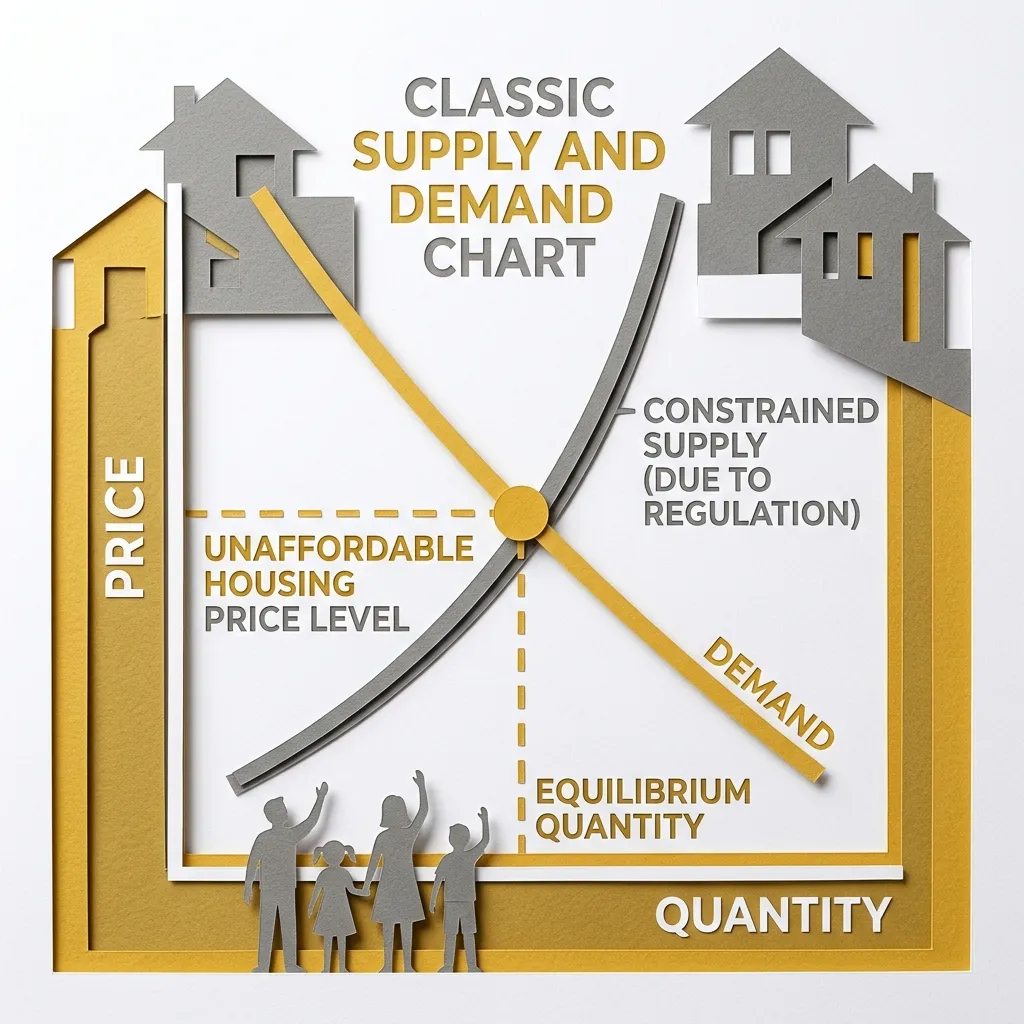
The most direct beneficiaries are existing homeowners in desirable areas. When the supply of housing in a metro area is legally constrained below the level that demand would support, the price of existing housing rises. Homeowners who bought before the shortage became acute see their property values increase. Because the largest single asset that most American middle-class families hold is their home, rising home values feel like good news to the people experiencing them. The fact that those rising values are the direct product of policies that exclude others from the neighborhood is not something most homeowners think about consciously. They experience it as the neighborhood staying the way it is.
The political economy of this is straightforward and well-documented. Homeowners vote at higher rates than renters. They attend more city council meetings. They participate in planning commission hearings. They form neighborhood associations that generate organized opposition to new development. When a developer proposes a new apartment building, a duplex conversion, or an accessory dwelling unit in a single-family neighborhood, the homeowners who would like their neighborhood to stay exactly as it is show up to oppose it. The renters who would benefit from lower prices if the housing were built either do not live there yet or, if they do, tend to be younger, more mobile, and less politically organized than the homeowner opposition.
This dynamic is so well-understood among housing researchers that it has its own name and taxonomy. YIMBY (Yes In My Back Yard) advocacy organizations have emerged across the country precisely to provide political counterweight to the NIMBY (Not In My Back Yard) opposition that typically dominates local planning processes. The struggle between these two tendencies is the central political conflict in housing policy, and the NIMBYs have an enormous structural advantage because they are organized, locally powerful, and in many jurisdictions the dominant voting bloc.
The second major beneficiary of restricted housing supply is the construction industry that does get to build. When the only new housing being permitted is expensive luxury construction (because the regulatory cost and delay makes it uneconomic to build anything cheaper), developers of luxury housing face less competition than they would in a deregulated market. The high-end builders who can navigate the permitting gauntlet have a structural advantage over smaller operators. This creates an ironic political alignment: some large construction and real estate interests benefit from the regulatory system they nominally oppose.
The losers are everyone trying to get into the housing market: young workers trying to move to high-opportunity cities, immigrants settling in metropolitan areas, working-class families being priced out of neighborhoods they have lived in for generations, and the economy as a whole, which loses the productivity gains that would come from workers being able to locate in the cities where their skills are most valuable. Chang-Tai Hsieh and Enrico Moretti’s 2019 paper “Housing Constraints and Spatial Misallocation,” published in the American Economic Journal, estimates that if housing regulations in New York, San Jose, and San Francisco were relaxed to the median level of American cities, national GDP would be approximately 2 percent higher because more workers would be able to move to the high-productivity cities where their labor is most valuable. Two percent of GDP is roughly $500 billion per year. The housing shortage is not merely a quality-of-life problem. It is an enormous economic drag on the entire country.
The Missing Middle: What Zoning Has Banned
One of the least-discussed aspects of the housing shortage is the specific housing types that single-family zoning has made illegal to build in most American cities. “Missing middle housing” is a term coined by architect and urban designer Daniel Parolek to describe the range of housing types that were common in American cities before the post-World War II era of suburban zoning but that are now prohibited in most residential neighborhoods: duplexes, triplexes, fourplexes, courtyard apartments, townhouses, and small apartment buildings of six to twelve units.
These housing types are “missing” in two senses. They are physically absent from most American neighborhoods built after about 1945. And they fill the middle of the density spectrum between the detached single-family house on one end and the large apartment tower on the other, a middle that zoning codes have systematically eliminated.
The significance of this missing middle is not just aesthetic. It is the natural form that affordability takes in a functioning housing market. A duplex costs less to build per unit than a detached house. A fourplex costs less per unit than a duplex. A small apartment building costs less per unit than a fourplex. As density increases, the cost of land (the most expensive component of urban housing) gets spread across more units, driving down the per-unit cost. Zoning codes that prohibit everything except single-family houses at one end and large apartment towers at the other have effectively banned the housing types that organically produce affordable housing without subsidies.
The same neighborhoods that prohibit duplexes often contain older duplexes and small apartment buildings built before current zoning took effect. This is not a coincidence. The zoning codes that ban these housing types were often written specifically to prevent more from being built, while grandfathering existing ones. The result is that these naturally affordable housing types exist only where they were built before the ban, they cannot be repaired or rebuilt if destroyed, and they gradually disappear through attrition as neighborhoods age.
Minneapolis became the first major American city to formally end single-family zoning when it adopted the Minneapolis 2040 Plan in 2018. The plan allows duplexes and triplexes on any residential lot across the city and removes minimum parking requirements, which had been a significant obstacle to infill development on small lots. A study using synthetic control methods, published in 2023, found that home prices and rents in Minneapolis grew 16 to 34 percent less than they would have in a counterfactual city that had not adopted the reforms. Austin, Texas, has allowed sixplexes in single-family zones and eliminated parking minimums for developments near transit, and has experienced a significant building boom accompanied by rent declines of approximately 22 percent from peak levels as of early 2026.
These results are not surprising to housing economists. They confirm what the basic economics of supply and demand predicts: when you allow more units to be built, more units get built, prices moderate relative to what they would have been, and the people who most need housing relief are the ones most likely to benefit from a looser market. The surprise is how long it took for even one major American city to try.

Rent Control: The Policy That Helps Some by Hurting Everyone Else
When housing becomes unaffordable, the most politically intuitive response is to cap the rent that landlords can charge. Rent control has a long history in American cities, dating back to World War II-era price controls, and it has expanded significantly in recent years as housing costs have surged. California passed statewide rent control legislation in 2019. Oregon followed. New York City’s rent stabilization system covers roughly one million apartments. Dozens of municipalities have adopted or expanded rent control ordinances in the past decade.
The political appeal of rent control is obvious: it protects existing tenants from being priced out of their homes. For a family living in a rent-stabilized apartment that they have occupied for years, the protection is real and meaningful. They can stay in their neighborhood. They do not face sudden displacement. Their housing costs remain predictable.
The economic problem with rent control is equally well-documented, and it is the opposite of what its advocates intend. Rent control helps the tenants who currently occupy controlled units. It harms the tenants who do not, and it harms the overall market by reducing the supply of housing it was designed to make affordable.
The most rigorous recent study of rent control’s effects is Diamond, McQuade, and Qian’s 2019 paper “The Effects of Rent Control Expansion on Tenants, Landlords, and Inequality: Evidence from San Francisco,” published in the American Economic Review. The study examined the expansion of San Francisco’s rent control ordinance in 1994 and used the sharp eligibility cutoffs created by the policy to create a natural experiment. The findings were clear and counterintuitive. Landlords subject to rent control reduced the supply of rental housing in San Francisco by 15 percent, primarily by converting rental units to condominiums, selling buildings for owner-occupancy, or redeveloping into exempt uses. This reduction in supply pushed up citywide rents by approximately 5.1 percent. The people who had rent-controlled apartments were 10 to 20 percent more likely to stay in their units than those in uncontrolled apartments. But the people who needed housing in San Francisco after the policy took effect faced a tighter, more expensive market because the total supply of rental housing had contracted.
The mechanism is not mysterious. A landlord who cannot raise rents to market levels faces reduced income from a property. The economic return on maintaining and investing in the property declines. The incentive to convert the property to a use that is not subject to the rent cap increases. Over time, rent-controlled housing deteriorates (because there is less money to maintain it), gets converted to condominiums or owner-occupied buildings (which are typically exempt from rent control), or gets demolished and replaced with a new building (which may be temporarily exempt under vacancy decontrol provisions). All of these responses reduce the supply of rental housing for new renters.
Rent control is also deeply regressive in ways that are rarely acknowledged in political debate. Because controlled apartments can be held by their occupants regardless of whether their incomes have changed, wealthy tenants who moved into controlled apartments when they were young and poor may continue to occupy them decades later, capturing the subsidy well after they no longer need it. In New York City, extensive journalism and policy research have documented the phenomenon of high-income tenants occupying rent-stabilized apartments in prime Manhattan locations. The subsidy flows to whoever happened to occupy the apartment first, not to whoever most needs affordable housing now.
The alternative framing is important: rent control is a transfer from landlords to the specific tenants who happen to occupy controlled units at the time the control takes effect or is expanded. It is not a mechanism for producing affordable housing broadly. It is a mechanism for freezing the distribution of affordable housing as it exists at one moment in time, while the broader market shrinks and becomes more expensive.
This does not mean that no displacement protection is ever appropriate. Policies like just-cause eviction requirements, which require landlords to have a legally recognized reason for ending a tenancy, and right-to-counsel programs that provide legal assistance to tenants facing eviction, protect tenants from arbitrary displacement without restricting the price at which landlords can offer new leases. These policies address legitimate concerns about tenant vulnerability without the supply-reducing effects of rent control.

The Permitting Maze: How Process Itself Became the Barrier
Even when local zoning technically allows new housing to be built, the permitting and approval process in many American jurisdictions has become a substantial barrier in its own right. California is the most extreme case, but it represents a tendency visible across most major metropolitan areas.
In San Francisco, a new apartment building requires approval from the Planning Department, the Building Department, the Historic Preservation Commission if the site is in a historic district, the Fire Department, the Department of Public Works, and potentially the Board of Supervisors if any appeal is filed. Each of these processes has its own review period, its own opportunity for appeals, and its own set of requirements that must be met before the next stage can begin. The California Environmental Quality Act (CEQA), originally intended to protect against genuine environmental harm from industrial development, has been interpreted and litigated into a tool that neighbors and competitors use to delay housing projects for years through mandatory environmental review requirements. A study by UC Berkeley’s Terner Center for Housing Innovation found that the average time from project application to final approval for a new apartment building in San Francisco exceeds three years, with many projects taking five or more.
These delays are not free. Carrying costs, the interest on construction loans, property taxes on idle land, and the salaries of the lawyers and consultants needed to navigate the approval process, add substantially to the final cost of every unit built. A 2020 study by McKinsey Global Institute estimated that regulatory barriers, delays, and compliance costs add an average of $200,000 to the cost of a new apartment unit in California’s major cities. This cost is ultimately paid by whoever rents or buys the unit, in the form of higher prices that reflect the full cost of building it through the regulatory gauntlet.
Other states have taken different approaches with different results. Texas has no statewide zoning enabling legislation; while Texas cities can and do zone, they face less permitting friction than California cities and have seen far more housing construction as a result. Houston, the nation’s fourth-largest city, has no traditional zoning ordinance at all, relying instead on private deed restrictions and market mechanisms to organize land use. Houston has built significantly more housing than comparable cities in California, has significantly lower housing costs despite comparable job growth and in-migration, and has not suffered the chaotic, dysfunctional development pattern that zoning advocates predict in the absence of regulation.
The comparison matters because it directly addresses the most common argument against loosening land use regulation: that without it, neighborhoods would be overrun by incompatible uses and the quality of life that makes them desirable would be destroyed. Houston’s experience suggests that this concern is overstated. Markets, private deed restrictions, and voluntary community standards do substantial work in organizing land use even without government zoning. The specific catastrophes that zoning advocates predict in Houston’s absence have not materialized. What has materialized is a city where working-class families can still afford to rent in desirable neighborhoods, where young workers can move without spending 40 percent of their income on housing, and where the housing stock has grown to accommodate population growth in ways that coastal cities have refused to allow.
The Federal Role: Tax Policy That Favors Owners Over Renters
State and local zoning gets most of the attention in housing policy debates, but federal tax policy also plays a significant role in the housing market, mostly by tilting incentives in favor of homeownership over renting and by making it easier to profit from land value appreciation than from actual housing production.
The mortgage interest deduction, which allows homeowners to deduct interest paid on mortgage debt from their federal taxable income, costs the federal government approximately $30 billion per year in forgone revenue. The deduction primarily benefits upper-income homeowners: the benefit is worth more to someone in the 37 percent tax bracket than to someone in the 12 percent bracket, and it is worth nothing to the roughly one-third of Americans who rent. Its primary economic effect is to increase the amount that buyers are willing to pay for homes (because mortgage interest is tax-deductible, buyers can afford to bid more), which raises home prices and benefits existing homeowners while further pricing out renters and first-time buyers.
The exclusion of capital gains from home sales up to $250,000 for individuals and $500,000 for couples similarly subsidizes home price appreciation. When a homeowner sells a house that has appreciated by $300,000 over fifteen years of ownership, they pay no capital gains tax on the first $250,000 of profit. A renter who invested the same money in stocks and achieved the same appreciation would pay capital gains tax on the full gain. This tax asymmetry is not justified by any principle of sound tax policy; it is an artifact of the political power of homeowners, who constitute roughly 65 percent of American households and vote at higher rates than renters.
The Low-Income Housing Tax Credit (LIHTC), which is the federal government’s primary tool for subsidizing affordable housing construction, is a legitimate but limited response to the shortage. LIHTC provides tax credits to developers who agree to keep a portion of units in new developments affordable to tenants earning below 60 percent of area median income. The program has produced approximately 3.5 million affordable units since its creation in 1986, making it the largest affordable housing program in the federal portfolio. But LIHTC housing is expensive to produce (the per-unit cost often exceeds market-rate construction because of the administrative complexity of the program), politically difficult to site (neighbors oppose it in high-opportunity areas for the same reasons they oppose any new affordable housing), and has nowhere near the capacity to address a shortage that runs into the millions of units in major metro areas.
The straightforward libertarian and economist’s argument on the federal tax side is twofold: eliminate or phase out the mortgage interest deduction and the capital gains exclusion on home sales, because they subsidize homeownership speculation at public expense and inflate home prices; and get the federal government out of the business of trying to subsidize its way to affordable housing supply, because the subsidy programs are too expensive and too limited to address a problem that is primarily regulatory rather than financial. If cities were allowed to build the housing their markets demand, LIHTC would be a supplemental tool for the most deeply affordable housing rather than the only mechanism available.
What Reform Actually Looks Like
The political framing of housing policy as a debate between those who want more government intervention (progressives favoring rent control and subsidized housing) and those who want to leave the market alone (conservatives favoring local control) misses the essential point: the market has not been left alone. It has been comprehensively regulated in ways that systematically suppress supply. The choice is not between a regulated market and an unregulated one. It is between the current dysfunctional regulation and different regulation that does not prevent housing from being built.
A reform agenda with a genuine track record and strong empirical support looks like this.
Legalize the missing middle. Every state should follow Minneapolis’s example and pre-empt local single-family-only zoning. Duplexes, triplexes, and small apartment buildings should be allowed by right on any residentially zoned lot. This does not require demolishing single-family neighborhoods; it allows them to evolve organically as individual properties are redeveloped or modified. Oregon has passed statewide missing-middle legislation. California has passed legislation allowing duplexes statewide, though implementation has been contested. More states need to act, because the political economy at the local level is too thoroughly captured by homeowner interests to produce reform through city councils.
Eliminate parking minimums. Mandatory parking minimums, which require developers to include a specified number of parking spaces per residential unit regardless of whether tenants need or want them, add between $20,000 and $50,000 per space to the cost of residential construction. They prevent the development of smaller lots that do not have room for the required parking. Minneapolis, Buffalo, and Hartford have eliminated parking minimums entirely. More cities and states should follow.
Reform permitting to limit appeals and mandatory review periods. California has moved toward “by right” permitting for projects that comply with existing zoning codes, meaning that compliant projects cannot be blocked by discretionary review or neighbor appeals. Extending this principle and reducing the avenues through which opponents can use environmental review and procedural challenges to delay projects would significantly reduce the cost and time required to build new housing.
Repeal rent control and replace it with just-cause eviction protection. Rent control reduces supply and helps only those already housed. Just-cause eviction requirements protect tenants from arbitrary displacement without reducing the incentive to build. The swap is a genuine improvement for renters taken as a group, even though it is politically costly because the current winners under rent control, incumbent tenants in controlled units, will oppose losing their subsidy.
Reform federal tax policy to stop subsidizing home price appreciation. Capping or eliminating the mortgage interest deduction and reducing the capital gains exclusion on home sales would remove tax incentives that inflate home prices and benefit existing homeowners at the expense of renters and first-time buyers.
None of these reforms is easy or politically costless. All of them face organized opposition from the groups that currently benefit from the housing shortage. But the evidence for their effectiveness is strong, the economic case for them is compelling across the ideological spectrum, and the human cost of maintaining the current system, measured in homelessness, excessive commutes, delayed family formation, reduced economic mobility, and crowded and degraded living conditions, is enormous.
The housing crisis is a government problem. It is also, therefore, a problem that government has the power to fix, not by spending more money or imposing new mandates, but by removing the legal barriers it has spent decades constructing.
A few distinctions matter here. Legalizing the missing middle, eliminating parking minimums, and reforming permitting are genuinely libertarian reforms: they remove government restrictions on what consenting owners can do with their own property. These recommendations have principled libertarian grounding. The recommendation to replace rent control with just-cause eviction protection is an improvement over price controls but is not libertarian, because it mandates lease terms on landlords and tenants who might prefer different arrangements. A landlord and tenant who agree to a month-to-month tenancy without cause-based protections are being overruled by a government mandate neither of them chose. The federal tax reforms, capping the mortgage interest deduction and capital gains exclusion, remove government distortions, which is good, but they operate as policy tools rather than simple reductions in state intervention. Readers should understand the zoning and permitting reforms as the libertarian core of this agenda, and the rest as pragmatic complements that address different dimensions of the problem with different degrees of alignment to market principles.
How Other Countries Handle Housing Policy: 11 International Models
The United States is not unique in facing housing affordability pressures, but it is unusual in the specific combination of regulatory barriers that drive its crisis. Looking at how other countries have organized land use and housing finance reveals approaches that range from more permissive zoning to more active government building programs to radical supply-oriented reform.
Japan is the international example that housing reformers in the United States most frequently cite. Japan’s land use system is set nationally rather than locally, creating a framework of use categories that applies uniformly across the country with local governments permitted to be more restrictive within but not beyond federal limits. Japan’s zoning code allows mixed residential-commercial uses at most density levels, and its national government periodically overrides local objections to housing construction. Tokyo, with a metropolitan population larger than California’s, has maintained relatively stable real housing costs over three decades during which San Francisco and New York tripled in nominal terms. Tokyo’s affordability comes from continuous and substantial construction: Tokyo builds more new housing units per year than the entire state of California, despite having comparable population. The lesson is that when supply is allowed to respond to demand, prices do not explode regardless of local opposition.
Germany has kept housing more affordable in its major cities than comparable U.S. metros not through rent control alone but through a combination of factors: a large private rental market that is culturally normalized (approximately 55 percent of Germans rent, compared to 35 percent of Americans), strong tenant protection laws that limit arbitrary eviction and require long notice periods, rent control in the form of “Mietpreisbremse” (rent brake) that limits rent increases for existing tenants, and substantial postwar social housing investment. German cities also have stronger traditions of allowing mixed-use development at moderate density than U.S. suburbs. Germany’s experience is complicated by increasing pressure in Berlin and Munich, where housing costs have risen significantly despite the regulatory framework. Germany imposed a five-year rent freeze in Berlin in 2020, which the Constitutional Court struck down, and since then housing costs have accelerated, illustrating the same pattern the San Francisco rent control research identified: price ceilings reduce supply.
Singapore solved its housing problem through the Housing Development Board (HDB), a government agency that built and sold subsidized apartments to most of the Singapore population. Approximately 80 percent of Singaporeans live in HDB flats, which they purchase through the Central Provident Fund. The Singapore model achieves near-universal housing stability but involves massive government control of land (the Singapore government owns approximately 90 percent of land), heavy subsidy from public budgets, and the absence of a market-driven rental sector for most of the population. Singapore’s model is not directly replicable in the United States, but its success illustrates that housing stability is achievable when treated as a genuine policy priority rather than a market outcome to be hoped for.
The Netherlands built a large social housing sector (over 30 percent of stock) that provides affordable rental housing to lower-income households, managed by non-profit housing associations (woningcorporaties). The Dutch sector is large enough to house households well above subsistence income, unlike U.S. public housing which is concentrated among the poorest. The Netherlands also restructured its mortgage market after the financial crisis to reduce overleveraging and speculative homeownership. The Dutch face their own housing shortage in major cities (Amsterdam, Utrecht, Rotterdam), which has been driven partly by restrictions on social housing expansion under EU state aid rules and partly by regional planning constraints.
Austria, particularly Vienna, maintains one of Europe’s largest social housing sectors. About 60 percent of Vienna’s residents live in either municipal housing (Gemeindebau) or subsidized cooperative housing. The Gemeindebau apartments house households across the income spectrum, not just the poorest, which prevents the concentration of poverty that characterizes U.S. public housing and maintains political support for the program across income groups. Vienna’s housing costs are among the lowest of any major European capital. The model requires sustained public investment and political commitment over decades but has produced exceptional stability.
Switzerland has some of the world’s highest housing costs in absolute terms, particularly in Geneva and Zurich, but Swiss incomes are correspondingly high. Switzerland has a large rental market, with approximately 60 percent of households renting. Swiss municipalities and cantons have significant control over zoning, and zoning in Switzerland tends toward lower density than comparable European cities, contributing to cost pressures. Switzerland has housing cooperatives that provide affordable housing to a portion of the population, and some cantons have taken steps to limit Airbnb and short-term rental conversion of long-term housing stock.
Finland is the global leader in Housing First policy, an approach to homelessness that provides permanent housing as the first intervention rather than conditioning housing on sobriety or program participation. Finland has largely eliminated chronic homelessness since adopting Housing First nationally in 2008, converting shelter beds to supportive housing units. Finland’s Housing First success does not directly address affordability for working households, but it demonstrates that political commitment to treating housing as a right rather than a market outcome can produce results that pure market approaches fail to achieve for the most vulnerable populations.
Australia faces its own housing crisis in Sydney and Melbourne, where median house prices exceed 10 times median annual earnings. Australia’s crisis shares causes with the U.S. version: restrictive local zoning, particularly in inner suburbs, long planning approval processes, high development fees and charges, and a tax system (through negative gearing and the 50 percent capital gains discount) that incentivizes housing investment speculation over owner-occupancy. Australian state governments have been moving toward supply-side reform including zoning changes to allow medium density near transit and streamlined approval processes. The Australian housing crisis demonstrates that the U.S. experience is not unique to American political culture.
The United Kingdom has long restricted housing supply through its planning system, which requires “planning permission” from local authorities for virtually any construction. Unlike U.S. zoning, which prohibits uses not specifically allowed, the UK system allows local authorities to deny any development they judge inappropriate, giving local opposition enormous power to block housing. The result has been chronic undersupply in London and other high-demand areas. The UK government under successive administrations has attempted to reform the planning system to allow more housing but has repeatedly retreated under pressure from Conservative MPs representing homeowner constituencies. England permitted approximately 200,000-250,000 new homes per year in recent years, well below the government’s stated target of 300,000.
France combines a large social housing sector (about 18 percent of stock, managed by HLM organizations) with private market construction that varies significantly by region. Paris has severe housing constraints driven by strict preservation requirements, height limits, and a long planning process. Greater Paris housing costs have risen substantially despite rent controls applied in Paris proper. Regional cities like Lyon, Bordeaux, and Toulouse have more accessible housing markets. France illustrates how a large city’s historical and architectural preservation goals can conflict with housing supply in ways that strict protections make very difficult to resolve.
Canada shares the U.S. pattern of local zoning control and is experiencing similar housing crises in Toronto and Vancouver. The Canadian federal government has made housing a priority since 2022, offering financial incentives to provinces and municipalities that accelerate zoning reform and permitting timelines. The “Housing Accelerator Fund” provides federal money to municipalities conditioned on allowing more housing to be built. Canada’s zoning reform experience is being watched by U.S. reformers as a federal-municipal model for incentivizing local supply.
What emerges from international comparison is that no model is problem-free. Countries with large social housing sectors (Austria, Singapore) have achieved stability but at the cost of sustained public investment and land ownership. Countries with supply-permissive systems (Japan) have maintained affordability through construction volume. Countries with restrictive zoning (UK, Canada, Australia) are experiencing housing crises similar to U.S. cities. The libertarian supply-oriented diagnosis applies across all these examples: when supply cannot respond to demand, prices rise regardless of the policy environment. The U.S. is not unusual in restricting supply, but it is unusual in the depth of its regulatory barriers and the degree to which those barriers are protected by local homeowner political power.
Go Deeper: Books by Alex Merced
The housing crisis is ultimately a case study in regulatory capture and concentrated-interest politics: the people who benefit from restricted housing supply have organized politically to maintain it, while those who pay the cost are dispersed, unorganized, and often not yet present in the communities that exclude them. Alex Merced has engaged all three of the frameworks needed to fully understand this dynamic.
Economic Ideas: From Beginning to Early 2026 develops the economic foundations that explain the housing shortage: supply and demand analysis, the economics of price controls (which is exactly what rent control is), the theory of regulatory capture that explains why local governments stay captured by homeowner interests, and the concept of the “zoning tax” that economists use to measure the price premium created by land use restrictions. The book provides the analytical toolkit for understanding why allowing more supply is the central answer to the affordability problem.
The Field Guide to Libertarianism applies libertarian first principles to exactly the kind of situation the housing crisis represents: a market that is not free but is systematically regulated against the interests of those with the least power, while the regulatory apparatus is maintained by those who benefit from it. The field guide makes the case that property rights, genuinely applied, require the right to build on your land and to rent to willing tenants, not merely the right to hold what you already have while blocking everyone else.
Political Thought and Debates of the United States traces the political history of zoning and land use regulation in American cities, including the documented history of how exclusionary zoning was used as a tool of racial segregation after race-explicit deed covenants became legally unenforceable, and how that legacy has persisted in the form of economic exclusion that maps closely onto racial exclusion. Understanding this history is essential to understanding why reform is politically difficult and why it matters.
All three are available on Amazon. The full catalog of Alex Merced’s work is at books.alexmerced.com.
Sources and Further Reading
-
Glaeser, Edward, and Joseph Gyourko. “The Impact of Building Restrictions on Housing Affordability.” FRBNY Economic Policy Review 9, no. 2 (2003): 21-39.
-
Glaeser, Edward. Triumph of the City: How Our Greatest Invention Makes Us Richer, Smarter, Greener, Healthier, and Happier. Penguin, 2011.
-
Diamond, Rebecca, Tim McQuade, and Franklin Qian. “The Effects of Rent Control Expansion on Tenants, Landlords, and Inequality: Evidence from San Francisco.” American Economic Review 109, no. 9 (2019): 3365-3394.
-
Hsieh, Chang-Tai, and Enrico Moretti. “Housing Constraints and Spatial Misallocation.” American Economic Journal: Macroeconomics 11, no. 2 (2019): 1-39.
-
Rothstein, Richard. The Color of Law: A Forgotten History of How Our Government Segregated America. Liveright Publishing, 2017.
-
Parolek, Daniel. Missing Middle Housing: Thinking Big and Building Small to Respond to Today’s Housing Crisis. Island Press, 2020.
-
Been, Vicki, Ingrid Gould Ellen, and Katherine O’Regan. “After 50 Years of Zoning Reform, Rental Housing Still Faces Exclusion.” Brookings Institution, 2023.
-
Furth, Salim. “Does Zoning Drive Up Housing Prices?” Mercatus Center Working Paper, 2020.
-
McKinsey Global Institute. “A Tool Kit to Close California’s Housing Gap: 3.5 Million Homes by 2025.” McKinsey and Company, 2016.
-
Terner Center for Housing Innovation. “The Costs of Permitting Delays in California Housing Development.” UC Berkeley, 2020.
-
Gyourko, Joseph, Albert Saiz, and Anita Summers. “A New Measure of the Local Regulatory Environment for Housing Markets.” Urban Studies 45, no. 3 (2008): 693-729.
-
Manville, Michael, Paavo Monkkonen, and Michael Lens. “It’s Time to End Single-Family Zoning.” Journal of the American Planning Association 86, no. 1 (2020): 106-112.
-
Kuhlmann, Daniel. “The Zoning Tax: How Land Use Regulation Drives Up Housing Prices.” Cato Institute Policy Analysis No. 946, 2022.
-
Salim Furth and Emily Hamilton. “Do Minimum Parking Requirements Make Housing More Expensive?” Mercatus Center, George Mason University, 2021.
-
Euclid v. Ambler Realty Co., 272 U.S. 365 (1926).
-
Shelley v. Kraemer, 334 U.S. 1 (1948).