TL;DR
- The minimum wage debate has been dominated by two oversimplified positions: the conservative view that any wage floor above the market rate must destroy jobs, and the progressive view that it does not matter what the wage floor is set at because raising it always helps workers. Both positions are wrong. The evidence is more nuanced, more context-dependent, and more interesting than either side acknowledges.
- The traditional competitive labor market model predicts that a wage floor above the market clearing rate will reduce employment. Card and Krueger’s landmark 1994 study challenged this prediction for small wage increases in local labor markets and sparked thirty years of research that has found more variable effects than the simple model predicted. The reason is that some labor markets are not perfectly competitive: employers in markets with monopsony power can hold wages below the competitive level, and a wage floor can raise wages without reducing employment in those conditions.
- What the evidence actually shows: small minimum wage increases in low-unemployment labor markets, applied at state or local level with adjustment for local cost of living, produce little measurable employment harm for most workers. Large, rapid increases, especially in lower-wage rural areas where the minimum wage represents a high fraction of median wages, are more likely to produce employment losses concentrated among workers with the least experience and skills. The debate about whether minimum wage increases help or hurt workers cannot be answered in the abstract. It depends on where, how much, and how fast.
- The libertarian case is not simply “minimum wages always destroy jobs.” It is that wage floors are a less efficient tool for improving the incomes of low-wage workers than wage subsidies like the Earned Income Tax Credit, because wage floors impose the cost of the subsidy on low-wage employers rather than spreading it across all taxpayers, which produces both employment distortions and distributional effects that do not serve the interests of the workers the policy is intended to help.
The federal minimum wage in the United States is $7.25 per hour, where it has stood since 2009. Inflation since 2009 has reduced the purchasing power of that wage by approximately 30 percent, which means the real federal minimum wage is lower today than it was fifteen years ago. It is lower, in real terms, than at almost any point since the 1950s when the modern minimum wage was established.
At the same time, dozens of states and hundreds of municipalities have set their own minimum wages above the federal floor. California’s minimum wage reached $16 per hour in 2024, with a separate $20 floor for fast food workers. Washington, D.C. has a $17 minimum. New York City has a $16 minimum with ongoing increases scheduled. Seattle set a $15 minimum in 2015, which at the time was among the highest in the country and was treated as an experiment whose results would be watched closely.
The result is that the United States is simultaneously running a large number of natural experiments in minimum wage policy, comparing states and localities with different wage floors, different rates of increase, and different labor market conditions. This body of evidence is the best empirical basis for understanding what minimum wages actually do, and it is substantially more complicated than either side in the political debate is willing to admit.
The Textbook Model and Why It Was Challenged
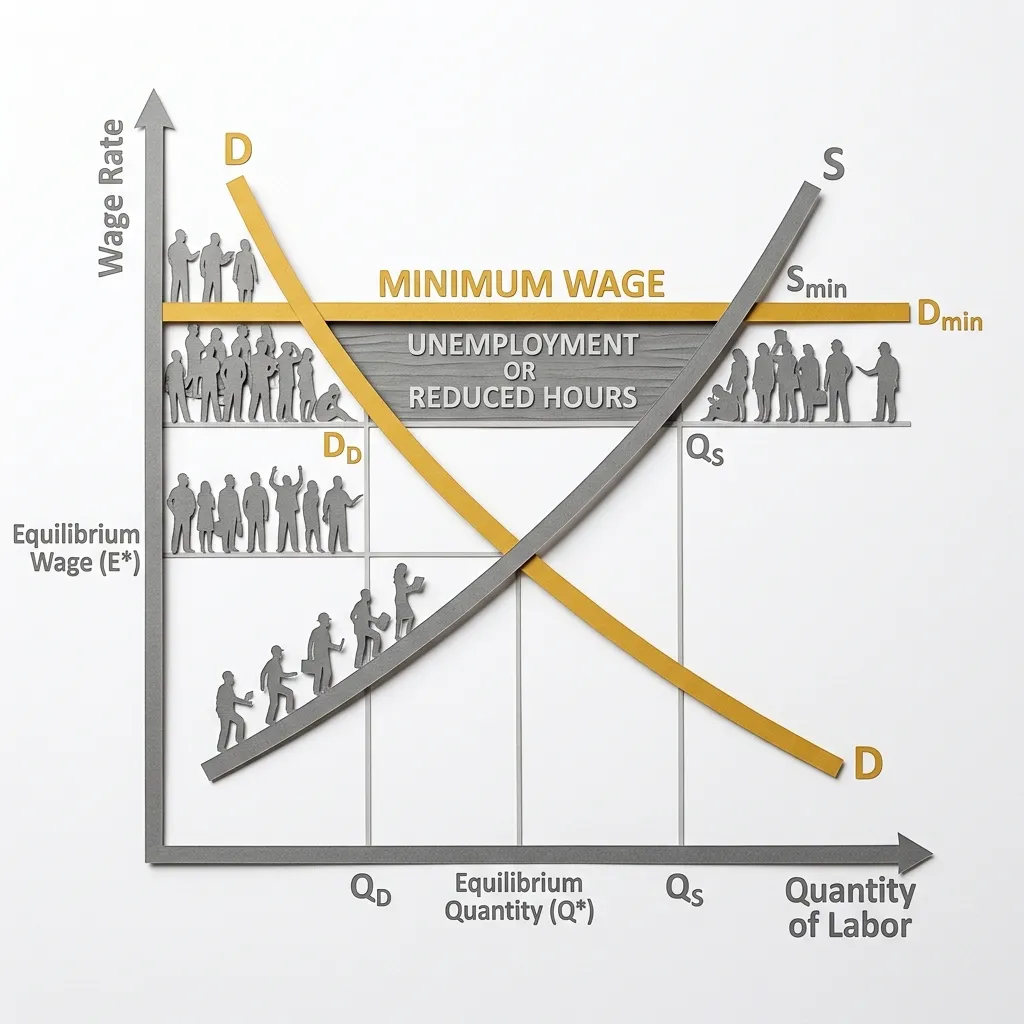
The economic case against minimum wages begins with the basic competitive labor market model. If employers are competing for workers in a labor market where both workers and employers can freely enter and exit, wages will settle at the level where the quantity of labor supplied equals the quantity of labor demanded: the competitive equilibrium wage. A wage floor imposed above this equilibrium will create a situation where more workers want jobs at the higher wage than employers want to hire, which is unemployment. The higher the floor above equilibrium, the larger the unemployment gap.
This prediction is intuitive, follows directly from standard supply and demand analysis, and was the dominant view among economists through the early 1990s. It implies that minimum wages, however well-intentioned, harm the workers they are supposed to help by reducing employment among the lowest-wage workers who are already the most economically vulnerable.
The challenge to this consensus came from David Card and Alan Krueger’s 1994 study of fast food employment in New Jersey and Pennsylvania. New Jersey raised its minimum wage in 1992 from $4.25 to $5.05 per hour. Pennsylvania, across the border, did not. Card and Krueger surveyed fast food restaurants in both states before and after the New Jersey increase and compared employment trends. They found no evidence that employment in New Jersey’s fast food industry fell relative to Pennsylvania’s after the wage increase. In some specifications, New Jersey employment appeared to increase.
The study was immediately controversial. Critics argued that survey data was unreliable, that the comparison group was poorly chosen, that the time period was too short to capture full employment effects, and that later studies using payroll data found negative effects that the survey-based study had missed. Neumark and Wascher, in particular, produced a series of studies using payroll data that found negative employment effects from the New Jersey increase that Card and Krueger’s survey had not detected.
The debate over the original study has never been fully resolved, but it shifted the terms of the broader research program. If some careful researchers found no employment effect from a moderate minimum wage increase in New Jersey’s labor market in 1992, the simple competitive model was not the whole story.
Monopsony: Why the Simple Model Is Sometimes Wrong
The theoretical reason that Card and Krueger’s result is possible without violating economic logic is monopsony. A monopsony in a labor market is a situation where one employer, or a small group of employers, has substantial market power over wages because workers do not have competitive alternative employment options.
In a perfectly competitive labor market, if one employer tries to hold wages below the market rate, workers simply take jobs at competing employers who offer the market wage. The competitive pressure forces all employers to pay the competitive wage. But in a market with a single dominant employer, or where workers face significant costs of switching employers (geographic immobility, search costs, industry-specific skills, non-compete agreements), the dominant employer can hold wages below the competitive level. In this monopsony environment, a wage floor does not destroy employment the way it would in a competitive market: instead, it corrects the wage suppression that the employer’s market power allows.
The monopsony model predicts that in markets where employers have wage-setting power, a minimum wage increase up to the competitive equilibrium level can actually increase both wages and employment by correcting the distortion. Beyond the competitive equilibrium, even in a monopsony market, employment will eventually fall as the floor exceeds the point that profit-maximizing employment would support.
Monopsony power in labor markets is not limited to single-company towns. Economists including Alan Manning, Arindrajit Dube, and Lawrence Katz have argued that monopsony-like conditions are widespread in low-wage labor markets because of search frictions (workers do not instantly know about all available jobs), geographic immobility (especially for workers without cars or with family caregiving responsibilities), employer non-compete agreements (which are surprisingly common even in low-wage occupations), and industry-specific norms. If low-wage labor markets exhibit more monopsony characteristics than the simple competitive model assumes, the employment effects of moderate minimum wage increases will be smaller, and possibly nonexistent, than the competitive model predicts.
The empirical debate has not settled whether low-wage labor markets are better described by competitive or monopsony models. Both camps can point to studies supporting their position. The honest conclusion is that labor markets are heterogeneous: some are more competitive and some are more concentrated, and the employment effects of minimum wage increases will differ accordingly.

What the Seattle and California Experiments Actually Show
The state and local minimum wage increases of the past decade have provided the most direct evidence available on the employment effects of larger minimum wage increases in high-cost labor markets.
Seattle’s 2015 increase to $15 per hour generated two prominent studies with conflicting conclusions. A study by researchers at the University of Washington, using state administrative payroll data, found that the Seattle increase did reduce hours worked in low-wage industries, with workers in affected industries losing an average of approximately $125 per month in earnings because the hours reduction partially offset the wage gain. A second study by researchers at the University of California, Berkeley, examining restaurant industry employment specifically, found no significant reduction in restaurant employment in Seattle relative to comparable counties. The two studies reached different conclusions partly because they were measuring different things: one looked at hours in all low-wage industries, the other looked at headcount in the restaurant sector only.
The Seattle data illustrates a general pattern in minimum wage research: the effect on employment measured in jobs may be small while the effect on hours worked may be larger. Employers can respond to a minimum wage increase by cutting hours as well as positions, and cuts in hours are harder to detect in employment count data but represent real reductions in worker earnings. If the goal of a minimum wage increase is to raise the annual income of low-wage workers, cuts in hours can undermine that goal even when the wage increase does not reduce the number of workers employed.
California’s $20 fast food wage that took effect in April 2024 is the largest minimum wage experiment in the current wave of state increases. Early data through mid-2024 showed no significant surge in fast food layoffs in aggregate, but did show restaurant closures in some markets, price increases in others, and the introduction of kiosk ordering systems at a faster rate than comparable states. Whether the long-term employment effects become visible over a longer time horizon than early studies can capture is an open empirical question.
The Dube-Lester-Reich research program, which has produced many of the studies finding no significant employment effects from state minimum wage increases, consistently emphasizes that the comparison group matters enormously. Studies comparing high-minimum-wage states to all other states may be comparing high-cost labor markets to low-cost ones where economic conditions are fundamentally different. Studies comparing counties on opposite sides of state borders, where economic conditions are more comparable, tend to find smaller employment effects. The methodological debate about how to identify valid comparison groups is ongoing and unresolved.
The Geography Problem: Why One Federal Floor Does Not Fit All
One of the most important and least-discussed aspects of the minimum wage debate is that the economic impact of any given wage floor is not constant across the country because the cost of living and the median wage level vary enormously by region.
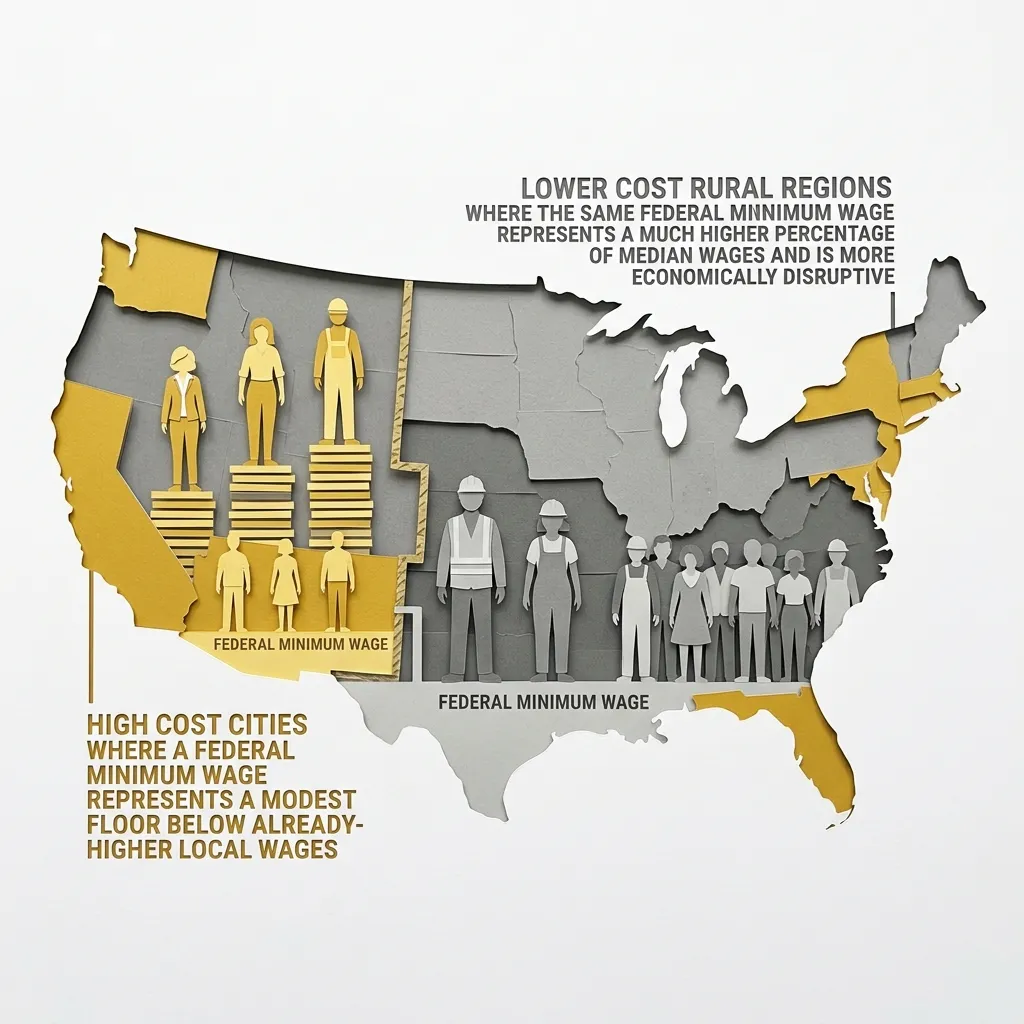
A $15 federal minimum wage would represent approximately 52 percent of the median wage in the Seattle metropolitan area, where the median worker earns approximately $29 per hour. In rural Mississippi, the same $15 minimum wage would represent approximately 77 percent of the median wage. Basic economic analysis predicts that a minimum wage set at a higher fraction of the median wage will produce larger employment effects, because more workers and employers are directly affected by the constraint and fewer workers are earning above the floor already.
The Congressional Budget Office modeled the employment effects of a $15 federal minimum wage in 2021 and estimated that it would lift approximately 900,000 workers out of poverty while reducing employment by approximately 1.4 million workers. The CBO analysis was careful to note that these are net effects: millions of workers would see wage increases that improved their circumstances, while a smaller number would lose jobs or hours. Whether the net result is positive or negative depends in part on value judgments about how to weigh gains for some workers against losses for others, and in part on empirical questions about the exact magnitude of employment effects that the research does not resolve.
The variation across the country in labor market conditions is the strongest argument for allowing minimum wages to be set at the state and local level rather than by federal mandate. A state like Mississippi can set a minimum wage that reflects the cost of living and median wages in Mississippi’s labor markets. A state like California can set a higher minimum wage that reflects California’s higher costs. When a federal minimum wage is set, it effectively forces every employer in every local labor market to face the same floor regardless of local conditions, which is likely to produce employment disruptions in low-wage rural areas while being largely irrelevant in high-wage urban ones.
The Better Tool: Wage Subsidies Over Wage Floors
The libertarian critique of minimum wages is not simply that they destroy jobs. It is that they are a less efficient and less well-targeted tool for improving the incomes of low-wage workers than the available alternatives, and that their costs and benefits are distributed in ways that do not serve the interests of the workers they are supposed to help.
A minimum wage is a mandate imposed on employers of low-wage workers. It requires those employers to pay more for labor than the market would otherwise produce. The cost of this mandate falls on the employers who hire at the minimum wage level, primarily small businesses in labor-intensive service industries: restaurants, retail stores, cleaning services, home care. These are not, on average, highly profitable industries. The incidence of the minimum wage cost falls partly on employers (through reduced profits or accelerated exit), partly on workers (through reduced hours and employment), partly on consumers (through higher prices), and partly on investors who withdraw capital from industries whose returns fall below their threshold.
The Earned Income Tax Credit (EITC), by contrast, is a wage subsidy paid to low-income workers by the federal government through the tax system. A worker who earns low wages receives a credit that supplements their income, funded by general tax revenues rather than by their employer specifically. The EITC reaches workers in a broader range of situations, including self-employed workers and workers whose employer would go out of business if faced with a minimum wage mandate, and it is explicitly targeted at low-income households rather than all minimum wage earners (many of whom, it should be noted, are teenagers in middle-class households rather than primary breadwinners in poverty).
Research by economists Jeffrey Grogger, Nada Eissa, and others has found that the EITC increases work incentives at the low end of the income distribution by making work more financially rewarding relative to not working. The minimum wage, by contrast, reduces employers’ demand for low-wage labor, which may reduce work incentives for workers at the margin between employment and non-employment.
The political preference for minimum wage mandates over EITC expansion reflects several factors: minimum wage mandates impose costs on businesses rather than on government budgets (making them attractive to politicians who want to appear pro-worker without spending money), they are simpler to explain and defend, and they are associated with labor unions whose members earn above the minimum but benefit from the compression it creates in wage structures. None of these factors reflects the interests of the lowest-wage workers who bear the risk of employment losses.
A comprehensive approach to improving the incomes of low-wage workers would combine a modest state-level minimum wage (set at an appropriate fraction of the local median wage rather than at an absolute dollar level) with robust EITC expansion, reduction in occupational licensing barriers that prevent low-income workers from entering higher-paying trades, and elimination of the payroll tax on the first $20,000 of earned income, which would provide the equivalent of a significant wage increase to the lowest-paid workers without requiring employers to reduce hiring.
What an Honest Policy Position Looks Like
The people who argue most loudly about the minimum wage tend to be the ones most willing to misrepresent the evidence. The progressive who insists that no minimum wage increase can ever harm any worker is not engaging honestly with the research. The conservative who insists that any minimum wage must destroy jobs and therefore the floor should be eliminated is not engaging honestly with the research either. The evidence is more nuanced.
A defensible policy position on minimum wages acknowledges several things:
The real value of the federal minimum wage has fallen significantly since 2009 due to inflation. Indexing the minimum wage to inflation is basic policy hygiene that would prevent the repetition of long periods during which the real value erodes without any legislative action.
The optimal level of the minimum wage varies by local labor market conditions. Federal minimum wages should be floors, not mandates to eliminate state and local variation. States with higher costs of living should be free to set higher minimums. States with lower costs of living may be better served by lower floors that allow their labor markets to allocate work more efficiently.
Large, rapid minimum wage increases in low-wage areas are more likely to produce employment harm than small, gradual increases in high-wage areas. The research consensus on this point is stronger than the research consensus on the average effect.
The EITC is a more efficient and better-targeted tool for improving low-income workers’ incomes than the minimum wage, and should be expanded rather than treated as a substitute for thinking seriously about wage policy.
And finally: the most important determinant of wages at the bottom of the income distribution is the overall tightness of the labor market. When unemployment is low and employers are competing for workers, wages at the bottom of the distribution rise without mandates. Policy that maintains full employment through sound macroeconomic management does more for low-wage workers than any particular wage floor, because it puts workers in a position to demand and receive better wages through the normal operation of labor market competition.
Being honest about where this agenda lands: preferring the EITC over wage mandates is a better policy choice, not a libertarian one. The EITC is a government wage subsidy paid by general taxpayers. Preferring state-level minimum wages over federal mandates aligns with federalist principles, but state minimum wages are still government interventions in voluntary agreements between workers and employers. The pure libertarian position is that wage floors are an illegitimate interference in contracts between adults. The libertarian approach to improving wages at the bottom of the distribution is to remove the barriers that suppress workers’ ability to earn more: occupational licensing restrictions that block entry to higher-paying trades, immigration policies that reduce labor market options, employer non-compete clauses that limit worker bargaining power, payroll taxes that raise the cost of hiring low-wage workers, and policies that tie benefits to specific jurisdictions and reduce worker mobility. Neither the EITC nor a state-level minimum wage is a libertarian solution. The recommendations here are pragmatic improvements worth pursuing. Readers should understand them as steps toward good policy, not as the libertarian endpoint.
How Other Countries Set and Enforce Minimum Wages: 11 Approaches
The United States debates a single national minimum wage for a continent-spanning economy with enormous regional variation. Other countries have developed more nuanced approaches that illuminate both the range of possibilities and the tradeoffs involved.
Denmark and Sweden have no statutory national minimum wage at all, which frequently surprises Americans who assume that Nordic social models rely on government wage floors. Instead, wages at every level are determined through collective bargaining between unions and employer associations in sectoral agreements covering most workers. Danish workers typically earn a de facto minimum around $22 per hour equivalent through these agreements, well above any U.S. proposal. The model depends on high union density (approximately 67 percent in Denmark, 60 percent in Sweden) and a cultural norm of negotiation rather than legislation. The Nordic experience suggests that wage floors are not the only way to ensure workers earn living wages, but replicating the conditions that make collective bargaining work this effectively is a distinct policy challenge.
France sets its minimum wage through the SMIC (Salaire Minimum Interprofessionnel de Croissance), which is automatically indexed to inflation plus half of any increase in blue-collar purchasing power. The SMIC applies nationally at a single rate: approximately 11.65 euros per hour in 2024. France also requires that any collective bargaining agreement produce wages above the SMIC. The French system produces one of the highest minimum wages as a share of median wages among OECD countries, at roughly 63 percent of median earnings. French labor economists have noted that this high ratio is associated with significant youth and low-skill unemployment, as employers substitute capital for labor when the floor is set very high relative to productivity.
Germany introduced a national minimum wage only in 2015, after decades without one (relying, like the Nordic countries, primarily on collective bargaining). The initial rate of 8.50 euros was set cautiously. Research on the impact of Germany’s minimum wage has generally found modest negative employment effects for very low-wage workers in certain sectors, concentrated in domestic services and some agricultural regions. Germany adjusts its minimum wage through an independent commission (the Mindestlohnkommission) that meets every two years and considers economic conditions, avoiding the U.S. pattern of long periods without adjustment followed by sudden large increases.
The United Kingdom introduced the National Living Wage in 2016, targeting workers age 25 and over, and has progressively raised it toward two-thirds of median earnings. The Low Pay Commission, an independent body of employer and union representatives, recommends the rate annually based on economic evidence. The UK’s approach has been to raise the minimum wage faster than historical norms while monitoring employment effects carefully and adjusting the trajectory if evidence of harm appears. The U.K. experience through 2024 showed minimal aggregate employment effects, though with some negative effects in care work and hospitality.
Australia sets its minimum wage through a process managed by the Fair Work Commission, which conducts annual reviews and issues National Minimum Wage Orders. Australia’s minimum wage is one of the world’s highest in absolute terms, at approximately $23.23 Australian dollars per hour (roughly $15 USD). It applies with industry-specific award rates for many sectors that may be higher. Employers can seek special provisions for workers with disabilities. Australia’s high minimum wage has coexisted with relatively low unemployment, partly because the country’s strong resource economy sustains wage levels that would produce more employment disruption in less productive economies.
Switzerland has no national statutory minimum wage but several cantons have introduced cantonal minimums following referendum campaigns. Geneva, for example, set a minimum of 24 Swiss francs per hour in 2020 (approximately $27 USD), making it among the world’s highest. The Swiss national government has not intervened, respecting cantonal autonomy. The Swiss experience illustrates that geographic variation in minimum wages is not uniquely American: federal systems produce variation when wage setting is decentralized, and that variation broadly tracks regional cost of living and labor market conditions.
Japan sets regional minimum wages, with the national government specifying a floor that prefectures must meet or exceed. Regional wages vary substantially: Tokyo’s minimum is around 1,113 yen per hour (approximately $7.50 USD), while rural prefectures hover near the national floor of around 900 yen. Japan has gradually increased its minimum wages under government pressure, aiming to reach 1,000 yen nationally. Japan’s segmented labor market, with a large share of part-time and irregular workers who have fewer protections than regular full-time workers, creates distributional concerns that the minimum wage alone cannot address.
South Korea adopted a national minimum wage in 1988 and has substantially increased it in recent years. The government of President Moon Jae-in committed to raising the minimum wage to 10,000 won per hour by 2022, reflecting about an 85 percent increase from the 2017 level. Research on South Korea’s minimum wage increases found significant employment losses among self-employed workers and in low-wage service sectors, particularly in small urban businesses. South Korea’s experience is a cautionary data point for large, rapid minimum wage increases: the employment effects that were modest when increases were gradual became more pronounced when they were compressed into a short timeframe.
New Zealand uses a minimum wage set by the government through an annual review, with separate adult, starting-out, and training rates. New Zealand abolished its starting-out rate for 16- and 17-year-olds in 2016 in response to concerns that it was used to undercut the wages of adult workers. The adult minimum wage was raised substantially in recent years, reaching NZD $22.70 per hour in 2024. Researchers at the New Zealand Treasury have noted mixed employment effects, with stronger negative impacts in retail and hospitality than in other sectors.
Brazil sets its national minimum wage annually through presidential decree, adjusted for the prior year’s inflation and the real GDP growth rate from two years earlier. The minimum wage functions as a floor not only for private employment but also for social security benefits and the government pension, which creates powerful political pressure to raise it. Brazil’s minimum wage policy has reduced earnings inequality significantly since the early 2000s but has also been associated with high informality in the labor market, as employers avoid formal employment to escape mandated costs.
The Netherlands uses a statutory minimum wage set by the government twice yearly, indexed to average wage increases. The Dutch minimum wage in 2024 was approximately 13.27 euros per hour for workers over 21. Notably, the Netherlands maintains youth minimum wages set as fixed percentages of the adult minimum, declining from 85 percent for 20-year-olds to 50 percent for 15-year-olds. This age graduation reflects a policy judgment that inexperienced workers can be employed at lower rates without displacing adult workers. The Dutch youth minimum has faced repeated political pressure to eliminate it.
What emerges from international comparison is that the United States’ approach of setting a single national floor and then not adjusting it for long periods is unusual. Most comparable countries either index their minimum wages automatically or review them annually through independent expert bodies. The combination of geographic rigidity and infrequent adjustment makes the U.S. federal minimum wage particularly ill-suited to the country’s regional economic variation.
Automation and the Minimum Wage: The Long-Run Effect Nobody Wants to Discuss
The minimum wage debate is almost entirely conducted in terms of what happens in the months after a wage increase takes effect. The more important question, and one that the research literature is only beginning to address seriously, is what happens in the five to ten years after a wage increase, particularly as automation technology becomes more capable and less expensive.
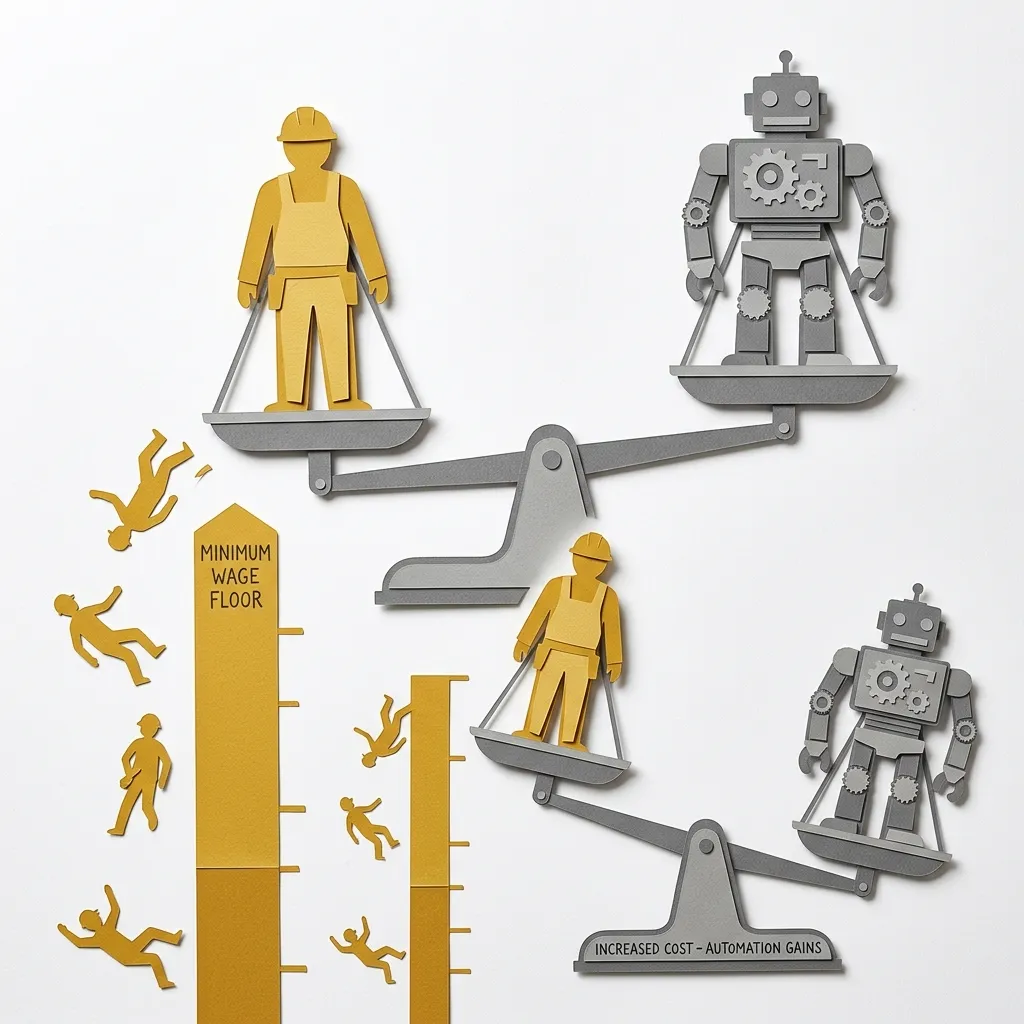
The canonical study of minimum wage effects looks at employment levels in industries employing minimum wage workers before and after a wage increase and compares them to similar industries in states or localities that did not experience an increase. This research design can detect short-run employment effects, and the debate over whether those effects are positive, negative, or zero is genuine and unresolved. What it cannot detect is the gradual substitution of capital for labor that occurs as businesses respond to higher labor costs not by firing workers immediately but by investing in automation that allows them to employ fewer workers over time as equipment replaces labor in tasks that technology can handle.
The evidence of this gradual substitution is mounting in restaurant, retail, and logistics industries. Self-checkout kiosks in grocery stores and fast food order kiosks in restaurants deployed faster in states and cities with higher minimum wages. Warehouse automation investment accelerated as e-commerce labor costs rose. Truck platooning and routing optimization technologies that reduce driver hours are most aggressively adopted by logistics companies facing higher driver costs. None of these investments register in the short-run research that dominates the minimum wage empirical debate.
The workers most likely to be displaced by automation-as-response-to-minimum-wage are not the typical minimum wage worker of economic modeling. They are the specific workers performing tasks that are most amenable to automation: routine physical and cognitive tasks that can be structured into workflows that machines can handle. These tend to be workers in the lower middle of the wage distribution, slightly above the minimum wage itself, who perform tasks that become economically worth automating when labor costs rise. The minimum wage intended to help workers at the bottom of the distribution may be accelerating displacement of workers in the tier just above it.
This is not an argument against ever raising the minimum wage, since the same automation pressures operate at any wage level and eventually affect all workers. It is an argument for intellectual honesty about the full set of effects that minimum wage increases produce over long time horizons, and for not dismissing automation displacement as a theoretical concern when the evidence of its occurrence is increasingly available in the data.
Go Deeper: Books by Alex Merced
The minimum wage debate is ultimately a debate about how labor markets work, when competitive models are accurate predictors, when they are not, and what policy tools actually improve the economic situation of the workers who are most vulnerable. All three of Alex Merced’s books engage directly with these questions.
Economic Ideas: From Beginning to Early 2026 covers labor market economics in depth: competitive and monopsony models of wage determination, the economics of price floors applied to labor markets, the theory and evidence on the EITC as a wage subsidy, and the broader relationship between macroeconomic policy and wages at the bottom of the distribution. This is the analytical foundation for evaluating the minimum wage debate honestly rather than tribally.
The Field Guide to Libertarianism develops the libertarian position on minimum wages not as a simple rejection of all wage floors but as a framework for understanding why wage mandates impose costs on the most vulnerable employers of low-wage workers, why the incidence of those costs falls in ways that do not reliably benefit the target population, and why the EITC and full employment are superior policy tools for the actual goal of improving life for low-wage workers.
Political Thought and Debates of the United States traces the political history of the minimum wage from its origins in progressive-era reform movements through the New Deal debates and the decades of congressional battles over increases, explaining why the minimum wage has become a political symbol whose importance to both sides far exceeds its practical economic impact and why the politics of wage policy are so resistant to evidence.
All three are available on Amazon. The full catalog of Alex Merced’s work is at books.alexmerced.com.
Sources and Further Reading
-
Card, David, and Alan B. Krueger. “Minimum Wages and Employment: A Case Study of the Fast-Food Industry in New Jersey and Pennsylvania.” American Economic Review 84, no. 4 (1994): 772-793.
-
Neumark, David, and William L. Wascher. Minimum Wages. MIT Press, 2008.
-
Dube, Arindrajit, T. William Lester, and Michael Reich. “Minimum Wage Effects Across State Borders: Estimates Using Contiguous Counties.” Review of Economics and Statistics 92, no. 4 (2010): 945-964.
-
Congressional Budget Office. “The Effects on Employment and Family Income of Increasing the Federal Minimum Wage.” CBO, 2021.
-
Jardim, Ekaterina, et al. “Minimum Wage Increases, Wages, and Low-Wage Employment: Evidence from Seattle.” Quarterly Journal of Economics 137, no. 4 (2022): 2301-2355.
-
Reich, Michael, et al. “Minimum Wages and Employment: Evidence from the Seattle-Tacoma-Bellevue Metropolitan Area.” UC Berkeley Institute for Research on Labor and Employment, 2017.
-
Manning, Alan. Monopsony in Motion: Imperfect Competition in Labor Markets. Princeton University Press, 2003.
-
Dube, Arindrajit. “Minimum Wages and the Distribution of Family Incomes.” American Economic Journal: Applied Economics 11, no. 4 (2019): 268-304.
-
Eissa, Nada, and Jeffrey B. Liebman. “Labor Supply Response to the Earned Income Tax Credit.” Quarterly Journal of Economics 111, no. 2 (1996): 605-637.
-
Meer, Jonathan, and Jeremy West. “Effects of the Minimum Wage on Employment Dynamics.” Journal of Human Resources 51, no. 2 (2016): 500-522.
-
Cengiz, Doruk, et al. “The Effect of Minimum Wages on Low-Wage Jobs.” Quarterly Journal of Economics 134, no. 3 (2019): 1405-1454.
-
Autor, David. “Skills, Education, and the Rise of Earnings Inequality Among the ‘Other 99 Percent.’” Science 344, no. 6186 (2014): 843-851.
-
Bernstein, Jared. “The Employment Effect of Minimum Wages: Evidence from Recent State Labor Market Trends.” Economic Policy Institute, 2014.
-
Aaronson, Daniel, and Brian J. Phelan. “Wage Shocks and the Technological Substitution of Low-Wage Jobs.” Economic Journal 129, no. 617 (2019): 1874-1904.
-
Winship, Scott. “Revisiting the Minimum Wage-Employment Debate: Throwing Out the Baby with the Bathwater?” IZA Journal of Labor Policy 4, no. 1 (2015): 1-36.