TL;DR
- Prohibition is a policy argument that crosses every political line, applied at one point or another by progressives, conservatives, and everyone in between. It is also a policy that produces the same results regardless of which side of the political spectrum applies it: black markets, increased violence, degraded safety, eroded civil liberties, and enriched criminal intermediaries.
- The drug war, immigration restrictions, firearms regulations targeted at lawful buyers, and restrictions on reproductive healthcare all follow this same structural logic. None of them eliminate the demand. All of them transfer supply to unregulated, often dangerous actors.
- The Loveatarian does not take a position on whether you should use drugs, cross a border, own a gun, or end a pregnancy. It takes a clear position on one thing: prohibition does not work, and the costs it imposes fall on the most vulnerable people, not on the behavior the law is targeting.
The argument against prohibition is not new. It has been made with great precision in the context of alcohol since the 1920s, in the context of drugs since at least the 1970s, and by economists and historians across a much longer sweep of time. What is less often recognized is that the argument does not depend on the specific thing being prohibited. It is structural. It describes what happens to any market where the state attempts to suppress voluntary behavior through criminalization, regardless of what that behavior is.
This article applies the full prohibition argument to four domains where it is usually treated as four separate debates: drugs, immigration, firearms, and bodily autonomy. They are not separate debates. They are the same debate, running in parallel, producing the same outcomes, and demanding the same structural understanding.
The Logic of Prohibition: What Always Happens
Before turning to specific examples, it is worth laying out the structure of the argument precisely, because it is the structure, not the moral valuation of any particular behavior, that does the analytical work.
When the state prohibits a voluntary behavior for which significant demand exists, the prohibition does not eliminate the demand. Demand is driven by human need, desire, economic incentive, and circumstance. Laws change what is legal; they do not reliably change what people want. What prohibition reliably changes is the supply side: who provides the good or service, how it is produced, and under what conditions.
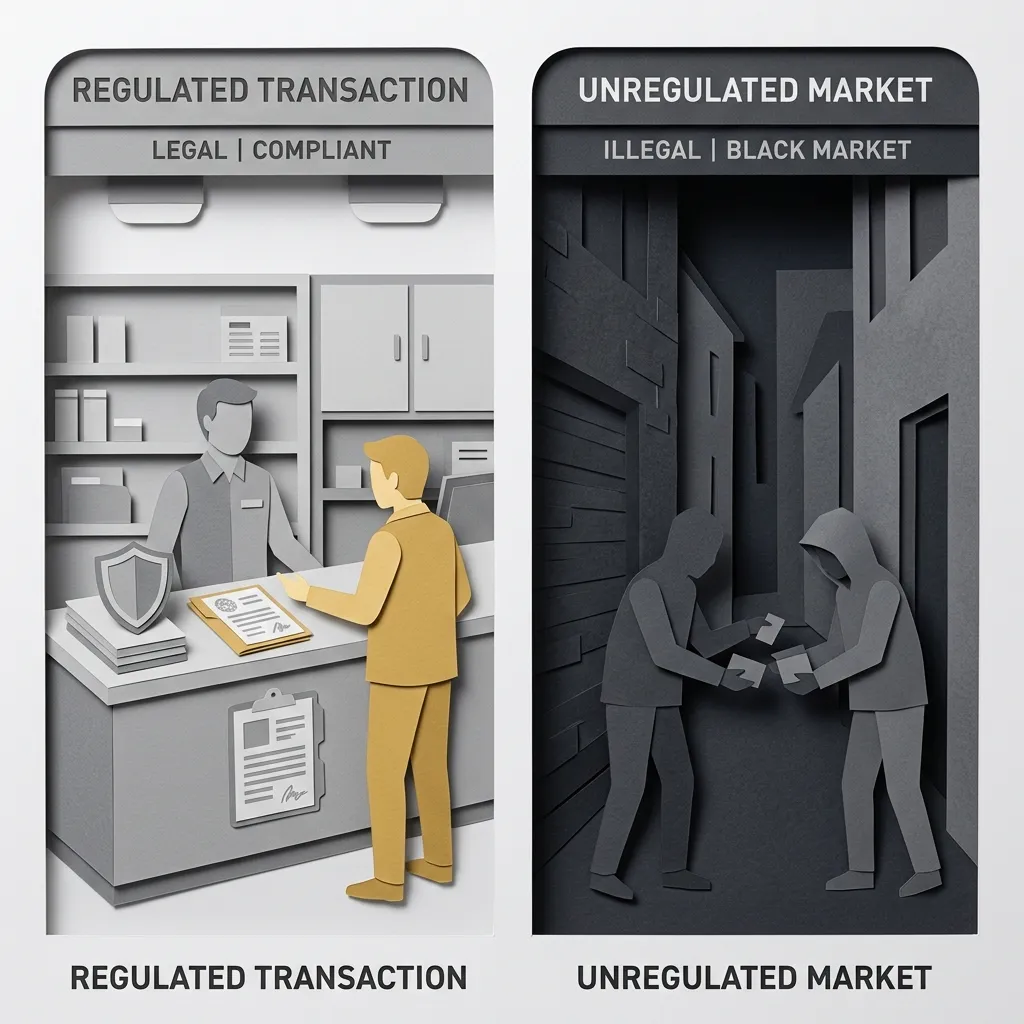
When legal supply is eliminated, black market supply fills the gap. The black market differs from the legal market in one fundamental way: it cannot use the legal system. A black market participant cannot go to court to enforce a contract. A black market buyer cannot call a regulator if the product is dangerous. A black market competitor cannot sue a rival for fraud. All the mechanisms that legal markets use to resolve disputes, enforce standards, and protect participants are unavailable. What remains is informal: reputation, community pressure, and, when those fail, force.
The consequence is predictable and well-documented across every domain where prohibition has been tried:
Black markets create criminal enterprises. Supplying a prohibited good is profitable precisely because prohibition limits competition. The suppliers who remain are those willing to accept the legal risk and the violence that comes with unregulated market operation. Organized crime is not a cause of black markets; it is the form that supply takes when legal organization is prohibited.
Violence increases. When disputes cannot be resolved legally, they are resolved physically. The correlation between drug market territory disputes and homicide is one of the strongest in criminology. The same logic applies to every other black market: smuggling organizations, clandestine providers, and their competitors resolve conflicts with force because no other resolution mechanism is available to them.
Quality control disappears. A legal market has to compete for customers over time. Producers who make dangerous products face lawsuits, regulatory action, and loss of business. Black market producers face none of these constraints. The buyer has no recourse and often no information about what they are getting. This is why prohibition-era alcohol was frequently adulterated and deadly. It is why fentanyl contamination has made modern drug prohibition more lethal than at any previous point in American history. It is why reproductive procedures performed outside clinical settings are far more dangerous than those performed within them.
Civil liberties erode. Enforcement of prohibition requires surveillance, searches, seizures, informant networks, and the suspension of normal legal protections in the name of combating the prohibited activity. The War on Drugs has produced stop-and-frisk policing, no-knock raids, civil asset forfeiture, mass incarceration, and the systematic racial profiling of communities of color. Immigration enforcement has produced family separation, indefinite detention, warrantless searches in border zones that extend 100 miles inland (covering two-thirds of the U.S. population), and the militarization of domestic law enforcement. Prohibition’s enforcement apparatus always expands far beyond the specific activity being prohibited, because prohibition is structurally very difficult to enforce.
The most vulnerable people pay the highest price. Prohibition’s costs do not fall equally. The wealthy can find ways around almost any prohibition: international travel, private medical providers, legal cover, connections. The poor and the marginalized pay the full cost: the dangerous black market, the criminal record, the detention, the unsafe procedure, the desperate desert crossing.
These are not accidental side effects of imperfect implementation. They are structural consequences of the policy itself, and they recur every time the policy is applied.

Drugs: Fifty Years of Evidence
The United States declared a War on Drugs in 1971. The federal government has spent more than one trillion dollars on that war over the following half century. (Cato Institute, “The Budgetary Impact of Ending Drug Prohibition,” Jeffrey Miron, 2013.) The results are documented and not ambiguous.
Drug use rates have not declined to any meaningful degree compared to pre-prohibition baselines. The specific substances of abuse have shifted, often toward more dangerous substitutes, as prohibition raised the cost of bulkier, lower-potency substances and incentivized producers to concentrate. In the 1970s and 1980s, the primary drug crisis was heroin and cocaine. The suppression of those markets contributed to the rise of crack cocaine, methamphetamine, and prescription opioid abuse. The crackdown on prescription opioids contributed to the heroin resurgence of the 2010s. The suppression of heroin has contributed to the fentanyl crisis of the 2020s, which has produced overdose death rates that dwarf every previous period of the drug war. In 2022, more than 107,000 Americans died from drug overdoses, the majority involving synthetic opioids like fentanyl, which exist in the drug supply specifically because prohibition creates incentives for ever-more-concentrated, ever-more-profitable, and ever-more-dangerous substances. (CDC, “Drug Overdose Deaths in the United States, 2002-2022,” 2024.)
The incarceration record is equally clear. The U.S. prison population increased by more than 500 percent between 1970 and 2010, driven substantially by drug offenses. At the peak, roughly one in four federal prisoners was incarcerated for a drug offense. The racial disparities in enforcement are among the most documented in American law: despite similar rates of drug use and sales across racial groups, Black Americans are arrested for drug offenses at rates roughly 3 to 4 times higher than white Americans. (Equal Justice Initiative, “A History of Racial Injustice: Drug Policy,” eji.org.) The drug war’s enforcement burden has not fallen on drug use in general. It has fallen on specific communities, primarily poor communities of color, while leaving the demand that drives the market largely untouched.
The international evidence on alternatives is equally instructive. Portugal decriminalized personal possession of all drugs in 2001, shifting the policy framework from criminal justice to public health. The predicted collapse did not occur. Drug use rates did not spike; in many categories they declined. New HIV diagnoses among people who inject drugs fell from over 1,000 cases annually in 2001 to dramatically lower levels within a decade, as people could seek help without fear of arrest and harm reduction services could operate openly. Drug-related deaths fell substantially in the years following decriminalization. (Drug Policy Alliance, “Portugal’s Drug Policy: Lessons for Creating Fair and Successful Drug Policies,” drugpolicy.org, 2019.) Portugal’s policy is not a libertarian paradise; it involves significant public health investment. But it demonstrates that the criminal prohibition of drug use is not required to reduce drug-related harm, and that removing it does not produce the catastrophic explosion of drug use that prohibitionists predict.
The drug war’s failure is not a failure of will or resources. It is a structural failure: the policy cannot achieve what it promises to achieve, and in attempting to achieve it, produces enormous collateral damage.
Immigration: The Border Is Not a Seal
The debate about immigration is typically framed as a question about national sovereignty and economic competition. The Loveatarian is not arguing for the abolition of immigration law. It is arguing for an honest reckoning with what restrictive immigration enforcement actually produces, as opposed to what it promises.
The promise is control. The reality is the same structure that prohibition always produces: a black market for crossing, dominated by criminal intermediaries, characterized by higher danger and lower standards.
The United States has invested tens of billions of dollars in border security infrastructure over the past three decades. The militarization of the U.S.-Mexico border began in earnest with Operation Gatekeeper in 1994, which focused enforcement resources on the urban crossing points in San Diego and El Paso that had historically been the primary routes. The policy succeeded in making those specific crossings more difficult. It did not reduce the total flow of unauthorized immigration; it redirected it. Migrants began crossing through the Sonoran Desert, the Big Bend region of Texas, and other remote, physically dangerous terrain. The result was a dramatic increase in crossing-related deaths. The bodies of migrants who die of heat, dehydration, and exposure in the Arizona desert are recovered by the hundreds annually. (No More Deaths, “Disappeared: How the U.S. Border Enforcement Agencies Are Fueling a Missing Persons Crisis,” 2023.)
The restriction of legal pathways has enriched human smuggling organizations. Coyotes, the term for smugglers who guide migrants across the border, charged a few hundred dollars per crossing in the early 1990s. By the 2020s, the cost of a smuggled crossing had risen to $6,000 to $15,000 or more, depending on origin country and route. The migration continues, but the profit now flows to criminal organizations rather than to regulated transportation businesses. In some regions of Mexico and Central America, smuggling networks are controlled by cartels that also traffic drugs and extort migrants. The tightening of the border has deepened the entanglement of migration with organized crime, not because migrants are criminals, but because prohibition of migration has handed the migration industry to criminals.
The civil liberties costs are substantial and often invisible to people who do not live near the border. The “Constitution-free zone” created by CBP policy within 100 miles of any U.S. border or coast allows warrantless searches of vehicles and property, and affects approximately 200 million Americans who live within that zone. Interior enforcement operations have detained and deported U.S. citizens who lack the documentation to quickly prove their status. Family separation policies have separated thousands of children from their parents. The enforcement apparatus required to police a large undocumented population necessarily develops tools and practices that threaten the civil liberties of everyone in proximity to it.
The Loveatarian’s position on immigration is not that borders are illegitimate. It is that enforcement regimes that cannot control the thing they are supposedly controlling, while producing massive collateral costs in death, criminal enrichment, and civil liberties erosion, deserve exactly the same scrutiny as any other failed prohibition.

Firearms: What Restrictions Actually Restrict
The firearms debate in the United States is among the most contentious in American politics, and the Loveatarian approaches it carefully. This article does not take a position on any specific firearms regulation. It makes a narrower structural argument: that restrictions targeting lawful buyers and sellers, without disrupting the supply chain to criminal actors, follow the same prohibitionist logic as every other example discussed here, and produce the same results.
The empirical record on firearms restrictions is genuinely mixed, and anyone who claims it is simple is not being honest. Some interventions, background checks for commercial purchases, bans on domestic abusers possessing firearms, and red flag laws administered with appropriate due process, have documented positive effects on specific categories of gun violence. These are targeted interventions with plausible mechanisms of effect.
What the record does not support is the proposition that restrictions on legal access to firearms reduce criminal access to firearms in a straightforward way. The Bureau of Justice Statistics has found consistently that the vast majority of firearms used in crimes were not obtained through licensed dealers by the person who committed the crime: they were stolen, obtained through private transfers in states with no background check requirements, or purchased by straw buyers. (Bureau of Justice Statistics, “Source and Use of Firearms Involved in Crimes: Survey of Prison Inmates, 2016,” January 2019.) Restrictions on legal commerce do not meaningfully restrict this supply chain because they are not the supply chain that serves criminal demand.
The black market for firearms is well-documented and growing. A ghost gun, a firearm assembled from commercially available components without serial numbers, bypasses the legal transaction system entirely. 3D-printed receivers are now widely available. The Glock switch, a small device that converts a semi-automatic pistol to automatic fire, is illegal and widely available on the black market. As the legal market is made more restrictive for lawful buyers, the parallel black market serves those willing to operate outside the law. This is the prohibition dynamic: lawful buyers face more obstacles; criminal actors find alternative supply.
This does not mean that no firearms regulation is defensible. It means that the case for any specific restriction must honestly account for what it will and will not accomplish, who it will burden, and what its enforcement costs will be. Restrictions that primarily burden lawful buyers while leaving criminal supply chains intact are not neutral trade-offs. They are costs imposed on one group with minimal corresponding benefit.
Bodily Autonomy: The Prohibition No One Can Finish
The Loveatarian takes no position on the metaphysical question of when a human life begins. That question involves genuine philosophical disagreement that honest people, reasoning carefully, answer differently. This article takes a clear position on a different question: what happens when governments attempt to prohibit abortion, and who bears the consequences.
The answer, documented across historical periods and countries, follows the same pattern as every other prohibition.
Before Roe v. Wade established a constitutional right to abortion in 1973, abortion was prohibited or severely restricted in most U.S. states. Abortions did not stop. The Guttmacher Institute, which has tracked abortion statistics for decades, estimates that approximately 200,000 to 1.2 million illegal abortions were performed annually in the United States before Roe, with an annual death toll in the thousands from unsafe procedures. (Guttmacher Institute, “Lessons from Before Roe: Will Past Be Prologue?” guttmacher.org, 2003.) Following Roe, abortion-related maternal deaths declined dramatically. Following the 2022 Dobbs decision, which overturned Roe and returned abortion regulation to the states, abortion did not stop in states that banned it. People traveled to states where abortion remained legal, ordered medication abortion through the mail, or sought unsafe alternatives. The demand did not go away. The supply chain changed.
Research published in 2026 found that states with more abortion restrictions had higher rates of maternal mortality. (Society for Maternal-Fetal Medicine annual meeting research, 2026.) OB/GYN physicians in restricted states have documented cases where they could not legally provide standard care for patients experiencing miscarriages, ectopic pregnancies, or other pregnancy complications because the legal risk of being accused of performing an illegal abortion deterred intervention. The enforcement apparatus created to ban abortion has also, necessarily, constrained the practice of obstetric medicine in ways that harm patients whose pregnancies are wanted.
The pattern is identical to every previous case: the target of the prohibition does not reliably decrease; the danger to the people who engage in the prohibited activity increases; the medical and quality control infrastructure that makes the activity safer is withdrawn; and the enforcement apparatus imposes costs on everyone in proximity to the prohibited activity, not only those directly involved. The people least able to travel, least able to access the legal alternatives, and least able to navigate the enforcement apparatus bear the heaviest cost.
The Loveatarian argues for empathy here as elsewhere. The people who support abortion restrictions are acting on genuine moral convictions about human life and dignity. Those convictions deserve honest engagement rather than dismissal. But honest engagement includes an honest account of what the policy produces: more dangerous procedures, more difficult circumstances, more deaths among people who are determined to exercise bodily control regardless of the legal status of doing so. If the goal is to reduce the harm associated with unwanted pregnancies, prohibition is not demonstrably an effective tool for achieving it.
The Common Thread: Who Benefits from Prohibition?
Across all four domains, prohibition fails its own stated goals with remarkable consistency. Drugs remain widely available. Unauthorized immigration continues. Firearms reach criminal actors. Abortion occurs. The demand is not eliminated. The behavior is not stopped.
What prohibition does accomplish, reliably, is the enrichment of the intermediaries who supply the prohibited market. Al Capone was not made wealthy by alcohol; he was made wealthy by alcohol prohibition. The cartels that profit from drug trafficking are not made powerful by drug use; they are made powerful by drug prohibition. The smuggling networks that profit from migration are not made powerful by the desire to migrate; they are made powerful by the closure of legal pathways. The black market arms dealers who supply untraceable weapons are not made powerful by demand for firearms; they are made powerful by the barriers placed in the path of legal acquisition.
Prohibition reliably transfers the supply of a demanded good from regulated, accountable, legal providers to unregulated, unaccountable, criminal ones. It is, in this sense, a subsidy to organized crime, paid by making legal competition impossible.
The case against prohibition is therefore not primarily a case for the behaviors being prohibited. It is a case for honest reckoning with results. If fifty years of drug prohibition have not reduced drug use and have produced a fentanyl crisis that kills 100,000 Americans a year, the burden of argument falls on those who wish to continue the same policy. If closed borders have not reduced unauthorized migration and have produced a death toll in the desert and a windfall for smuggling cartels, the burden of argument falls on those who wish to tighten the policy further. If restrictions on lawful firearm acquisition do not reach the criminal supply chain, the burden of argument falls on those who claim the restriction serves public safety.
Evidence, not intention, should determine policy. And the evidence on prohibition is, by now, extensive enough that continuing to apply the same structural approach to new domains requires an increasingly heavy burden of justification.

Conclusion: The Honest Alternative
The libertarian alternative to prohibition is not “do nothing.” Libertarians have a well-developed framework for thinking about harm: harms to others are the legitimate domain of law; harms to oneself are the domain of individual choice and voluntary community response. The distinction is meaningful and it matters.
What it means in practice is a policy orientation toward harm reduction rather than criminalization, toward transparent regulated markets rather than opaque criminal ones, and toward honest accounting of what enforcement costs fall on whom.
Portugal’s drug policy demonstrates that treating substance use as a public health issue rather than a criminal one can reduce death and disease without increasing use. A functional immigration system with adequate legal pathways for the people who actually want to come here would serve economic need, respect human dignity, and eliminate the criminal smuggling industry that currently profits from the gap between supply and legal access. A firearms policy built around accountability, training, and accurate screening of high-risk individuals would serve genuine public safety goals without the collateral burden on lawful buyers that broad restrictions impose. Access to safe reproductive healthcare, administered by licensed physicians to patients making medical decisions, is demonstrably safer than the alternatives that follow from prohibition.
None of these are naive proposals. All of them require serious policy design and honest trade-off analysis. But all of them start from the same point: an honest acknowledgment that prohibition, as a policy tool, has a fifty-year documented track record in the United States alone, and that track record argues strongly against reaching for it again.
Go Deeper: Books by Alex Merced
The prohibition argument is one of the oldest and most consistently vindicated arguments in the libertarian intellectual tradition, and it has deep roots in economic theory, public health research, and political philosophy. Alex Merced has written across all three frameworks.
Economic Ideas: From Beginning to Early 2026 develops the economic framework behind the prohibition critique. The theory of black markets, the economics of organized crime as a response to prohibition, the concept of deadweight loss from criminalization of voluntary transactions, and the public choice analysis of why prohibition persists despite its failures are all economic arguments with long intellectual histories that this book traces.
The Field Guide to Libertarianism presents the political philosophy that ties the specific prohibition examples together. The distinction between harms to self and harms to others, the case for harm reduction over criminalization, the argument that bodily autonomy is a foundational liberty regardless of the gender of the body in question, and the broader critique of the enforcement state as a threat to liberty regardless of what it is enforcing are all central themes of this guide.
Political Thought and Debates of the United States situates the prohibition debates in American political history. The temperance movement and its constitutional expression in the Eighteenth Amendment, the competing frameworks of personal liberty and majoritarian morality that have structured American drug policy since the Harrison Narcotics Act of 1914, and the long contest between immigration restriction and the nation’s founding self-conception as a refuge for those seeking a better life are all threads in American political thought that this book traces.
All three are available on Amazon. The full catalog of Alex Merced’s work is at books.alexmerced.com.
Sources and Further Reading
-
Cato Institute. Jeffrey Miron. “The Budgetary Impact of Ending Drug Prohibition.” cato.org, 2013.
-
CDC, National Center for Health Statistics. “Drug Overdose Deaths in the United States, 2002-2022.” March 2024.
-
Equal Justice Initiative. “A History of Racial Injustice: Drug Policy.” eji.org, updated 2022.
-
Drug Policy Alliance. “Portugal’s Drug Policy: Lessons for Creating Fair and Successful Drug Policies.” drugpolicy.org, 2019.
-
Bureau of Justice Statistics. “Source and Use of Firearms Involved in Crimes: Survey of Prison Inmates, 2016.” bjs.ojp.gov, January 2019.
-
Guttmacher Institute. “Lessons from Before Roe: Will Past Be Prologue?” guttmacher.org, 2003.
-
Society for Maternal-Fetal Medicine. Research on abortion restrictions and maternal mortality. Presented at SMFM annual meeting, 2026.
-
No More Deaths / No Más Muertes. “Disappeared: How U.S. Border Enforcement Agencies Are Fueling a Missing Persons Crisis.” nomoredeaths.org, 2023.
-
Okrent, Daniel. Last Call: The Rise and Fall of Prohibition. Scribner, 2010.
-
Baum, Dan. Smoke and Mirrors: The War on Drugs and the Politics of Failure. Little, Brown, 1996.
-
Miron, Jeffrey. Drug War Crimes: The Consequences of Prohibition. Independent Institute, 2004.
-
Massey, Douglas S., Jorge Durand, and Nolan J. Malone. Beyond Smoke and Mirrors: Mexican Immigration in an Era of Economic Integration. Russell Sage Foundation, 2002.
-
Kopel, David B. The Samurai, the Mountie, and the Cowboy: Should America Adopt the Gun Controls of Other Democracies? Prometheus Books, 1992.