TL;DR
- American higher education has become extraordinarily expensive, and the primary mechanism driving that expense is the federal student loan program itself. By guaranteeing loans to any student enrolled at any accredited institution regardless of the likelihood of repayment or the economic value of the credential, the federal government created an incentive for universities to raise tuition as fast as the loan program would accommodate. Universities spent the proceeds on administrative expansion, amenities, and competitive programs that attract students rather than on improving the quality of instruction. Students who borrowed the most for the least economically valuable credentials are the ones suffering the most.
- Loan forgiveness addresses the symptom without touching the disease. Canceling existing debt while leaving the system that produces it unchanged will produce a new generation of over-indebted graduates within a decade. The underlying problem is that the federal government is a lender with no interest in whether its loans produce returns sufficient to repay them, which means it has no mechanism for preventing the kind of lending that no private lender would extend.
- A genuine solution requires allowing market discipline to re-enter higher education financing: income-share agreements that align institutional incentives with graduate outcomes, private lending that prices the risk of low-return programs accurately, and federal loan access calibrated to the expected economic return of the credential being purchased.
In 1965, the Higher Education Act created the federal student loan program as a way to expand access to college for students who could not afford it. The premise seemed sound: college education was associated with significantly higher lifetime earnings, and if the main barrier to access was upfront cost, then government-backed lending would allow students to invest in their own human capital and pay it back from the higher earnings that investment produced.
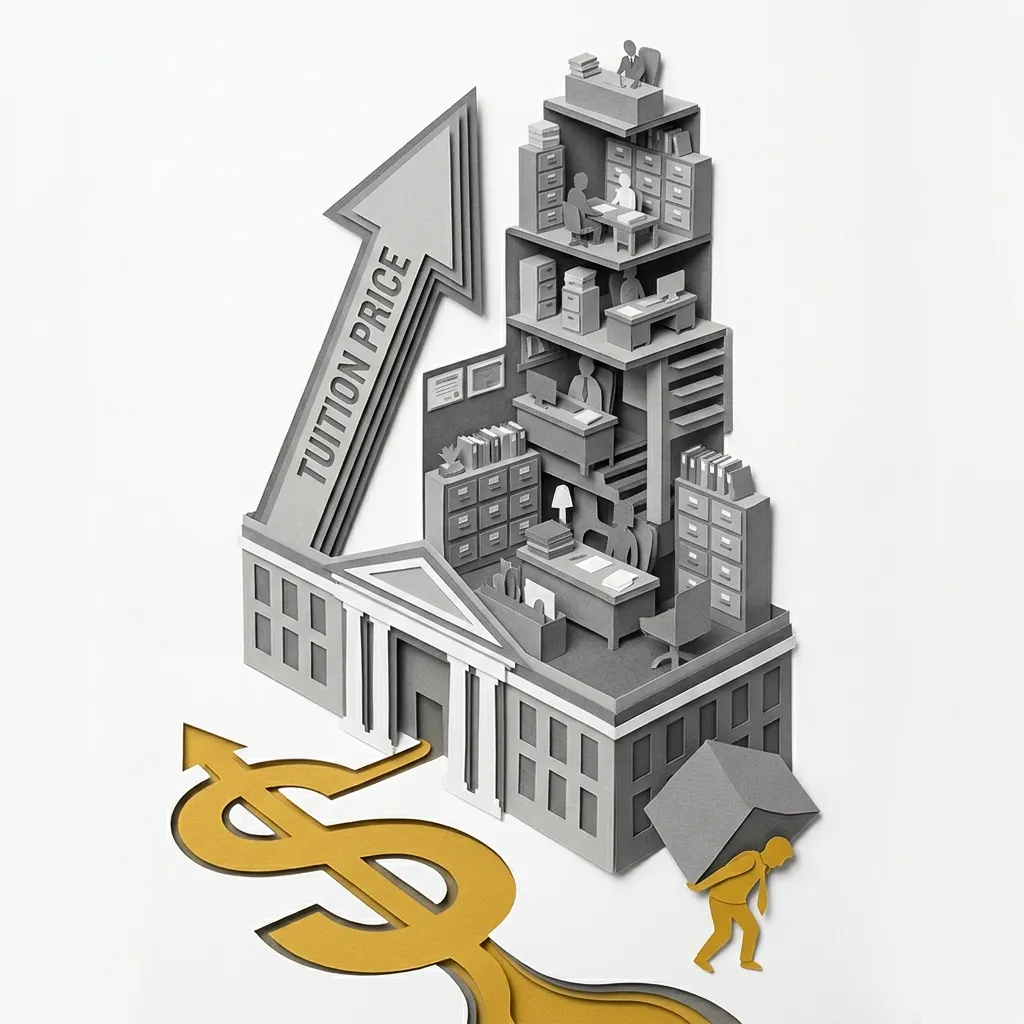
Sixty years later, Americans hold over $1.8 trillion in outstanding student loan debt, approximately 42.7 million borrowers have federal student loans, and the median monthly payment for those in active repayment runs between $200 and $300. (Federal Student Aid Portfolio Summary, 2024.) Tuition at four-year institutions has increased by more than 1,200 percent since 1980, far outpacing inflation, healthcare costs, and nearly any other major consumer expense. The federal government is the largest single creditor in this system, having taken over direct lending from banks in 2010.
Something went wrong. Working out what went wrong, and why, requires being willing to examine the role of the federal loan program itself in creating the problem it was designed to solve.
The Mechanism: How Guaranteed Lending Inflates Prices
In a normal market, prices are constrained by buyers’ willingness and ability to pay. If a university raises its tuition too high, enrollment falls, revenue declines, and the university is forced to lower prices or reduce costs. The competitive pressure of other universities offering comparable education at lower prices provides additional discipline.
Federal guaranteed lending broke this mechanism in several ways simultaneously.
First, it expanded the pool of money available to any student who wanted to attend any accredited institution. Before federal loans existed, the practical limit on tuition was what students and their families could pay from savings and income, plus private scholarships. Federal loans removed that limit. A student could borrow whatever the institution charged, regardless of whether they could ever repay it, because the federal government guaranteed the loan and bore the default risk.
Second, because the federal government guaranteed loans without regard to the creditworthiness of the borrower or the economic value of the credential being purchased, universities faced no market signal from lenders about whether their product was worth what they were charging. A private lender making an unsecured loan to a student majoring in a low-earning field at a high-cost institution would charge a risk premium that reflected the probability of repayment. That risk premium would make the loan expensive, which would make the total cost of attending that institution visible to the student at the point of decision. Federal loans carry no such signal. The interest rate for federal student loans is set by Congress, not by any assessment of the expected return on the specific degree being financed.
Third, the unlimited availability of federal lending gave universities a direct financial incentive to raise tuition: if students can borrow whatever you charge, you can charge more. This is the core of what William Bennett, then-Secretary of Education, argued in a 1987 New York Times op-ed: that increases in federal financial aid enable colleges to raise tuition without losing enrollment, because the aid absorbs the price increase. This became known as the Bennett Hypothesis.
The empirical evidence for the Bennett Hypothesis is real but contested. Studies that have found the strongest support for it tend to focus on specific time periods and on private and for-profit institutions, where federal loan pass-through to tuition appears most pronounced. A 2015 paper by Lucca, Nadauld, and Shen, published as a National Bureau of Economic Research working paper, found that institutions that became eligible for federal loans charged significantly higher tuition than comparable ineligible institutions. Studies of the for-profit sector have found particularly strong effects, with some estimates suggesting that for-profit institutions capture most of their tuition revenue directly from federal aid. Research by the Federal Reserve Bank of New York estimated that for every additional dollar of federal aid made available, institutions raised tuition by approximately 60 cents.
The Administrative Expansion Universities Bought With the Money
Tracking where tuition revenue went once it was available is illuminating. The answer is not primarily to better classrooms, more faculty, or improved instruction. It went, in large part, to an expanding administrative apparatus.
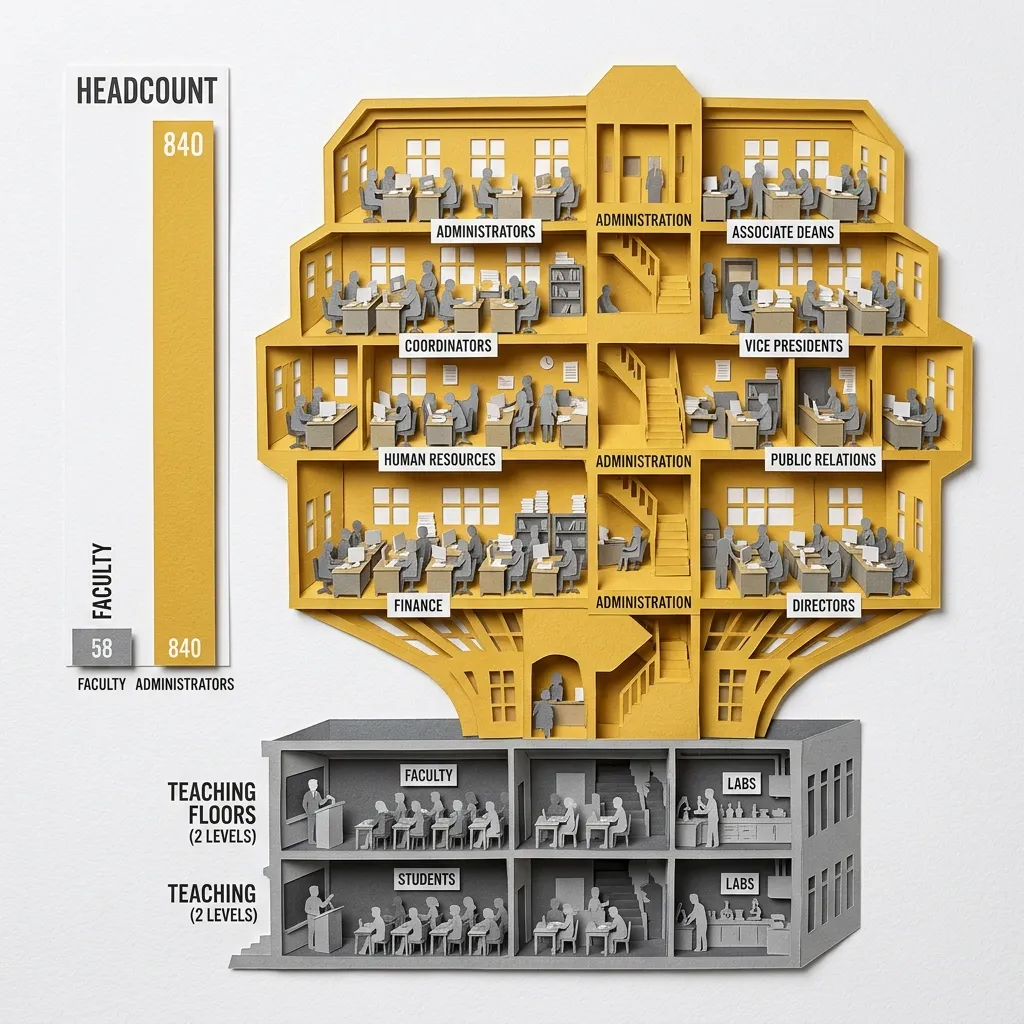
Benjamin Ginsberg documented this trend in his 2011 book The Fall of the Faculty: The Rise of the All-Administrative University and Why It Matters. Between 1975 and 2005, the number of full-time faculty at American universities increased by 51 percent. The number of full-time administrators increased by 85 percent. The number of other professional staff (including student services staff, academic support staff, counselors, and specialists of various kinds) increased by 240 percent. Student enrollment over the same period increased by approximately 56 percent. Administrative staffing grew at four times the rate of student enrollment.
The phenomenon is visible in the titles that proliferate at modern universities: Vice Presidents for Diversity, Associate Deans for Student Success, Directors of Community Engagement, Coordinators of Wellness Programming, Specialists in Inclusive Excellence. These positions are real and often held by people who work hard at what they do. The question is whether the total cost of maintaining this administrative ecosystem, which now rivals or exceeds instruction costs at many institutions, represents a good use of the money that students borrow to pay tuition.
The data on administrative spending and tuition are correlated in the direction that the concern predicts. The American Council of Trustees and Alumni, in its 2014 report on administrative spending, found that institutions with higher administrative spending relative to instruction costs also had higher tuition and fees. This suggests that administrative expansion is a cause rather than a result of tuition inflation, though the causation runs in multiple directions and is difficult to fully isolate.
The amenities race has also consumed a significant share of the tuition revenue that universities captured through loan-enabled price increases. Starting in the 1990s and accelerating through the 2000s and 2010s, universities competed for students partly by offering campus amenities, luxury dormitories, elaborate student recreation centers, dining facilities with extensive food variety, and other amenities that have nothing to do with the quality of instruction. These investments were explicitly competitive: universities that offered better amenities attracted more applicants, which allowed them to be more selective and to market their selectivity as evidence of quality. The cost of these amenities was rolled into tuition and financed largely by student borrowing.
Who Holds the Debt and Who Cannot Repay It
The political debate about student debt tends to focus on the typical borrower in ways that obscure the most serious problems. The typical four-year college graduate with student debt holds a manageable amount, earns a reasonable income premium over a non-graduate, and pays their loans off within ten to fifteen years. This is not the population that is struggling most severely under the student debt system.
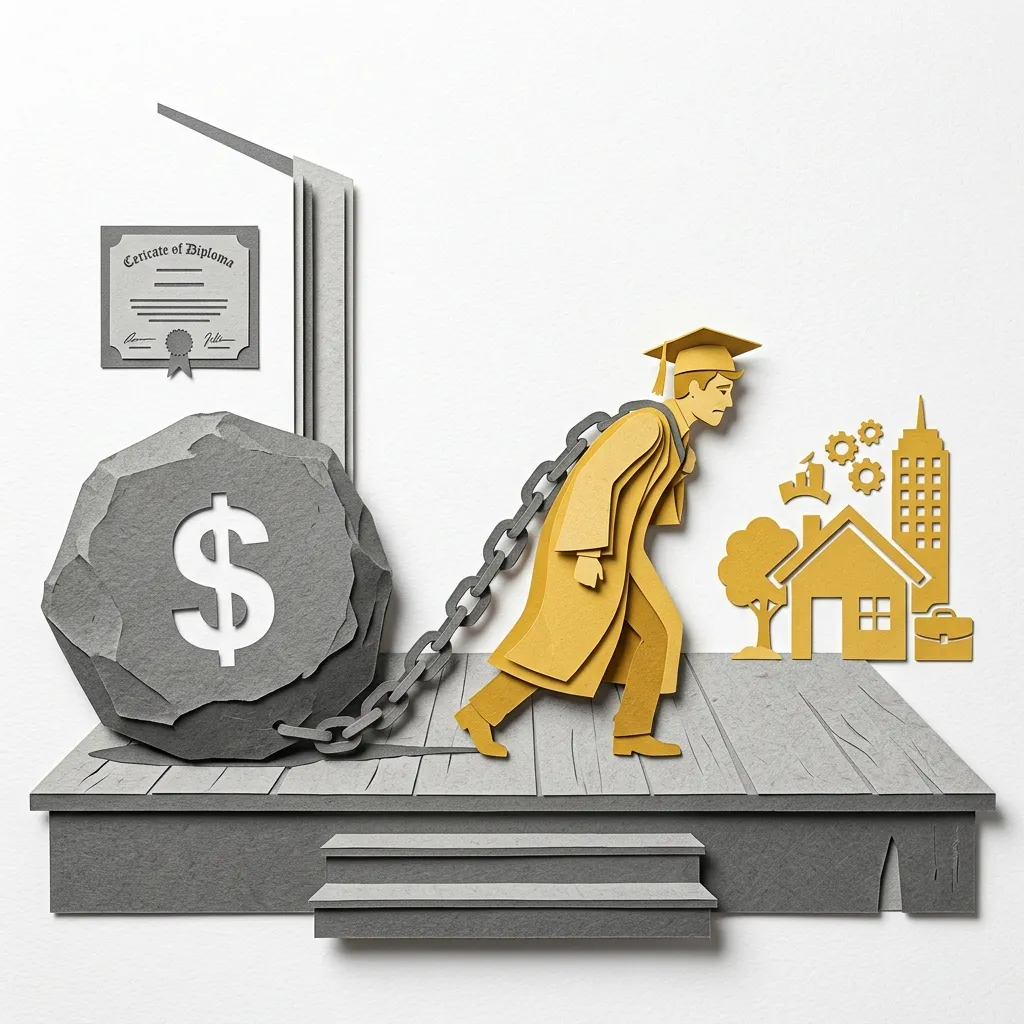
The populations suffering most acutely are three overlapping groups: students who took out loans for programs they did not complete, students who attended for-profit institutions, and students who borrowed for graduate degrees that did not produce the income needed to service the debt.
Students who borrow but do not complete a degree face the worst financial outcome in the student loan system. They carry debt without the credential that the debt was meant to finance. Their non-completion may reflect personal circumstances, inadequate academic preparation, or institutions that were not upfront about completion rates and graduate employment. The federal loan system makes no distinction between a student who will graduate and go on to a well-paying career and a student who will drop out after a year with debt and no degree. Both are equally eligible for the same maximum loan amounts. This is a catastrophic failure of the system’s design.
For-profit institutions represent a particular concentration of harm. These institutions have access to federal student aid and have used it aggressively to market to populations that traditional colleges underserve: working adults, first-generation students, veterans. Many provide genuine value to some students. But the sector as a whole has a documented history of enrolling students in programs with low completion rates and low post-graduation earnings, collecting tuition via federal loans, and leaving graduates (and non-completers) with debt they cannot repay. The Obama-era “gainful employment” rule attempted to impose accountability for post-graduation earnings on programs, using the logic that programs whose graduates could not earn enough to service their debt should lose access to federal aid. The rule was revoked by the Trump administration, reinstated by the Biden administration, and has been subject to ongoing litigation and reversal.
Graduate and professional debt is a larger share of total outstanding debt than public discussion often acknowledges. The 42.7 million federal borrowers include a significant population with large balances from law school, medical school, dental school, and various master’s programs. Law school graduates who did not land high-paying positions at major law firms, MBA holders from lower-ranked programs who did not achieve the salary premiums the programs advertised, and social work or education graduate program graduates who entered public service careers at salaries that did not justify the debt load are all part of the picture. Graduate PLUS loans, which carry no borrowing cap, have allowed graduate students to borrow six-figure amounts for programs whose graduates routinely earn insufficient incomes to service those amounts under conventional repayment terms.
The data on who does not repay is instructive. Delinquency and default rates are highest among students who attended for-profit institutions, students who did not complete their programs, and students who borrowed smaller amounts (which is counterintuitive but reflects the fact that smaller borrowers are disproportionately non-completers). Students who borrowed the most in absolute terms, primarily those with graduate degrees, actually default at lower rates because the income-driven repayment programs that keep them current are most generous relative to their circumstances, and because graduate credential holders earn more even when their returns are below expectations.
Why Loan Forgiveness Does Not Fix the Problem
Loan forgiveness became a major political issue in the Biden administration, which took various actions to discharge student debt for specific categories of borrowers, including public service workers, borrowers who were defrauded by for-profit institutions, and borrowers with disabilities. The broader cancellation proposals, including cancellation of up to $10,000 for all borrowers and $20,000 for Pell Grant recipients, were struck down by the Supreme Court in Biden v. Nebraska in 2023, on the grounds that Congress had not authorized the executive branch to cancel debt at that scale.
The political debate about loan forgiveness largely elides the most important economic question: cancellation addresses the existing stock of debt but does nothing to prevent a new and equivalent stock from accumulating within a decade if the underlying system is unchanged. If the reason tuition is high is that the federal loan program provides universities with guaranteed revenue regardless of the value of the credential, canceling today’s borrowers’ debt without reforming the lending program means that tomorrow’s students will borrow similar amounts for similar programs with similar outcomes. The beneficiaries of cancellation will graduate, the universities will continue charging as much as the loan program accommodates, and the next generation of borrowers will face the same situation.
The distributional arguments against broad cancellation are also significant. The Brookings Institution has done extensive analysis of who holds student debt and found that debt is concentrated among higher-income households, because higher-income people are more likely to have attended college and more likely to have attended graduate school. Canceling $10,000 of debt for everyone who borrowed would direct more of the benefit to higher-income households than to the working-class students who are most financially stressed by their debt. This is not an argument against targeted relief for borrowers who were genuinely defrauded or for whom the system failed systematically. It is an argument that broad cancellation is a regressive fiscal policy dressed up as progressive debt relief.
The Return on Investment Problem: Not All Degrees Are Equal
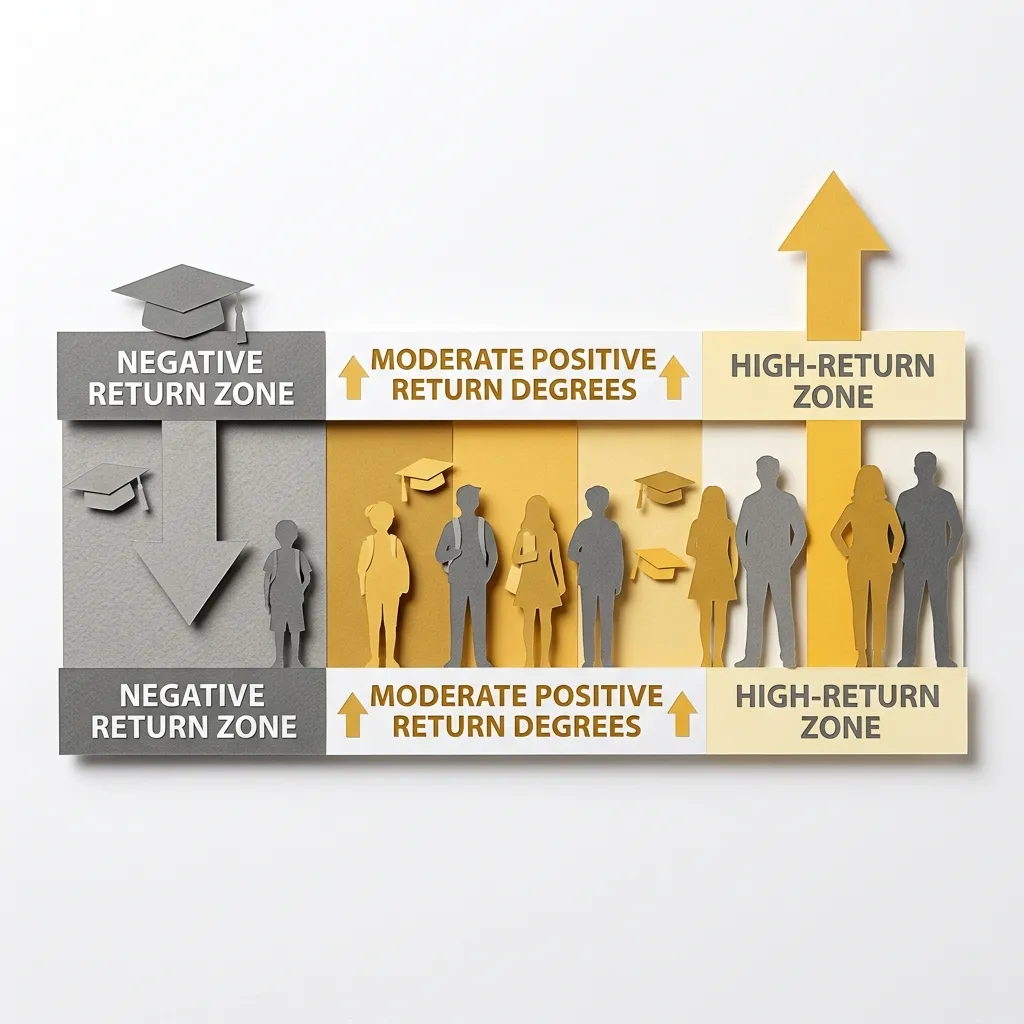
The strongest argument for the federal student loan system is that college education produces a significant wage premium and that the loans finance an investment that pays for itself. This argument is valid for some students in some programs at some institutions. It is not valid across the board, and the loan program’s failure to make these distinctions is a central design flaw.
The wage premium from a bachelor’s degree, compared to a high school diploma, has historically been estimated at approximately $1 million in lifetime earnings, though more recent estimates show significant variation by field, institution, and labor market conditions. The Georgetown Center on Education and the Workforce has published detailed analyses showing that median earnings ten years after enrollment vary by major from over $80,000 per year for computer science and engineering graduates to under $40,000 for some arts and humanities graduates. These are median outcomes; individual outcomes vary enormously within any field.
The returns to graduate education are even more variable. A Juris Doctor degree from a top law school at which graduates routinely land positions at large law firms paying $225,000 per year in starting salaries produces a positive return on debt of $100,000 to $200,000. A Juris Doctor from a lower-ranked law school at which many graduates work in solo practice, public interest positions, or non-legal jobs produces a much less certain return on the same debt. A master’s degree in a professional field from a well-regarded institution may produce positive returns. A master’s degree from an online for-profit institution in a low-earning field may produce negative returns on its debt load.
The problem is that the federal loan program makes no adjustment for these varying returns. A student borrowing $40,000 for a nursing degree at a community college that will lead to a well-paying healthcare career and a student borrowing $140,000 for an online master’s degree at a for-profit institution in a field where the median wage does not support $140,000 of debt both have equal access to federal loans. The loan program treats all accredited degrees as equivalent investments, which they are not.
Income-share agreements (ISAs) represent one market-based mechanism that aligns the interests of educational institutions with the employment outcomes of their graduates. Under an ISA, a student agrees to pay a fixed percentage of their income for a specified number of years after graduation in exchange for funding their education. The institution is repaid only to the extent that the graduate earns income, which gives the institution a direct financial stake in the graduate’s employment success. ISAs have been adopted by some coding bootcamps and alternative credential programs, and some traditional universities have experimented with them. They have not displaced federal loans at scale, partly because federal loans remain a cheaper and more flexible option for most students given the subsidized interest rates Congress sets.
What Reform Should Look Like
The goal is not to prevent people from attending college. It is to ensure that the financing system for higher education produces results that are worth the debt incurred and that institutions face some accountability for the outcomes their graduates achieve.
Restore private lending with institutional risk-sharing. The 2010 decision to move to direct federal lending eliminated private lenders from the market, which also eliminated the pricing signals that private lenders, operating at risk, would generate about which programs and institutions are creditworthy. Reintroducing private lenders, whose loan rates would reflect assessed repayment probability, would create information that students currently lack about the financial risk of specific programs. Institutional risk-sharing, under which universities bear partial liability for the default of their graduates, would give universities a direct financial incentive to track and improve graduate employment outcomes.
Calibrate loan limits to expected program returns. The current system allows students to borrow up to cost of attendance for any accredited program. A reformed system would set loan limits that reflect expected graduate earnings by field and institution type, based on actual earnings data for graduates. Students who want to borrow more than the evidence-based limit could do so, but with a requirement for private financing that reflects the additional risk.
Expand and improve gainful employment accountability. Programs whose graduates consistently earn insufficient income to service their debt should lose access to federal aid. This is not a punitive measure; it is the basic accountability mechanism that any sensible lending program requires. It creates an incentive for institutions to improve programs that produce poor outcomes or to stop offering them.
Invest in transparent outcome data. Students currently make major financial decisions with very little access to the actual earnings outcomes of graduates from specific programs at specific institutions. The College Scorecard, created by the Obama administration, makes some of this data available but it is incomplete and not widely used in student decision-making. Requiring institutions to publish, clearly and prominently, the median earnings of graduates at one, five, and ten years post-graduation by program would help students make better-informed borrowing decisions.
Invest in community colleges and skilled trades. Community colleges and vocational training programs produce credentials with consistently strong returns relative to cost and debt. They are chronically underfunded and undervalued in the cultural hierarchy that pushes four-year degrees as the default pathway. Redirecting some of the federal higher education investment toward community colleges and apprenticeship programs would produce better outcomes for more students at lower debt levels.
The student loan system is not beyond repair, but repairing it requires acknowledging that the problem is institutional, not individual. It requires holding universities accountable for the outcomes they produce rather than simply collecting tuition and letting students bear all the risk of programs that do not deliver.
A word on where these proposals actually sit: institutional risk-sharing, loan limit calibration tied to expected returns, and expanded gainful employment accountability are government mandates restructuring federal involvement in student lending, not eliminating it. They move the program closer to market discipline without removing the government from the market. That is a meaningful difference from the libertarian position, which is to withdraw the federal government from student lending entirely, end the accreditation system’s gatekeeping function for federal aid, and let private lenders price the risk of different programs at market rates. A private market for student loans would charge higher rates for low-return programs, creating exactly the pricing signal that the federal guarantee suppresses. Programs that cannot attract students willing to borrow at market rates would lose enrollment, which is the mechanism that drives out low-value credentials. The reforms proposed here are improvements that would produce better outcomes within the existing system. They are compromise solutions, not libertarian ones. The income-share agreement concept and investment in community colleges and trades are the closest this agenda comes to what a fully market-oriented system would produce organically.
How 11 Countries Finance Higher Education: What the Rest of the World Does Differently
The United States stands alone among wealthy nations in combining high nominal tuition with a government-backed lending system that insulates universities from the market signals that would otherwise constrain prices. Understanding how other countries organize higher education financing reveals both that alternatives exist and that each alternative involves genuine tradeoffs.
Germany is the most frequently cited alternative: public universities charge no tuition, and students can attend any public university for free. Funding comes from general tax revenue at the state (Land) level. The absence of tuition does not mean the absence of cost: German taxpayers fund the system, and Germany’s higher education spending as a share of GDP is comparable to other European countries. German universities do face quality and resource constraints that come with tight public budgets: less administrative flexibility, lower faculty salaries than U.S. research universities, and less research infrastructure. Germany also has a more stratified education system, with a strong vocational track that channels many students away from university entirely. The outcome is that roughly 30 percent of young Germans attend university, compared to roughly 65 percent in the United States, reflecting different cultural expectations and career pathways.
Norway provides free university education and additionally pays students a monthly living stipend through the State Educational Loan Fund, with a portion converted to outright grants upon completion. Norwegian students are essentially paid to attend university. The system is funded by Norway’s oil revenue and high income taxes. Norway’s per-student public expenditure on higher education is among the world’s highest. The outcome in terms of graduate earnings premiums is broadly comparable to other OECD countries, but the distribution of that investment across the population is more equal since no one takes on debt.
Sweden eliminated tuition in 1976 and reintroduced it for non-EU students in 2011. Swedish students still pay no tuition but do receive income-tested student loans and grants through CSN (the national student aid authority). Loan amounts are modest compared to U.S. levels, and repayment is income-contingent with a 25-year cap after which remaining balances are forgiven. Sweden’s system has experienced its own concerns about whether grants are sufficient for living costs, and research has documented that family background still predicts educational attainment, suggesting that free tuition alone does not eliminate economic barriers.
The United Kingdom introduced tuition fees of £1,000 per year in 1998, raised them to £3,000 in 2006, and then to £9,000 (later £9,250) in 2012. This tuition is financed through income-contingent loans from the Student Loans Company, a government entity. Graduates repay a fixed percentage of income above a threshold for 30 years, after which remaining balances are forgiven. The UK system shifts cost from taxpayers to graduates but uses income-contingency to limit hardship during low-earning periods. Research on the UK reform has found that graduate earnings remain above non-graduate earnings by margins that justify the debt in most cases, but that access for students from lower-income families declined following the 2012 increase, suggesting that even income-contingent loan systems create psychological barriers to enrollment.
Australia developed the world’s first large-scale income-contingent student loan system through the Higher Education Contribution Scheme (HECS) in 1989. Australian students can defer their contribution to university costs until they earn above a minimum income threshold, at which point repayment is collected automatically through the tax system. HECS contributions are indexed to inflation rather than carrying an interest rate. The Australian system has been widely studied and is considered one of the more successful designs for balancing access with fiscal responsibility. It has been expanded and modified significantly over the decades, and has faced criticism that increasing tuition levels have shifted more cost to students than originally intended.
France maintains very low public university fees for French citizens, averaging approximately 170 euros per year, with selective grandes ecoles and private institutions charging substantially more. The French system maintains broad access at the undergraduate level but channels students through a high-stakes national examination (the baccalauréat) that shapes their educational trajectory. Elite French institutions (Sciences Po, HEC Paris, the Polytechnique) are largely publicly funded but highly selective. The French system’s low fees coexist with significant inequality in educational outcomes shaped more by family background and secondary schooling quality than by university cost.
The Netherlands sets annual university tuition at approximately 2,314 euros for national and EU students, with significantly higher fees for non-EU students. Dutch students finance this through income-contingent loans available from DUO (the public student finance organization). The Dutch introduced income-contingent student financing in 2015 and have debated its adequacy since. Dutch universities are public or semi-public and receive substantial state funding alongside student contributions. The Netherlands has maintained broad access while building in the incentive for students to contribute to their own educational costs.
Japan has a significant public-private divide in higher education, with approximately 75 percent of university students attending private institutions. Tuition at private Japanese universities averages approximately 800,000 yen per year (approximately $5,500 USD), with public universities charging about half that. Japan’s Japan Student Services Organization (JASSO) provides both interest-free and interest-bearing loans. Japan expanded scholarship availability significantly in 2020, providing income-contingent loans with forgiveness for graduates who work in certain sectors. Japan’s student debt levels are lower than U.S. levels primarily because tuition is substantially lower, not because the financing model is fundamentally different.
South Korea has among the highest higher education costs in Asia relative to income, with private university tuition averaging approximately 6-8 million won per year (roughly $4,500-$6,000 USD). South Korean students and families bear a very high share of educational costs through tuition, private tutoring, and supplementary education spending. Student loan defaults have been a significant policy concern, leading to reforms expanding income-contingent repayment options. South Korea’s intense educational credentialing culture drives high demand for university credentials regardless of their labor market returns, producing an oversupply of graduates relative to available professional positions.
New Zealand introduced income-contingent student loans in 1992 and extended them to living costs. New Zealand implemented fee-free first-year tertiary education in 2018 as a partial subsidy. The New Zealand system broadly resembles the Australian one, with income-contingent automatic repayment through the tax system. Research on New Zealand’s fee-free first year found minimal effects on enrollment patterns, suggesting that the first-year subsidy was not the binding constraint on access.
Canada leaves university tuition setting largely to provinces, producing significant variation: Quebec charges approximately CAD $4,000 per year for provincial residents (with a history of student protests against any increases), while other provinces charge CAD $7,000-$10,000. The federal government provides student loans with income-contingent features through the Canada Student Financial Assistance Program. Canadian student debt levels are substantially lower than U.S. levels partly because tuition is lower and partly because the Canadian system has income-contingent features that limit distress.
The consistent lesson from international comparison is that the U.S. system is unusual in combining high tuition, high borrowing, and lender indifference to whether the credential is worth the debt. Countries with free or low-cost universities accept higher tax burdens. Countries with income-contingent loans like Australia and the UK protect graduates from catastrophic outcomes but still expose them to significant debt. No country runs a system quite like the U.S. combination of unlimited federally guaranteed loans, high private tuition, and weak accountability for outcomes, and no other country has produced an analogous tuition inflation crisis.
The Accreditation Monopoly Nobody Talks About
Behind the student loan crisis is a structural feature of higher education that rarely appears in policy debates: accreditation. Regional accreditation, issued by six regional accrediting bodies recognized by the Department of Education, is required for a college to participate in federal student aid programs. Without accreditation, a college’s degrees are not recognized by most employers, and its students cannot access federal loans or Pell Grants.
Accreditation was designed to protect students from diploma mills: unscrupulous institutions that collect tuition while delivering worthless credentials. The intent was legitimate. The result is a cartel. Existing accredited institutions have substantial representation on accrediting bodies, and those bodies apply standards that are designed around the existing model of higher education, which includes full-time residential campuses, faculty with Ph.D. credentials in traditional academic fields, libraries, athletic facilities, and administrative structures that replicate what accredited universities already have. New entrants that deliver education differently, through online-only instruction, through apprenticeship-like models, through accelerated credentials focused on specific skills, face accreditation standards that are calibrated for a delivery model they are not trying to replicate.
The result is that the accreditation system prevents the emergence of lower-cost, higher-value alternatives to traditional four-year universities. An online institution that could deliver rigorous instruction at a fraction of the cost of a residential university cannot easily obtain accreditation, because its model does not fit the accrediting standards designed for residential universities. Employers who would gladly hire graduates of a well-designed skills credential cannot in most cases recognize that credential as equivalent to an accredited degree, because the federal financial aid system has made accreditation the entry point to legitimacy.
A genuine reform of higher education financing would address accreditation alongside loan policy: creating clear pathways for accrediting alternative models, allowing employer credentials and skills assessments to qualify workers for positions without requiring accredited degrees, and breaking the linkage between federal loan eligibility and traditional accreditation that has enabled incumbent universities to maintain their market position while charging whatever traffic will bear.
Go Deeper: Books by Alex Merced
The student loan crisis is a textbook case of a well-intentioned government program creating the problem it was designed to solve, by removing the market discipline that would otherwise constrain price inflation and align incentives with outcomes. Alex Merced’s books provide the economic and political frameworks for understanding exactly how this happens and why it keeps happening.
Economic Ideas: From Beginning to Early 2026 covers the economics of subsidized credit markets in detail: how guaranteeing loans removes the lender’s incentive to assess repayment probability, how the resulting moral hazard produces lending at prices and to programs that unsubsidized markets would not support, and the theory of price inflation in markets where the purchasing power of buyers is artificially expanded by government-backed credit. The Bennett Hypothesis is a specific application of these principles to higher education financing.
The Field Guide to Libertarianism situates the student loan problem within the broader libertarian critique of government programs that concentrate benefits on organized interests (universities and their administrators) while dispersing costs across borrowers who are young, politically unorganized, and making their biggest financial decisions with the least information and experience. The field guide explains why markets, imperfect as they are, do a better job than government programs at pricing risk and aligning incentives with outcomes.
Political Thought and Debates of the United States provides the political history of the Higher Education Act and its expansions, tracing how a program designed to expand access to education was captured by institutional interests and gradually converted into a mechanism for transferring government-backed revenue to universities regardless of the value of the education delivered. Understanding how that political evolution happened is essential for understanding why reform is difficult and what political coalitions would be needed to achieve it.
All three are available on Amazon. The full catalog of Alex Merced’s work is at books.alexmerced.com.
Sources and Further Reading
-
Bennett, William J. “Our Greedy Colleges.” New York Times, February 18, 1987.
-
Lucca, David, Taylor Nadauld, and Karen Shen. “Credit Supply and the Rise in College Tuition: Evidence from the Expansion in Federal Student Aid Programs.” Federal Reserve Bank of New York Staff Reports, No. 733, 2015.
-
Federal Student Aid Portfolio Summary. U.S. Department of Education, Q4 2024.
-
Ginsberg, Benjamin. The Fall of the Faculty: The Rise of the All-Administrative University and Why It Matters. Oxford University Press, 2011.
-
Georgetown Center on Education and the Workforce. “The College Payoff: Education, Occupations, Lifetime Earnings.” McCourt School of Public Policy, Georgetown University, 2021.
-
Looney, Adam, and Constantine Yannelis. “A Crisis in Student Loans? How Changes in the Characteristics of Borrowers and in the Institutions They Attended Contributed to Rising Loan Defaults.” Brookings Papers on Economic Activity, Fall 2015.
-
Dynarski, Susan. “An Economist’s Perspective on Student Loans in the United States.” Economic Studies at Brookings, 2014.
-
American Council of Trustees and Alumni. “The Staffing Surge: An Analysis of Non-Teaching Personnel Growth at American Universities.” ACTA, 2014.
-
Vedder, Richard, Christopher Denhart, and Jonathan Robe. “Why Are Recent College Graduates Underemployed?” Center for College Affordability and Productivity, 2013.
-
Webber, Douglas. “Are College Costs Worth It? How Individual Ability, Major Choice, and Debt Affect Optimal Schooling Decisions.” Journal of Public Economics 148 (2017): 1-13.
-
Sandy Baum and Katharine Lyons. Student Debt: Rhetoric and Realities of Higher Education Financing. Palgrave Macmillan, 2016.
-
Preston Cooper. “The Market Failure in Student Lending.” Manhattan Institute, 2021.
-
Biden v. Nebraska, 600 U.S. 477 (2023).
-
National Center for Education Statistics. Digest of Education Statistics. U.S. Department of Education, updated annually.
-
College Scorecard. U.S. Department of Education. collegescorecard.ed.gov.