In conventional political discourse, the relationship between corporations and the state is characterized as a fundamental conflict. On one side, corporate enterprises are viewed as unchecked profit-seeking entities that naturally seek to exploit consumer ignorance, suppress worker wages, and externalize environmental costs. On the other side, the regulatory state is framed as an impartial referee, utilizing administrative agencies, antitrust legislation, and taxation to protect the public welfare. Within this paradigm, the primary source of economic dysfunction is deemed to be an insufficiency of state power, which allows corporate lobbyists to subvert the regulatory process.
This framework suffers from a foundational error in its understanding of political and economic incentives. The state and the large corporation are not natural adversaries; they are partners in a mutually beneficial corporatist coalition. Rather than fearing administrative power, large businesses frequently capture it, using state regulations to construct entry barriers that protect their market share from competitors. Conversely, politicians do not merely regulate business to protect the public interest; they use the threat of regulatory action as a mechanism to extract financial tribute. To understand the modern economy, one must analyze the lifecycle by which industries are drawn into political lobbying, the mechanics of regulatory capture, and the extortion dynamics of the legislative process.
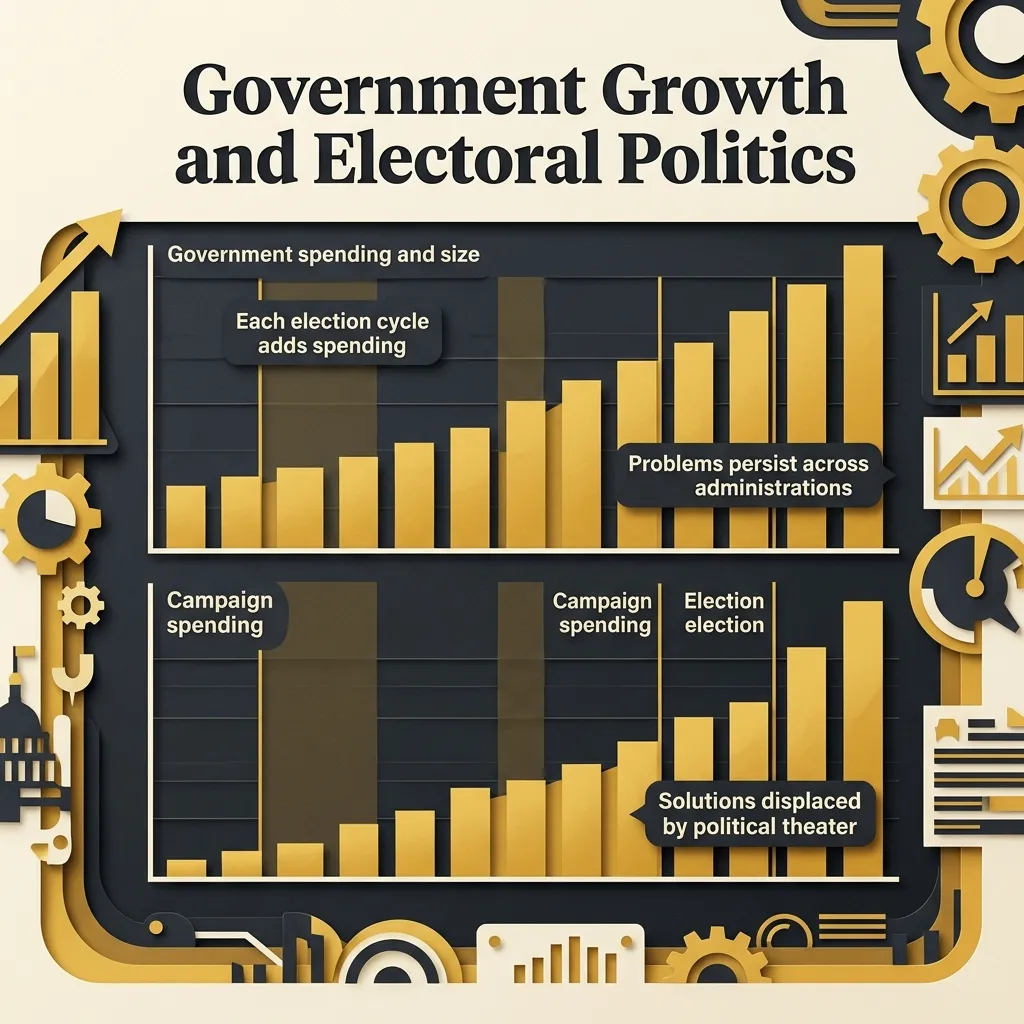
The Lifecycle of the Lobbying Trap
One of the most persistent myths of free-market capitalism is that big businesses are naturally pro-market. In reality, large corporations are highly suspicious of free competition, which constantly threatens their market share with new, innovative startups. The process by which an industry shifts from market-driven innovation to state-protected corporatism follows a predictable lifecycle consisting of three distinct phases.
Phase 1: The Innovative Frontier (High Growth and Zero Lobbying)
Every new industry starts with innovation. Entrepreneurs focus entirely on satisfying customers, developing new products, and driving down costs. During this initial phase, the industry has no interest in government. Startups do not hire lobbyists, they do not establish Political Action Committees (PACs), and they do not open offices in Washington, D.C.
This was evident in the early days of the personal computer industry. In the late 1970s and 1980s, companies like Apple and Microsoft spent their capital on engineering, product development, and customer acquisition. They had virtually no political presence because the state did not yet understand the industry well enough to regulate it, and the industry had no interest in seeking state-enforced monopolies.
The same pattern repeated with the early internet in the 1990s, the rise of ride-sharing services in the 2010s, and the emergence of decentralized finance and cryptocurrency in the late 2010s and early 2020s. In each case, the founders of these companies were focused on creating value. Their capital was allocated to engineers, designers, and marketing campaigns. Because the market was unregulated, entry barriers were low, competition was fierce, and consumer choice drove the allocation of resources.
Phase 2: The Regulatory Threat and Defensive Lobbying
As the new industry grows, it begins to disrupt established incumbents. Ride-sharing disrupts taxi cartels; digital currencies threaten central bank monopolies; online retailers displace brick-and-mortar giants; digital media displaces legacy television networks.
The threatened incumbents respond by lobbying the government to regulate, tax, or ban the new technology. At the same time, politicians notice the growing sector and seek to assert regulatory control. They hold hearings, propose draft bills, and demand oversight, claiming that the unregulated industry poses a risk to consumers, systemic stability, or national security.
At this point, the young industry faces an existential crisis. To survive, the companies are forced to invest in political defense. They hire their first lobbying firms, establish government relations departments, and begin donating to political campaigns. The goal is entirely defensive: to secure a voice in the regulatory conversation and prevent the state from writing rules that would outlaw their technology or make their business model non-viable.
For example, when Microsoft faced a massive antitrust lawsuit from the Department of Justice in the late 1990s, the company had a minimal lobbying presence in Washington. In the wake of that lawsuit, Microsoft significantly expanded its political footprint, spending millions of dollars on lobbying and campaign contributions. The company learned that it could not ignore the state without risking its corporate survival.
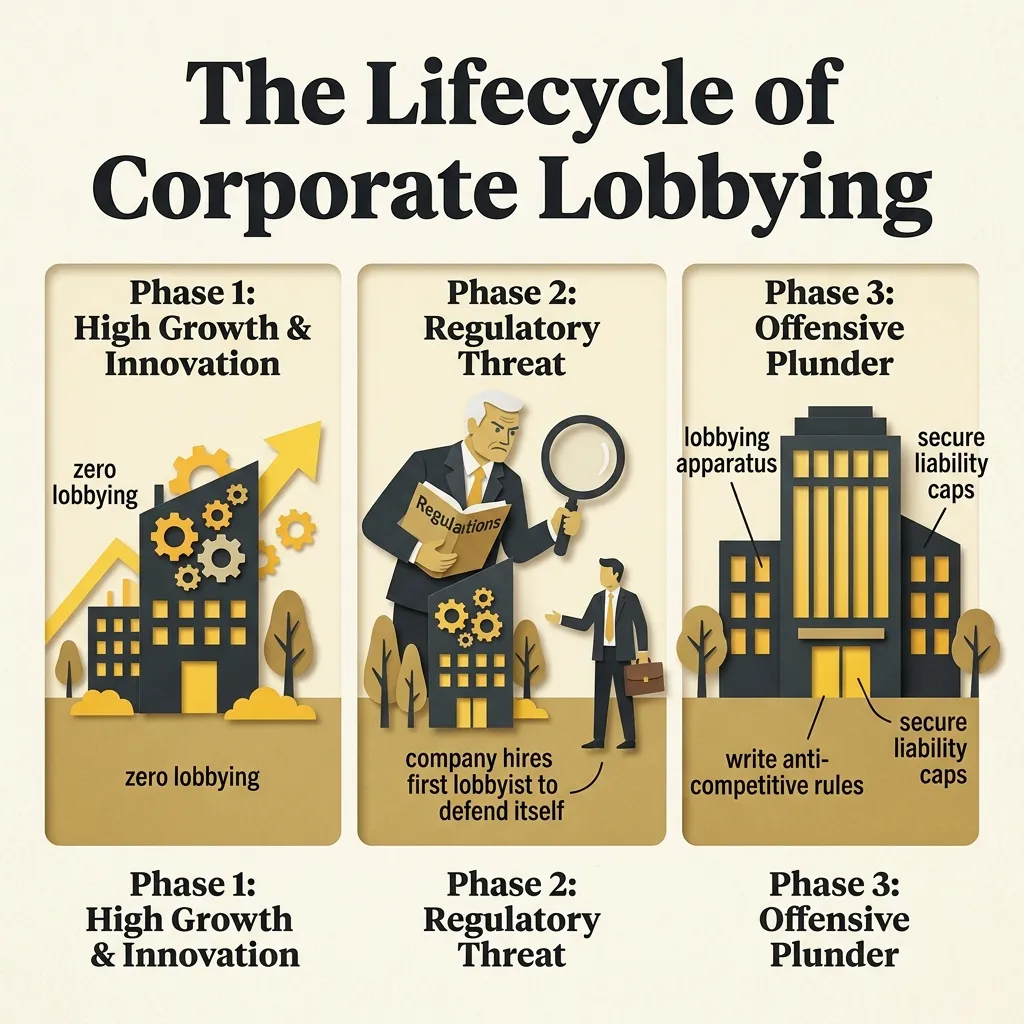
Phase 3: The Offensive Transition (Lobbying as a Profit Center)
Once the lobbying apparatus is established and the industry matures into a collection of large, established firms, a critical transition occurs. The corporations realize that the same political channels they built for defense can be used offensively.
Instead of fighting regulation, they begin advocating for it. They write compliance standards, safety audits, and licensing requirements that they can easily afford to implement, but which are prohibitively expensive for new, under-capitalized startups. They lobby for liability caps, protecting themselves from lawsuits in the event of negligence. They seek subsidies, tax loopholes, and government contracts.
The lobbying department is no longer a defense cost; it becomes a profit center. The corporations have entered the corporatist coalition, using the coercive power of the state to lock in their monopolies, stifle competition, and secure high returns at the expense of consumers and taxpayers.
This offensive lobbying represents a major departure from market capitalism. In a free market, a firm can only earn profits by convincing customers to voluntarily purchase its products. In a corporatist system, a firm can earn profits by lobbying the government to pass laws that force customers to buy its products, subsidize its operations, or outlaw its competitors. This rent-seeking behavior diverts capital from productive innovation into political manipulation.
Feeder Bills: The Legislative Extortion Racket
Mainstream critics of corporate power treat the relationship between money and politics as a one-way street: corporations buy politicians to get what they want. This view ignores the active role of politicians and political parties, who operate what is effectively a protection racket.
In the legislative branch, political parties rely on continuous campaign contributions to fund their operations, run advertisements, and win elections. To keep the money flowing, politicians use a tool known as a feeder bill or shake-down bill.
A politician or party introduces a piece of legislation that threatens a specific industry. It might be a bill to impose a price cap on pharmaceuticals, place a heavy environmental tax on chemical plants, or mandate strict data-privacy compliance audits on tech firms. The bill is not meant to pass. It exists to create a threat.
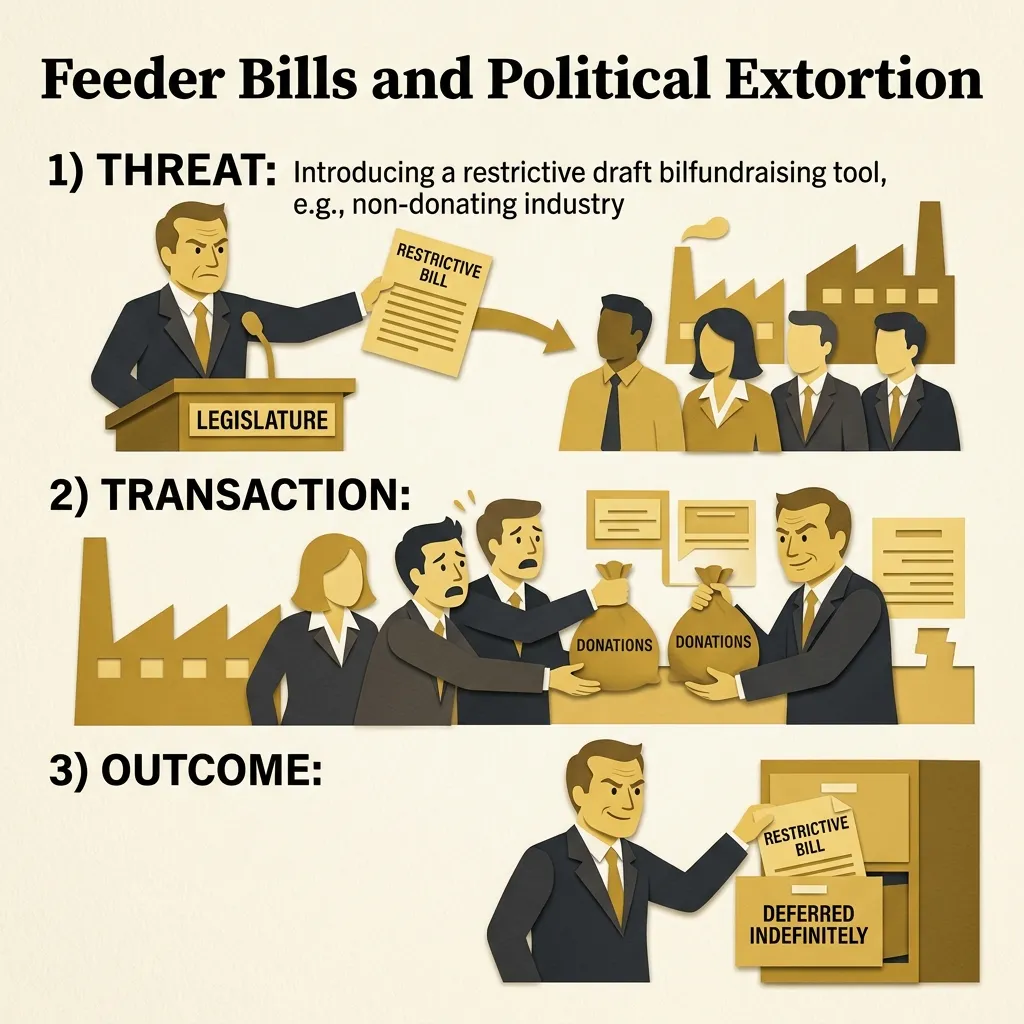
The Mechanics of the Shakedown
The targeted industry responds predictably. The executives and their lobbyists panic, knowing that if the bill passes, their business is ruined. They immediately request meetings with the politicians sponsoring the bill and begin pouring contributions into the party's campaign committees and PACs.
Once the contributions reach a satisfactory level, the bill is quietly tabled, allowed to die in committee, or delayed until the next session. This is legislative extortion. The state uses its power to write rules as a leverage point to extract wealth from productive industries. For the political class, the threat of regulation is a highly effective fundraising tool, and they have no incentive to resolve the threat, as doing so would shut down the flow of money.
This dynamic explains why certain legislative threats, such as drug pricing reform, financial transaction taxes, or data privacy mandates, are introduced repeatedly session after session. These bills serve as permanent cash cows for both political parties. They are never resolved because their value lies in their status as threats.
Furthermore, feeder bills are often targeted at industries that have historically refrained from donating to political campaigns. When a new tech startup or a rapidly growing industry attempts to remain politically neutral, they are quickly taught that neutrality is not an option. The introduction of a threatening bill serves as an invitation to the bargaining table, forcing the industry to buy its way out of regulatory destruction.
Rent Extraction vs. Rent Seeking: McChesney's Shakedown Model
Economist Fred McChesney formalized this relationship in his seminal work on political rent extraction. While traditional public choice theory focuses on rent seeking (where private actors pay politicians for special privileges), McChesney observed that a significant portion of political money flows in the opposite direction. Under rent extraction, politicians extract wealth from private actors by threatening to take away their existing assets or rights.
In this model, the state behaves as a predatory monopolist of regulatory power. Politicians create value for themselves by threatening to destroy value for others. This extortion is far more lucrative than selling privileges, because the threat of total destruction is a more powerful motivator than the promise of a small subsidy. The cost of this system to society is immense: it diverts millions of dollars from research, development, and wages into the pockets of politicians, political consultants, and public relations firms, leaving the general public poorer.
Regulatory Capture: Staffing the Monopolistic State
When the government creates a regulatory agency (such as the FDA, the FCC, the SEC, or the EPA) to monitor an industry, the public assumes that the agency will act as an independent watchdog. Public choice theory shows that these agencies are almost always captured by the very firms they are meant to regulate. This regulatory capture occurs through several distinct mechanisms.
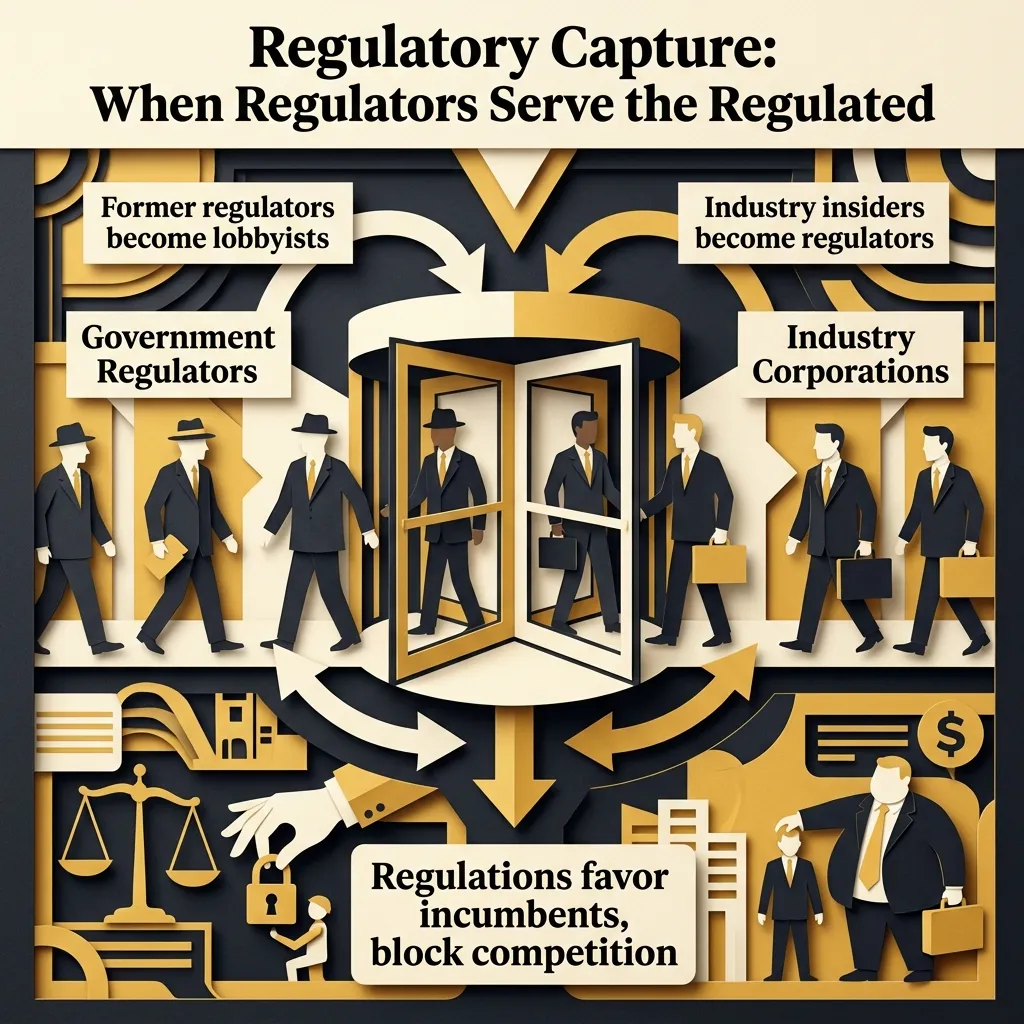
The Revolving Door
To write regulations for a complex, technical field like finance, pharmaceuticals, or telecommunications, the government must recruit people who understand the industry. The only place to find these people is within the private corporations themselves. Therefore, agency directors, inspectors, and rule-writers are typically recruited from corporate boardrooms.
These regulators know that their tenure in government is temporary and that they will eventually return to the private sector, where the salaries are much higher. It is irrational for them to write rules that would destroy the companies they hope to work for in the future.
The corporate giants understand this dynamic. They welcome new regulations because they know they can influence the rule-writing process. They write complex compliance requirements that raise the cost of entry for new competitors, ensuring that their market monopoly is protected by the force of law. Regulatory agencies do not protect consumers; they act as the administrative arm of the corporate cartel.
This revolving door creates a shared culture between regulators and the regulated. They attend the same industry conferences, share the same technical assumptions, and view the market through the same corporatist lens. The boundary between the public regulator and the private executive dissolves, resulting in a single ruling class that manages the market for its own benefit.
Asymmetric Information and Expertise
Another major driver of regulatory capture is information asymmetry. A regulatory agency has limited resources and staff compared to the multi-billion-dollar corporations it is tasked with monitoring. To write rules, the agency must rely on data, research, and analysis provided by the industry itself.
This allows corporations to shape the informational environment of the regulators. They fund the scientific studies, compile the economic reports, and draft the compliance templates that the agency uses to justify its rules. The regulators, lacking independent sources of information, write rules that are pre-approved by the dominant corporate interests.
The result is a system of "crony regulation" where the rules are designed to look like consumer protection, but are structured to benefit the incumbents. For example, when the FDA mandates multi-million-dollar clinical trials for new drugs, it is not just protecting safety; it is also ensuring that small biotech firms cannot bring competing products to market without selling their intellectual property to a handful of pharmaceutical giants who can afford the compliance costs.
Concentrated Benefits and Diffuse Costs: The Logic of Capture
Economist Mancur Olson, in his landmark book "The Logic of Collective Action," explained the mathematical inevitability of regulatory capture. When a regulation is proposed, its benefits are typically concentrated on a small number of large firms, while its costs are diffuse, spread out across millions of individual consumers.
For instance, a tariff on imported steel benefits a few domestic steel manufacturers by millions of dollars, while costing each American consumer only a few dollars in higher prices for cars, appliances, and housing. The steel manufacturers have a massive incentive to spend millions of dollars lobbying for the tariff, organizing campaigns, and donating to politicians. In contrast, the individual consumer has no incentive to spend time or money fighting the tariff, as the cost of doing so far exceeds the personal savings they would realize.
This asymmetry of incentives ensures that regulatory agencies are constantly subjected to intense, organized pressure from concentrated corporate interests, while the public remains unorganized and silent. Over time, the regulatory environment is shaped entirely by the demands of the regulated, resulting in a system that extracts wealth from the politically unrepresented public to enrich the politically connected corporate class.
Detailed Economic Mechanisms of the Corporatist Coalition
To fully appreciate how the corporatist coalition operates, one must look beyond political science and examine the specific economic mechanisms that corporations and the state use to enrich themselves at the expense of the public.
1. Compliance Costs as an Entry Barrier
In a free market, competition is the primary driver of efficiency and consumer welfare. When a firm charges high prices or provides poor service, new competitors enter the market to capture those profits by offering better alternatives. This process of creative destruction prevents the consolidation of monopoly power.
To prevent this, dominant corporations use compliance costs to build regulatory moats. A regulatory mandate (whether it is a licensing requirement, a safety audit, or a reporting standard) imposes a fixed cost on all firms in the industry. For a multinational corporation with billions of dollars in revenue, the cost of hiring a compliance team of lawyers and accountants is negligible as a percentage of total revenue.
For a small competitor or a startup, that same fixed cost is ruinous. The startup must divert its limited capital away from product development and customer service into compliance. Many potential competitors are deterred from entering the market entirely. By raising the fixed costs of doing business, the state acts as an entry-barrier engine, protecting the market share of incumbents and allowing them to charge monopoly prices without fear of competition.
2. The Cartelization of Standards
When a regulatory agency sets industry-wide standards, it effectively outlaws alternative approaches. Under the guise of consumer safety, the state mandates that all firms use specific technologies, processes, or business models.
This process of standardization stifles innovation. In a free market, firms compete by experimenting with different methods of production and delivery. Regulatory standards freeze the industry in place, preventing the development of superior, cheaper alternatives that do not conform to the state-mandated template.
Furthermore, these standards are almost always written by the dominant firms, who design them to align with their existing technology and patents. This forces all other firms in the industry to purchase licenses from the incumbents or invest in expensive re-tooling. The state uses its coercive power to enforce a corporate cartel, ensuring that no one can compete using a different, more efficient paradigm.
3. Liability Caps and Risk Socialization
In a free market, firms are fully liable for the damages they cause to third parties. If a chemical plant pollutes a local water supply, or a financial institution defaults on its obligations, the owners and executives face ruinous lawsuits and bankruptcy. This threat of liability forces firms to act prudently and manage risk.
In a corporatist system, the state socializes this risk. Large corporations lobby for laws that place caps on their liability. For example, the Price-Anderson Nuclear Industries Indemnity Act limits the liability of nuclear power plant operators in the event of an accident. Similarly, vaccine manufacturers are protected from liability for vaccine-related injuries under the National Childhood Vaccine Injury Act, with claims instead processed through a state-funded compensation program.
These liability caps create a massive moral hazard. By shielding corporations from the full cost of their negligence, the state encourages them to engage in high-risk, high-return behaviors that they would never attempt in a free market. If the risk pays off, the corporation keeps the profits. If the risk results in disaster, the cost is borne by the taxpayers and victims.
4. Subsidies, Bailouts, and the Political Commons
The most direct mechanism of the corporatist coalition is the transfer of wealth from taxpayers to corporations through subsidies and bailouts. Under the guise of national security, economic stability, or job preservation, the state uses its taxation power to support failing or favored firms.
This process distorts the market price system. In a free market, profits and losses are the signals that guide the allocation of resources. Profits show that a firm is creating value for customers; losses show that it is wasting resources. By bailing out failing firms, the state short-circuits this feedback loop, keeping inefficient, poorly managed firms in business and preventing resources from being redeployed to more productive uses.
Moreover, these subsidies and bailouts create a political commons where corporations compete for state funding. The firms that win these contests are not those that satisfy customers best, but those that have the most political influence. This encourages corporations to invest their capital in political lobbying rather than productive innovation, leading to a general decline in economic dynamism.
Historical and Contemporary Case Studies
To see these dynamics in action, it is useful to examine specific industries where the corporatist coalition has successfully captured the regulatory process and built powerful monopolies.
Historical Roots: The Corporation as a Creature of the State
To understand the corporate-state alliance, we must examine the historical origins of the modern corporation. In the era of mercantilism, a corporation was not a private contract between willing individuals; it was a monopoly charter granted by the monarch.
Entities like the British East India Company, the Dutch East India Company, and the early colonial charters were explicit arms of the state. They were granted exclusive trading monopolies, sovereign jurisdiction over foreign territories, and the power to raise private armies to enforce their trade lanes. In exchange, these companies shared their plunder with the crown, financed state debt, and expanded the geopolitical reach of the empire.
The limited liability joint-stock corporation was created not to foster free-market competition, but to serve the mercantilist objectives of the state. While the modern corporate form has been adapted to the private market, it retains its historical heritage: a legal entity created by state decree, endowed with artificial privileges (such as corporate personhood and limited liability) that protect investors from personal responsibility while socializing risk. The modern large corporation is not a product of the free market; it is a creature of the state, dependent on state power to sustain its size and security.
The Pharmaceutical Industry
The pharmaceutical industry is one of the most heavily regulated and highly profitable sectors in the modern economy. Mainstream critics argue that high drug prices are the result of market failure and corporate greed, calling for price controls and stronger regulatory oversight.
A closer analysis reveals that the industry's profits are entirely dependent on state-enforced monopolies. The FDA's drug approval process is extremely complex and expensive, costing upwards of two billion dollars to bring a single new drug to market. This high cost acts as a barrier, preventing small firms from competing.
Furthermore, the state grants pharmaceutical companies long-term patent monopolies, outlawing the production of generic alternatives. When these patents are about to expire, firms engage in "evergreening": making minor, non-therapeutic modifications to a drug to secure a new patent and extend their monopoly.
The industry also benefits from state-subsidized research. Much of the basic research for new drugs is funded by government grants to universities and public laboratories. Once a promising compound is identified, the intellectual property is transferred to a private pharmaceutical company, which then charges monopoly prices to the public that funded the research. The state uses its regulatory power to protect pharmaceutical profits while socializing the cost of research and development.
The Financial Sector
The financial sector is another prime example of the corporatist coalition. After the 2008 financial crisis, the government passed the Dodd-Frank Wall Street Reform and Consumer Protection Act, claiming it would end "too big to fail" and protect consumers from Wall Street speculation.
The actual result of Dodd-Frank was the acceleration of financial consolidation. The act imposed thousands of pages of new regulations, compliance standards, and reporting requirements. Wall Street banks could easily afford to hire the compliance teams required to navigate these rules, but small community banks were crushed by the cost. In the years following the passage of Dodd-Frank, hundreds of community banks closed or were acquired by larger institutions.
At the same time, the largest banks remained protected by the Federal Reserve's implicit promise of bailouts. By raising the cost of doing business, the state eliminated the competition from smaller, local banks, consolidation progressed, and the market share of the largest financial institutions grew. The regulators and the large banks worked together to construct a regulatory moat that protected Wall Street from Main Street.
The Agricultural Sector
The agricultural sector is dominated by a small number of multinational agribusiness corporations that receive billions of dollars in state subsidies each year. These subsidies, which were originally introduced during the Great Depression to support family farms, are now distributed to the largest agricultural conglomerates.
These subsidies distort the agricultural market, encouraging the overproduction of specific crops (such as corn and soy) and discouraging the cultivation of healthier alternatives. This has led to a highly centralized, industrial agricultural system that is dependent on state funding and chemical inputs.
In addition, the FDA and USDA enforce food safety regulations that are designed to fit the industrial model of the large agribusinesses. These regulations are often impossible for small, local organic farms to meet. For example, rules requiring expensive pasteurization equipment or centralized slaughterhouses outlaw traditional, decentralized methods of food production. The state uses its regulatory power to protect the industrial market share of agribusinesses while driving small, independent farmers out of business.
Conclusion: The Path to Separation of State and Economy
The alliance between corporations and the state is the primary source of modern economic stagnation, price gouging, and political corruption. However, the mainstream solution (expanding the regulatory state to manage the corporations) is a logical contradiction.
Adding more regulatory agencies, oversight boards, and campaign finance rules only creates new leverage points for political extortion and new opportunities for regulatory capture. As long as the state holds the power to grant privileges and destroy industries, corporations will invest in acquiring that power, and politicians will use it as a shakedown mechanism.
The only genuine solution is to dismantle the state's regulatory power. If the government has no subsidies to grant, no tariffs to impose, no monopolies to protect, and no regulatory barriers to sell, then corporations cannot use the state to plunder consumers, and politicians cannot use the law to extort businesses. We end corporatism not by expanding the state, but by separating the state from the economy entirely, leaving corporations to survive only by serving consumers in a truly free, competitive market.
This separation requires a fundamental shift in how we view the role of the state. We must recognize that the state's regulatory power is not a shield that protects us from corporate power, but the primary weapon that corporations use against us. By stripping the state of this weapon, we can restore economic dynamism, lower entry barriers, and create a truly free society where success is determined by consumer choice, not political favor.