In contemporary political theory, democracy is frequently treated as an unalloyed moral good. The standard narrative suggests that the expansion of democratic input naturally leads to a more just, peaceful, and prosperous society. Within this framework, any political dysfunction is interpreted as an insufficiency of democratic participation, to be resolved by increasing voter turnout, removing barriers to registration, and ensuring that the majority's will is translated directly into policy.
This perspective ignores the structural incentives created by majoritarian voting rules. Democracy is not merely a tool for gathering preferences; it is a mechanism that structures political competition. When a system requires only a simple majority (51 percent of the vote) to secure absolute control over the state's coercive apparatus, it establishes a destructive set of incentives. These incentives encourage politicians to optimize for division rather than consensus, tearing the social fabric of a free society. To build a stable framework for liberty, one must analyze the mathematical calculus of majority rule, the political economy of campaign polarization, the potential of voting alternatives, the public choice limits of state power, and the radical prospect of shifting state functions into share-based governance corporations.

The Calculus of the 51 Percent Threshold
In any competitive system, actors optimize their behavior to match the rules of the contest. In a majoritarian democracy, the rule is simple: the candidate or coalition that wins 50 percent plus one vote wins all of the political power, while the losing side gets none.
This rule creates a specific economic calculus. From the perspective of political campaign management, securing any vote beyond the 51 percent threshold is a waste of scarce resources. Capital, time, and advertising spent to secure 60 percent or 70 percent of the electorate yield a zero marginal return in terms of winning power. Consequently, rational political parties do not seek broad, inclusive consensus. Instead, they seek to construct a bare minimum winning coalition.
The most cost-effective way to build a 51 percent coalition is not to propose complex, universal solutions that appeal to everyone. The most efficient strategy is to identify a core demographic group, consolidate its support, and secure the remaining margin by demonizing the other 49 percent of the population.
This strategy relies on the mobilization of fear, resentment, and distrust. By framing the opposition not as citizens with differing views, but as an existential threat to the coalition's safety and values, politicians can ensure high voter turnout and intense loyalty among their supporters. In a majoritarian system, polarization is not a bug; it is a highly rational, mathematically optimized campaigning method.
The long-term consequence of this majoritarian calculus is the destruction of social capital. In a free society, economic progress and peaceful coexistence depend on a high degree of mutual trust and voluntary cooperation among diverse groups. When political parties continuously wage campaigns based on mutual demonization, they systematically erode this trust.
Elections cease to be peaceful contests over administrative management and become existential struggles for survival. The minority group knows that if they lose, they will be subjected to the coercive policies, taxes, and regulations of the winning 51 percent. This creates a state of permanent political warfare, where each side believes it must capture the state to protect itself from plunder by the other, eventually undermining the foundations of a free society.
Marginal Cost and Political Optimization
To formalize this in economic terms, we can look at a campaign's allocation of capital. Let C(V) be the cost function of obtaining V votes, and B be the benefit of winning office (the control over the state's budget and regulatory power). In a winner-take-all majoritarian system, the payoff function for a candidate is a step function where the payoff equals B if V is greater than or equal to 0.51, and the payoff equals 0 if V is less than 0.51.
Because the payoff does not increase for votes obtained beyond the 51 percent threshold, the marginal benefit of an extra vote once V is greater than or equal to 0.51 is exactly zero. A rational campaign will allocate its budget (I) such that it maximizes the probability of reaching exactly the 51 percent mark. It will not spend a single dollar attempting to appeal to the remaining 49 percent of the electorate.
This mathematical reality explains why political campaigns are highly targeted and exclusionary. Campaigns segment the electorate into narrow categories: swing voters, base voters, and opposition voters. They ignore opposition voters entirely, spend minimal resources maintaining base voters, and focus their marginal spending on swing voters using targeted emotional appeals. The broader public interest is discarded in favor of micro-targeted coalition building.
The Breakdown of the Median Voter Theorem
In classic political science, Harold Hotelling and Anthony Downs formulated the Median Voter Theorem, which suggested that in a two-party system, candidates would converge toward the preferences of the median voter, resulting in moderate, centrist platforms. This model assumed that voters possess perfect information, that their preferences lie on a single-dimensional spectrum, and that turnout is 100 percent.
In the real world, these assumptions fail. Voter turnout is highly variable and depends on voter motivation. Because individual voters face a minute probability of influencing the outcome of an election, the rational choice for most citizens is to remain politically uninformed (a concept public choice theorists call "rational ignorance").
To overcome this rational ignorance and motivate voters to go to the polls, campaigns must engage in "hyper-mobilization." Moderate, centrist policy proposals do not generate the emotional intensity required to overcome the transaction costs of voting. Fear and outrage do. Therefore, instead of converging on the median voter, campaigns optimize by polarizing the electorate, driving their base to the polls through the systematic demonization of the opposition. The Median Voter Theorem breaks down, replaced by a game of competitive mobilization where the most polarizing and emotionally manipulative campaigns win.
The Campaign Economy: Financial Incentives of Polarization
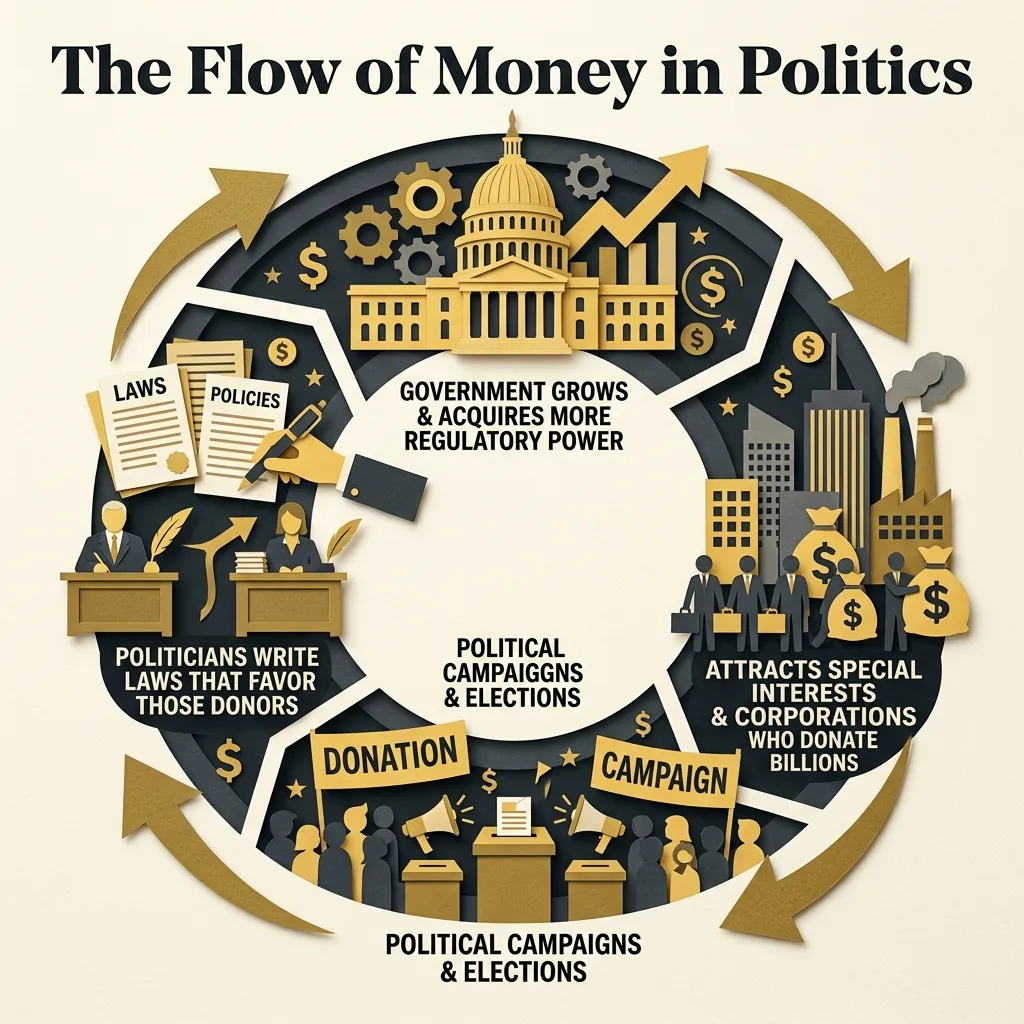
The financial structure of modern political campaigns reinforces this majoritarian calculus. Political parties and candidates operate within a competitive marketplace for campaign donations, where the primary currency is attention and outrage.
In this marketplace, moderate and cooperative messages perform poorly. A campaign proposal that outlines a balanced compromise on a complex regulatory issue does not motivate donors to write checks or share social media posts. Outrage, however, is a powerful motivator.
The Market for Outrage
When a political campaign warns that the opposition is planning to destroy the donors' livelihoods, subvert the constitution, or exploit their families, it triggers an immediate emotional response. This fear-based messaging drives small-dollar donations, volunteer engagement, and media coverage.
Political consultants, utilizing sophisticated data analytics, have optimized this loop. They know that negative advertising (ads that highlight the alleged corruption, incompetence, or malice of the opponent) yield a much higher return on investment than positive advertising. Consequently, campaign funding flows disproportionately into messages that divide the public.
This dynamic results in a massive misallocation of societal resources. Every election cycle, billions of dollars are diverted from productive economic investments (such as research and development, capital equipment, and employee wages) into zero-sum political advertising. This capital is spent not to create wealth, but to compete for the right to redistribute existing wealth. The campaign economy acts as a tax on productive enterprise, turning economic partners into political combatants.
Furthermore, the constant stream of negative messaging has a cumulative effect on the population's mental health and social relations. Neighbors begin to view neighbors with suspicion; family members are alienated over political differences; and workplace cooperation becomes strained. The campaign marketplace treats social cohesion as a resource to be mined and sold for campaign cash, leaving behind a depleted and fractured society.
Attention Economics and Media Capture
This political marketplace is amplified by the business model of modern mass media. In an information ecosystem funded by advertising and user engagement, media corporations operate under the laws of "attention economics."
Algorithms designed to maximize screen time prioritize content that triggers strong negative emotions: anger, fear, and moral outrage. A headline describing a successful compromise in a congressional committee does not generate clicks. A headline detailing a senator's attack on a rival party member does.
This aligns the financial interests of media organizations with the strategic goals of polarizing political campaigns. The media provides free coverage to the most provocative and extreme candidates, while ignoring moderates who seek consensus. The resulting feedback loop systematically distorts public discourse, convincing the population that their political opponents are cartoonish villains and that compromise is a form of betrayal.
Changing the Rules: Voting Alternatives and Their Incentives
If political polarization is driven by the incentives of majoritarian rules, then changing those rules can alter the behavior of political actors. Several voting alternatives (ranked-choice voting, approval voting, and quadratic voting) offer different incentive structures that lower the returns on negative campaigning and polarization.
1. Ranked-Choice Voting
Under ranked-choice voting (RCV), voters rank candidates in order of preference rather than selecting only one. If no candidate wins a majority of first-preference votes, the candidate with the fewest votes is eliminated, and their supporters' votes are redistributed to their second-choice candidates. This process repeats until a candidate secures a majority.
This mechanism changes the campaign incentives. In a traditional first-past-the-post system, a candidate benefits from attacking a similar rival to steal their voters. Under RCV, a candidate must appeal to the supporters of other candidates to secure their second- and third-preference votes.
If a candidate spends their campaign demonizing a rival, that rival's supporters will not rank them second. RCV penalizes extreme polarization and rewards candidates who build broad coalitions, seek common ground, and engage in civil, positive campaigning.
2. Approval Voting
Approval voting is an even simpler alternative. Voters can vote for, or "approve of," as many candidates as they find acceptable on the ballot. The candidate with the highest number of approvals wins the election.
This rule eliminates the "spoiler effect" and the need for strategic voting. A voter can support an independent or third-party candidate without worrying that doing so will help their least favorite candidate win.
For candidates, the path to victory under approval voting requires appealing to as wide a segment of the population as possible. A candidate cannot win by mobilizing a narrow, angry 51 percent faction, because voters from other factions can easily approve of moderate alternatives. Candidates are incentivized to find broad, popular consensus points rather than exploiting wedge issues that split the electorate.
3. Quadratic Voting
A more mathematically advanced alternative is quadratic voting. Under this system, voters are allocated a budget of "voice credits" that they can spend to vote on various proposals. Unlike traditional voting where each vote has a constant cost of one, the cost of casting multiple votes on a single issue scales quadratically, where Cost equals V squared.
To cast one vote on a proposal costs one credit; to cast two votes costs four credits; to cast three votes costs nine credits; and so on. This quadratic cost curve allows voters to express the intensity of their preferences.
In a simple majority system, a casual 51 percent majority can outvote an intense 49 percent minority that will be severely harmed by the policy. Quadratic voting allows the minority to concentrate their voice credits on the issue that affects them most, outvoting the majority that has only a weak preference on the matter. This system protects minority groups from majoritarian tyranny and reduces the incentive for the majority to impose costs on concentrated groups.
Arrow's Impossibility Theorem and Voting Limitations
To fully appreciate voting rules, one must look at the mathematical limits of social choice theory. Economist Kenneth Arrow, in his seminal Impossibility Theorem, proved that no ranked voting system can convert the preferences of individuals into a consistent community-wide ranking without violating at least one of several intuitive fairness criteria.
Arrow showed that when voters have three or more options, it is mathematically impossible to design a voting system that satisfies transitivity, non-dictatorship, independence of irrelevant alternatives, and Pareto efficiency simultaneously. This theorem undermines the claim that democratic voting represents a coherent "will of the people." Instead, the outcome of an election is heavily dependent on the arbitrary structure of the voting rules and the design of the ballot.
This mathematical limit is further illustrated by the Condorcet Paradox, where collective preferences can be cyclic (a majority prefers candidate A to B, B to C, and C to A), even if individual preferences are consistent and transitive. This means that a voting system can result in shifting majorities that chase their own tails in endless policy reversals. Because no voting system is mathematically perfect, democratic processes will always suffer from manipulation, strategic voting, and inconsistent outcomes. Shifting from one voting rule to another can improve incentives, but it cannot make collective decision-making inherently rational. The only way to avoid the paradoxes of social choice is to reduce the number of issues decided by collective vote, leaving them instead to individual decision-making in the marketplace.
The Public Choice Critique: Reducing the Scope of the State
While voting reforms can mitigate the worst excesses of campaign behavior, they do not address the root cause of political corruption and conflict (the concentration of coercive power in the state).
Public choice theory teaches us that the resources invested in capturing political power are directly proportional to the value of that power. If the state holds the authority to distribute trillions of dollars in subsidies, write regulations that cartelize major industries, and impose confiscatory taxes on selected groups, the return on capturing 51 percent of the state is astronomical.
Under these conditions, no amount of voting reform will stop interest groups and corporations from investing massive sums of money to control elections. The prize is simply too valuable. The intensity of political conflict is a function of the state's scope.
Conversely, if the scope of the government is strictly limited to protecting individual rights and maintaining a basic legal framework, the payout of winning an election is low. When the state has no subsidies to grant, no monopoly privileges to enforce, and no regulatory favors to sell, the return on capturing the state drops to near zero.
As a result, corporations and pressure groups stop investing in lobbying and campaign donations. Political campaigns become low-stakes events, and the incentive to demonize the opposition declines because the state lacks the power to enforce ruinous policies on the losing side. The most effective way to reduce political corruption and social conflict is not to change how we vote, but to reduce what the winners can do with their victory.
The Iron Triangle and Regulatory Growth
As the scope of government expands, it gives rise to a self-reinforcing structure known as the "Iron Triangle." This consists of the mutually supportive relationship between congressional subcommittees (which write laws), government bureaucracies (which enforce rules and manage budgets), and corporate interest groups (which fund campaigns).
Within this triangle, the general public is locked out. The congressional committee members rely on corporate donations to win their 51 percent majorities; the bureaucrats seek larger budgets to expand their authority; and the corporate lobbies demand regulations that protect them from competitors.
Each leg of the triangle supports the other two, resulting in a continuous expansion of regulatory complexity and government spending. Voting in general elections has little effect on this structural alliance, because the bureaucrats and committee staffs remain in place regardless of which party wins the thin majority. The only way to break the Iron Triangle is to strip the state of the regulatory and budgetary authority that feeds it.
A Radical Alternative: The Governance Corporation Model
To move beyond the limitations of geographic, majoritarian representation, we can consider a more radical approach (spinning off traditional state functions into separate corporate entities owned directly by the citizens).
In this model, public services such as municipal water supply, road maintenance, public transit, and even local parks are detached from the municipal state. Each service is structured as an independent corporation, and every citizen in the jurisdiction is issued exactly one share in the company.
Shareholder Governance and the Reverse Dividend
Rather than funding these services through general taxation (property, income, or sales taxes), the governance corporation is funded by a specific, dedicated fee (a "reverse dividend").
As long as a citizen remains up to date on their reverse dividend payments, their share is active, granting them full voting rights to elect the corporation's board of directors. If a citizen chooses not to pay, their share is suspended, they lose their voting rights, and they may be restricted from using the service, but they are not subjected to the criminal penalties associated with tax evasion.
This structure aligns incentives with performance. In a traditional political democracy, if the public school system or the transit authority performs poorly, voters cannot easily address the issue. They must wait for the next election cycle and vote for a mayor or council member who has authority over dozens of unrelated issues. The feedback loop is weak, delayed, and diluted.
Under the governance corporation model, the feedback loop is direct and immediate. The board of directors is judged solely on the quality and efficiency of the specific service they manage. If the roads are full of potholes or the transit system is unreliable, shareholders can vote to replace the board directly, without the distraction of unrelated cultural or ideological debates.
The Role of Strict Covenants
A major concern with corporatizing public assets is the risk of asset stripping or mission creep. A board of directors might decide to sell off a public park to developers for a short-term cash payout, destroying a community asset.
To prevent this, governance corporations are established with strict legal covenants written directly into their charters. These covenants are permanent, non-amendable legal constraints that limit the board's authority.
For example, a corporation spun off to manage a public park would have a covenant stating that the property must remain a green space accessible to the public, and that the board has no legal authority to sell the land, build commercial structures, or dissolve the company. Any attempt to do so would be legally void and subject the board to immediate removal.
These covenants ensure that the corporation remains focused on its specific mission, protecting public assets from both corporate predation and political manipulation. It allows for the de-politicization of public spaces, where a park remains a park because the charter requires it, not because a friendly political party is currently in power.
Contractual Governance vs. Territorial Monopolies
This model represents a shift from territorial monopolistic governance to contractual, proprietary governance. In a territorial monopoly (the modern state), citizens are subjected to whatever rules the ruling 51 percent decides to write, with no recourse other than moving to another country.
In a contractual system, the relationship between the citizen and the service provider is governed by a explicit legal agreement. The rights and obligations of both parties are fixed and cannot be unilaterally amended by a vote of the board or a simple majority of shareholders.
This structure protects individual liberty by replacing political coercion with voluntary contract. If a citizen is dissatisfied with the performance of a roads corporation, they can choose to withdraw their funding, lose access to the roads, and seek alternative transit methods, without fear of being arrested for tax evasion. The corporation must compete for the citizen's support, forcing it to remain efficient, responsive, and respectful of individual rights.
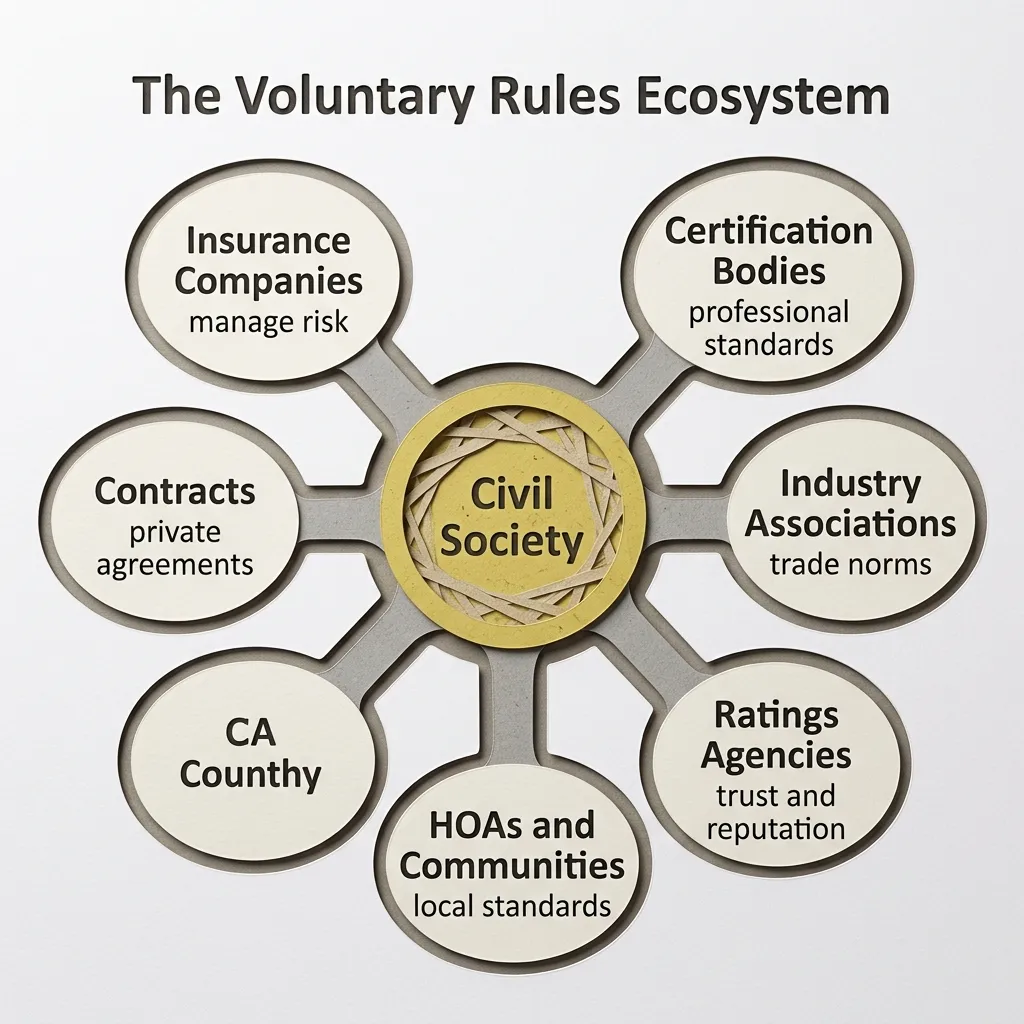
This concept draws inspiration from the work of Spencer MacCallum on "proprietary leaseholds" and private communities. MacCallum observed that complex real estate developments, shopping centers, and hotel complexes successfully organize public services (security, cleaning, infrastructure maintenance, dispute resolution) through private, contractual agreements without the need for political representation or coercion.
By scaling this contractual model to municipal services, we can enjoy high-quality infrastructure without the conflict of majoritarian politics. In a leasehold community, the manager-owner has a direct financial interest in maintaining the quality of the environment to attract and retain tenants. The services are not funded by arbitrary taxes, but by contractual service fees. If the management fails to perform, property values decline and tenants leave, imposing an immediate financial cost on the owners. This aligns the incentives of the service provider with the welfare of the residents in a way that political democracy can never replicate. The governance corporation adapts this model by replacing the single owner with citizen-shareholders, ensuring that the community's assets are managed as a trust rather than a political spoils system.
Democracy as a Defensive Outlet
Democracy remains an essential mechanism for a peaceful society, but its value is defensive, not offensive. Democracy is important because it provides a peaceful, non-violent outlet for citizens to voice concerns, resolve disputes, and replace incompetent or predatory administrators without resorting to civil conflict. It acts as a safety valve for social pressure.
The Tyranny of the Unconstrained Majority
However, when democratic mechanisms are used offensively to force the values, economic preferences, and lifestyles of one group onto another, they become a primary source of social conflict. Majoritarian rules create a winner-take-all arena that rewards division, exploits fear, and concentrates coercive power.
The error of modern democratic theory is the conflation of the democratic process with the scope of collective decision-making. That a decision is made democratically does not make it just or efficient. If 51 percent of a population votes to ban the religious practices of the other 49 percent, the decision is democratic, but it is also a gross violation of individual liberty.
When the scope of collective decision-making is unlimited, democracy becomes a tool for mutual predation. To prevent this, a free society must place strict, constitutional limits on what the majority can decide. The fundamental rights of the individual (to speak, to practice their faith, to trade, and to own property) must be placed beyond the reach of the 51 percent.
The Myth of the Rational Voter and Systematic Biases
Economist Bryan Caplan, in his work "The Myth of the Rational Voter," analyzed why unconstrained democracy systematically produces poor economic policies. Caplan observed that voters do not merely suffer from rational ignorance; they suffer from "rational irrationality." Because an individual vote has no practical impact on policy, voters face zero cost for indulging in politically comforting but economically destructive beliefs.
Caplan identified four systematic biases that distort voter preferences:
- Anti-market bias: A tendency to underestimate the economic benefits of the market mechanism and view transaction as a zero-sum game.
- Anti-foreign bias: A tendency to underestimate the economic benefits of interaction with foreigners, leading to support for tariffs and immigration restrictions.
- Make-work bias: A tendency to equate economic health with employment rather than productivity, resulting in support for featherbedding and subsidies for obsolete industries.
- Pessimistic bias: A tendency to believe that economic conditions are constantly worsening, leading to support for preventative regulations and state interventions.
In a majoritarian democracy, candidates must satisfy these systematically biased voter preferences to win. A candidate who proposes economically sound but counter-intuitive policies (such as abolishing tariffs or agricultural subsidies) will lose to a rival who appeals to the public's biases. Consequently, unconstrained democracy leads to a gradual accumulation of inefficient, rent-seeking policies that slow growth and erode individual liberty.
Narrow Scope and Social Peace
By restricting the scope of government to the protection of individual rights, we ensure that democracy serves its proper defensive function. When the state lacks the authority to regulate personal behavior, control local industries, or redistribute wealth, the stakes of political elections are low.
Voters can still use the democratic process to replace corrupt officials or adjust public administration, but they cannot use it to plunder their neighbors. The incentive to polarize declines, negative campaigning loses its financial utility, and social trust can begin to recover.
Democracy is a useful safety valve, but like any valve, it must be contained within a strong, limited framework. If the container is too large or the pressure is too high, the system will rupture. The key to social peace is not more democracy, but a smaller state.