The Libertarian Party was born in 1971 out of frustration. A group of Americans who had been drawn to the ideals of limited government and individual freedom looked at the political options available to them and found neither major party acceptable. Richard Nixon's administration had imposed wage and price controls, expanded the draft, and shown every sign of treating the Constitution as a nuisance rather than a constraint. Many in this group had come from the conservative movement but found it too comfortable with state power. Some had been reading Murray Rothbard, Leonard Read, and Ayn Rand. All of them wanted something different.
What they built over the next five decades is a remarkable story of persistence against structural odds. The Libertarian Party has never won a major federal office. It has faced ballot access laws designed to keep challengers out, media organizations that ignored or mocked it, and a voting public conditioned to treat third-party votes as wasted. Despite all of this, it has endured as the largest and most consistent third party in the United States, fielded presidential candidates in every election since 1972, and at its peak in 2016 drew over 4.4 million votes nationally.
The Founding: Colorado Springs, 1971
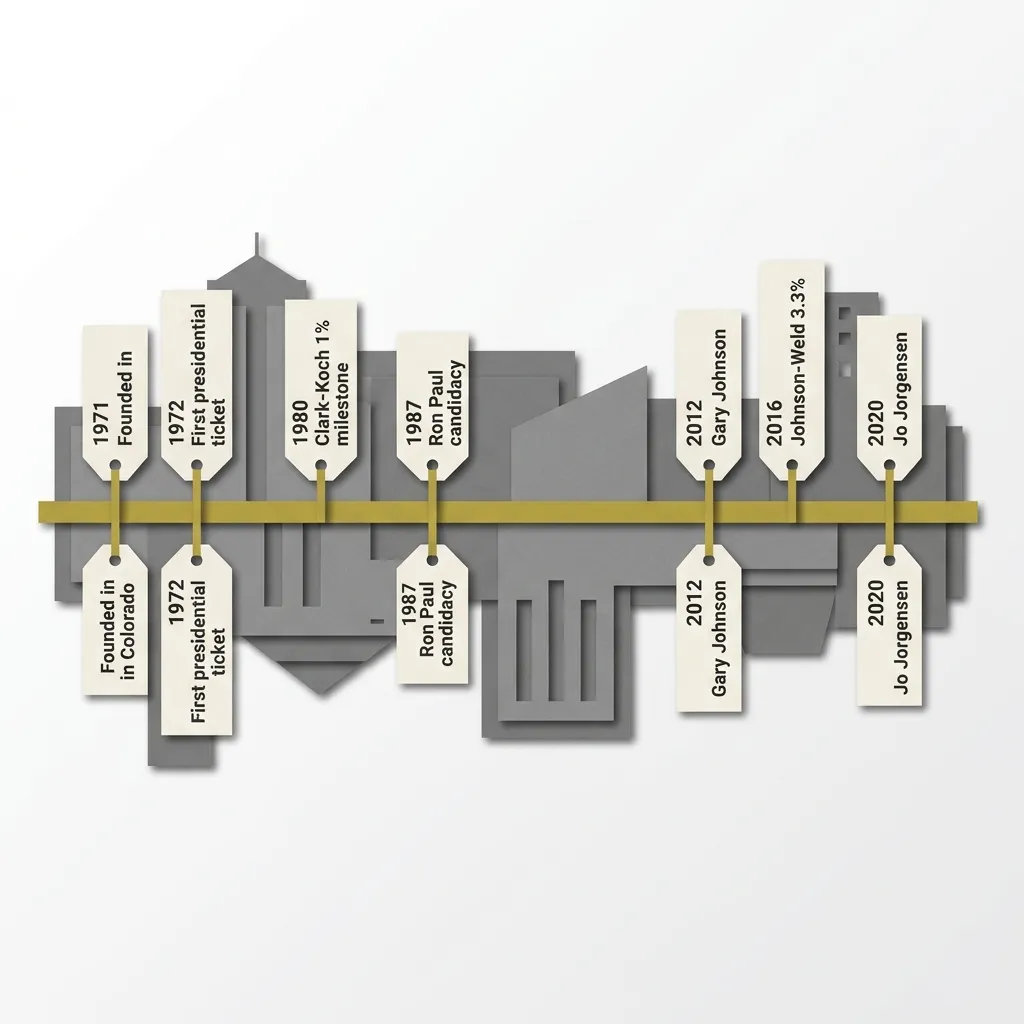
The meeting that produced the Libertarian Party took place in the living room of David Nolan in Westminster, Colorado, in December 1971. Nolan was a young MIT graduate and political activist who had grown disillusioned with the Republican Party. He gathered a small group of like-minded friends, and together they signed the founding documents of a new party.
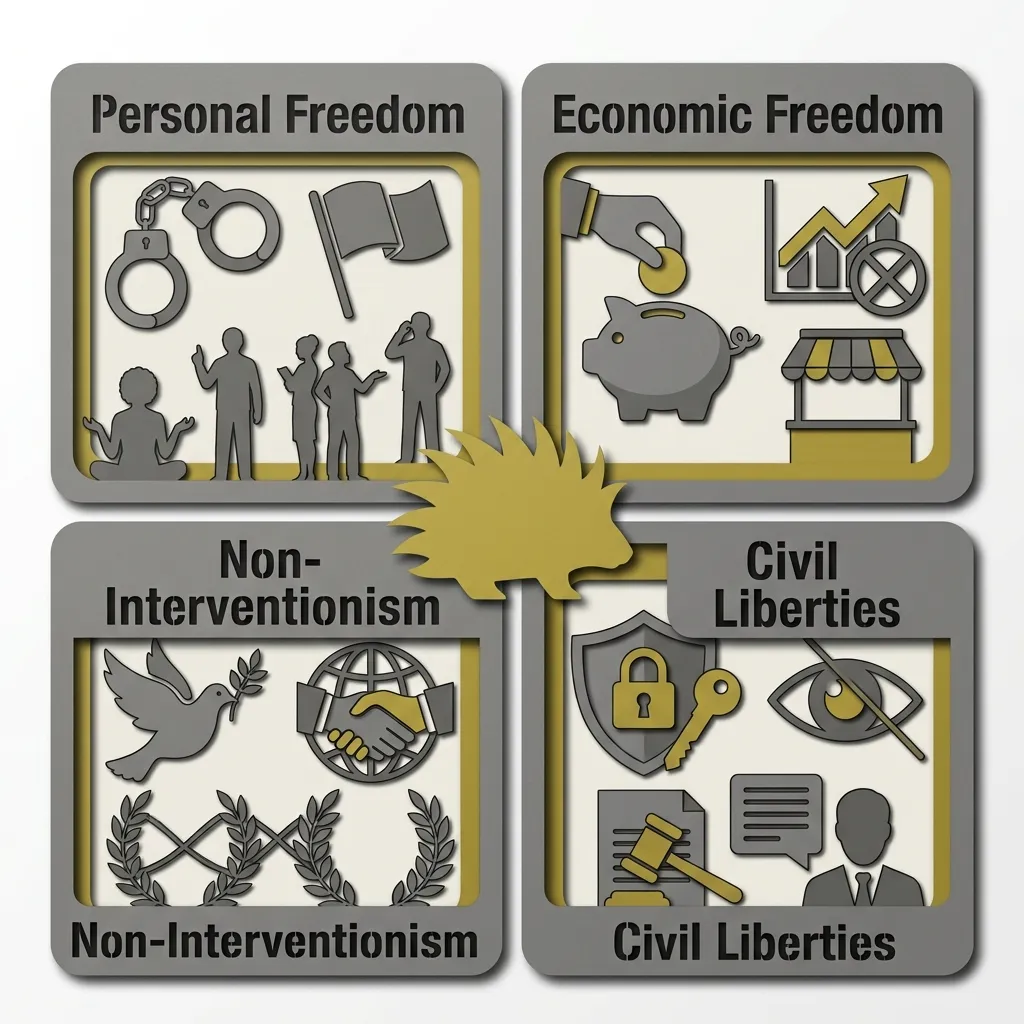
Nolan's own contribution to libertarian thought extended beyond the founding. He developed what became known as the Nolan Chart, a two-dimensional political map that plotted personal freedom on one axis and economic freedom on the other. The traditional left-right spectrum, he argued, was inadequate because it treated economic and personal freedom as opposites when in fact both were dimensions of a single commitment to individual liberty. Libertarians, by this account, were the only consistent advocates of both. The chart became a widely used tool for political education and a fixture in libertarian outreach for decades.
The party adopted its Statement of Principles in 1974, after a period of internal drafting and debate. The statement opened with a clear commitment: "We, the members of the Libertarian Party, challenge the cult of the omnipotent state and defend the rights of the individual." It affirmed that no person or group has the right to initiate force against another, and that all political authority must be derived from the consent of the governed. The porcupine was adopted as the party's unofficial symbol: a creature that minds its own business but is well-defended when threatened.
First Campaigns: 1972 to 1979
The party's first presidential ticket, in 1972, consisted of John Hospers and Tonie Nathan. Hospers was a philosophy professor at the University of Southern California and a friend of Ayn Rand, though the two had parted ways over political strategy. Nathan was a journalist and broadcaster from Oregon. They received 3,674 popular votes, an almost invisibly small number, but they made history: when a Republican elector in Virginia named Roger MacBride cast his electoral college vote for Hospers and Nathan rather than Nixon, Tonie Nathan became the first woman and the first Jewish person to receive an electoral vote in a United States presidential election. Roger MacBride later became the LP's presidential candidate in 1976.
The 1976 campaign was a modest step forward. MacBride received just over 172,000 popular votes, about 0.2% of the total, and was on the ballot in 32 states. The party was beginning to build the organizational infrastructure needed to compete: state affiliates, ballot access drives, and a small but dedicated base of activists. The effort was expensive and legally complicated, since each state had its own rules for third-party ballot access, many of them designed to limit competition.
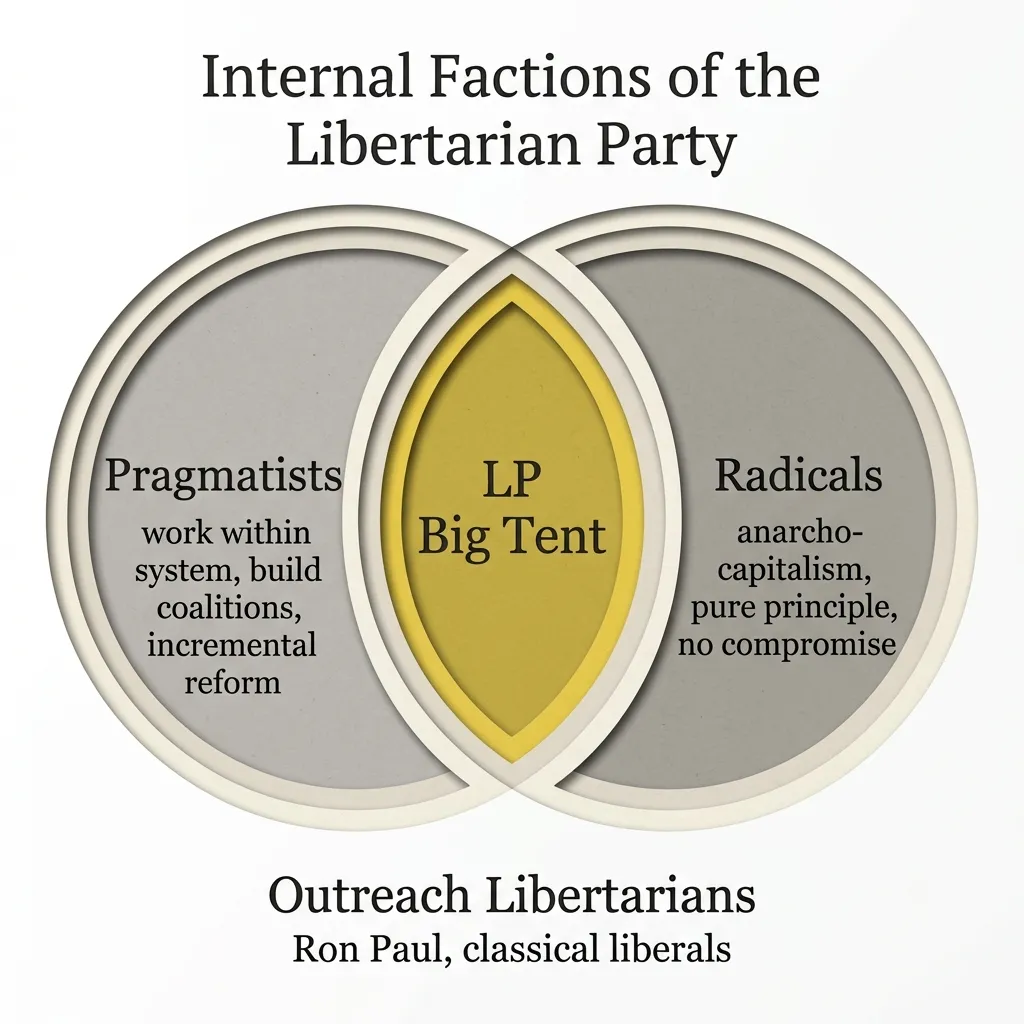
In these early years the party attracted a mix of people who came from the libertarian movement proper, former Republicans frustrated with the Nixon years, and a smaller contingent from the left who were drawn to the party's opposition to the draft and the drug war. The internal culture was largely that of Rothbardian anarcho-capitalism, though the party's platform was broad enough to include minarchists who wanted a minimal state rather than no state at all. This tension between radicals and pragmatists was present from the beginning and has never fully resolved.
The Clark-Koch Campaign: 1980
The 1980 presidential campaign was the most significant in the party's history up to that point and set a record for LP vote share that would stand for thirty-two years. The candidate was Ed Clark, a California attorney who had run a strong race for governor of California in 1978 and demonstrated a capacity for appealing to a broader audience than the party's core activists. His vice-presidential running mate was David Koch, one of the Koch brothers who would later become famous as major funders of the broader libertarian and conservative movement.
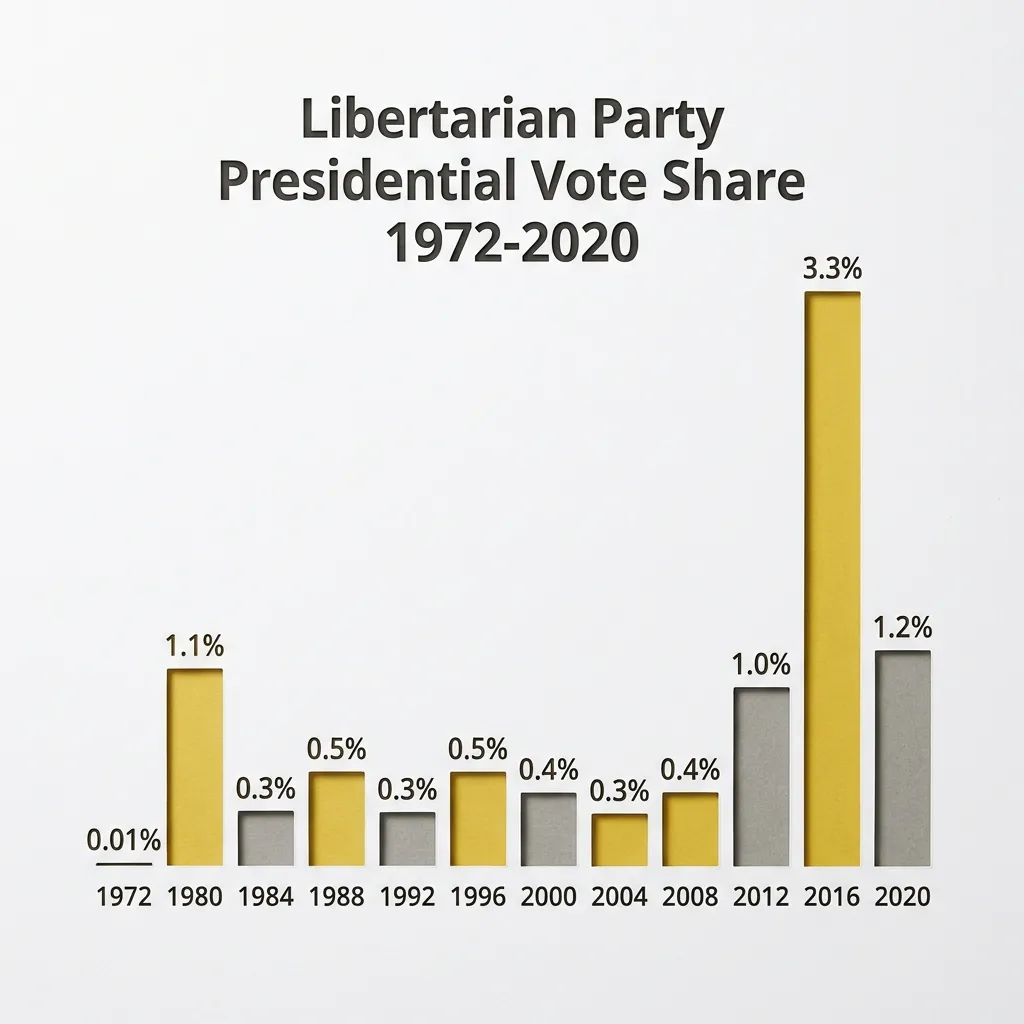
Koch's presence on the ticket brought something the party had rarely enjoyed before: money. The campaign was able to run television and radio advertisements, hire professional staff, and reach voters who had never heard of the Libertarian Party. Clark and Koch appeared on the ballot in all 50 states plus the District of Columbia, a significant organizational achievement. They received 921,299 votes, just over 1% of the total. It was the highest vote share an LP presidential candidate had ever received, and it would remain so until 2012.
The 1980 campaign also illustrated a recurring tension in LP politics. Clark positioned himself as a moderate, describing libertarianism as "low-tax liberalism" and emphasizing its appeal to independents and disaffected Democrats. The party's more radical wing was uncomfortable with this framing, arguing that it softened the party's principled message. After the campaign, the party's internal debates became sharper, and Koch and several other pragmatist figures eventually departed from active LP involvement.
The 1980s: Institutionalization and Debate
The decade following the Clark-Koch campaign was one of consolidation and internal struggle. The party established its national headquarters in Washington, D.C., built out its state party network, and developed more sophisticated voter outreach and media operations. Vote totals in presidential elections remained modest: Bergland in 1984 received about 228,000 votes, about 0.25% of the total, and Paul in 1988 received about 432,000 votes, about 0.5%.
Ron Paul's 1988 candidacy deserves particular attention. Paul was a Texas obstetrician and former congressman who had served in the House as a Republican from 1976 to 1985 before becoming the LP's presidential nominee. His campaign was modest by any standard, but it gave Paul national exposure outside Texas for the first time and allowed him to build a mailing list of supporters that would serve him well when he returned to the Republican Party and ran again for Congress in 1996. Paul remained connected to the libertarian movement throughout his career, and his 1988 LP run was an important chapter in that story.
The internal debates of the 1980s centered on questions that still animate LP politics. How much should the party moderate its message to attract more voters? Should it emphasize economic freedom or personal freedom in its outreach to different audiences? Should it cooperate with sympathetic Republicans and Democrats on specific issues, or maintain a strict separation to preserve its identity? The answers were never settled, and different factions within the party reached different conclusions in different states and at different times.
The 1990s: Harry Browne and the Internet Age
The 1990s brought a new generation of technology and a new face to the LP's presidential campaigns. Harry Browne, a financial writer and investment advisor who had built a following with his books on personal finance and freedom, ran as the LP's presidential candidate in 1996 and 2000. Browne was an effective communicator who understood the emerging power of the internet as an organizing and fundraising tool, and his campaigns built some of the first serious online communities around libertarian politics.
Browne received about 485,000 votes in 1996 and about 384,000 in 2000. The 2000 total was a disappointment partly because Ralph Nader's Green Party campaign attracted many protest voters who might otherwise have considered a third-party option on the right or center. Browne and the LP also faced questions about whether the party should have pushed harder for federal matching funds by clearing the 5% vote threshold, a goal that remained perpetually just out of reach.
The 1990s also saw the party grapple with the Clinton years, a period when many libertarians found themselves agreeing with Republican critiques of government expansion while disagreeing sharply with Republican positions on social issues, drug prohibition, and foreign policy. The LP positioned itself as the consistent voice for both economic and personal freedom, arguing that Republicans and Democrats each supported freedom only when it suited their own coalition and suppressed it when it did not.
The 2000s: Post-9/11 Politics and the Iraq War
The September 11 attacks and the wars that followed put the Libertarian Party's non-interventionist foreign policy under intense pressure. In the immediate aftermath of the attacks, questioning military action abroad was politically unpopular, and the party's principled opposition to the invasion of Iraq placed it well outside the mainstream of American political discourse. The LP lost some members who supported the war and attracted others who opposed it, particularly as public opinion on Iraq soured after 2004.
Michael Badnarik, the LP's 2004 presidential candidate, received about 397,000 votes. Badnarik was a computer programmer and Constitution instructor from Texas who had won the nomination at a contested convention. His campaign was notable for its grassroots character and its use of the internet for organizing and fundraising, following patterns that Howard Dean's Democratic primary campaign had helped establish that same year.
The 2008 candidate was Bob Barr, a former Republican congressman from Georgia who had been a prominent prosecutor during the Clinton impeachment proceedings before becoming an outspoken critic of the Bush administration's surveillance programs and the Patriot Act. Barr's nomination was controversial within the LP because of his past support for the drug war and other positions that libertarians found objectionable. Supporters argued that his national profile and Republican voter lists would expand the party's reach. He received about 523,000 votes, nearly 0.4% of the total.
The Ron Paul Effect: 2008 to 2012
Ron Paul's 2008 Republican primary campaign changed the landscape for libertarian politics in the United States more than any LP presidential campaign had. Paul ran as a Republican but on a platform of sound money, non-interventionism, drug legalization, and strict constitutional limits on federal power. His campaign generated an unprecedented grassroots response, raising over $35 million in the primary season and breaking single-day fundraising records. The "Ron Paul Revolution" brought hundreds of thousands of young people into contact with libertarian ideas for the first time.
The effect on the LP was complicated. Many Paul supporters joined or re-engaged with the party. Others stayed in the Republican Party, working to elect Paul-aligned candidates in primaries and eventually building what became the liberty caucus within the GOP. Paul himself returned to the Republican presidential primary in 2012, again generating significant grassroots support before Mitt Romney secured the nomination. The libertarian-leaning bloc Paul had built within Republican politics remained an identifiable force for the rest of the decade.
The LP's 2012 presidential candidate was Gary Johnson, the former two-term Republican governor of New Mexico. Johnson had governed as a pragmatic fiscal conservative and social moderate, and he brought to the LP something it had rarely had: real executive experience and a record of accomplishment in government. He received just over 1.27 million votes, about 1% of the total, the highest LP vote total since 1980 and the highest number of raw votes in LP history at that point. He had achieved this in part by appealing to disaffected voters from both parties and presenting libertarianism in accessible, practical terms.
The High-Water Mark: Gary Johnson in 2016
The 2016 presidential election produced the most favorable conditions the Libertarian Party had ever seen and the most votes it had ever received. Both major party nominees, Hillary Clinton and Donald Trump, had historically high unfavorability ratings among the general public. Surveys consistently showed that a substantial portion of American voters were uncomfortable voting for either major party candidate and were open to alternatives.
Gary Johnson ran again, this time with William Weld, the former Republican governor of Massachusetts, as his running mate. The Johnson-Weld ticket was designed to appeal to moderate Republicans and independents who found Trump unacceptable and Democrats who found Clinton uninspiring. The ticket received significant media coverage, including several appearances on major network programs, and polling in the high teens at points during the summer.
The final result was 4,489,235 votes, 3.28% of the total popular vote. It was the highest vote share the LP had ever received, by a wide margin, and the most raw votes by a factor of more than three. Johnson and Weld fell short of the 5% threshold that would have given the party federal matching funds in the following election cycle, but the result was nonetheless a significant achievement. It demonstrated that there was a genuine appetite for a libertarian alternative when conditions were right and the candidates were credible.
The campaign was not without controversy within the party. Some LP members felt that Johnson and Weld moved too far toward the Republican establishment, particularly when Weld made favorable comments about Clinton near the end of the campaign. Others believed the campaign did not do enough to promote core libertarian principles and focused too much on presenting the candidates as reasonable centrists. These debates continued at party conventions and in libertarian publications for years afterward.
2020 and the Jorgensen Campaign
The 2020 LP presidential candidate was Jo Jorgensen, a senior lecturer in psychology at Clemson University and the party's 1996 vice-presidential nominee. Jorgensen won the nomination at a virtual convention held during the COVID-19 pandemic, defeating several other candidates including Jacob Hornberger of the Future of Freedom Foundation and Spike Cohen, who became her running mate.
Jorgensen ran on a platform that was more explicitly anti-state than Johnson's campaigns had been, emphasizing foreign policy non-interventionism, the drug war, police reform, and pandemic-related civil liberties. She received about 1.87 million votes, 1.18% of the total. The result was a significant drop from 2016, though the conditions were very different: with Trump on the ballot and a pandemic reshaping the political environment, most third-party vote share collapsed. The 2020 total was still the third-highest in LP history.
The Mises Caucus and Internal Conflict
The 2022 LP national convention in Reno, Nevada, was among the most consequential and contentious in the party's history. The Mises Caucus, a faction aligned with the Austrian economics tradition and the paleo-libertarian politics associated with Murray Rothbard and Lew Rockwell, had spent several years organizing within the party and arrived at the convention with enough delegate support to take control of the party's leadership and platform.
The Mises Caucus succeeded. Angela McArdle was elected national chair, and the party's messaging shifted in a direction more critical of mainstream libertarianism's alliance with progressive social causes. The caucus argued that the LP had been captured by a cosmopolitan, left-leaning libertarianism that alienated potential supporters from working-class and conservative backgrounds. Critics within the party argued that the Mises Caucus was importing right-wing populist politics into a party that stood for something more principled and consistent.
In 2024, the LP nominated Chase Oliver as its presidential candidate after a contested convention in Washington, D.C. that included an invitation to Donald Trump to speak (he did), a moment that generated considerable controversy. Oliver, a long-time LP activist and candidate from Georgia, ran a principled campaign on traditional libertarian platform positions. The 2024 results placed the LP at a lower total than 2020, reflecting both the compressed political environment of that cycle and the ongoing internal disputes.
The LP's Structural Challenges
Understanding the Libertarian Party's history requires understanding the structural obstacles it faces. The United States uses single-member districts with plurality voting, a system that political scientists have long observed tends to produce and entrench a two-party system. A voter who prefers the LP but fears wasting their vote in a close race will often vote for the lesser-evil major party candidate instead. This dynamic repeats in every election and at every level of government.
Ballot access laws compound the problem. Each state sets its own rules for how many signatures a third party must collect to appear on the ballot, and many states impose rules that make this process extremely expensive and labor-intensive. The LP has had to fight costly legal battles in many states simply to be allowed to participate. These battles consume resources that might otherwise go to campaigning and outreach.
Media coverage has historically been minimal. Presidential debates, which are organized by the Commission on Presidential Debates (a nonprofit created by the two major parties), have set polling thresholds that have kept LP candidates out of the main debate stage. Johnson came closest in 2016 but fell short of the 15% polling threshold required. Without debate access, reaching the tens of millions of Americans who watch those broadcasts is very difficult.
What the LP Has Accomplished
Given these obstacles, it is worth taking stock of what the LP has actually accomplished. Most obviously, it has kept libertarian ideas present in American political discourse for more than fifty years. Its presidential candidates have given speeches, appeared in media, and participated in down-ballot debates that reached audiences who would not otherwise have encountered arguments for drug legalization, non-interventionism, the Federal Reserve's abolition, or school choice.
The LP has also won offices at the state and local level. Hundreds of LP candidates have served as city council members, county commissioners, school board members, and in state legislatures. These victories are rarely reported nationally, but they represent real governing experience and real policy influence at the local level. In several states, LP candidates have received enough votes in close races to affect the outcome between the major parties, giving the party leverage it would not otherwise have.
The party has also served as an incubator for ideas that eventually found their way into mainstream policy debates. Drug policy reform, which the LP championed decades before it became a majority position, has now been adopted in some form by most states. Criminal justice reform, opposition to warrantless surveillance, and skepticism of foreign military intervention have all moved from LP platform positions toward the political mainstream over the past twenty years. The LP cannot claim full credit for these shifts, but it was consistently on the right side of these arguments before they were popular.
The Libertarian Party Today
The Libertarian Party in the mid-2020s is a party in flux. The internal battles between the Mises Caucus and the party's more traditional libertarian wing continue to shape its direction. Membership and fundraising have been volatile. The question of whether to pursue a strategy of principled purism or pragmatic coalition-building remains unresolved, as it has been since 1971.
Some observers of libertarian politics argue that the LP's role as an electoral vehicle has always been secondary to its role as an educational organization. On this view, the party's real purpose is to provide a platform for libertarian ideas, train activists, and demonstrate to the major parties that there is a constituency for civil liberties and limited government. Elections are occasions for outreach rather than genuine bids for power.
Others argue that the LP must become a serious electoral force if it is to matter, and that this requires nominating credible candidates, building coalitions across ideological lines, and accepting some degree of message discipline. The 2016 Johnson-Weld campaign pointed in this direction, and its results showed what was possible when conditions aligned.
Both views have merit, and both have been tried. The LP's history is in some ways the story of a party that has never quite decided which of these it wants to be, and that has accomplished more than its size would suggest precisely because it has served both functions at different moments. Whether a future campaign will break through to the kind of sustained electoral success that would change the structure of American politics remains an open question. The conditions that produced 2016's result have not disappeared. They may yet produce something larger.