The idea that individuals possess an inherent domain of freedom, one that no ruler, law, or collective has the right to invade, is among the most persistent and consequential in human history. It appears in Greek philosophy, Roman jurisprudence, medieval theology, Enlightenment political theory, and the radical pamphlets of the nineteenth century. What we call libertarianism today is the heir to all of these traditions, distilled and sharpened across centuries of argument, revolution, and reform. Understanding where these ideas came from is the first step toward understanding what they demand of us now.
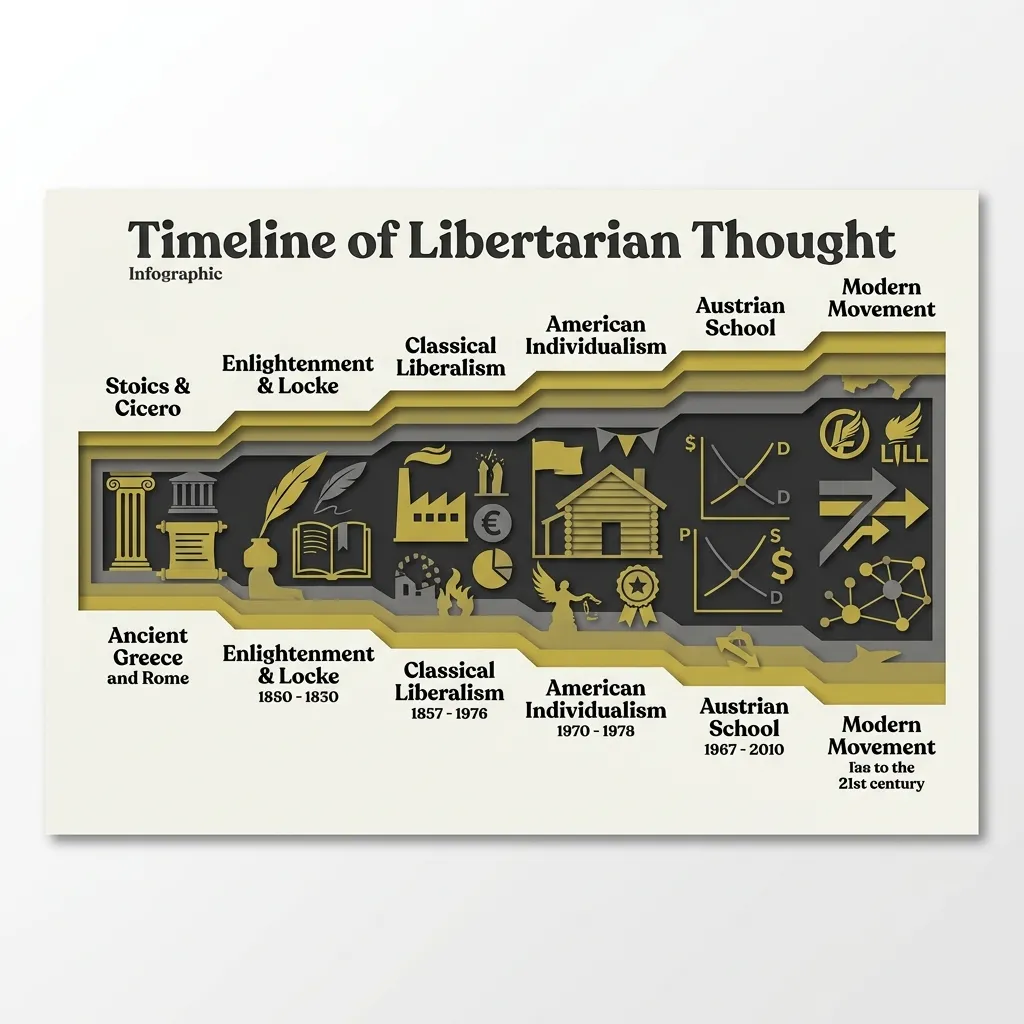
Ancient Seeds: Greece, Rome, and the Stoics
The earliest recognizable arguments for individual liberty appear in classical antiquity, though they arrive in forms that would be unfamiliar (and sometimes uncomfortable) to modern libertarians. The pre-Socratic sophists, particularly Antiphon of Athens (5th century BCE), distinguished betweennomos (law, convention) and physis (nature), arguing that many social rules were artificial impositions rather than natural necessities. The truly free person, Antiphon suggested, would follow nature rather than the arbitrary dictates of the city. This tension between natural freedom and conventional restraint would echo across Western philosophy for millennia.
Aristotle contributed a different thread: the concept of the person as a rational agent whose excellence is realized through self-directed action. For Aristotle, virtuous behavior could not be coerced; it had to be chosen. This insight, that genuine moral life requires the freedom to act and to err, would resurface in libertarian arguments against paternalism two thousand years later.
The Stoic school, founded by Zeno of Citium around 300 BCE and reaching its fullest expression in the writings of Cicero, Epictetus, and Marcus Aurelius, made the most direct contribution to libertarian thought. The Stoics taught that all human beings share a rational nature, thelogos, that makes them, in a fundamental sense, equal. From this equality of rational nature, they derived a cosmopolitan ethics that transcended the boundaries of city-states and empires. Cicero's formulation was especially influential: in De Re Publica andDe Legibus, he articulated the idea of a universal natural law, binding on all governments and all persons, that no human legislation could legitimately override. This natural law tradition became the scaffolding on which later rights theorists would build.
Rome's legal tradition reinforced these ideas in a practical direction. Roman jurists, particularly those of the classical period from the first to third centuries CE, developed elaborate protections for private property, contract, and personal status. The legal concept of dominium(ownership), carrying near-absolute rights over one's property, became part of Western legal DNA. When medieval and modern thinkers reached for a foundation for property rights, they reached first to Rome.
The Medieval Thread: Scholasticism and the Limits of Power
The Christian Middle Ages are often caricatured as an age of pure authority and suppressed individuality. The reality is more complicated. Medieval Scholastic philosophy, drawing on both Aristotle and Roman law, produced serious treatments of property, contract, and the limits of legitimate rule. Thomas Aquinas in the thirteenth century distinguished between eternal law, natural law, human law, and divine law, insisting that human law derived its authority only from its conformity to natural law. An unjust law, Aquinas argued (following Augustine), was no law at all.
The late Scholastics of the Spanish School of Salamanca, Francisco de Vitoria, Domingo de Soto, Juan de Mariana, and others, went further still. Writing in the sixteenth century, at the moment of Spain's colonial expansion, they developed sophisticated arguments about natural rights, the legitimacy of resistance to tyranny, the justice of free markets, and the immorality of price controls. Juan de Mariana even defended tyrannicide under certain conditions. Murray Rothbard, who studied this tradition carefully, identified the Salamancans as genuine forerunners of libertarian economics and political theory.
The Enlightenment: Rights, Reason, and the Social Contract
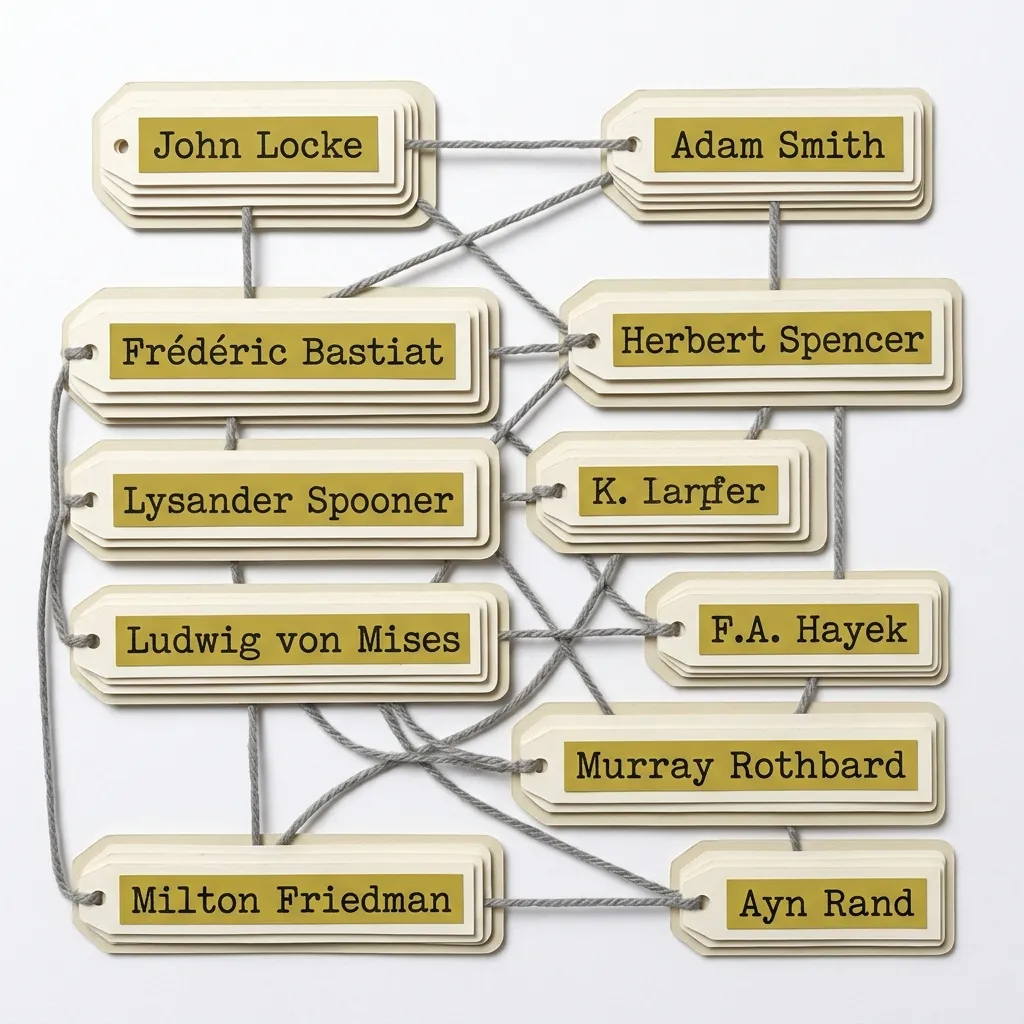
The seventeenth and eighteenth centuries produced the most direct ancestors of modern libertarian thought. The Enlightenment's commitment to reason, individual judgment, and the critique of inherited authority created intellectual conditions in which ideas about natural rights and limited government could be stated with new precision and force.
John Locke (1632–1704) is the figure who towers above all others in this period. In hisTwo Treatises of Government (1689), Locke argued that in the state of nature, prior to any political arrangement, every person possesses natural rights to life, liberty, and property. These rights are not granted by governments. They precede government. Political authority is legitimate only when it protects these rights; when it violates them, the people are justified in Locke's labor theory of property, the idea that one comes to own things by mixing one's labor with them, would be both celebrated and contested by libertarians for three centuries.
Adam Smith (1723–1790) shifted the focus from political philosophy to political economy.The Wealth of Nations (1776) made the case that the free market, the spontaneous coordination of millions of individual decisions through the price mechanism, produces better outcomes for everyone than any central planner could achieve. Smith's "invisible hand" metaphor captured a deep insight: social order does not require deliberate design. It emerges from the voluntary interactions of self-interested individuals, constrained by competition and the rule of law. This insight became foundational for libertarian economics.
In France, the physiocrats had already been making related arguments. Anne-Robert-Jacques Turgot and their successors insisted that the natural order of free exchange would produce prosperity if the state would simply stand aside: laissez faire, laissez passer. The phrase became a rallying cry for economic liberals across Europe.
Classical Liberalism: The Nineteenth Century High-Water Mark
The nineteenth century saw classical liberalism reach its greatest political influence. In Britain, the repeal of the Corn Laws (1846), free trade agreements, the gradual extension of civil liberties, and the rollback of mercantilist regulations all reflected the growing prestige of liberal ideas. The intellectual movement behind these reforms was led by a succession of brilliant thinkers.
Frédéric Bastiat (1801–1850) was perhaps the finest polemicist liberalism ever produced. HisThe Law (1850) stated the libertarian case against legal plunder with crystalline clarity: the law is perverted when it takes from some persons what belongs to them and gives it to others. His satirical "Candlemakers' Petition", in which candlemakers petition the government to block out the sun to protect them from unfair competition, remains one of the most effective illustrations of protectionist absurdity ever written. Bastiat also articulated the "seen and unseen" framework: economic analysis must account not only for the visible effects of a policy but for the invisible effects on alternatives that are foreclosed.
John Stuart Mill (1806–1873) occupies a complex position in the libertarian tradition. HisOn Liberty (1859) gave the clearest statement of the harm principle: the only legitimate reason for society to exercise power over any individual is to prevent harm to others. Mill's liberalism was not identical to later libertarianism. He was more sympathetic to some state interventions and eventually flirted with socialism. But his defense of individual freedom against social conformity and state coercion was enormously influential.
Herbert Spencer (1820–1903) pushed classical liberalism in a more radical direction. HisSocial Statics (1851) argued for an absolute right to ignore the state, anticipating later anarcho-capitalist arguments. Spencer believed that evolution operated in the social sphere as well as the biological: free competition and voluntary cooperation would, over time, produce a more just and peaceful social order than any government could design. His later retreat from these positions, under the pressure of criticism, disappointed radical libertarians but left an intellectual legacy that Rothbard and others would later reclaim.
American Individualism: The Radical Tradition
In the United States, the libertarian tradition took on a distinctly radical character. The founding generation had absorbed Locke's arguments and applied them to the question of British colonial rule. The Declaration of Independence, with its line "We hold these truths to be self-evident, that all men are created equal, that they are endowed by their Creator with certain unalienable Rights", is among the most powerful statements of natural rights theory ever penned.
But the most radical expressions of American individualism came from thinkers who went well beyond the founders. Lysander Spooner (1808–1887) was perhaps the most uncompromising. A lawyer by training, Spooner argued in No Treason: The Constitution of No Authority (1867–1870) that the U.S. Constitution had no binding force on anyone who had not personally consented to it. A A social contract signed by people long dead, or never signed at all, could not obligate the living. Spooner also wrote brilliant anti-slavery arguments, demonstrating that slavery was inconsistent with any coherent theory of natural rights, and he challenged the Post Office's monopoly by establishing a competing mail service, the American Letter Mail Company, before the government shut it down.
Benjamin Tucker (1854–1939), editor of the journal Liberty, synthesized European anarchist thought with American individualism to create what he called "philosophical anarchism" or "individualist anarchism." Tucker rejected the state entirely but also rejected what he saw as the "wage slavery" of industrial capitalism, a position that placed him to the left of most later libertarians on economic questions. Tucker's circle included figures like Voltairine de Cleyre, who articulated a feminist individualism that challenged both state authority and conventional gender arrangements.
The Austrian School: Economics as a Science of Freedom
The most intellectually rigorous contribution to libertarian thought in the twentieth century came from the Austrian School of economics. Founded by Carl Menger in Vienna in the 1870s, the Austrian School developed a distinctive methodology, praxeology (the logic of human action), and a body of economic theory that had profound implications for questions of political economy.
Ludwig von Mises (1881–1973) was the dominant figure of the twentieth-century Austrian tradition. His Socialism (1922) delivered what he believed was a decisive refutation of central planning: without market prices to aggregate dispersed information and coordinate production decisions, socialist planners would be operating in the dark. This "economic calculation problem" sparked a decades-long debate and remains one of the most important arguments in the history of economic thought. Mises's Human Action (1949) was a systematic presentation of praxeological economics, a comprehensive account of how free markets work and why government intervention tends to produce outcomes worse than the ones it was meant to correct.
Friedrich Hayek (1899–1992), Mises's most distinguished student, extended the calculation argument in an influential direction. In "The Use of Knowledge in Society" (1945) and The Constitution of Liberty (1960), Hayek argued that the knowledge relevant to economic coordination is inherently dispersed across millions of individuals: local, tacit, and impossible to centralize. The price system is a remarkable information-processing mechanism that allows this dispersed knowledge to be used even though no one person possesses it. Any attempt to replace market prices with central planning would necessarily destroy the information mechanism that makes coordination possible. Hayek won the Nobel Prize in Economics in 1974.
"The curious task of economics is to demonstrate to men how little they really know about what they imagine they can design."
F.A. Hayek, The Fatal Conceit (1988)
Ayn Rand and the Objectivist Tradition
Ayn Rand (1905–1982) arrived in the United States as a refugee from Soviet Russia and spent her career constructing a comprehensive philosophical system, Objectivism, that provided a distinctive foundation for individual rights and laissez-faire capitalism. Her novels The Fountainhead(1943) and Atlas Shrugged (1957) reached millions of readers with a message that the creative, productive individual (the "prime mover" of civilization) was systematically exploited and suppressed by collectivist society.
Rand grounded her ethics in the concept of rational self-interest: each person's primary moral obligation is to his or her own life and flourishing. Altruism, the demand that one sacrifice oneself for others, she regarded as a moral corruption that made genuine human achievement impossible. From this ethics, she derived an absolute defense of individual rights and capitalism as the only social system consistent with human nature.
Rand explicitly rejected the libertarian label and had sharp disputes with Murray Rothbard and others. Nevertheless, her influence on the libertarian movement has been enormous: survey after survey finds Atlas Shrugged among the books most cited by people who identify as libertarians as having changed their minds.
Murray Rothbard and the Libertarian Synthesis
Murray Rothbard (1926–1995) was the architect of modern libertarianism as a self-conscious political philosophy. A student of Mises, deeply versed in the history of American individualism, and a prolific writer across economics, history, and philosophy, Rothbard spent his career constructing a comprehensive libertarian system and building the institutional foundations of a libertarian movement.
His Man, Economy, and State (1962) was a systematic presentation of Austrian economic theory, reconstructed from first principles. Power and Market (published separately in 1970, later combined) extended the analysis to demonstrate that all government intervention in the economy produced results inferior to those of the free market. For a New Liberty(1973) was his popular manifesto, presenting the libertarian position on every major policy question of the day. The Ethics of Liberty (1982) provided the philosophical foundation: a theory of natural rights derived from the axiom of self-ownership.
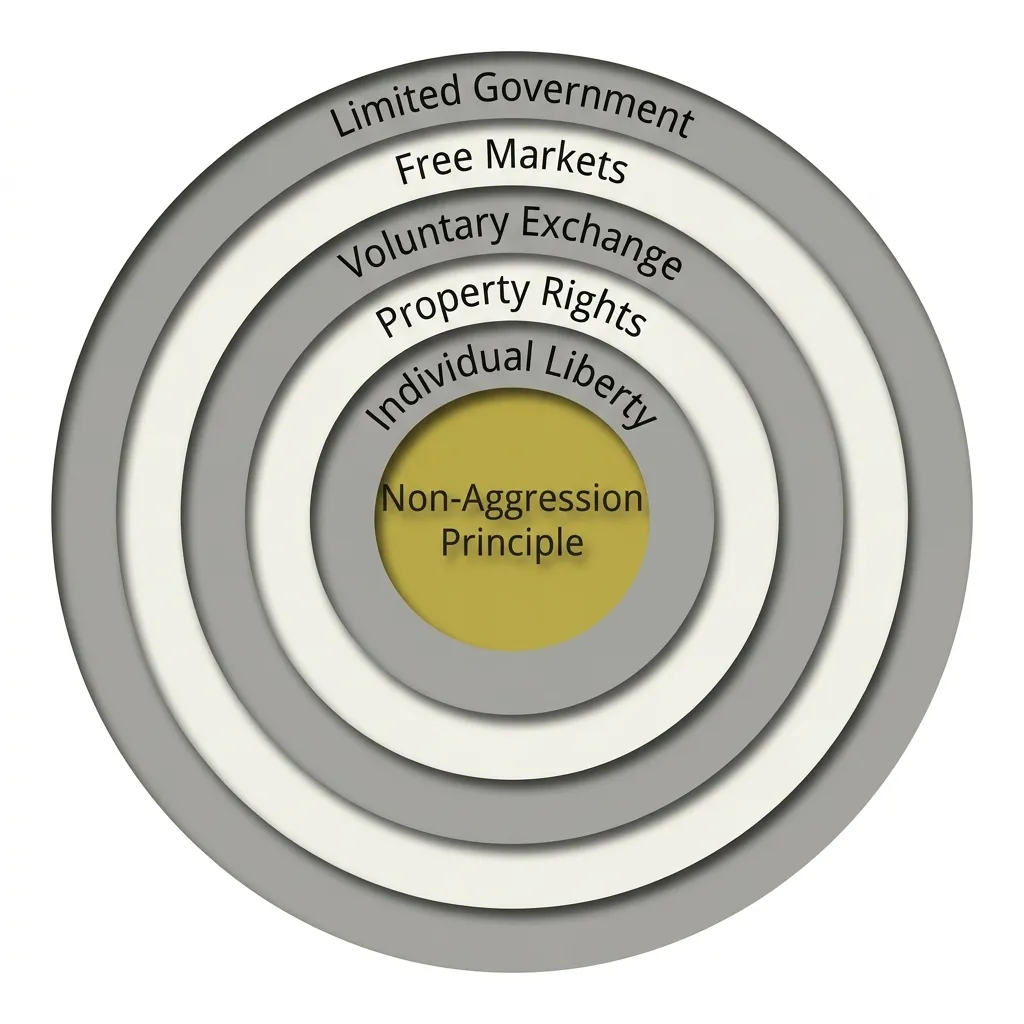
The self-ownership principle, the claim that each person owns his or her own body and by extension the products of his or her labor, was Rothbard's starting point for an entire political philosophy. From self-ownership, combined with the Lockean theory of property acquisition, Rothbard derived the non-aggression principle: no person may initiate physical force against another. This principle, he argued, rules out not only private violence and theft but taxation, military conscription, drug prohibition, and virtually every other form of state coercion. The logical conclusion was anarcho-capitalism: a society of completely voluntary institutions, with private firms competing to provide security and dispute resolution services in place of the state.
Milton Friedman and the Chicago School
Milton Friedman (1912–2006) represented a different strand of free-market liberalism, one more willing to work within existing political institutions and more pragmatic in its policy recommendations. His Capitalism and Freedom (1962) argued that economic freedom was a necessary condition for political freedom, and made the case for a range of reforms: a negative income tax in place of the welfare bureaucracy, school vouchers, an end to occupational licensing, floating exchange rates, and the abolition of the Federal Reserve.
Friedman was a brilliant communicator and his television series Free to Choose (1980), based on the book co-authored with his wife Rose Friedman, reached an enormous popular audience. The Chicago School he helped lead exercised direct influence on government policy in the United States and internationally during the 1970s and 1980s.
The relationship between the Chicago School and the libertarian movement has always been somewhat uneasy. Rothbard regarded Friedman as a statist in libertarian clothing, pointing to his support for a negative income tax (which Rothbard saw as a guaranteed income that would entrench the welfare state) and his monetarism (which involved an active role for the central bank). Friedman saw Rothbard's absolutism as politically unrealistic. The debate between these two orientations, principled absolutism versus pragmatic incrementalism, continues in libertarian circles today.
The Libertarian Party and the Institutional Movement
The Libertarian Party was founded in Colorado in 1971, by David Nolan and others frustrated with the Nixon administration's wage and price controls, its continuation of the draft, and its general expansion of federal power. The party provided an electoral vehicle for libertarian ideas and, over time, developed policy platforms on everything from drug legalization to foreign non-intervention to free trade.
The party's history has been marked by persistent tension between pragmatists who want to build electoral coalitions and radicals who see the party primarily as an educational vehicle for pure libertarian principles. Third parties face structural disadvantages in the American electoral system: single-member districts, winner-take-all elections, ballot access laws designed to protect incumbents. These structural disadvantages have kept the Libertarian Party from winning major offices, though it has consistently outperformed other third parties in presidential elections.
The Cato Institute, founded in 1977 by Rothbard, Nolan, and Charles Koch (the latter two soon departing from Rothbard's influence), became the most prominent libertarian think tank in Washington. The Reason Foundation, the Mises Institute, the Foundation for Economic Education, and dozens of other organizations formed the institutional infrastructure of the libertarian movement, producing research, hosting conferences, training young scholars, and engaging the policy conversation.
Ron Paul and the Libertarian Mainstream
No figure did more to bring libertarian ideas to a mass audience in the early twenty-first century than Ron Paul, the Texas congressman and physician who ran for the Republican presidential nomination in 2008 and 2012. Paul's campaigns, particularly his 2008 run, generated an unexpected surge of grassroots energy and small-dollar donations, powered largely by young people who found in his message of sound money, non-interventionist foreign policy, civil liberties, and constitutionally limited government a coherent alternative to both major parties.
Paul's movement demonstrated that there was a significant constituency for libertarian ideas within the Republican coalition, and it spawned a generation of activists, organizations, and eventually elected officials who identified with some version of libertarianism. His son Rand Paul continued this work in the U.S. Senate, attempting to build a "libertarian-leaning" bloc within Republican politics.
Contemporary Libertarianism: Pluralism and New Directions
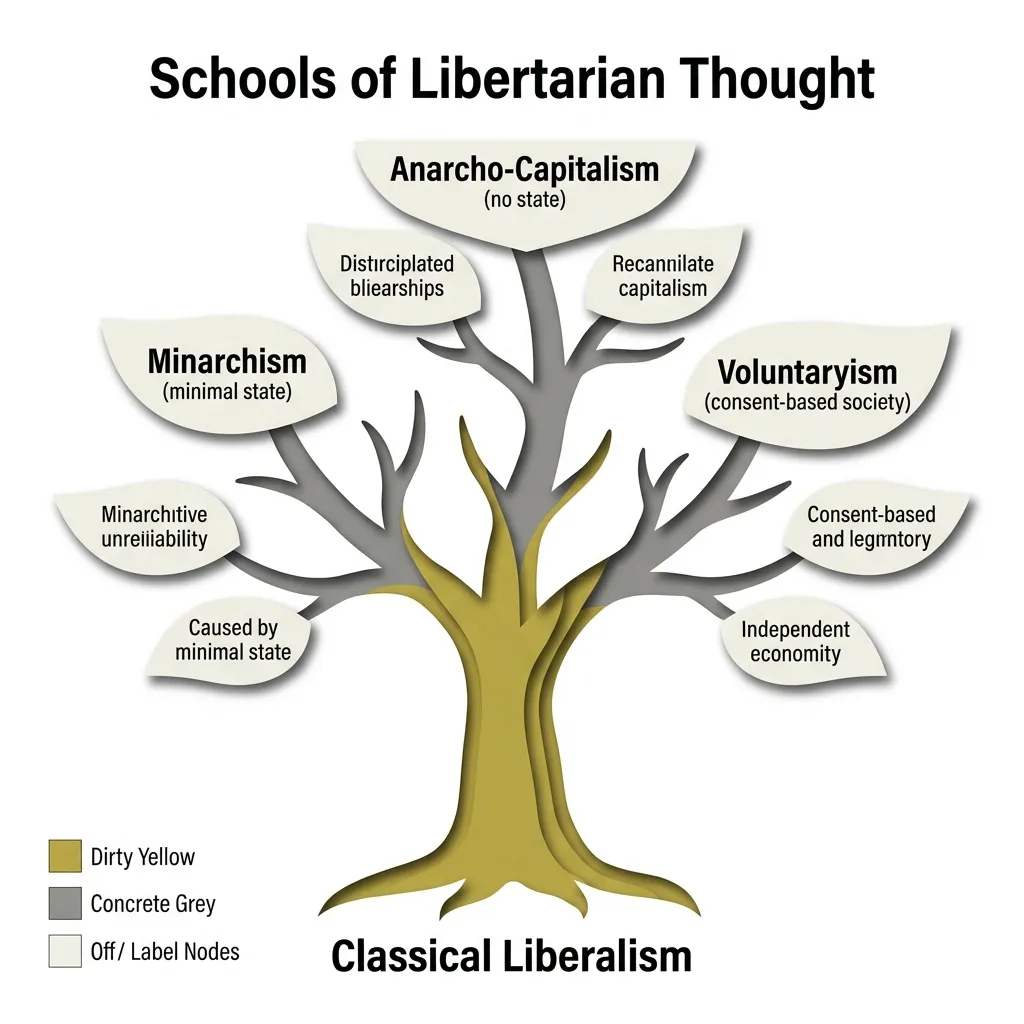
Contemporary libertarianism is not a monolith. It encompasses anarcho-capitalists who want to abolish the state entirely, minarchists who want to limit government to the protection of life, liberty, and property, classical liberals who favor a somewhat larger but still sharply limited state, and bleeding-heart libertarians who argue that concern for the poor and disadvantaged is consistent with libertarian principles (indeed, some argue it is required by them).
New intellectual currents have enriched the tradition. Public choice economics, the application of economic reasoning to political behavior, provided a rigorous framework for analyzing why governments tend to fail even when they are staffed by well-intentioned people. Regulatory capture theory showed how industries consistently use regulation to protect themselves from competition rather than to serve consumers. The economics of information, developed by Friedrich Hayek and extended by George Stigler, Israel Kirzner, and others, deepened the case for market coordination over central planning.
The digital revolution has generated new libertarian-adjacent movements: cryptography advocates, open-source developers, decentralization enthusiasts, and proponents of cryptocurrency. They share libertarianism's suspicion of centralized authority and enthusiasm for voluntary, self-organizing systems, even when they do not explicitly identify with the libertarian label.
At the same time, libertarianism has faced serious intellectual challenges. Critics from the left have argued that formal freedom without attention to structural inequalities of power and wealth is inadequate. A person born into poverty may be formally free to contract but materially unable to do so on fair terms. Critics from the right have argued that libertarianism's individualism undermines the communities, traditions, and shared norms that make a free society possible. And critics from within the tradition have debated whether the non-aggression principle can bear the weight Rothbard placed on it, whether self-ownership is a coherent foundation for rights, and whether anarcho-capitalism is a realistic vision or a philosophical fantasy.
Libertarianism as a Living Tradition
What unites this diverse intellectual history is not a single doctrine but a common orientation: the conviction that individuals matter, that their freedom to live as they choose (within the limits set by others' equal freedom) is morally fundamental, and that power, whether public or private, requires justification rather than mere acceptance. This orientation has expressed itself differently across different historical contexts: as natural law theory in the seventeenth century, as political economy in the eighteenth, as radical individualism in the nineteenth, as Austrian economics and natural rights theory in the twentieth.
Each generation has inherited a tradition and transformed it, responding to new challenges and absorbing new intellectual resources. The result is not a finished system but a living conversation, one that has been going on for more than two thousand years and shows no sign of ending. The ideas of Cicero, Locke, Bastiat, Mises, and Rothbard are not museum pieces. They are tools for understanding a world in which the struggle between freedom and power continues, in new forms, every day.
For those who are new to this tradition, the history traced in this article is an invitation. These are not merely abstract philosophical disputes; they are attempts to work out the conditions under which human beings can live together without dominating one another. That is a project worth continuing.