Immigration is one of those debates where almost everyone is talking past everyone else. A person worried about wage competition in a local labor market, a person worried about cultural change in their community, and a person worried about long-term voting patterns are all raising different concerns. They may use similar language but they are arguing about different things. A libertarian concerned about the welfare state subsidy to immigrants and a libertarian committed to open borders as a natural rights matter are both called libertarians but they reach different conclusions. Before the argument can be had clearly, the different vectors of the debate need to be separated.
This article does that work. It maps the three main tracks along which immigration debates actually run, looks at the evidence and the strongest arguments on each, and then explains why most libertarians, though not all, conclude that much freer movement of people is both morally required and practically beneficial.
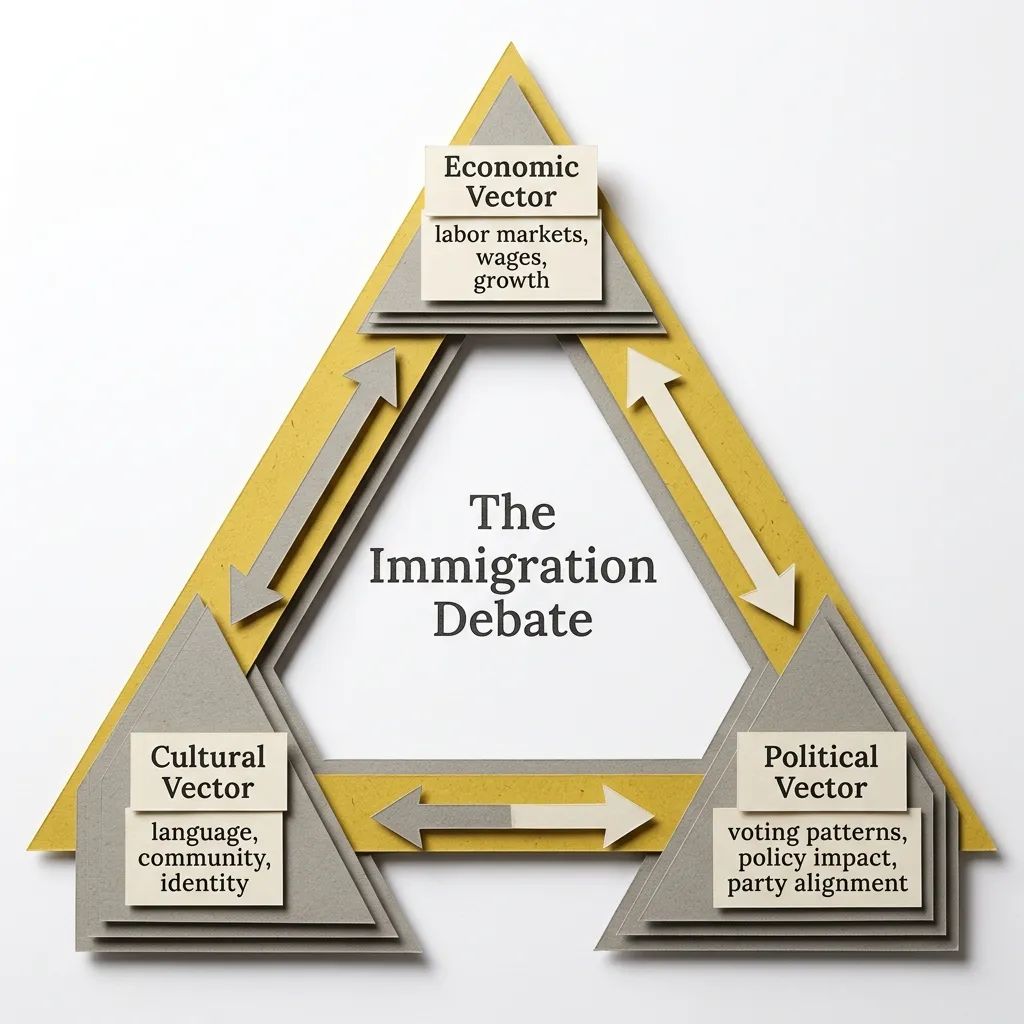
The Economic Vector
The economic debate over immigration is the most amenable to empirical analysis and the one where the evidence is clearest. The basic economic case for immigration goes like this: people move from places where they are less productive to places where they are more productive. That movement increases total output. The immigrant gains (their wages rise), the receiving country gains (more goods and services are produced, more taxes are paid), and the sending country often gains too (remittances flow back, and emigrants often return with skills and capital).
The evidence broadly supports this. Immigrants to the United States have historically contributed more in taxes than they consume in services over their lifetimes, particularly first-generation immigrants who arrived as working-age adults. Immigrant entrepreneurship is disproportionately high: immigrants or their children founded a substantial fraction of Fortune 500 companies. Nobel Prizes in science go disproportionately to immigrants. Silicon Valley would not exist in anything like its current form without immigrant engineers, scientists, and founders.
The concern on the other side is wage competition. When labor supply increases, wages in competing occupations can fall, at least in the short run. This concern is most acute for low-skilled native workers whose labor is most directly substitutable with low-skilled immigrant labor. The economic literature is genuinely mixed on the magnitude of this effect. Some studies find significant wage suppression; others find minimal effects, particularly over longer time horizons as the economy adjusts. The honest answer is that the effects are real but smaller than restrictionists claim and unevenly distributed: costs fall on some workers in some industries, while benefits are broadly diffused.
The libertarian economic argument does not require pretending that wage competition does not exist. It requires pointing out that the right response to wage competition is not to restrict immigration but to address the conditions that make low-wage workers vulnerable: minimum wage floors that reduce employment, occupational licensing that locks workers out of trades they could perform, regulations that benefit incumbent businesses over new entrants. The problem is not immigration; it is a policy environment that has already left many American workers with few options.
The Welfare State Complication
Milton Friedman made the argument that open borders and a welfare state cannot coexist. If anyone can enter the country and claim benefits, the cost of those benefits will grow without limit. This is the most serious economic objection to open immigration within a libertarian framework, and it deserves a serious answer.
The data on immigrant welfare use is more nuanced than the argument suggests. Unauthorized immigrants are largely ineligible for federal welfare programs. Legal immigrants face a five-year waiting period for most federal benefits. First-generation immigrants, across legal categories, use welfare at lower rates than comparable native-born Americans, partly because of selection effects (people who move internationally tend to be more motivated and risk-tolerant than average) and partly because of legal restrictions. It is the second generation that approaches native welfare-use rates.
The Friedman objection is a real one in theory, but it is less decisive in practice than it appears. The solution libertarians generally propose is not to restrict immigration but to restrict access to welfare by immigrants for some period, or to move toward a less expansive welfare state overall. "Open borders, closed welfare" is a coherent position that addresses the Friedman concern while preserving the right to move.
The Cultural Vector
The cultural debate is harder to address with data because it is partly about values rather than facts. The concern is that high levels of immigration, particularly of people from cultures with different languages, religions, and norms, will change the character of communities in ways that existing residents did not choose and cannot easily reverse.
This concern has some validity. Mass immigration does change communities. Languages change. Businesses change. Neighbors change. For people who value community stability and cultural continuity, rapid demographic change can be genuinely disorienting. The libertarian case for immigration does not require pretending this concern is baseless or that everyone who raises it is motivated by racism or xenophobia.
But the cultural argument for restriction has weaknesses too. Cultural change is not a new phenomenon, and the cultures that existing residents value were themselves produced by immigration and change. The Irish, Italian, Jewish, and Eastern European immigrants who arrived in the early twentieth century were also seen as culturally threatening by the existing Anglo-Protestant majority. They were said to be unassimilable, religiously incompatible, politically dangerous. Within two or three generations, their descendants were indistinguishable from the "real Americans" whose culture they had supposedly threatened.
The rate of cultural change matters. The cultural argument is more plausible when immigration is very large and concentrated in specific communities, creating enclaves where assimilation is slow. It is weaker when immigration is more distributed and when the receiving society has functioning institutions of civic integration. The question is not whether any cultural change is permissible but whether the rate of change is manageable, which is an argument for some regulation of flows rather than an argument for prohibition.
The Political Vector
The political debate concerns voting patterns and long-term electoral effects. The argument, most common on the right, is that immigrants from certain countries tend to vote for larger-government parties, and that admitting large numbers of such immigrants will produce permanent electoral majorities for policies that restrict freedom. This concern is the most explicitly self-interested of the three vectors and the most difficult to address on principle.
The empirical evidence on immigrant voting patterns is more complex than the argument suggests. Hispanic immigrants, who constitute the largest recent immigrant group, are not monolithic voters. Cuban Americans have historically voted Republican. Mexican Americans and Central Americans skew Democratic but not uniformly. Second and third generations become more like the native-born population over time in their political behavior. The assumption that immigration produces a permanent Democratic majority does not fit the historical record well.
More fundamentally, from a libertarian perspective, the political vector argument is difficult to sustain without abandoning basic principles. If the argument is that people whose views differ from mine should not be allowed to move here because they might vote differently, that is an argument for restricting freedom based on anticipated political consequences, which is a very weak foundation for any principle of liberty. Libertarians who find themselves arguing that immigration should be restricted because immigrants might support bigger government are accepting a logic that could equally justify restricting domestic citizens with similar views from voting.

The Natural Rights Case for Free Movement
The strongest libertarian case for free movement does not rest primarily on economic efficiency, though that case is strong. It rests on natural rights. If a person owns themselves and their labor, they have the right to offer that labor to willing employers. If an employer in another country wants to hire someone from a different country, and both parties consent, what is the justification for the state preventing that transaction? The border is a line drawn on a map by governments. The people on either side of it did not consent to its location or to the restrictions it imposes on their movement.
Lysander Spooner's question applies here: what gives the people who designed this system the authority to bind people who never agreed to it? The person born in Mexico who wants to work in Texas did not consent to the border between them. The employer in Texas who wants to hire them did not consent to immigration law restricting their ability to do so. The justification for the restriction has to be something other than consent, and whatever it is needs to be strong enough to outweigh the liberty interests of two people who want to make a voluntary transaction.
The standard justification is national sovereignty: the people of a country have the collective right to decide who enters their territory. This is a real argument, but it requires establishing that the nation-state has a kind of corporate personhood with rights that can override those of the individuals it affects. Libertarians are generally skeptical of that kind of collective right when it overrides individual liberty. The same argument was used to justify restrictions on interracial marriage (the state has an interest in the racial composition of its population) and on religious assembly (the state has an interest in cultural homogeneity). The argument from collective sovereignty is not self-evidently stronger when applied to immigration.
Where Libertarians Disagree
Not all libertarians support open borders, and the disagreements are genuine rather than merely rhetorical. Some libertarians, particularly those associated with the Mises Caucus and the paleo-libertarian tradition, argue that in a world where the welfare state exists and where immigration has political effects, the Friedman objection and the political vector concern are decisive enough to support significantly restricted immigration as a second-best position.
Murray Rothbard himself shifted toward a more restrictionist position late in his career, arguing that in the absence of a fully private property society, open borders in practice amounted to forced integration, because immigrants could use public property (roads, parks, government buildings) that had been funded by existing residents. This is a clever argument but it proves too much: by the same logic, any use of public goods by anyone could be restricted, which leads to conclusions most libertarians would find uncomfortable.
Hans-Hermann Hoppe, a Rothbard student, developed the restrictionist case further, arguing that property rights require homeowners' associations or equivalent institutions to control who has access to private communities, and that the nation-state can serve as a proxy for such an institution at scale. Critics within the libertarian movement point out that this grants the state an authority over territory that libertarians normally reject, and that the analogy between a private community and a nation-state elides crucial differences.
The Practical Libertarian Position
Whatever position one takes on the philosophical questions, there is a practical libertarian agenda on immigration that most libertarians can agree on. The current U.S. immigration system is neither free nor humane. Legal pathways for migration are severely restricted and the wait times for legal immigration from countries like Mexico and the Philippines run to decades. This creates the unauthorized immigration that restrictionists object to: if legal immigration were faster and easier, more people would use it.
A practical libertarian immigration reform would expand legal immigration significantly, create a guest worker system that allows people to come and work without committing to permanent residency, end the drug war that funds the cartels that control the border and profit from human smuggling, and limit immigrant access to welfare programs for some initial period. This is not open borders in a pure sense. It is a dramatic liberalization from the current system that would reduce unauthorized immigration while respecting the rights of people who want to work and the employers who want to hire them.
The current system, by contrast, has all the disadvantages of restriction without achieving restriction's stated goals. Unauthorized immigration is large. The border enforcement apparatus is expensive and frequently abusive. The cartels that profit from smuggling are strengthened. Workers who cross illegally are exploited. Employers who want to hire legally cannot find enough workers through the legal system. This is Prohibition logic applied to labor migration, and it produces Prohibition results.
Separating the Vectors, Reaching a Conclusion
The value of separating the three vectors is that it allows the debate to be more honest. A person who is genuinely concerned about wage competition for low-skilled native workers should be asked whether restricting immigration actually helps those workers, or whether the same resources directed at occupational licensing reform, wage subsidies, or job training would help them more. A person genuinely concerned about cultural change should be asked whether restriction is the right tool or whether better integration programs would address the concern more effectively. A person genuinely concerned about the political effects of immigration should be asked whether the logic of that concern is consistent with any principle of liberty they hold elsewhere.
When the vectors are separated and examined on their own terms, the case for dramatic restriction weakens considerably. The economic benefits of immigration are large and broadly distributed. The cultural concerns are real but historically manageable. The political concerns require accepting a logic that is difficult to contain to the immigration case alone.
The libertarian conclusion, for most people who think through the question carefully, is that movement is a fundamental expression of human freedom, that the case for preventing voluntary transactions between consenting adults requires a very strong justification, and that the existing justifications for the existing level of restriction do not meet that bar. A world where people can move more freely, work more freely, and trade more freely is a freer world by any measure that takes individuals rather than states as the unit of analysis.