The standard critique of libertarianism on empathy goes something like this: libertarians do not care about the poor, the sick, or the vulnerable because they oppose the government programs designed to help them. If you do not want the state to provide healthcare, housing, or income support, you must be indifferent to suffering. Compassion requires big government. Liberty and care are in tension.
This framing is wrong at almost every level. Opposing a particular mechanism for helping people is not the same as not wanting to help people. Preferring voluntary charity over coercive taxation is not indifference; it may be a considered judgment that voluntary charity works better. And the claim that state welfare programs are the most effective expression of social empathy deserves scrutiny rather than assumption. But the deeper problem with the critique is that it confuses mandated compassion with genuine care, and these are very different things.
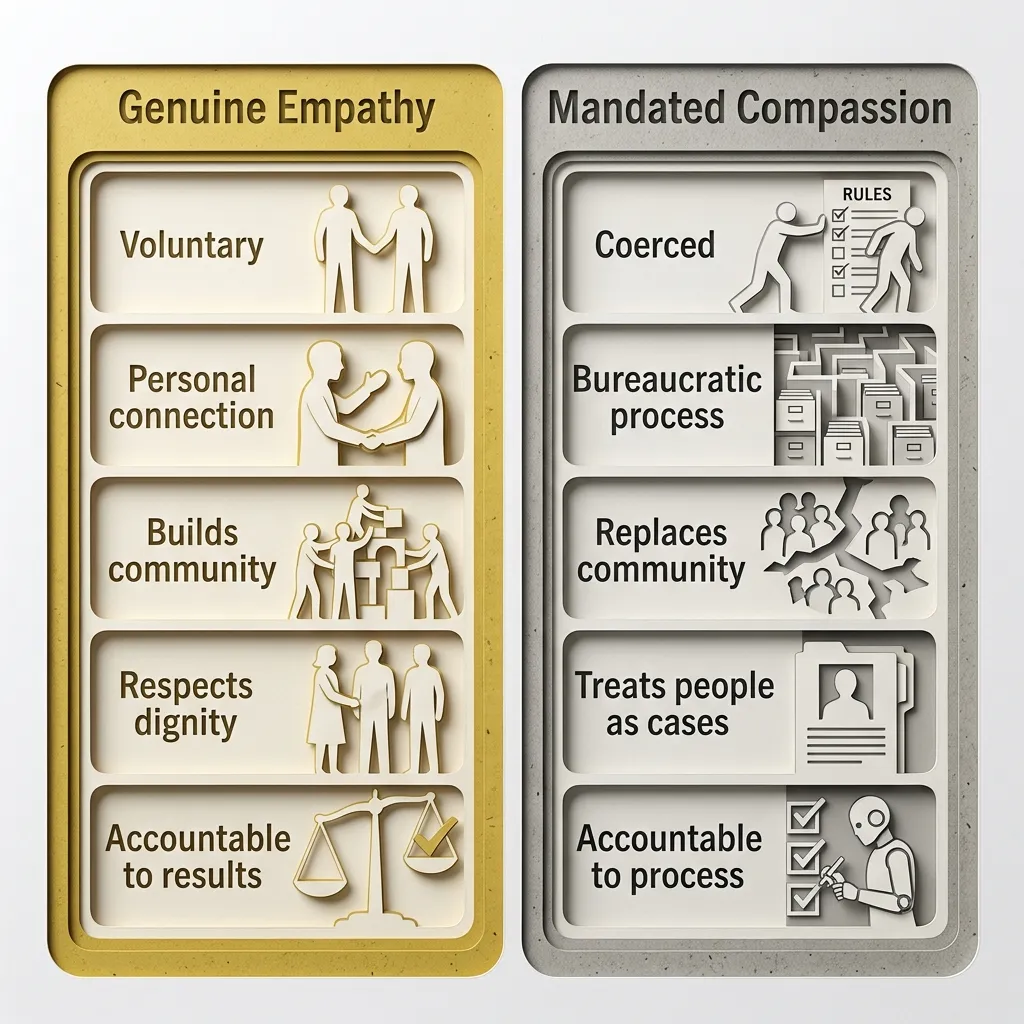
What Genuine Empathy Is
Empathy is the capacity to understand and share the feelings of another person. It is, at its core, a relational and personal experience. You see someone struggling, you recognize their situation as something that could happen to you or someone you love, and you respond. That response might be practical help, emotional support, advocacy, or simply showing up. Whatever form it takes, genuine empathy involves a real connection between the person feeling it and the person it is directed toward.
Mandated compassion is different. When the state taxes you to fund a welfare program, your connection to the people that program serves is essentially administrative. A check is generated. A form is processed. A caseworker meets with a client according to program rules. The people who pay the taxes and the people who receive the benefits usually have no relationship at all. The transaction is handled by intermediaries whose job is compliance with regulations, not genuine care for individuals.
This is not an argument against all state programs. Some problems are large enough and structural enough that voluntary efforts cannot address them adequately, and state intervention may be justified on practical grounds. But it is an argument that we should not confuse state programs with empathy. Writing a tax check is not the same as caring. Voting for a program and forgetting about it is not the same as taking responsibility for the people it is supposed to help. The language of compassion around state welfare programs often papers over the absence of genuine human connection.
The Crowding-Out Problem
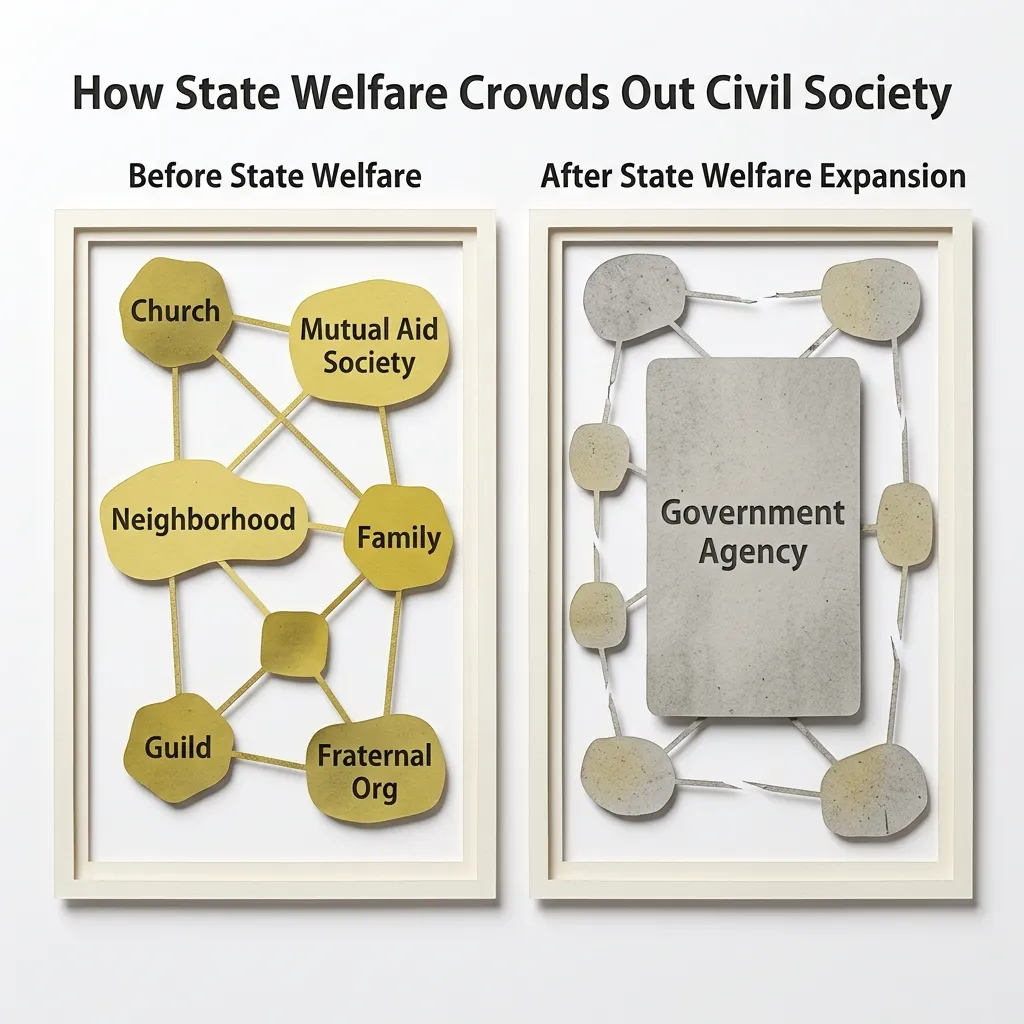
Before the twentieth century's major welfare state expansions, American civil society maintained an extensive network of mutual aid societies, fraternal organizations, church charities, neighborhood associations, and informal community support systems. Working-class communities in particular developed elaborate structures of mutual support: dues-paying organizations that provided sickness benefits, death benefits, and community belonging. These were not charity in the patronizing sense; they were mutual arrangements among equals who expected to both give and receive over the course of their lives.
As the state expanded its welfare functions through the twentieth century, many of these institutions weakened or disappeared. Partly this was because the state programs made them less necessary. Partly it was because the tax burden of funding state programs reduced the resources people had available for voluntary contributions. Partly it was because the state programs crowded out the social norms and habits of mutual support that the older institutions had maintained.
The result is a society that in some respects is more materially secure than before but less connected. Robert Putnam's research on social capital documented a dramatic decline in Americans' participation in civic organizations, religious communities, and informal social networks over the second half of the twentieth century. Whether the welfare state caused this or merely coincided with it is debated, but the correlation is worth taking seriously. A society where people look to the state to care for the vulnerable rather than taking that responsibility on themselves may be one where fewer people develop the habits of care at all.
Empathy and Human Dignity
Genuine empathy takes seriously the dignity of the people it is directed toward. It treats people as individuals with their own history, their own judgments, and their own capacity to determine what they need. Bureaucratic programs often struggle to do this. Rules are applied uniformly because that is what bureaucracies do. The person in front of the caseworker is, administratively, a case, not a person. Eligibility rules may prevent help from reaching people who genuinely need it while providing it to people who do not. The mismatch between what the program requires and what the individual actually needs is a structural feature, not a failure of individual caseworkers.
Voluntary charity can adapt in ways that state programs cannot. A neighbor who knows your situation can help in ways that address your actual problem. A church community that knows its members can distinguish between temporary need and structural problems that require different responses. A mutual aid society can apply judgment that a bureaucratic program cannot. The relational nature of voluntary care is not a weakness; it is the feature that makes genuine empathy possible at all.
This does not mean that voluntary care always works or that it can scale to address very large or very dispersed need. There are genuine limitations to what voluntary institutions can do, and libertarians who deny this are not being honest. The argument is not that voluntary care is always sufficient. It is that voluntary care is more genuinely empathetic when it exists, and that state programs can crowd it out, and that a healthy society needs both and should not assume that the state is always the right tool for every problem.
The Libertarian Ethic of Care
Libertarianism does not require indifference to others' suffering. It requires respecting others' autonomy, which includes taking their suffering seriously and responding to it without condescension. The libertarian who volunteers at a food bank, donates to medical research, mentors young people in their community, and advocates for criminal justice reform is expressing a genuine ethic of care. The difference from progressive politics is not that libertarians care less but that they prefer voluntary mechanisms over coercive ones.
This preference has practical foundations. Voluntary organizations are accountable to their donors in ways that state programs are not. A charity that does not produce results loses donations; a government program that does not produce results usually loses nothing because its budget is determined by politics rather than effectiveness. Voluntary organizations can experiment, adapt, and fail gracefully; state programs tend to persist regardless of whether they work because the constituencies that benefit from them have political power. The argument that voluntary mechanisms are better is partly a moral argument about autonomy and partly a practical argument about accountability.
Empathy as the Mechanism of Change
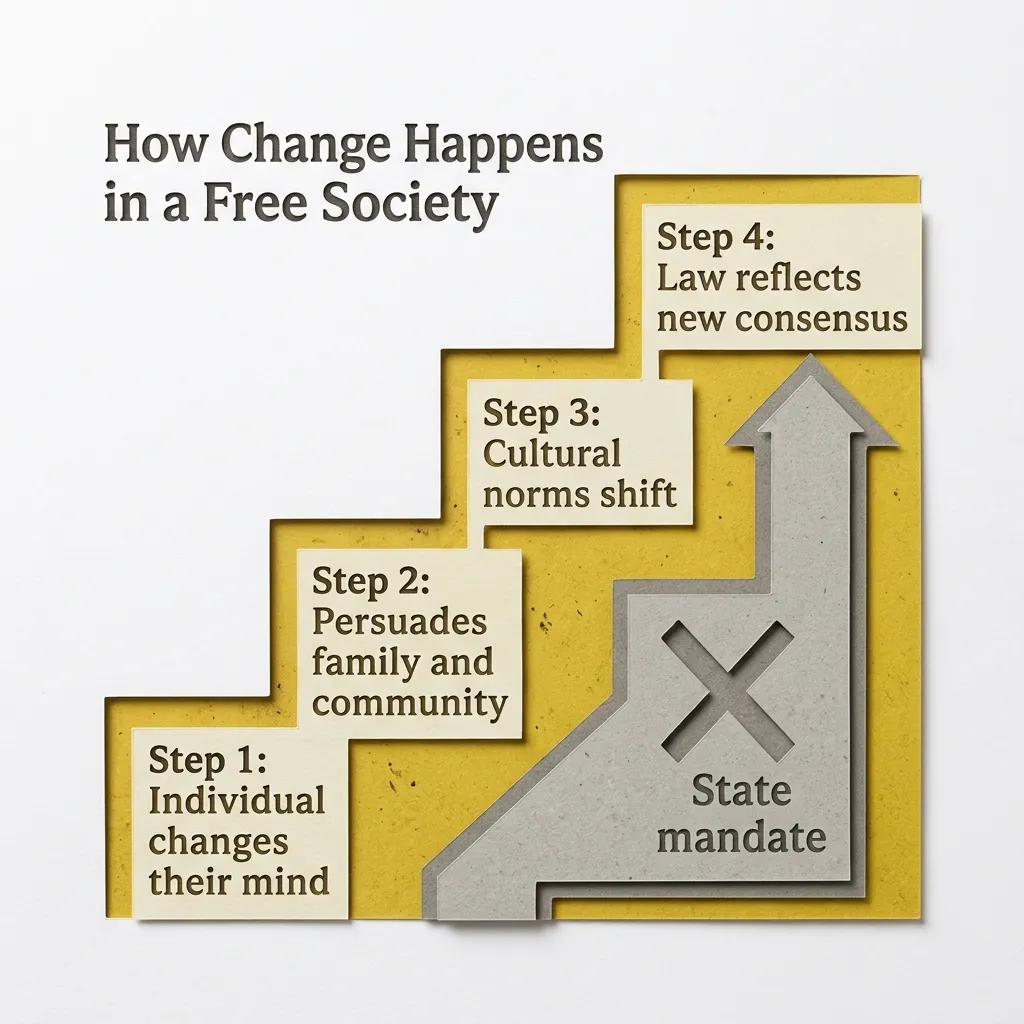
In a free society, the way you change culture is through persuasion, example, and connection, not through force. If you believe that people should be more generous to the poor, the libertarian approach is to demonstrate generosity yourself, to build organizations that do the work well, to tell compelling stories about people who need help and people who have helped them, and to make the moral case for caring. This is slow and uncertain work. It is also the only kind of change that is genuine.
When progressive politics tries to use state power to force generosity through redistribution, the result is compliance without transformation. People pay their taxes and feel that they have fulfilled their obligations. The habit of genuine care, the capacity to see a neighbor as someone whose welfare is your concern, does not develop. What develops instead is a politics of resource allocation where different groups compete for a share of the state's redistribution budget. This is not empathy. It is interest-group politics conducted in the language of compassion.
The alternative is to build a culture where genuine care is the norm: where people check on their neighbors, where communities take responsibility for their vulnerable members, where voluntary organizations develop the expertise and resources to address real need. This is harder to legislate than a welfare program, but it produces something more valuable: people who actually care, rather than people who have outsourced their obligation to care to the state and do not think about it again.
What a Culture of Empathy Looks Like
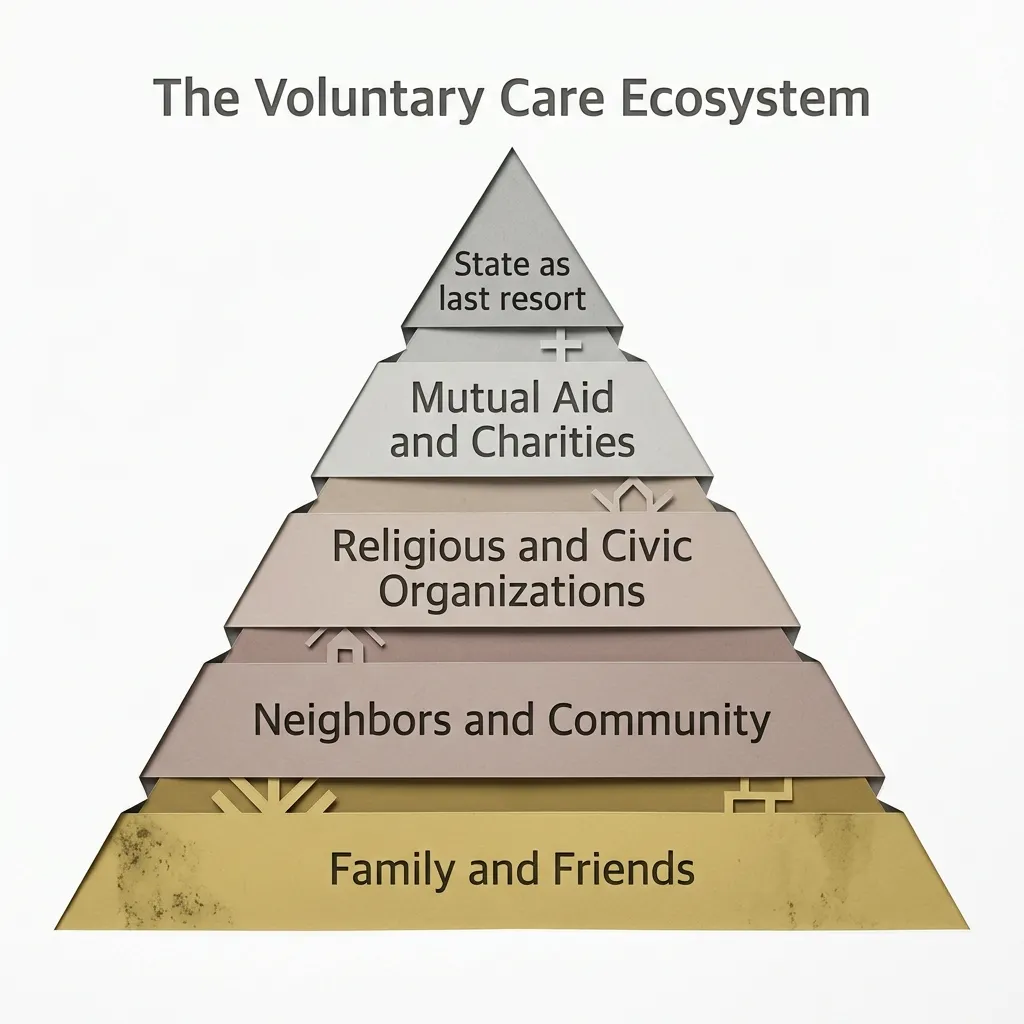
A culture of empathy is not a culture where the state provides for everyone's needs from cradle to grave. It is a culture where people pay attention to the people around them, where institutions at every level from family to neighborhood to religious community to voluntary association provide support when people struggle, and where the state is a last resort rather than a first response.
This requires a particular kind of civic character. It requires people who feel responsible not just for themselves but for their communities. It requires institutions that are capable of doing the work, which means they need resources, expertise, and the latitude to make judgments that bureaucratic programs cannot make. It requires a culture that values voluntary service and mutual aid rather than delegating all social responsibility to the state.
Building this culture is the work of families, religious communities, civic organizations, and voluntary associations. It is not primarily the work of government. Government can support it, by not crowding it out with state programs that make voluntary institutions redundant, by not taxing away the resources that people would otherwise direct toward voluntary giving, and by maintaining the legal framework within which civil society operates. But the culture of empathy itself has to be built by people who actually care, practicing care in their real lives.
The libertarian argument for empathy is ultimately this: care that is genuine, relational, and voluntary is better than care that is coerced, bureaucratic, and impersonal. A society with a strong culture of genuine care is a better society than one that has outsourced its compassion to the state. And building that culture requires people who take seriously their responsibility to each other, which is not an anti-libertarian idea at all. It is one of the oldest and most important arguments for why a free society needs strong people and strong communities to function.