One of the most persistent misreadings of libertarianism is that it requires indifference to culture, community, and values. The critique usually runs something like this: if libertarians think people should be free to do whatever they want, they must think nothing matters. Standards, traditions, and shared ways of life are just preferences, no more defensible than any other preference. The result, critics argue, is a society with no moral center, no roots, and no capacity to sustain the very institutions that freedom depends on.
This critique misunderstands what libertarian pluralism actually claims. Pluralism is not the view that all choices are equally good. It is the view that individuals and communities are better positioned than governments to discover and maintain good ways of living, that coercive uniformity produces worse outcomes than voluntary diversity, and that allowing many different communities to try different approaches is the surest way to find out what actually works. These are arguments for humility and competition, not arguments against excellence or virtue.
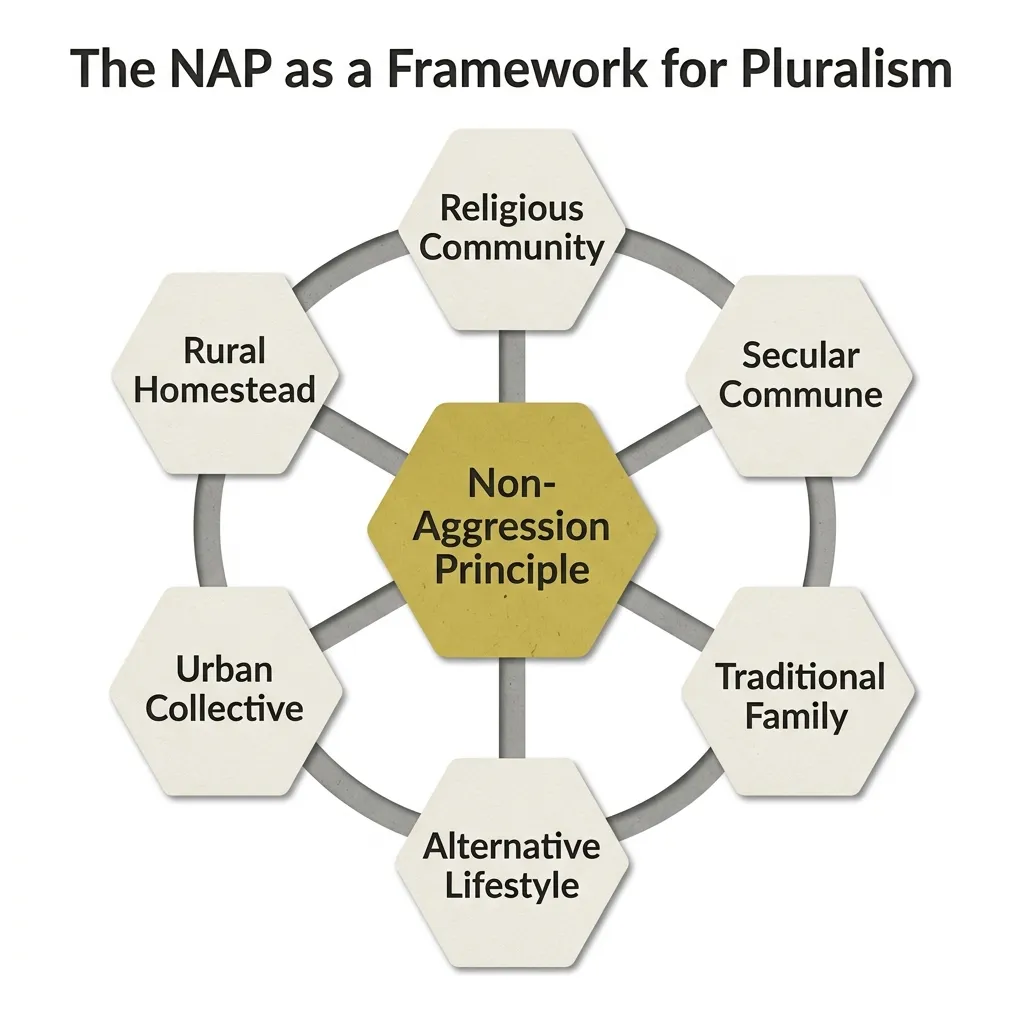
What Pluralism Means
Pluralism, in the libertarian sense, means that many different ways of organizing life can coexist within a single society as long as none of them uses force against the others. Religious communities can maintain their standards. Secular communities can maintain theirs. Traditional family structures can thrive alongside unconventional ones. Urban cooperatives and rural homesteads can each pursue their vision of the good life. The condition is simple: you can organize your own community any way you choose, but you cannot compel others to join it or prevent them from leaving it.
This is, in fact, a demanding standard. It rules out a great deal that has historically been done in the name of maintaining cultural or religious uniformity. States that imposed one religion on their populations, communities that punished people for leaving, majorities that used legislation to force their values on minorities: all of these violate the pluralist condition. Pluralism requires accepting that your neighbors may live differently than you, hold different beliefs than you, and raise their children differently than you, and that none of this gives you the right to stop them.
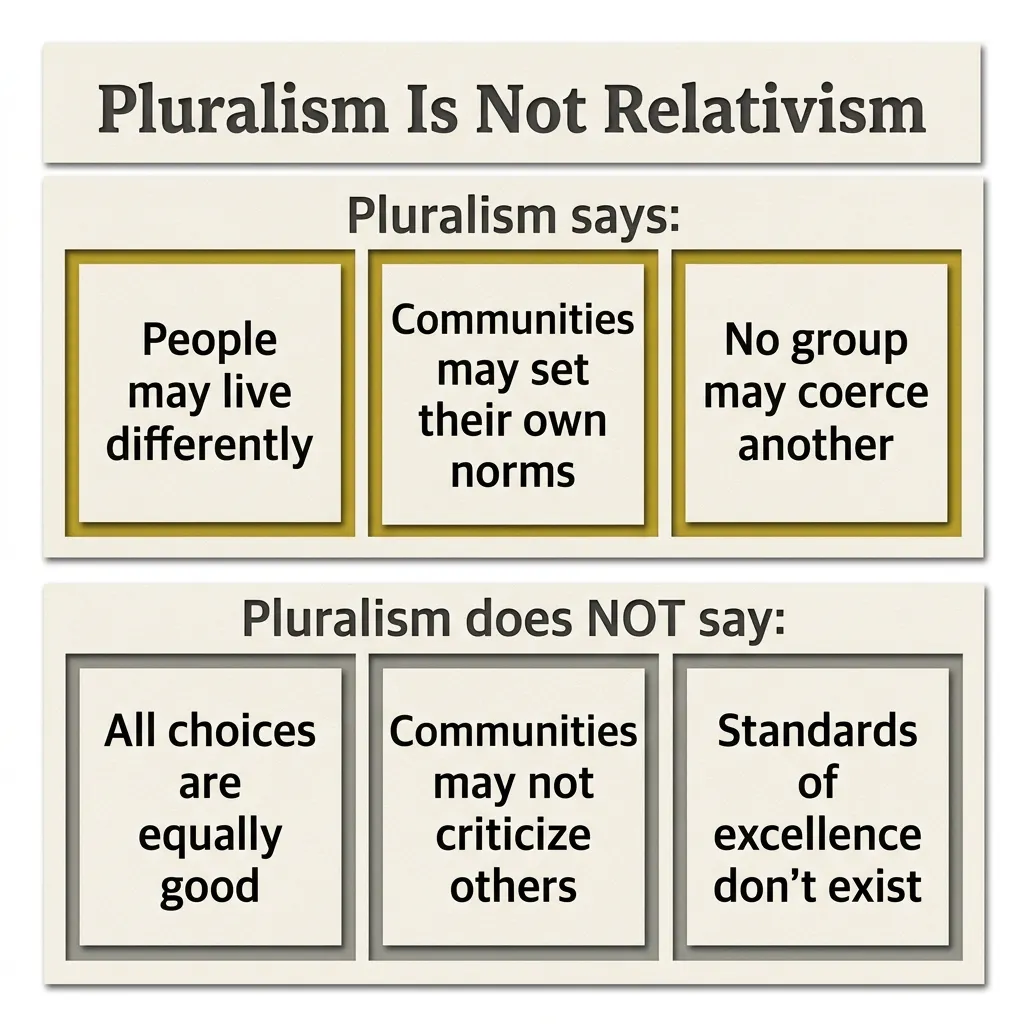
What pluralism does not require is that you approve of your neighbors' choices, stay silent about them, or pretend they are as good as your own. Criticism, persuasion, example-setting, and social pressure are all consistent with pluralism. You can argue strenuously that your neighbors are wrong. You can refuse to associate with them. You can build a community that explicitly rejects their values and competes for members against theirs. What you cannot do is call on the state to suppress them.
Why the State Is a Poor Enforcer of Culture
The history of state attempts to impose cultural uniformity is not encouraging. When governments have tried to enforce one religion, one language, one set of family norms, or one vision of the good life, the results have typically included suppression of dissent, persecution of minorities, corruption of the institutions doing the enforcing, and ultimately the failure to produce the cultural unity being sought. People who are forced to conform do not genuinely adopt the enforced values; they perform compliance while preserving their actual views in private.
The most successful cultural traditions in American history were not produced by state enforcement. They were produced by communities that voluntarily maintained them, passed them on through families and religious institutions, and competed in the open marketplace of ideas and practices. The Amish have maintained a distinctive way of life for three centuries without state support and largely without state interference. Countless immigrant communities maintained their languages, foods, and traditions for generations while integrating into broader American society. These are success stories of voluntary cultural persistence, not coerced uniformity.
When conservatives argue for using the state to enforce traditional values, they are accepting a tool that has historically been turned against them as readily as it has served them. A state powerful enough to enforce traditional family norms in one generation is a state powerful enough to enforce progressive social norms in the next. The machinery of cultural enforcement does not stay in the hands of whoever built it. Libertarians who want to preserve their values are better served by building voluntary institutions that transmit those values than by seizing state power to impose them.
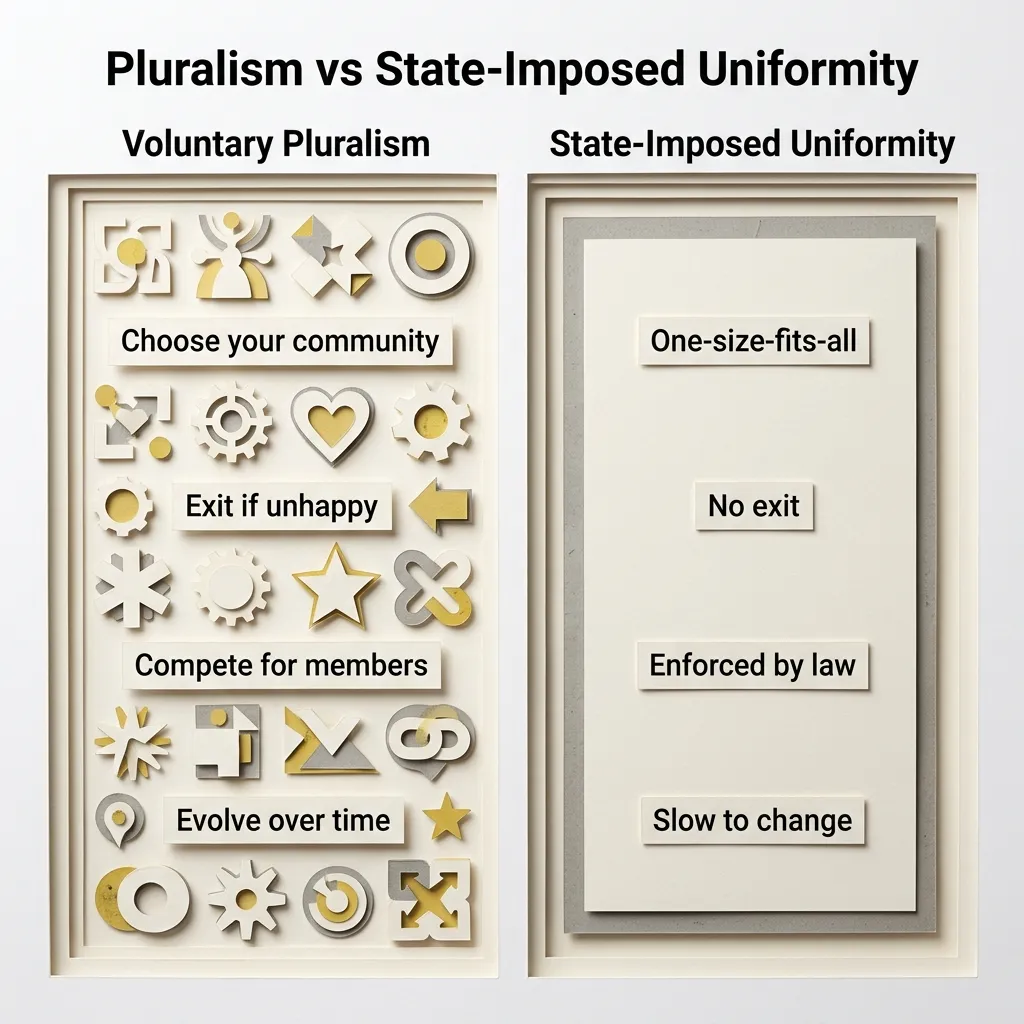
The Knowledge Argument for Pluralism
Friedrich Hayek's argument about dispersed knowledge is usually applied to economics, but it extends naturally to questions of culture and lifestyle. Hayek's point was that the information needed to run an economy well is dispersed among millions of people and cannot be aggregated and processed by any central authority. The price system works because it synthesizes that dispersed information automatically. Central planners fail because they lack access to the information they would need to make good decisions.
The same argument applies to how people should live. What constitutes a good life varies by person, by temperament, by circumstance, and by the specific community and tradition someone is embedded in. A central authority that tries to specify how everyone should live faces exactly the same information problem as a central planner trying to set all prices: it lacks access to the local, particular, constantly changing knowledge that would be required to get it right. The solutions that emerge from millions of people trying different approaches and learning from the results are likely to be better than solutions imposed from above.
This does not mean that all approaches are equally good or that learning never happens. It means that the learning happens better through competition among voluntary approaches than through monopoly enforced by the state. When communities can try different approaches to education, family structure, economic organization, and religious practice, and when people can move between communities, the better approaches will attract more adherents and the worse ones will lose them. This is a discovery process, not a declaration that nothing is better than anything else.
Pluralism Requires Strong Communities
A common mistake is to assume that pluralism weakens communities because it prevents any one community from imposing its norms on others. In fact, the opposite is often true. When a community cannot rely on the state to maintain its values, it must do the work of cultural transmission itself. It must be genuinely attractive to its members, offer real benefits of belonging, and make a compelling case for its way of life against competing alternatives. Communities that cannot do this will lose members; communities that can will flourish.
This is more demanding than state enforcement, but it produces better communities. A religious congregation that retains its members through genuine conviction, belonging, and community is stronger than one that retains them through social coercion. A cultural tradition that persists because it genuinely serves the people in it is more durable than one that persists because leaving is impossible. Voluntary communities are accountable to their members in ways that coercive communities are not.
The Tocqueville argument is relevant here. Tocqueville observed in the 1830s that Americans' propensity to form voluntary associations was one of the distinctive features of American democracy and one of its greatest strengths. When people want something done, they form an association to do it rather than waiting for the government. This creates a dense web of institutions that both accomplish real work and bind communities together. Pluralism does not destroy this web; it creates the conditions for it.

Pluralism and the Right to Criticize
Pluralism is sometimes confused with the view that all cultures and ways of life are equally valid and that criticism of any of them is inappropriate. This is not the libertarian view. Libertarian pluralism is entirely compatible with robust, vigorous criticism of particular ways of life. You can argue that a community's practices are harmful to its members. You can make the case that certain values produce better outcomes than others. You can try to persuade people to leave communities you consider harmful.
What you cannot do, within the libertarian framework, is use force to make those criticisms effective. The persuasive case for your values has to stand or fall on its own merits. If your way of life is genuinely better, it should be able to compete successfully in an open environment. If it can only survive through coercion, that is itself evidence that something is wrong with it.
This is why libertarians tend to be suspicious of both progressive attempts to use anti-discrimination law to force cultural conformity on private institutions and conservative attempts to use state power to suppress alternative lifestyles. Both moves substitute coercion for persuasion, and both assume that whoever holds the levers of state power today will hold them forever. Neither assumption is warranted.
Pluralism as American Tradition
The founders did not design a system intended to enforce cultural uniformity. The First Amendment's protection of religion, speech, and assembly was a recognition that the central government had no business deciding which beliefs were acceptable. The federal structure was partly designed to allow different states to experiment with different approaches, allowing the country as a whole to learn from variation. The tradition of local governance was premised on the idea that communities closest to a problem are best positioned to address it.
These features of American governance are expressions of the same pluralist logic that libertarians apply more consistently. The Founders did not always live up to these ideals, most obviously in their tolerance of slavery. But the ideals themselves point toward a society that accommodates many different ways of life rather than enforcing one.
A society that genuinely embraces pluralism is one where conservatives can build conservative communities, progressives can build progressive communities, religious people can live according to their faith, and secular people can build communities of meaning without religion. None of these groups has to win a political battle to pursue their vision of the good life. They only have to refrain from using force against the others. That is a much lower bar than political victory, and it is a much more stable foundation for a genuinely diverse society.