In the wake of the 2008 financial crisis and the massive government spending programs of the early 2020s, a long-marginalized economic school emerged to provide an intellectual justification for virtually unlimited state expenditure. This is Modern Monetary Theory, commonly known as MMT. Popularized by politicians and media commentators, MMT claims to offer a new lens for understanding how modern fiat currencies work under the hood.
MMT turns conventional economic logic on its head. It asserts that currency-issuing governments do not face financial constraints. They do not need to tax or borrow to spend; instead, they spend money into existence and tax it out of existence. While MMT advocates present this as a path to funding social programs and infrastructure without concern for deficits, libertarians and free-market economists view it as a dangerous recipe for inflation, capital destruction, and the complete subjugation of the private economy.
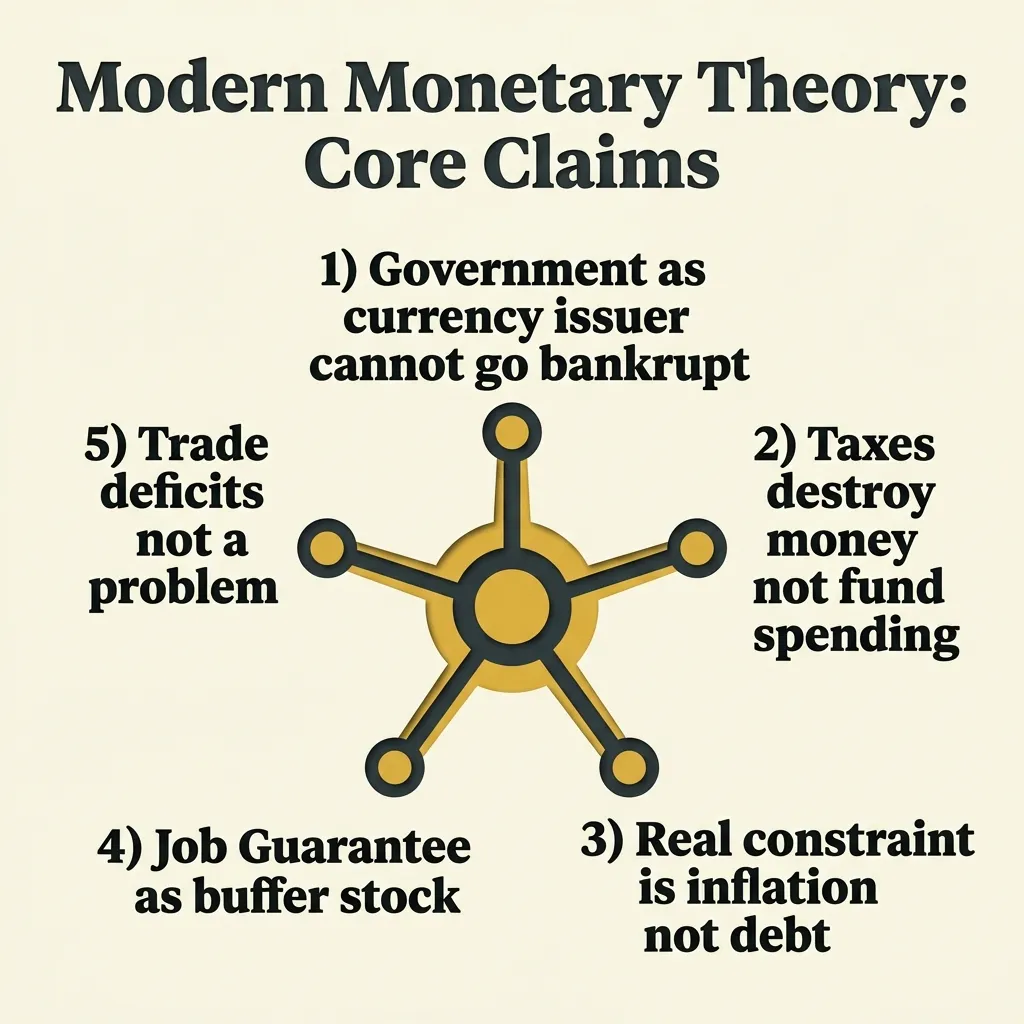
The Core Claims of Modern Monetary Theory
MMT is built on a few core claims regarding the nature of money, government debt, and inflation.
Currency Sovereignty
The starting point for MMT is the distinction between currency users and currency issuers. Households, businesses, and local governments are currency users. They must earn or borrow money before they can spend it. If they spend more than they take in, they run deficits, accumulate debt, and eventually risk bankruptcy.
A national government that is a currency issuer is in a completely different position. A sovereign government that issues its own fiat currency, controls its own central bank, and does not borrow in foreign currencies (such as the United States, Japan, or the United Kingdom) is a currency issuer. Such a government, MMT argues, can never run out of money. It cannot default on debt denominated in its own currency because it can always print the money required to pay it off. Financial deficits and debt ceilings are, in the MMT view, artificial political constraints rather than economic realities.
Taxation and Inversion of the Spending Cycle
In conventional economics, the government's budget constraint is represented as:
Spending = Taxation + Borrowing
According to this view, the government must tax citizens or borrow their savings before it can spend. MMT argues that this gets the cycle backwards.
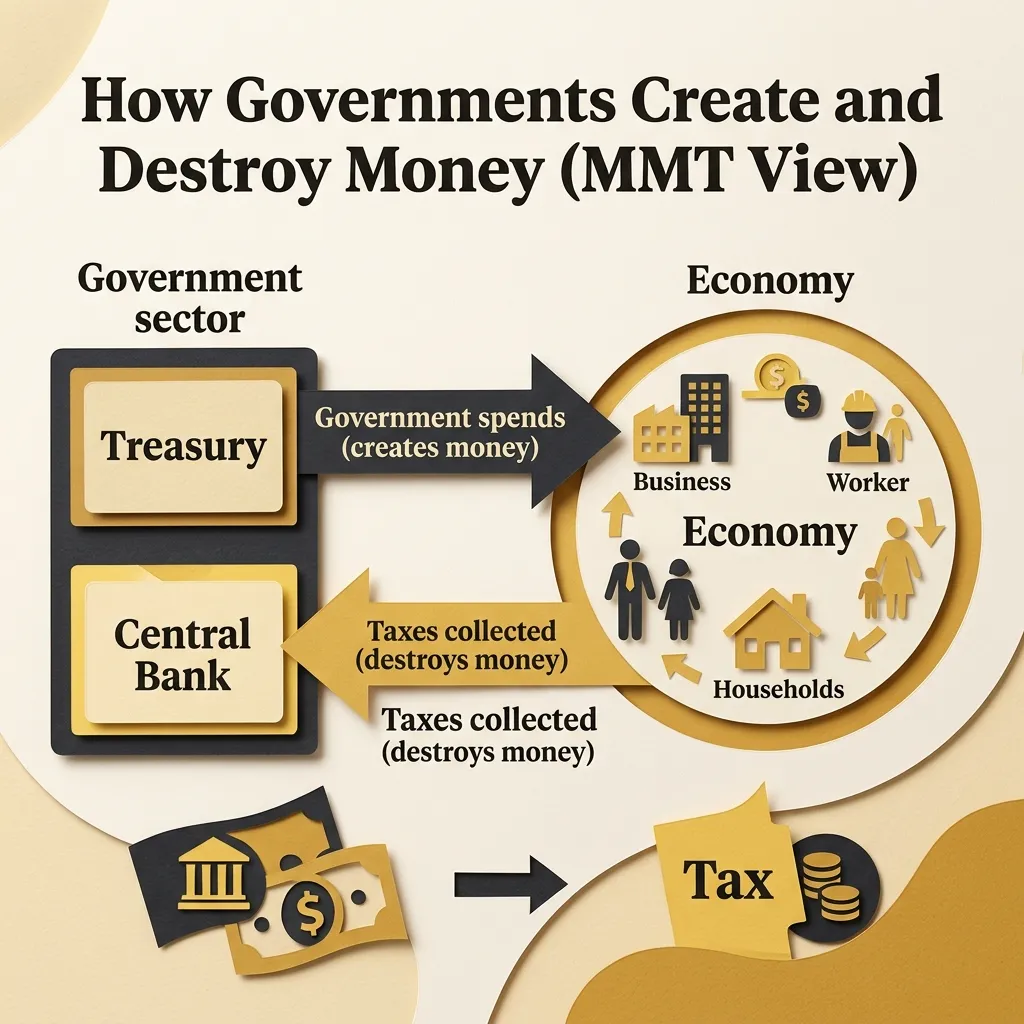
Because the government is the sole source of the currency, it must spend money into the economy before anyone has the currency to pay taxes. When the government spends, the central bank credits the reserve accounts of commercial banks, which then credit the accounts of citizens. This is money creation. When the government taxes, those bank accounts are debited. This is money destruction.
Therefore, MMT argues that the purpose of taxation is not to raise revenue. The purposes of taxation are:
1. To create demand for the currency: citizens must acquire the government's money because they need it to pay their tax liabilities.
2. To control inflation: taxes reduce the spending power of the private sector, freeing up real resources for the government to use.
3. To redistribute wealth and discourage specific behaviors.
The Real Resource Constraint
MMT does not claim that the government can spend without limit. It acknowledges that there is a limit, but insists that this limit is physical, not financial.
The true constraint on government spending is the availability of real resources: labor, raw materials, factories, and technology. If the government spends money when there is idle capacity (such as unemployed workers or vacant factories), it pulls those resources into use, increasing output without causing inflation.
Inflation only occurs when the government spends money to purchase resources that are already fully employed. At that point, the government is competing with the private sector for scarce resources, bidding up wages and prices. Therefore, the limit on spending is not the size of the deficit, but the point at which the economy reaches full physical capacity.
The Job Guarantee
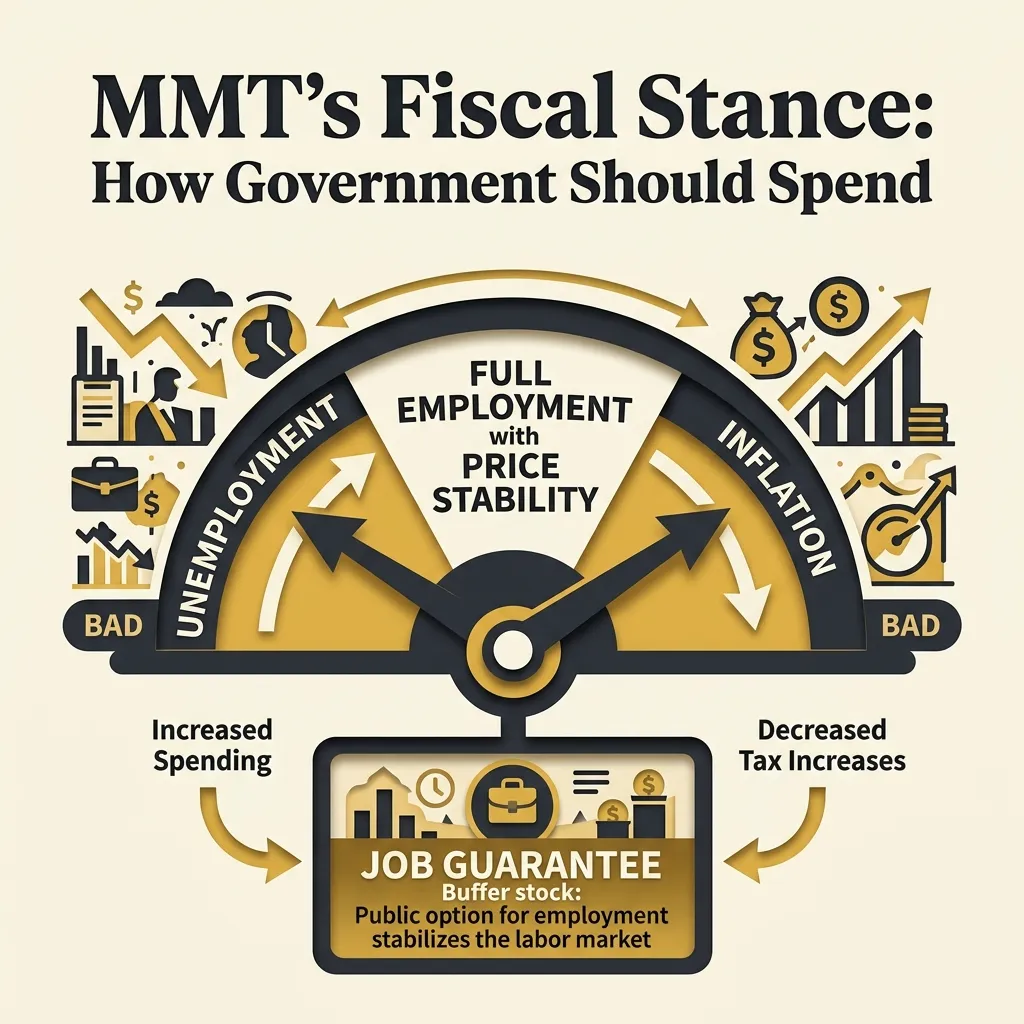
To manage the transition to full capacity, MMT advocates propose a Federal Job Guarantee. Under this program, the government acts as the employer of last resort, offering a job with a minimum wage and benefits to anyone who wants one.
This program is meant to act as an automatic stabilizer. During a private sector downturn, workers who lose their jobs are hired by the government program, maintaining demand and preventing recession. During an expansion, private employers can hire workers away from the job guarantee pool by offering higher wages, automatically shrinking the government program.
The Libertarian Refutation of MMT
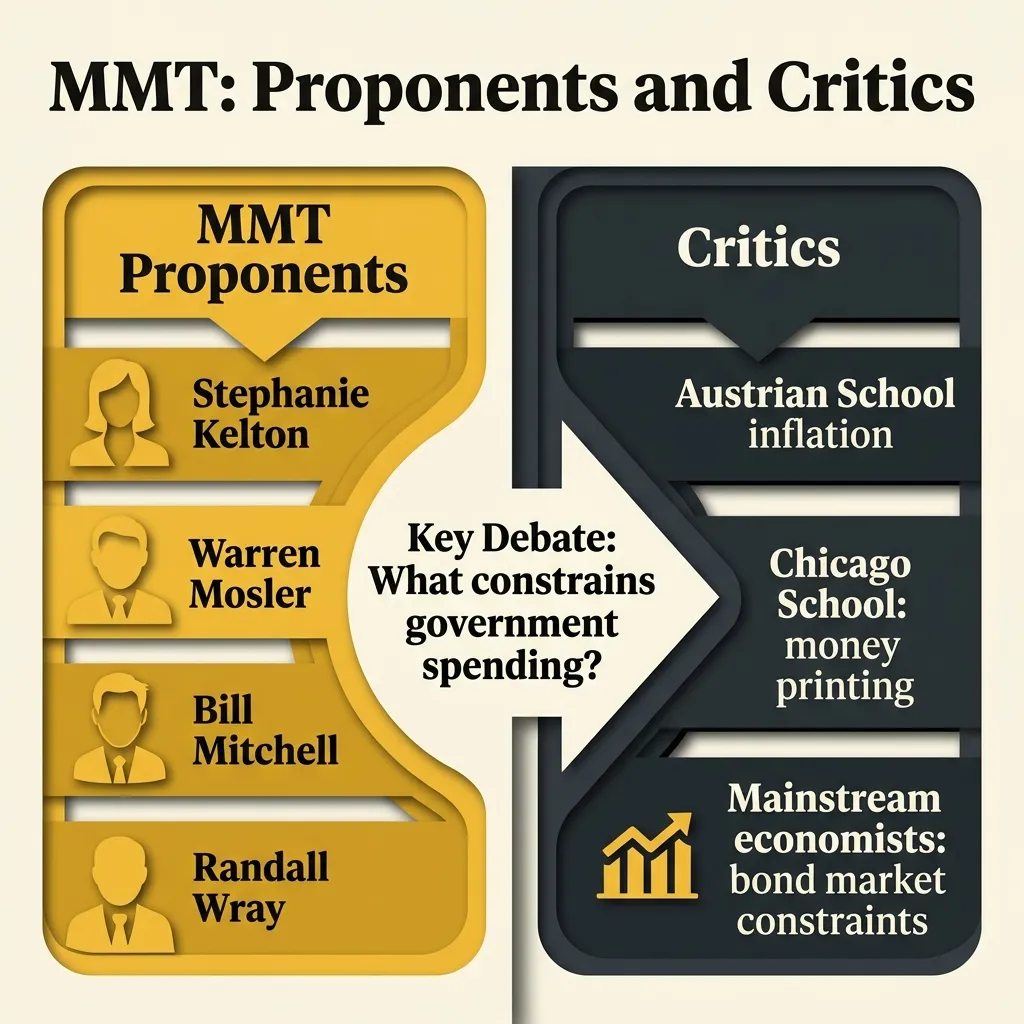
Libertarians and free-market economists, particularly those of the Austrian School, view MMT not as a modern breakthrough, but as a dangerous repackaging of ancient inflationist fallacies. The primary refutations of MMT focus on several core economic and political realities.
The Illusion of Tax-Based Inflation Control
In the MMT model, if government spending exceeds real capacity and causes inflation, the appropriate response is to raise taxes. This sucks money out of the private sector and cools demand.
This prescription is politically and economically impossible. Economically, taxation is not a neutral vacuum that removes excess money. Taxes are distortions that punish production, investment, and savings. Raising taxes on businesses and workers during an inflationary period reduces their incentive to produce, which lowers the supply of goods and services, making inflation worse.
Politically, Public Choice theory shows that politicians face massive incentives to spend money but almost no incentives to raise taxes. A politician who responds to rising prices by raising taxes on voters will be voted out of office. In practice, an MMT-guided government will print money to fund popular spending programs but will fail to implement the politically painful tax increases required to stop the resulting inflation.
The Calculation Problem and Resource Crowding-Out
MMT assumes that the government can identify idle capacity and deploy printed money to pull those resources into use. This ignores the calculation problem.
In a free market, prices tell entrepreneurs which resources are available and where they are most urgently needed. When the government creates money to fund projects, it does not do so based on economic calculation. It does so based on political priorities.
By spending printed money, the government bids resources away from private projects. Even if there is general unemployment, specific resources (such as engineers, concrete, or steel) are scarce. Government spending drives up the cost of these inputs, making private business ventures unprofitable and forcing them to shut down. MMT does not mobilize idle capacity; it crowds out private enterprise, shifting resources from productive, market-tested uses to unproductive, politically driven projects.
Loss of Currency Confidence and the International Trap
MMT assumes that a currency-issuing country exists in a vacuum. It ignores the international reality of currency competition.
If a government prints money without bound, the international value of its currency will plummet. Foreign investors and domestic citizens will lose confidence in the purchasing power of the currency, leading to flight from the currency. Import costs will soar, causing import-driven inflation. Countries that rely on imported energy, food, or technology cannot inflate their way to wealth; doing so leads to a rapid collapse in their standard of living, as seen historically in Weimar Germany, Zimbabwe, and Venezuela.
Moral Hazard and the Growth of the State
By removing the requirement that government spending be funded by taxes or real borrowing, MMT removes the last remaining checks on the growth of the state.
If money is free, then every political interest group will demand funding for its projects. The state will expand to control an ever-larger share of the economy, deciding who receives funding and which industries survive. This leads to a corporatist structure where success depends on political lobbying rather than satisfying consumers.
Conclusion: The Dangerous Reality of Inflationist Policy
Modern Monetary Theory is the logical conclusion of fiat macroeconomics. It strips away the polite fictions of central banking (that the central bank is independent and that debt must be paid off) and presents the system in its rawest form: a state monopoly on money used to fund the state's ambitions.
For libertarians, MMT is a warning of where fiat monetary systems inevitably lead. The theory's promise of free resources and deficit-free spending is an illusion. Wealth consists of real goods, services, and capital, which can only be created through work, savings, and investment. Printing money creates nothing but paper and digital entries. When applied in the real world, MMT does not create a wealthy society; it leads to the destruction of the currency, the erosion of property rights, and the complete dominance of the state over the individual.