Everyone who has ever played a card game knows that rules matter. Without rules, there is no game at all. You can shuffle a deck and deal cards, but without some agreement about what the cards mean and what counts as winning, nothing you do has any significance. Rules are not obstacles to playing the game. They are the conditions that make the game possible.
This is true of social organization in general. Markets require rules about property and contract. Communities require some agreement about what behaviors are acceptable. Society is not a state of nature where anything goes; it is a set of overlapping frameworks of expectation and accountability that allow people to interact productively. The question is never whether to have rules. The question is which rules, made by whom, enforced how, and at what level of complexity.
Libertarians are not anarchists who oppose all rules. Most libertarians believe the state has a legitimate role in enforcing certain rules: protecting people from violence and theft, enforcing contracts, and adjudicating disputes. The disagreement is about scope, complexity, and who gets to make the rules. This article makes the case that state rules should be as few and as simple as possible, and that most of the rule-making work in a free society should be done by voluntary associations that can adapt and improve over time.

The Uno Principle
Consider two card games: Uno and Magic: The Gathering. Uno has a small rulebook. You play colored numbered cards onto a discard pile matching color or number, draw when you cannot play, and win by emptying your hand. The special cards (Skip, Reverse, Draw Two, Wild) add texture but not complexity. A child can learn Uno in five minutes. An adult who has never played can join a game in progress after watching a few rounds. When someone cheats at Uno, everyone at the table can usually tell, because everyone understands the rules well enough to notice a violation.
Magic: The Gathering is a different kind of game. Its comprehensive rules document runs to more than two hundred pages. Thousands of unique cards exist, each with its own text that interacts with the other cards in ways that can produce enormously complex situations. Players who have been playing for years regularly encounter rules disputes that require looking up specific interactions. A person who wants to play Magic competitively has to invest significant time learning not just the basic rules but the edge cases, priority systems, stack mechanics, and card-specific exceptions. This creates a substantial barrier to entry. It also creates opportunities for exploitation by people who understand the rules better than their opponents.
This is not an argument that Magic is a bad game. Magic is a great game for people who invest in learning it. The point is what happens at the social level when you choose one type of ruleset over the other. Uno scales: you can play it with strangers at a family reunion with no preparation. Magic does not scale in the same way. Its complexity rewards the people who have already invested in it and disadvantages newcomers.
How This Applies to Law
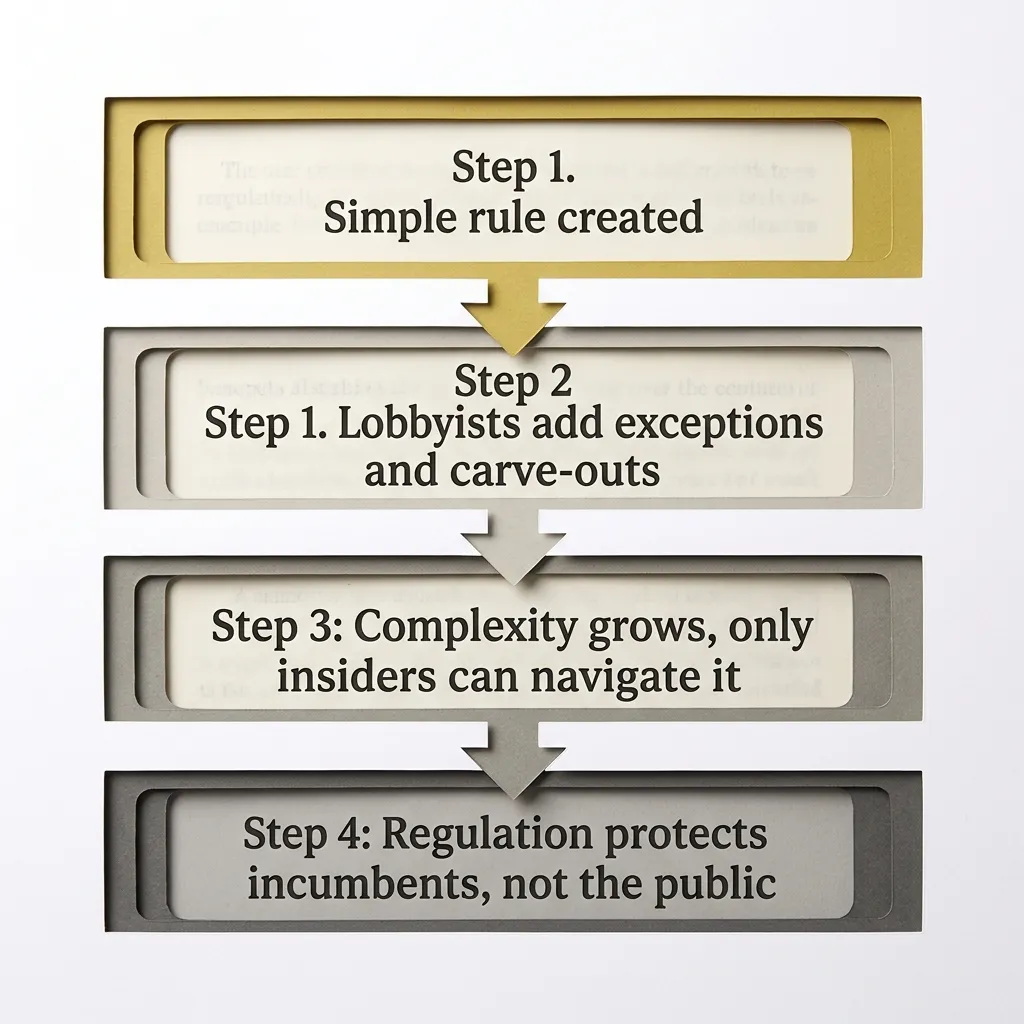
The federal tax code in the United States currently runs to roughly four million words. The regulations implementing it run to millions more. No individual human being understands all of it. Large corporations and wealthy individuals can hire specialists to navigate it and find advantages within it. Small businesses and ordinary taxpayers cannot. A tax code this complex does not primarily serve the stated goal of collecting revenue efficiently. It primarily serves the interests of whoever had the political access to write exceptions and carve-outs into it.
The same pattern applies across most areas of federal and state regulation. Environmental regulations that started with clear, enforceable principles have accumulated thousands of pages of specific rules, exceptions, and interpretive guidance. Healthcare regulations are so complex that entire professions exist purely to navigate them. Occupational licensing rules, which were originally intended to protect consumers from unqualified practitioners, have expanded to cover hair braiders, tour guides, and interior decorators in some states, occupations where the justification for licensing is essentially nonexistent.
When law becomes this complex, several things happen. First, compliance costs fall hardest on small actors. A large corporation can afford a compliance department. A small business cannot. Complex regulations thus tend to favor large incumbents over new entrants, reducing competition and entrenching existing power structures. Second, complexity creates opportunities for regulatory arbitrage: finding technical compliance with the letter of a rule while violating its spirit. Third, complexity makes it harder for ordinary citizens to know what the law actually requires, which erodes the basic principle that people should be able to understand the rules they are expected to follow.
The Rigidity Problem
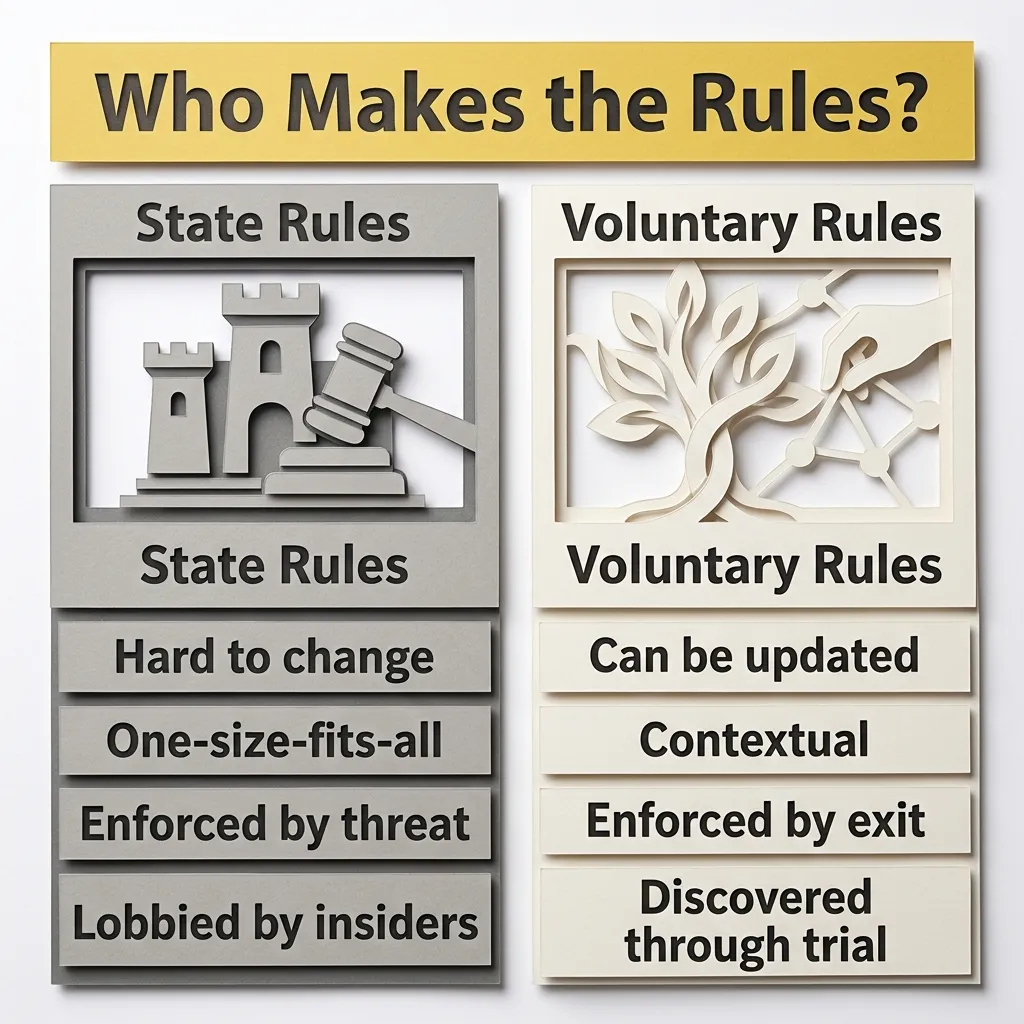
State rules have another disadvantage beyond complexity: they are hard to change. A statute passed by Congress requires an act of Congress to modify. A regulation issued by a federal agency requires a formal rulemaking process that can take years. In the meantime, conditions change, new information emerges, and the rule continues in force regardless. Laws designed for one technological environment often persist long after the technology has changed. Rules written in one economic context continue to operate in a very different one.
This rigidity is not a design flaw; it is partly intentional. Stability is a value in legal systems, and constant change to the rules would create uncertainty. But stability and rigidity are not the same thing. A legal system can be stable and predictable while still being capable of adapting to new circumstances. What the current system produces is something more like calcification: rules that survive not because they are good rules but because changing them requires overcoming the inertia of the political process and the resistance of whoever benefits from them as they are.
The people who benefit from existing rules usually have strong incentives to prevent change. Incumbents who profit from regulatory barriers to entry will lobby against loosening those barriers. Industries that have learned to navigate complex regulations will resist simplification that would level the playing field for new competitors. The political economy of rule-making biases state rules toward complexity and persistence, regardless of whether that complexity and persistence serves anyone's interests except those of the insiders who shaped it.
Voluntary Rule-Making: The Alternative
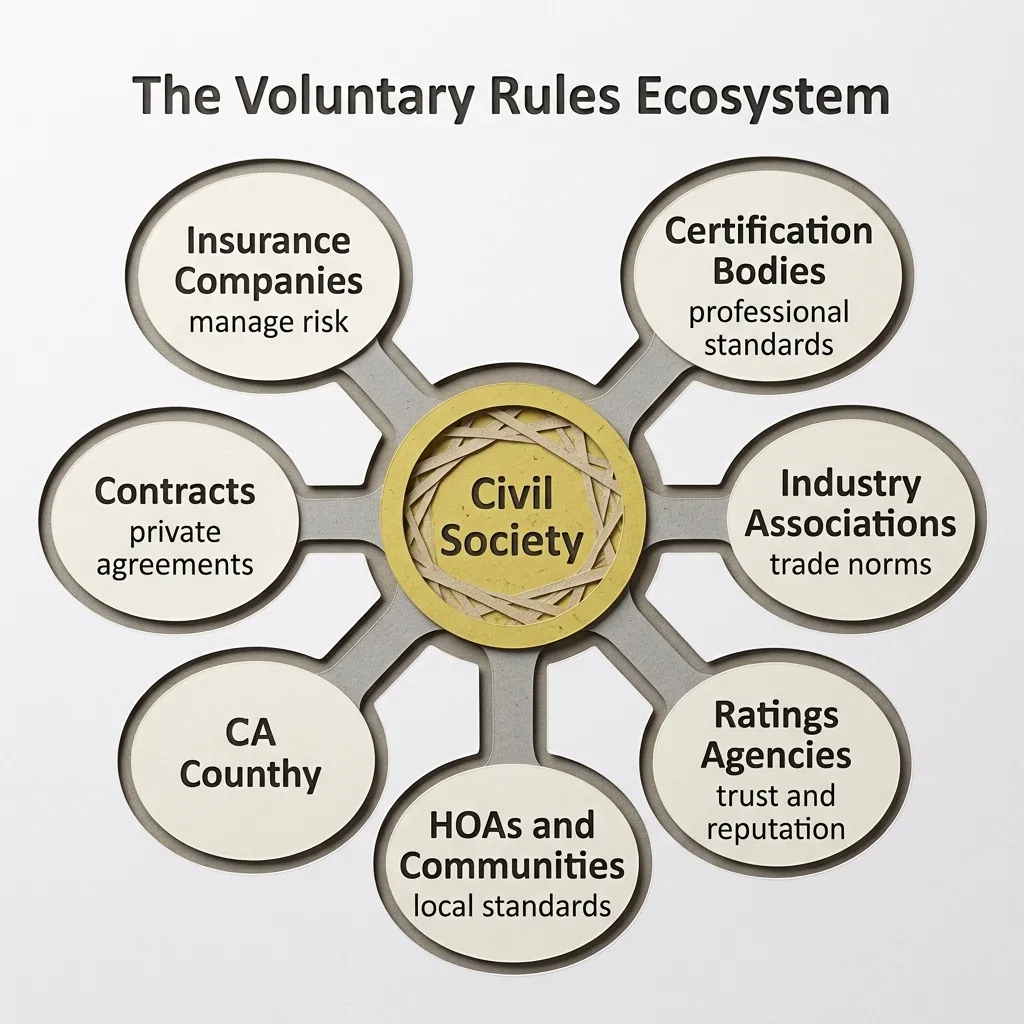
Outside the state, a different kind of rule-making exists. Insurance companies, certification organizations, trade associations, professional guilds, and industry standards bodies all create rules. These rules can be detailed and technical. They can require significant effort to comply with. But they have properties that state rules lack.
They are enforced by exit rather than by threat. An insurance company that sets safety requirements for a building enforces those requirements through the threat of not providing coverage, not through the threat of arrest. A certification organization that sets standards for a professional designation enforces them through the threat of revoking the certification. These enforcement mechanisms are powerful without involving the coercive apparatus of the state.
They can adapt. When Underwriters Laboratories decides that a new type of electrical component requires a different testing protocol, it can update its standards through a process that does not require an act of Congress. When an industry trade association determines that a best practice has changed, it can update its guidelines. This adaptive capacity is enormously valuable in a world where technology and economic conditions change faster than legislative processes can track.
Voluntary Rules in Practice
Insurance is the clearest example of voluntary rule-making working at scale. Insurance companies have powerful incentives to get risk right, because they pay out when things go wrong. A fire insurer that does not require adequate electrical wiring will pay more claims than one that does. Over time, the standards that insurance companies require of their clients become de facto safety regulations, enforced not by government inspectors but by actuarial tables and premium pricing. Buildings that do not meet insurer requirements become uninsurable and therefore unfeasible to finance or own.
Certification organizations like UL (formerly Underwriters Laboratories), NSF International, and ASTM International set product safety standards that manufacturers comply with not because the law requires it but because retailers will not carry products that lack the certification and consumers will not buy them. These organizations compete with each other to some extent, which creates pressure to develop standards that are genuinely useful rather than merely captured by industry incumbents.
Professional associations in medicine, law, engineering, and accounting set ethical standards and practice requirements that go well beyond what state licensing requires. A doctor who violates the standards of their specialty society faces professional consequences, peer isolation, and reputational damage that operate independently of any state sanction. These social enforcement mechanisms were how professional standards were maintained long before state licensing existed, and they continue to be the primary enforcement mechanism in practice.
Consumer review platforms, credit rating agencies, and reputational systems more broadly represent yet another form of voluntary rule-making. Yelp reviews and Amazon ratings are systems of accountability that constrain behavior without coercion. A restaurant that routinely gives its customers food poisoning faces consequences through the rating system long before any health inspector arrives. These systems are imperfect and can be gamed, but they process information in ways that state inspection systems cannot, at scale and in something approaching real time.
What the State Should Do
None of this means the state has no role in rule-making. The libertarian argument is not that voluntary rule-making is perfect or that markets produce good outcomes in all circumstances. It is that the state's comparative advantages are limited to specific functions, and that outside those functions, voluntary mechanisms tend to work better.
The state has a genuine comparative advantage in enforcing basic rules against violence and fraud. Courts, police, and prisons exist to back up the rule that you cannot take someone's property by force or deception. These are the core Uno rules of social cooperation, and they require the state's coercive apparatus because the alternative, private enforcement, creates its own problems of bias and escalation.
Beyond that core, the case for state rule-making is much weaker. Product safety regulation can be done by insurers and certification bodies. Professional standards can be maintained by professional associations. Environmental standards for pollution that genuinely harms others can be addressed through property rights and tort liability rather than regulatory complexity. The state's role should be narrow, and its rules should be simple enough that an ordinary person can understand them without hiring a specialist.
The Ideal: Simplicity and Subsidiarity
The ideal, from a libertarian perspective, is a legal system that looks more like Uno than Magic: The Gathering. A small number of clear rules that everyone can understand, enforced consistently, with as little room for insider manipulation as possible. Around that core, a rich ecosystem of voluntary rule-making that handles the complexity of real economic and social life in an adaptive, accountable way.
This does not mean no complexity anywhere. Magic: The Gathering exists, and people who want to play it voluntarily do so and navigate its complexity with pleasure. The difference is that participation is voluntary and exit is easy. If you do not want to deal with the complexity of Magic's rules, you do not have to. You can play Uno, or chess, or nothing at all. In a system of voluntary associations, the same logic applies. If you do not want to join a trade association with demanding standards, you do not have to. You accept the consequences of not having the certification, but you are not threatened with imprisonment for non-compliance.
State law does not work that way. Non-compliance is not an option you can accept the consequences of. It is a criminal matter backed by the threat of force. That is precisely why the bar for state rules should be high, why those rules should be simple and clear, and why the scope of state rule-making should be narrow. The more rules the state makes, the more of life is governed by the threat of force rather than by voluntary agreement, and the more opportunities exist for that threat to be captured by whoever has the most political access.
Simple rules that everyone can understand and that can be seen to be violated are the foundation of a free society. Complex rules that only specialists can navigate are the foundation of a captured one.