In January 1920, the United States banned the manufacture, sale, and transportation of intoxicating liquors. The stated goals were straightforward: reduce drinking, protect public health, cut crime, and strengthen American families. What followed instead was thirteen years of bootleggers, speakeasies, organized crime, poisoned alcohol, corrupted police, and a law that most of the country ignored. Congress repealed Prohibition in 1933, and the experiment was widely judged a failure.
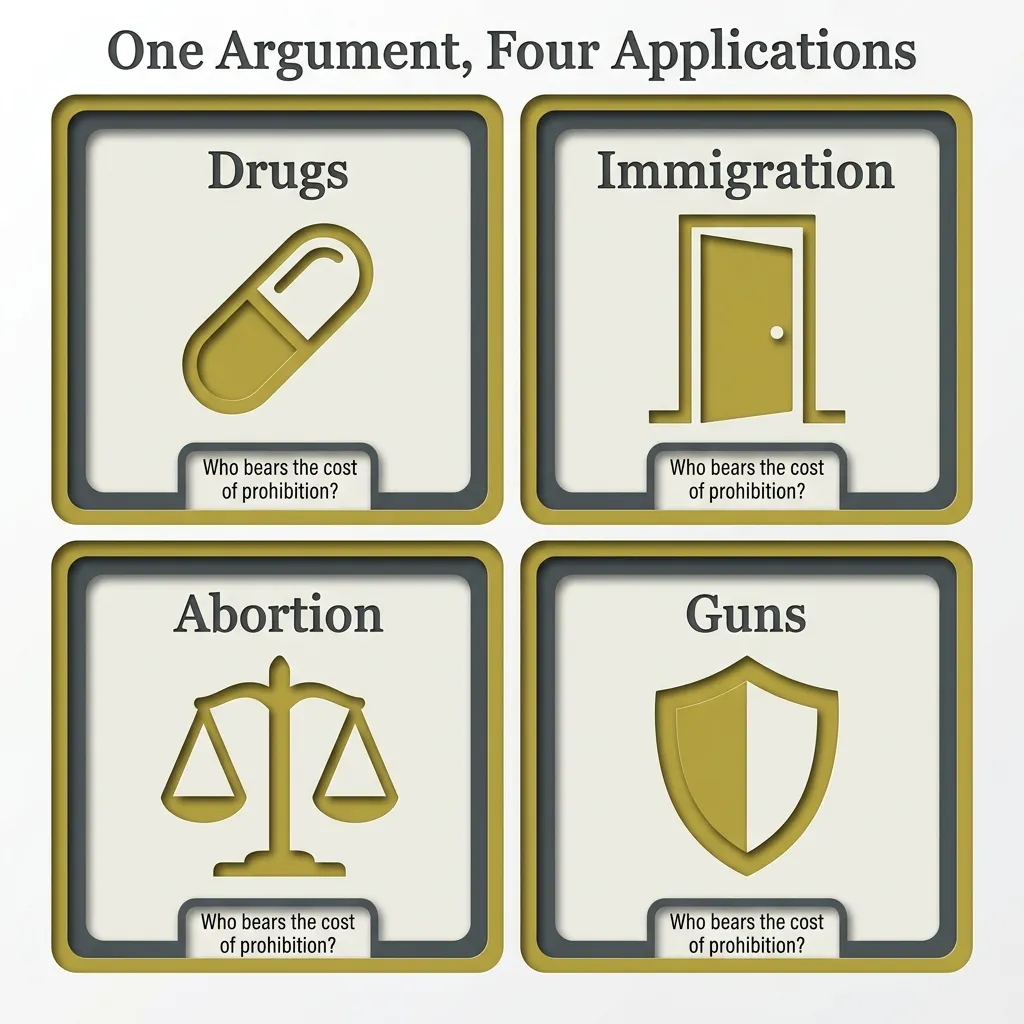
The remarkable thing is not that Prohibition failed. The remarkable thing is that the argument used to justify Prohibition has been recycled, largely unchanged, to justify other bans on things people want. Drugs. Immigration. Abortion. Guns. In each case, the structure of the argument is identical: the state bans something, announces that the ban will reduce the behavior, and proceeds to deal badly with the consequences when the behavior continues anyway. Understanding why Prohibition failed is the first step toward understanding why these other prohibitions fail too.
What Prohibition Actually Does
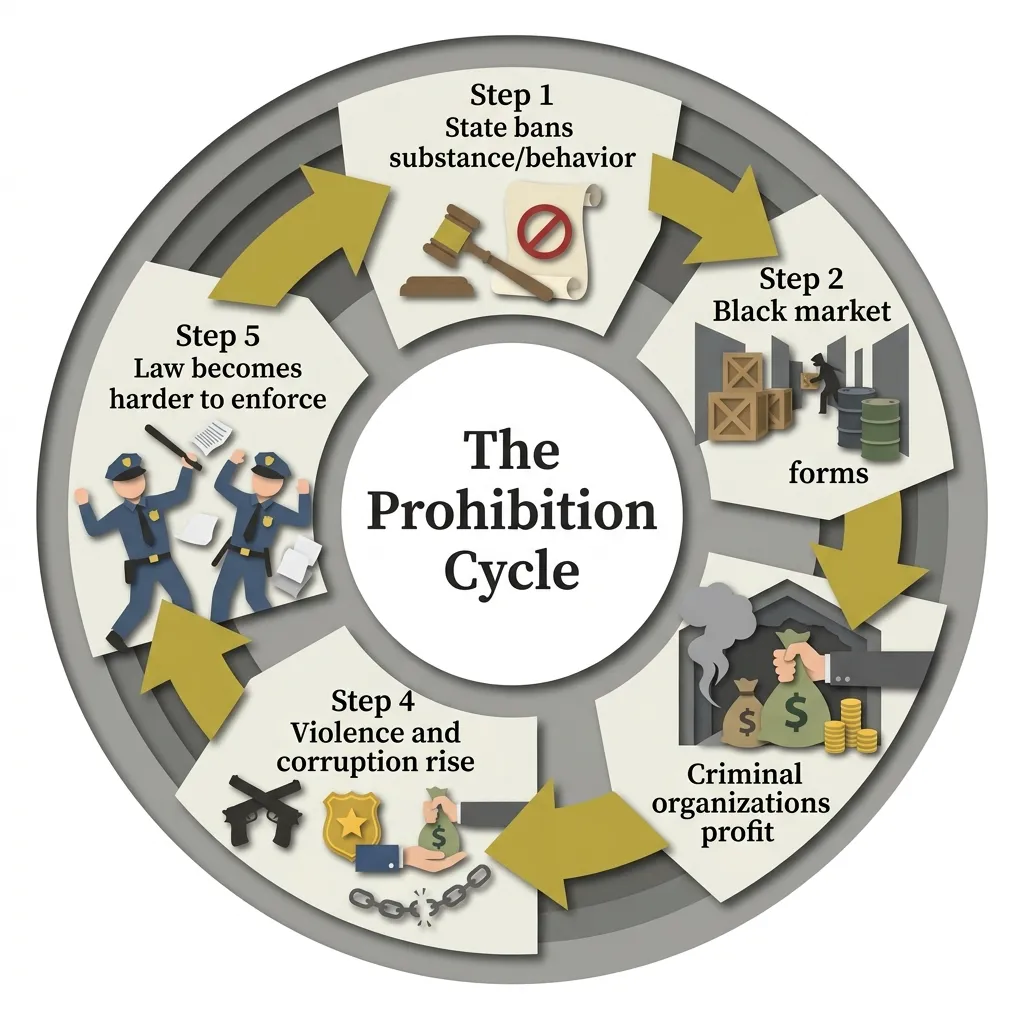
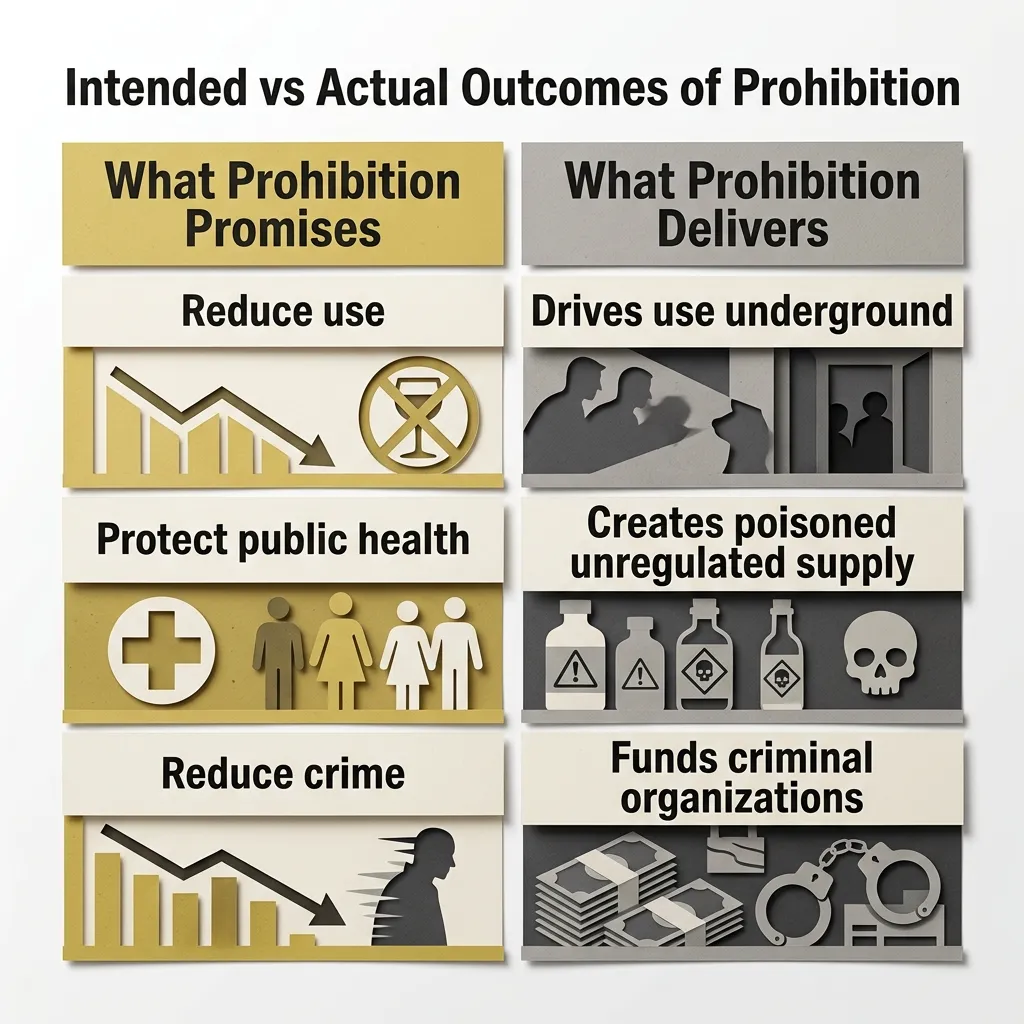
Prohibition does not make things disappear. It makes them more dangerous, more expensive, and more profitable for whoever is willing to supply them outside the law. When the government banned alcohol in 1920, Americans did not stop drinking. They drank less, certainly, but they obtained what they did drink from bootleggers who had no quality controls, no labeling requirements, and no liability for selling a product that blinded or killed customers. An estimated ten thousand people died from poisoned alcohol during Prohibition. That number is not a side effect of the ban; it is a direct consequence of it.
The economics are straightforward. When the state criminalizes a product or service that people want, it removes the product from the legal market but does not eliminate demand. The gap is filled by illegal suppliers who operate outside the law and therefore outside any of the norms that govern legal commerce: contracts, courts, quality standards, reputation effects. Violence replaces legal mechanisms for settling disputes. Corruption replaces the rule of law. The suppliers who succeed in this environment are precisely the people most comfortable with violence and least concerned with law.
Al Capone did not create organized crime. Prohibition created Al Capone. The revenues from illegal alcohol were so large, and the profit margins so high (because no taxes were paid and competition was suppressed by violence), that they funded the professionalization of criminal enterprises on a scale that had not previously existed in the United States. When Prohibition ended, those organizations did not dissolve. They diversified into other prohibited goods and services. The war on drugs, which began in earnest in the 1970s, gave them their next major revenue source.
The Seen and the Unseen
Bastiat's distinction between the seen and the unseen is useful here. The seen effects of Prohibition were a reduction in overall drinking and in alcohol-related liver disease. These were real. The unseen effects included the development of organized crime, mass corruption of law enforcement, the deaths from poisoned alcohol, the erosion of respect for law, and the political lessons drawn by criminal enterprises that would outlast Prohibition by decades. Policymakers who point only to the seen effects and ignore the unseen ones will systematically underestimate the costs of prohibition.
This is not a minor accounting adjustment. The unseen costs of prohibition often dwarf the seen benefits. A law that reduces a harmful behavior by 30% while simultaneously tripling the rate of violence around that behavior, corrupting local police, and creating a criminal industry worth billions of dollars is not a net positive policy. But because the violence is harder to attribute directly to the prohibition than the reduction in the original behavior, the accounting is usually done badly.
Applying the Argument: Drugs
The drug war is the most direct replication of Alcohol Prohibition, and its results have been correspondingly similar. Since President Nixon declared drugs "public enemy number one" in 1971 and formally launched the war on drugs, the United States has spent over a trillion dollars on enforcement. Drug use has not been eliminated. The incarceration rate exploded, particularly among Black and Latino communities. Overdose deaths, rather than declining, have increased dramatically, driven in large part by the fentanyl contamination of the illegal drug supply. When drugs are illegal and unregulated, users have no way to know what they are actually consuming.
The same pattern that Prohibition produced applies here. Banning drugs did not eliminate them. It created a black market that funds cartels, corrupts enforcement at every level, and produces a supply chain with no quality controls. The most dangerous drug in the United States right now is not a legal pharmaceutical. It is illicitly manufactured fentanyl, which enters the country through smuggling networks that exist precisely because the legal market for pain management is heavily restricted.
The libertarian position is not that drugs are good or that drug use is without harm. It is that prohibition of drugs is worse than the alternatives, and that adults have the right to make decisions about their own bodies and consciousnesses even when those decisions carry risks. The harm from drug use falls primarily on the user. The harm from drug prohibition falls on everyone: taxpayers funding the enforcement apparatus, communities disrupted by the violence of black market competition, and users who face contaminated supply with no recourse.
Applying the Argument: Immigration
Immigration prohibition follows the same logic. When legal pathways for migration are inadequate relative to demand, people cross illegally. The illegal crossing is more dangerous than a legal one would be, because it routes through deserts and rivers rather than ports of entry. It makes migrants dependent on coyotes and smuggling networks, which are organized crime enterprises. It subjects migrants to exploitation because they have no legal standing to complain about wage theft or abuse. And it creates a population of people living in the country without documentation, which makes them harder to track, less able to participate in the formal economy, and more vulnerable to exploitation by employers who know they cannot complain.
The restrictionist position assumes that stricter enforcement will reduce unauthorized immigration to zero or near zero. But this is the same assumption that Prohibitionists made about alcohol. The demand for migration does not disappear because crossing is illegal. It finds alternate routes, at higher cost and greater danger. The smuggling industry profits. The cartels that profit from drug smuggling also profit from human smuggling, and the two operations often share infrastructure. Building walls and increasing enforcement has never reduced unauthorized immigration to zero, and there is no empirical reason to think it ever will, as long as the underlying economic and safety differentials between countries persist.
Applying the Argument: Abortion
Abortion prohibition is the most contested of the four applications, because the philosophical question of when human life begins and what rights attach to a fetus is genuinely disputed and cannot be resolved by economics alone. The libertarian analysis here is not that abortion is morally uncomplicated. It is that the prohibition argument fails on the same empirical grounds it fails everywhere else.
When abortion is illegal, women who want abortions do not stop wanting them. They seek them through illegal channels, which are less safe, less accessible to poor women, and carry criminal penalties for both patient and provider. Historically, abortion rates in countries with legal abortion and in countries with illegal abortion have not been dramatically different. What differs is the safety and circumstances of the procedure. Prohibition does not prevent abortions; it makes them more dangerous and more expensive, and it punishes the women least able to afford alternatives.
The libertarian who believes that a fetus constitutes a person with rights has a genuine philosophical basis for opposing abortion that is consistent with libertarian principles. The point of the prohibition argument here is narrower: even granting the strongest case for intervention, prohibition as a strategy has a track record of producing outcomes that do not match its stated goals. The debate over abortion's underlying ethics is real and serious. The question of whether criminal prohibition is an effective tool for achieving any goal is a separate question, and the historical record on that question is fairly clear.
Applying the Argument: Guns
Gun prohibition is the application that most conservatives find obvious but most progressives resist acknowledging. The argument structure is identical to the others. There are an estimated 400 million firearms in the United States. A law banning them would not cause those guns to disappear. It would create a black market for them. Criminal organizations, which already traffic in illegal firearms, would profit. Law-abiding citizens who own guns for self-defense would be disarmed; criminals, who by definition do not comply with laws, would not be.
The empirical record in cities and states with strict gun laws is not encouraging for strict prohibitionists. Chicago, which has some of the strictest gun laws in the country, has persistent and severe gun violence. The guns used in that violence are not legally purchased in Chicago; they come from neighboring states and from black market channels. Restricting legal purchase did not restrict access by the people who use guns for crime. It restricted access by the people who were most likely to use them for self-defense.
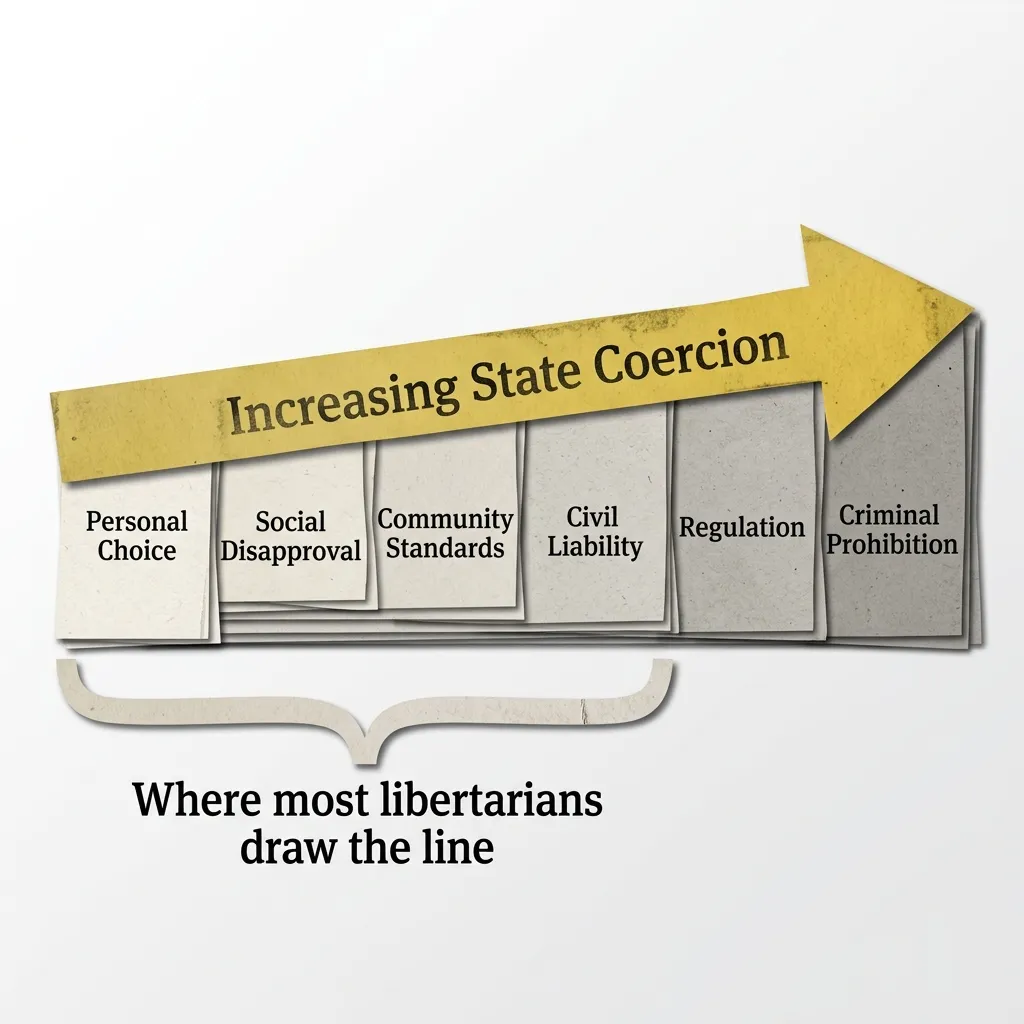
This does not mean that no gun laws are justifiable. Most libertarians support background checks, laws against possession by convicted violent offenders, and civil liability for negligent storage that leads to harm. These are not prohibitions; they are conditions and accountability mechanisms that operate within a framework of legal ownership. The argument is against prohibition: against banning the product entirely on the assumption that the ban will cause it to cease to exist.
The Consistent Principle
The reason libertarians apply the prohibition argument consistently across drugs, immigration, abortion, and guns is not that they are indifferent to the harms these debates are about. It is that the prohibition tool is poorly suited to achieving any of the goals it is deployed for, regardless of which side of the political spectrum is deploying it. The conservative who supports drug prohibition while opposing gun prohibition and the progressive who opposes drug prohibition while supporting gun prohibition are both being inconsistent. They are applying the prohibition logic selectively based on which populations they trust to handle freedom and which they do not.
The libertarian position is to be consistent. If Prohibition failed when applied to alcohol, and the same mechanism of failure applies to drugs, immigration, abortion, and guns, then the right lesson is not to find a better version of prohibition. It is to consider whether prohibition is the right tool at all. In most cases, the answer is no.
What Works Instead
The alternative to prohibition is not indifference. It is a different set of tools: education, treatment, social norms, civil liability, harm reduction, and the kind of community-level accountability that works differently from state coercion. These tools are less dramatic than a ban. They do not carry the satisfying clarity of a law that says "this is illegal." But they tend to work better, because they address the behavior rather than the product, and they do not create the secondary harms that prohibition generates.
Portugal decriminalized all drugs in 2001 and shifted resources to treatment. Drug use did not explode. HIV transmission dropped. Drug-related deaths fell. The approach treated drug addiction as a public health problem rather than a criminal one, and the results were better than those produced by criminalization. Switzerland did something similar with heroin, providing it in clinical settings to addicts, and saw crime drop, health improve, and many users eventually exit addiction. These are not arguments for unlimited drug availability. They are arguments for a different approach to a real problem.
The lesson of Prohibition is not that problems do not exist. Alcohol causes real harm. Drugs cause real harm. Unauthorized immigration creates real tensions. Guns in the wrong hands cause real deaths. The lesson is that prohibiting things people want is a blunt instrument that tends to cause more harm than it prevents, that concentrates power in criminal organizations, and that falls hardest on the people who can least afford the consequences. If the goal is genuinely to reduce harm, prohibition is rarely the best path to get there.