TL;DR
- The case for a freer world is usually made in the language of constitutions, economics, and policy. This article makes it in a different register: the language of psychology, because the liberty we are capable of building collectively is capped by the liberty we are capable of sustaining internally. A person who is governed by unexamined fear, chronic resentment, or the tribal compulsion to see the world sorted into enemies and allies will, when given political power, use that power coercively. This is not a hypothesis. It is the most consistent pattern in political history.
- The feelings of fear, suspicion, and contempt that most of us carry toward some group of people are not moral failures. They are evolutionary legacies, cognitive defaults, and in many cases the residue of real experiences that left real marks. Understanding where they come from is not an excuse for them. It is the starting point for doing something about them.
- The inner work of freedom is not therapy-speak for self-indulgence. It is the serious, difficult, daily practice of catching your own reactions, interrogating their sources, and choosing more deliberately how you engage with people who are different from you. It is the most genuinely political act most people will ever take.
There is a version of the libertarian argument for freedom that stays entirely in the realm of law and economics. It talks about constitutional limits, property rights, price signals, and the perverse incentives of state intervention. That version is important and true. But it is incomplete in a way that matters, because law and economics do not explain what happens in the space between what governments do and what people demand that governments do.
The missing piece is psychology. Not in the pop-science sense of personality tests and self-help tips, but in the deeper sense of how human minds actually process threat, build identity, regulate emotion, and make political decisions. The demand for coercive government does not arrive fully formed from abstract principle. It is generated by the accumulated fears, resentments, and contempts of real people who have decided that some other group of people represents a threat serious enough to justify compulsion. And those feelings originate in places that are very personal and very far upstream from the ballot box.
This article is about that upstream. It is about where the feelings of fear, resentment, and hate come from, when they are irrational rather than legitimate, how to develop the self-awareness to tell the difference, and what practical actions are available to people who want to be part of building a freer world rather than part of the fear-machinery that makes coercion feel necessary.
The argument is not that you should become a saint. It is that understanding your own psychology, and working to widen the circle of people you can genuinely coexist with, is not a soft cultural aspiration separate from the political project. It is the political project.
Where Fear, Resentment, and Hate Actually Come From
The brain evolved in an environment radically different from the one we now inhabit. For most of human evolutionary history, the relevant social world was a tribe of roughly 50 to 150 people, and the primary threats to survival were predators, rival tribes, food scarcity, and disease. In that environment, the rapid, automatic sorting of the world into “us” and “them” was not a bias. It was survival technology. A person who was slow to perceive threats, slow to mobilize group loyalty, and inclined to extend trust to strangers died, or at least reproduced less successfully than the person who was fast at all of those things.
The neurobiological machinery that evolved for that environment is the machinery we are still running on. The amygdala, the almond-shaped structure deep in the brain’s limbic system, functions as the brain’s alarm system. It processes emotional and threat-relevant stimuli before the reasoning parts of the prefrontal cortex have time to evaluate them, which is why fear can precede thought. When the amygdala detects what it registers as danger, it triggers the sympathetic nervous system into a fight-or-flight state: cortisol and adrenaline release, heart rate increases, attention narrows, and complex reasoning becomes temporarily impaired. The psychologist Daniel Goleman called this an “amygdala hijack”: a situation in which the emotional brain takes executive control before the rational brain has had a chance to evaluate whether the threat is real. (Goleman, “Emotional Intelligence,” 1995.)
The problem is that the amygdala does not distinguish reliably between a saber-toothed cat and a news segment about immigration. Both can trigger the same threat cascade. The perceived threat does not need to be physical or immediate to activate the stress response. It can be symbolic, statistical, or purely media-mediated. A person who has never met an undocumented immigrant can carry as much amygdala-level fear of undocumented immigration as a person who has experienced a violent crime, if the fear has been consistently reinforced by the information environment they live in. The emotion is real. The threat assessment that generated it may not be.
Resentment has a slightly different architecture. Where fear is a response to perceived threat in the present or future, resentment is a backward-looking emotion: it is the sustained feeling that one has been treated unjustly, that one deserves more than one has received, and that someone else is responsible for the gap. The philosopher Max Scheler, in his 1915 work “Ressentiment,” traced how this emotion can solidify into a worldview in which the frustrations of one’s own life are systematically attributed to the success and presence of some other group. The resentful person does not simply want justice for themselves; they want the relative diminishment of the group they hold responsible. This distinction matters, because it explains why resentment-driven political movements are so often concerned not just with improving the lives of their members but with reducing the visibility, status, and security of perceived opponents.
The psychological roots of hate are related but even more specific. Research on hate as a distinct emotional state, including work by the psychologist Robert Sternberg, who proposed a “duplex theory of hate,” suggests that intense hate typically involves three components: negation of intimacy (a profound sense of not wanting closeness or connection), passion in the form of anger or fear, and a commitment component that sustains the feeling over time. (Sternberg, “A Duplex Theory of Hate: Development and Application to Terrorism, Massacres, and Genocide,” Review of General Psychology, 2003.) Crucially, Sternberg found that stories play a central role in sustaining hate: the hating person has adopted a narrative that casts the hated group as fundamentally dangerous, threatening, or subhuman. These narratives are socially transmitted and reinforced. They are rarely generated from direct personal experience alone.

The Evolutionary Legacy Meets the Modern Information Environment
If the brain’s fear circuitry evolved for a world of small tribes and immediate physical threats, it was not designed to parse the probabilistic risk assessments that modern life actually requires. A rational evaluation of how dangerous immigrants are to your neighborhood requires statistical reasoning about crime rates, base rates, comparisons to native-born populations, and careful attention to whether available examples are representative. The amygdala does not do any of that. It does pattern-matching against existing templates: is this thing similar to something I already understand as dangerous? If yes, fire the alarm.
The availability heuristic, identified by the psychologists Daniel Kahneman and Amos Tversky in their foundational work on cognitive bias (summarized in Kahneman’s “Thinking, Fast and Slow,” 2011), describes the tendency to judge the likelihood or frequency of an event based on how easily examples come to mind. If you can easily recall three recent news stories about violent crimes committed by a particular group, your brain treats that group as more dangerous than the base rate statistics would support. The news media, social media, and political campaigns all exploit this systematically. Vivid, emotionally charged examples are selected precisely because they are memorable, which means they are highly available in the minds of people who consume that media, which in turn generates inflated estimates of risk and a felt urgency that is disproportionate to the actual threat.
Confirmation bias compounds this. Once a threat narrative is established, the cognitive system actively filters incoming information to reinforce it. Stories that confirm the threat are attended to and remembered. Stories that complicate or contradict it are dismissed, reinterpreted, or simply not encountered, because social and media algorithms that respond to engagement will consistently serve more of what generates strong emotional responses. The result is a feedback loop in which fear feeds information appetite, information appetite feeds fear, and the cognitive gap between perceived threat and actual risk grows steadily wider.
The political implications are documented. The political scientist Karen Stenner, in her book “The Authoritarian Dynamic” (2005), found that what she called “authoritarian predispositions” are activated not by actual threat but by perceived normative threat: the sense that established social order and group boundaries are becoming less clear. When people perceive that the social world is becoming more uncertain, more diverse, and less legible, those with underlying authoritarian tendencies respond with increased support for authority, conformity, and punitive measures against perceived outsiders. Importantly, this response can be triggered by media representations of diversity and change even in communities that are not actually changing. The threat is cognitive and emotional, not empirical.
Erich Fromm identified the deepest version of this pattern in his 1941 work “Escape from Freedom.” Fromm argued that genuine freedom is genuinely difficult: it requires making choices without guaranteed outcomes, taking responsibility for those choices, and enduring the anxiety of standing alone as an individual. When that anxiety becomes too heavy, people look for ways to escape it. One way is authoritarianism: submitting to a powerful leader or group that provides certainty, identity, and belonging in exchange for the surrender of individual judgment. Another is what Fromm called “automaton conformity”: unconsciously adopting the beliefs and emotional responses of one’s social group to the point where one’s own reactions feel authentic but are in fact entirely externally generated. Both are forms of freedom forfeited from the inside, before any external coercion is required.
The Tribal Symmetry That Neither Side Sees
One of the most important and underappreciated findings in social psychology is the symmetry of in-group bias. The research on intergroup conflict consistently shows that the fear, suspicion, and contempt that one group directs toward another are almost always mirrored on the other side. Jonathan Haidt and his colleagues in the moral psychology literature have documented that liberals and conservatives in the United States both believe their values are the obvious reasonable ones, both believe the other side is motivated by base or irrational impulses, and both experience the other as threatening the things that matter most. (Haidt, “The Righteous Mind,” 2012.)
The tribal architecture of the human mind does not distinguish between the left and the right, the religious and the secular, the native-born and the immigrant. It distinguishes between “us” and “them,” and it applies the same basic toolkit to every application of that distinction: positive attributions for in-group members, negative attributions for out-group members, attribution error (when an in-group member does something bad, it is situational; when an out-group member does the same thing, it is dispositional), and confirmation bias in the interpretation of new information.
This means that most political fear and resentment is, in structure, symmetrical even when it does not feel symmetrical from the inside. The person who is terrified of demographic change and the person who is terrified of white nationalism are running the same underlying cognitive program, applied to different content. Both are convinced that the other is the threat. Both are partly right. Both are generating, through their fear and resentment, the very political dynamics that make the other’s fear more justified than it would otherwise be.
Understanding this symmetry does not require moral equivalence between the positions. Some fears are more calibrated to reality than others. Some political movements are more dangerous than others. But the recognition that your fear of the other side is structurally identical to their fear of you is a genuinely liberating piece of information, because it reveals something important about the nature of the dynamic: it is not a war between the righteous and the dangerous. It is a collective action failure driven by mutual misperception, and it can, in principle, be interrupted.

When Fear and Resentment Are Rational and When They Are Not
Honesty requires acknowledging that not all fear is irrational. People have real experiences of real harm, and those experiences create real and justified wariness. A person who has been victimized by a crime, exploited by an employer, or betrayed by an institution is not being irrational when they carry wariness forward from that experience. The question is not whether the original feeling was justified but whether the cognitive generalization from that experience is proportionate.
The problem with fear-based generalizations is that they tend toward both over-breadth (applying the wariness to an entire category of people based on the behavior of some) and over-persistence (maintaining the wariness long after the conditions that generated it have changed). A fear is irrational, in the relevant sense, when the category being feared is much larger than the category that actually caused harm, or when the felt probability of harm is much higher than the actual probability, or when the fear generates behaviors (avoidance, hostility, political demands for coercion) that impose costs on people who have done nothing to generate it.
The availability heuristic is the primary mechanism through which rational fear becomes irrational generalization. If your only information about a group comes from a curated selection of the most alarming examples that group has produced, your fear of that group will exceed what direct evidence would support. This is not a character flaw; it is how the brain processes information under conditions of limited direct contact. The remedy is not to suppress the feeling but to interrogate its evidentiary basis: how many people who look like this have actually harmed me or people like me? What is the base rate of harm in this population? What would I need to know to update my assessment?
Resentment is irrational in a different way. It conflates a past injustice with a present threat and makes the removal of the resentment contingent on the punishment of someone who may not be available for punishment. The person whose economic situation has deteriorated due to the offshoring of manufacturing jobs carries a genuine grievance. The grievance may be entirely legitimate. But if that grievance is redirected toward immigrants competing in the same labor market, the emotional logic has traveled from legitimate complaint to misdirected attribution without passing through an evidence checkpoint. The immigrants did not make the offshoring decision. Punishing them, or demanding that the state punish them, does not address the original wrong. It merely finds a more proximate and more vulnerable target for the accumulated rage.
Hannah Arendt’s observation about the “banality of evil” is relevant here. In her 1963 book “Eichmann in Jerusalem,” Arendt found that the perpetrators of systematic atrocity were not, in the main, demons of special malevolence. They were ordinary people who had stopped thinking critically about the systems they were embedded in, who had adopted the categories their social and political environment provided them without examining those categories against independent evidence, and who had made the emotional surrender that Fromm described: the surrender of individual judgment in exchange for the comfort of certainty and belonging. The willingness to cause great harm to others does not require unusual cruelty. It requires only the failure to see the humanity of those others, and that failure is produced by exactly the tribal psychology, the media-mediated availability heuristic, and the escape from freedom’s anxiety that are the everyday experiences of ordinary people.
The Practice of Self-Awareness: Catching Yourself in the Moment
The practical question is what to do with this understanding. The answer begins with self-awareness, which is easier to advocate than to develop. What follows is a description of what it actually looks like in practice.
Self-awareness in the relevant sense is not constant introspection or therapeutic rumination. It is the specific capacity to notice, in the moment of an emotional reaction, that you are having one, to create a small gap between the reaction and the response, and to use that gap to ask a few questions before the reaction determines behavior. The psychologist Viktor Frankl, writing from the experience of Auschwitz, described this capacity as the last of human freedoms: the freedom to choose one’s response to a given set of circumstances, which cannot be taken away even when everything else is. (Frankl, “Man’s Search for Meaning,” 1946.)
The questions worth asking, in that gap, are simple but not easy:
Is this reaction about what just happened, or about something it reminded me of? The amygdala is a pattern-matching system, and the patterns it matches against include emotional memories that may be decades old. A present reaction that feels like pure present-tense fear or anger often has layers: a new event that triggered an older wound, a current person who called up an older grievance. Recognizing this does not require fully unpacking the older layer in the moment. It requires only noticing that the intensity of the reaction may not be proportionate to what the current situation actually calls for.
What am I assuming about the person or group I’m reacting to, and how much evidence do I actually have for that assumption? The tendency to attribute negative qualities to out-group members dispositionally (they are that kind of person) while attributing the same qualities in in-group members situationally (he was having a bad day) is documented and reliable. Catching this asymmetry in real time requires only the habit of asking: if someone from my group had done the same thing, how would I be interpreting it?
What would I need to know to update this feeling? This question exposes how open or closed the current emotional state is to new information. If there is genuinely nothing that would change the feeling, it has become a commitment rather than a response to evidence. Commitments of this kind are the raw material of hate in Sternberg’s sense: they are no longer tracking reality. They are maintaining a narrative regardless of what reality presents.

The Psychology of Contact: Why Meeting People Changes Everything
Gordon Allport’s intergroup contact hypothesis, first proposed in “The Nature of Prejudice” (1954) and subsequently tested in hundreds of empirical studies, is one of the most robust findings in social psychology: direct, positive contact with members of an out-group reduces prejudice toward that group. A 2006 meta-analysis by Pettigrew and Tropp reviewing 515 studies across 38 nations found significant prejudice-reduction effects in 94 percent of studies, across a wide variety of contact conditions. (Pettigrew and Tropp, “A Meta-Analytic Test of Intergroup Contact Theory,” Journal of Personality and Social Psychology, 2006.)
The mechanism is straightforward: prolonged, individualized contact with members of a feared or resented group disrupts the categorical thinking that sustains fear. A person who “knows” immigrants are dangerous from news media encounters an actual immigrant neighbor, coworker, or friend. The individual does not fit the category. The category begins to loosen. The brain updates. This is not guaranteed, and it is not automatic: contact under competitive or adversarial conditions can increase prejudice rather than decrease it. Allport’s conditions for productive contact (equal status, cooperative goals, social norms supporting the interaction) are important. But the basic finding is robust: actual relationships with actual people from groups you fear is the most reliable reducer of that fear that social science has identified.
The practical implications are straightforward and demanding. If you are aware that you carry strong negative feelings about a group of people you have little direct experience with, the most evidence-based intervention is to create conditions for direct, cooperative, individualized contact with members of that group. Not debate. Not argument. Not an information campaign. Contact. The kind that reveals the person behind the category.
This is harder than it sounds in an increasingly sorted society. Residential segregation by income, race, and political affiliation has increased significantly in the United States over the past three decades. Americans are increasingly likely to live, work, worship, and socialize with people who share their politics, religion, and socioeconomic status. Robert Putnam’s research on social capital documented the same pattern from a different angle: the dense cross-cutting ties that once connected Americans across lines of difference (civic organizations, bowling leagues, mixed-income neighborhoods) have weakened significantly. (Putnam, “Bowling Alone,” 2000.) This sorting is not politically neutral: it is the condition under which fear of the out-group grows unchecked by the moderating effect of personal relationship.
Reversing this requires deliberate choices to place yourself in proximity to people who are not like you, in contexts that allow genuine interaction rather than the superficial acknowledgment of different groups’ existence. It also requires a posture that Allport’s conditions point toward: not competitive, not adversarial, but cooperative. Doing something together with someone who is different from you is the fastest route to the individualization that disrupts stereotypical thinking. The shared project humanizes.
Curiosity as the Antidote to Fear
One way to reframe the inner work of freedom is to describe it not as the suppression of fear but as the cultivation of curiosity. Fear and curiosity are not just opposite emotional poles; they are competing cognitive orientations. Fear contracts attention and generates avoidance. Curiosity opens attention and generates approach. They cannot occupy the same space at the same moment in the same mind.
The philosopher and educator Simone de Beauvoir argued that genuine encounter with another person requires what she called “genuine recognition”: the willingness to see the other as a subject with their own inner life, perspective, and goals rather than as an object defined entirely by how they appear in your categories. (de Beauvoir, “The Ethics of Ambiguity,” 1947.) The failure of recognition is the foundation of dehumanization, which is in turn the foundation of every organized atrocity in recorded history. Recognizing the humanity of another person does not require agreeing with them, liking them, or welcoming their choices. It requires only the acknowledgment that they have an inner life that is as real and as complex as yours, and that their choices make sense from some perspective that you may not yet understand.
Curiosity is the practice of genuine recognition. It is the choice to approach the person who seems most alien to you with the question “what is it like to be them?” rather than the judgment “what is wrong with them?” That shift is not sentimental. It is strategic. People who are treated as curiosities rather than threats respond differently than people who are treated as dangers. They become less defensive, more willing to reciprocate recognition, and more available for the kind of individualized contact that loosens categorical fear.
The specific practice is to ask more questions and offer fewer verdicts. The next time you find yourself in conversation with someone whose politics, religion, or life choices are far from yours, suspend the impulse to counter-argue and replace it with the impulse to understand the experience from which their position arose. Not to agree. Not to validate. Just to understand, as completely as possible, what it feels like to be them, what they have seen, what they fear, and what they care about. You will almost always find that the internal logic of their position, when fully understood, reveals a human being who is working from experience just as you are, protecting something that matters just as you protect things that matter, and navigating fear just as you navigate fear.

What Forgiveness Is and Is Not
Forgiveness is the most misunderstood of the practices relevant to this discussion. It is commonly interpreted as a statement about the other person: that their actions were acceptable, that the harm they caused does not matter, that trust should be restored to its previous level. None of those things are what forgiveness means in the psychological and philosophical sense that matters here.
Psychologically, forgiveness is a decision made for the benefit of the forgiver rather than the forgiven. The Mayo Clinic’s research summary on forgiveness describes it as “letting go of resentment and thoughts of revenge,” noting that the process does not require reconciliation with the other person or minimizing the harm done. (Mayo Clinic Staff, “Forgiveness: Letting Go of Grudges and Bitterness,” mayoclinic.org, updated 2022.) What the research consistently finds is that chronic resentment is psychologically and physiologically costly: it maintains elevated stress hormone levels, consumes cognitive resources that could be used for other purposes, and keeps attention fixed on the past rather than available for the present. Releasing resentment is not an act of generosity toward the person who caused harm. It is an act of self-interest in the most literal sense.
The libertarian application of this understanding is not obvious but it is real. The energy that is consumed by chronic resentment toward outgroups is energy that is not available for building the voluntary institutions, community relationships, and trust networks that a free society actually depends on. The resentful voter who demands that the state punish the group they hold responsible for their grievances is not just wrong on the policy question; they are transferring energy from the voluntary sphere to the coercive sphere in a way that weakens the entire social fabric. Every hour spent cultivating grievance is an hour not spent building something.
Forgiveness, in this sense, is also not amnesia. It does not require pretending that injustices did not happen, that institutions were not biased, that power was not abused. It requires only the decision to stop organizing your present life around the injustices of your past, which is both a gift to yourself and a prerequisite for the kind of clear-eyed, present-tense engagement with reality that effective action requires.
There is also an important distinction between forgiving people and forgiving systems. A system that produces unjust outcomes deserves to be changed, regardless of whether the individuals within it are forgiven for their participation. These are not the same question. Personal forgiveness of the people who participated in an unjust system is psychologically useful for the person doing the forgiving, regardless of whether the system is reformed. Systemic reform is a political question that proceeds on different grounds. Conflating the two in either direction, either insisting that personal forgiveness implies acceptance of unjust systems or that reforming unjust systems requires maintaining personal resentment toward individuals, muddles both.
Practical Actions: Becoming Part of the Solution
The inner work described in this article has external expressions that are not just individually beneficial but genuinely political in their effects. Here are the ones with the clearest connection between personal practice and collective outcome.
Consume information from sources that challenge rather than confirm your priors. The algorithmic media environment is specifically designed to serve you more of what generates strong emotional reactions in you, which means it is specifically designed to amplify your existing fears and resentments and to keep you from encountering information that might complicate them. Deliberately seeking out reporting, analysis, and personal accounts from sources you find uncomfortable is not an act of open-mindedness for its own sake. It is epistemic hygiene, a corrective for the systematic bias that the information environment introduces. This does not mean treating all sources as equally credible. It means ensuring that your information diet includes credible sources that do not share your priors.
Invest in cross-cutting relationships. The research on contact theory is clear enough to be prescriptive: if you carry strong negative feelings about a group of people you have little direct experience with, the most effective thing you can do is find legitimate contexts for cooperative interaction with members of that group. Religious communities, sports leagues, volunteer organizations, civic associations, and shared projects of all kinds provide these contexts. The particular mechanism matters less than the quality of the contact: individualized, cooperative, roughly equal-status, and sustained over time.
Stop sharing content that is designed to generate fear of an outgroup. The virality of fear-based content is not an accident. It is the product of deliberate design choices by platforms that discovered that content triggering strong negative emotions generates more engagement than content that does not. Every person who shares that content participates in the system that amplifies collective fear. The decision not to share it is not a censorship decision; it is a decision about what you are willing to be a channel for. The amount of fear-amplifying content that circulates in political social networks would decline dramatically if even a significant minority of people adopted a personal standard of not forwarding things whose primary function is to make people afraid of or contemptuous of a group.
Speak up in your own community when fear is being used to justify harm. The most effective countering of fear-based political narratives rarely happens in cross-partisan argument. It happens within communities, where social norms operate. Research on opinion change consistently finds that it is more likely to occur when the challenging perspective comes from a trusted in-group member than from an outsider. If you are in a community that is generating fear-based demands for coercive policy, you are better positioned to push back than any external critic, precisely because you are trusted in a way the outsider is not. This is uncomfortable and requires a different kind of courage than the courage of cross-partisan debate, but it is more likely to actually work.
Support civil society institutions that do the contact work at scale. Interfaith councils, community land trusts, cross-partisan civic organizations, neighborhood associations, mutual aid groups, and the dozens of other institutional forms that create regular cross-cutting contact between people who would not otherwise interact are the infrastructure of a free society. They are not glamorous. They do not trend. They are also the most reliable mechanism for building the social trust that makes voluntary cooperation possible and reduces the demand for state coercion. Supporting them financially, participating in them actively, and defending them from the cultural forces that treat civic engagement as naive are all direct contributions to the political project of freedom.
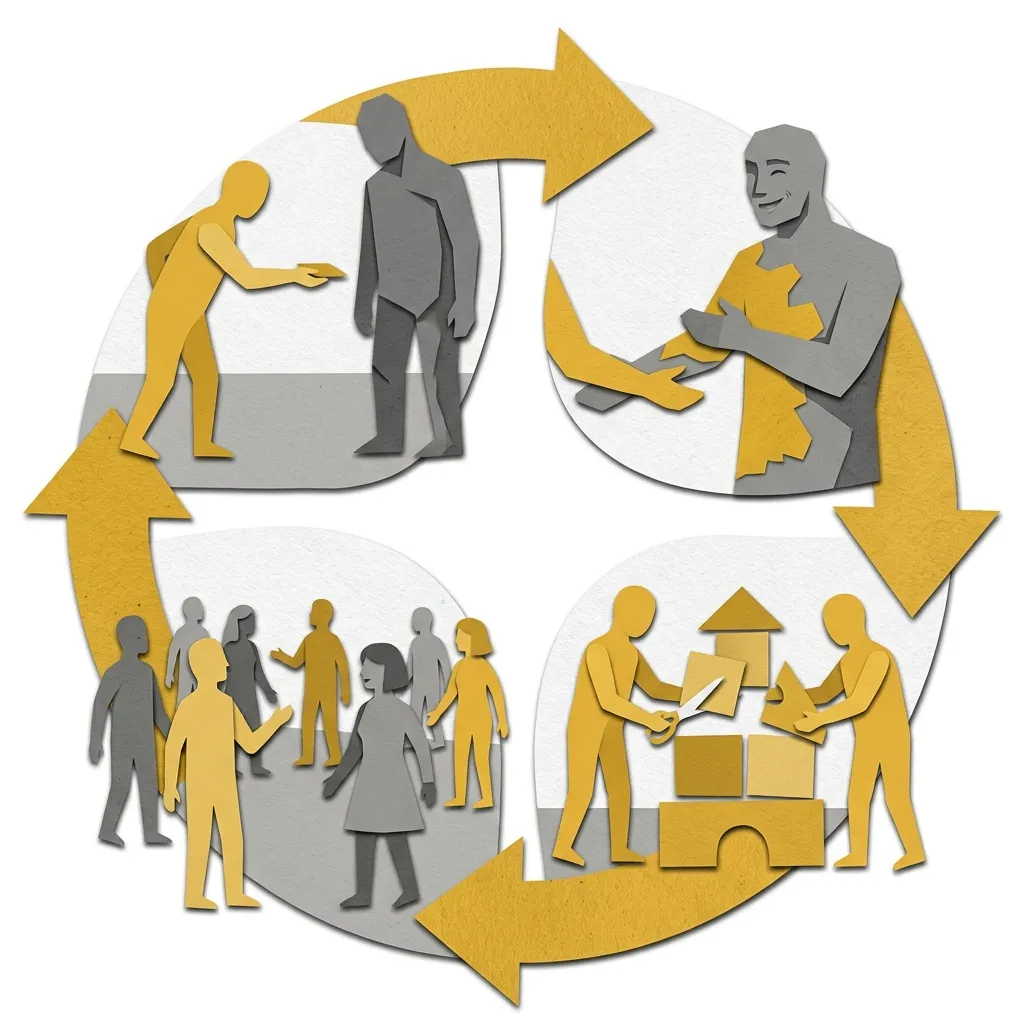
The Political Payoff: Why This Inner Work Has Real Collective Consequences
The argument for doing this work is not purely personal. It is political in the most direct sense: the demand for coercive government is generated by the accumulated fears and resentments of the electorate. A political system that is fed by a fearful, resentful, tribally organized population will consistently produce coercive, expansive, war-prone government regardless of what the constitution says, because the people who run that government and the people who elect them are carrying those fears into every decision.
The reverse is also true, and it is the Loveatarian’s most fundamental conviction: a culture that has done the inner work, that has reduced its collective fear load, that has widened its capacity for empathy, that has built genuine trust across lines of difference, will generate less demand for state coercion. The historical evidence for this is not speculative. Robert Putnam’s research showed that high social-capital communities have lower crime rates, better public health outcomes, and more effective local governance than low social-capital communities with comparable demographics. (Putnam, “Bowling Alone,” 2000.) The mechanism is trust: when people trust each other, they solve problems voluntarily before they become problems requiring state intervention.
Erich Fromm’s analysis pointed to the same conclusion from the other direction. The authoritarian political movements of the 20th century did not arise from populations of unusually evil people. They arose from populations that had become sufficiently isolated, frightened, and resentful that the promise of a powerful leader who would restore certainty and punish the responsible parties felt worth the cost of individual freedom. The antidote to that dynamic is not constitutional text. It is the cultivation of the psychological conditions under which people can bear their individual freedom without needing to escape it.
The libertarian project is ultimately a cultural project. You cannot legislate your way to a free society. You can only build one, from the inside out, one relationship at a time, one checked reaction at a time, one act of curiosity extended toward someone who seems alien at a time. That is not a small thing. It is the only thing that has ever actually worked.

Go Deeper: Books by Alex Merced
The inner work of freedom, the relationship between personal psychology and political outcome, and the cultural prerequisites of a free society are the threads that run through everything Alex Merced has written at the intersection of liberty, human nature, and political philosophy.
The Field Guide to Libertarianism develops the political philosophy behind the argument in this article: that liberty is not merely the absence of state coercion but a condition that requires active cultural maintenance, that the voluntary institutions of civil society are the real architecture of a free society rather than a supplement to the state’s work, and that the failure of individuals to develop the empathy and tolerance for difference that a pluralistic republic requires is a direct cause of the demand for state compulsion. The field guide makes the case that kindness, forgiveness, and the cultivation of genuine human connection are libertarian virtues, not soft additions to the hard doctrine of rights.
Political Thought and Debates of the United States traces how the patterns identified in this article, fear driving political demand for coercion, resentment generating prohibitionist impulses, tribal psychology producing war, have run through American political history from the founding debates through Reconstruction, the Progressive Era, the two World Wars, the culture wars, and the present moment. Understanding the historical instances of these dynamics makes the current iteration more legible and provides the historical evidence for why the cultural project this article describes is not idealistic but practical.
Economic Ideas: From Beginning to Early 2026 provides the economic framework for understanding why the social trust that personal transformation builds is not just a cultural amenity but an economic asset. The economics of social capital, the role of trust in reducing transaction costs, the institutional theory of how voluntary norms substitute for coercive rules, and the economic history of how high-trust societies consistently outperform low-trust ones are all developed in economic terms that complement the psychological and cultural arguments made here.
All three are available on Amazon. The full catalog of Alex Merced’s work is at books.alexmerced.com.
Sources and Further Reading
-
Goleman, Daniel. Emotional Intelligence: Why It Can Matter More Than IQ. Bantam Books, 1995.
-
Kahneman, Daniel. Thinking, Fast and Slow. Farrar, Straus and Giroux, 2011.
-
Haidt, Jonathan. The Righteous Mind: Why Good People Are Divided by Politics and Religion. Pantheon, 2012.
-
Allport, Gordon W. The Nature of Prejudice. Addison-Wesley, 1954.
-
Pettigrew, Thomas F., and Linda R. Tropp. “A Meta-Analytic Test of Intergroup Contact Theory.” Journal of Personality and Social Psychology 90, no. 5 (2006): 751-783.
-
Fromm, Erich. Escape from Freedom. Farrar and Rinehart, 1941.
-
Arendt, Hannah. Eichmann in Jerusalem: A Report on the Banality of Evil. Viking Press, 1963.
-
Frankl, Viktor E. Man’s Search for Meaning. Beacon Press, 1946.
-
Sternberg, Robert J. “A Duplex Theory of Hate: Development and Application to Terrorism, Massacres, and Genocide.” Review of General Psychology 7, no. 3 (2003): 299-323.
-
Stenner, Karen. The Authoritarian Dynamic. Cambridge University Press, 2005.
-
Scheler, Max. Ressentiment. Originally published 1915. Translated by Lewis B. Coser and William W. Holdheim. Schocken Books, 1972.
-
Putnam, Robert D. Bowling Alone: The Collapse and Revival of American Community. Simon and Schuster, 2000.
-
de Beauvoir, Simone. The Ethics of Ambiguity. Philosophical Library, 1947.
-
Mayo Clinic Staff. “Forgiveness: Letting Go of Grudges and Bitterness.” mayoclinic.org, updated 2022.
-
Tversky, Amos, and Daniel Kahneman. “Judgment Under Uncertainty: Heuristics and Biases.” Science 185, no. 4157 (1974): 1124-1131.
-
Tajfel, Henri, and John C. Turner. “An Integrative Theory of Intergroup Conflict.” In The Social Psychology of Intergroup Relations, edited by William G. Austin and Stephen Worchel. Brooks/Cole, 1979. (Original formulation of social identity theory and in-group bias.)
-
Nussbaum, Martha. Political Emotions: Why Love Matters for Justice. Harvard University Press, 2013.